Vehicle Occupancy Detection System Market Size, Share Demand Report By Component (Sensors, Control Units, Software), By Vehicle Type (Passenger Vehicles, Commercial Vehicles, Electric Vehicles), By Application (Airbag Control, Seatbelt Reminder, Child Presence Detection, Driver Monitoring), By Region & Segment Forecasts, 2026–2034
USD 3950
Market Overview
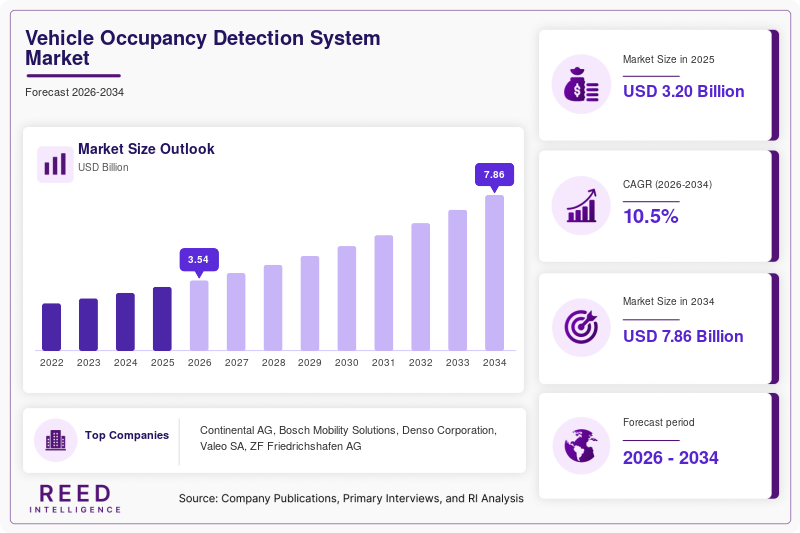
The Vehicle Occupancy Detection System Market was valued at approximately USD 3.2 billion in 2026 and is projected to reach USD 7.1 billion by 2034, expanding at a CAGR of 10.5% during the forecast period (2026–2034). The market growth is driven by increasing regulatory emphasis on passenger safety and advancements in intelligent vehicle systems. Automakers are integrating occupancy detection technologies to improve airbag deployment accuracy, enhance seatbelt reminders, and support advanced driver-assistance systems (ADAS).
A key global factor supporting market growth is the rising implementation of safety regulations mandating occupant detection systems in passenger vehicles. Governments across regions are enforcing stringent safety standards that require precise occupant sensing, especially for child presence detection and airbag suppression systems. This regulatory push has accelerated adoption among OEMs, contributing significantly to market expansion.
Key Highlights
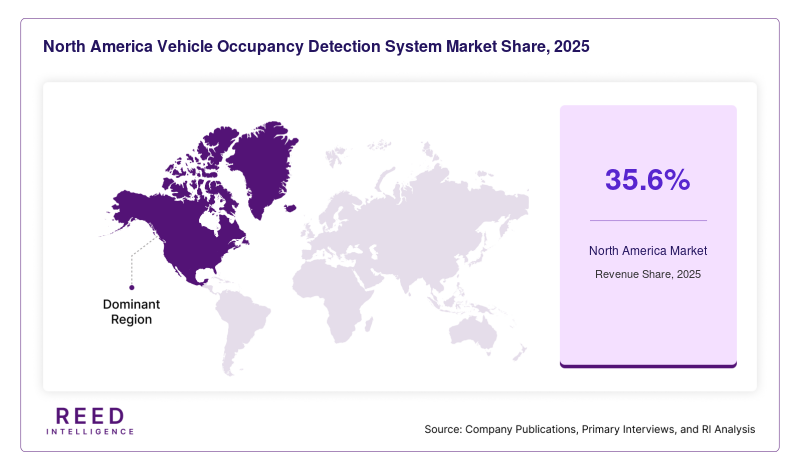
- North America dominated the market with a 35.6% share in 2025.
- Asia Pacific is expected to grow at the fastest CAGR of 11.8% during 2026–2034.
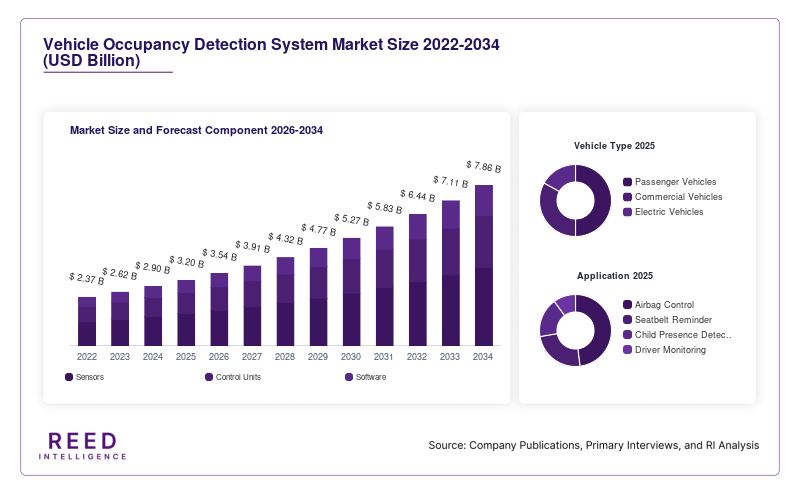
- By component, sensors accounted for the largest share of 42.3%, while software solutions are projected to grow at a CAGR of 12.9%.
- By vehicle type, passenger vehicles led with a 67.5% share, whereas electric vehicles are expected to expand at a CAGR of 13.6%.
- The United States remained the dominant country, with market values of USD 780 million in 2024 and USD 845 million in 2025.
Market Trends
Integration of AI-Based Occupancy Detection Systems
The integration of artificial intelligence (AI) and machine learning algorithms into vehicle occupancy detection systems is becoming a significant trend in the market. These advanced systems utilize cameras and sensors to analyze occupant posture, size, and movement patterns in real time. AI-driven solutions enhance accuracy compared to traditional weight-based systems, enabling better classification of passengers, including children and pets. Automakers are increasingly adopting these intelligent systems to support safety features such as adaptive airbags and driver monitoring systems. Additionally, AI integration enables predictive analytics, improving system responsiveness and reducing false detection rates. This trend is expected to accelerate as computing capabilities within vehicles improve.
Rising Adoption in Electric and Autonomous Vehicles
The growing adoption of electric and autonomous vehicles is driving demand for advanced occupancy detection systems. These vehicles require sophisticated interior monitoring to ensure passenger safety and enable autonomous functionality. Occupancy detection plays a critical role in managing cabin conditions, optimizing energy usage, and supporting ride-sharing applications. For instance, detecting occupied versus unoccupied seats helps regulate HVAC systems in EVs, improving energy efficiency. Moreover, autonomous vehicles rely heavily on occupancy data to manage passenger interactions and safety protocols. As EV and autonomous vehicle production increases globally, the demand for integrated occupancy detection systems is expected to grow steadily.
Market Drivers
Increasing Stringent Safety Regulations
Stringent government regulations related to vehicle safety are a primary driver of the Vehicle Occupancy Detection System Market. Regulatory bodies across regions have introduced mandates requiring advanced occupant detection technologies to improve passenger protection. These systems ensure proper airbag deployment, reducing the risk of injury in accidents. Child presence detection systems are also becoming mandatory in several markets, addressing concerns related to heatstroke incidents in parked vehicles. Compliance with these regulations compels automakers to integrate occupancy detection systems into both mid-range and premium vehicles. As safety standards continue to evolve, the adoption of these systems is expected to rise significantly.
Growth in Connected and Smart Vehicle Technologies
The expansion of connected and smart vehicle technologies is driving demand for occupancy detection systems. Modern vehicles are equipped with advanced features such as driver monitoring, smart infotainment, and personalized cabin experiences. Occupancy detection systems provide critical data to enable these features, including seat occupancy, passenger behavior, and cabin environment adjustments. This data integration enhances user experience while improving safety and efficiency. Additionally, the rise of vehicle-to-everything (V2X) communication systems further supports the need for accurate occupancy detection. As consumers increasingly demand intelligent vehicle features, manufacturers are investing in advanced occupancy detection solutions.
Market Restraint
High System Cost and Integration Complexity
One of the major restraints in the Vehicle Occupancy Detection System Market is the high cost associated with advanced systems and their integration into vehicles. Technologies such as camera-based and AI-driven occupancy detection systems require sophisticated hardware and software components, increasing overall vehicle production costs. This becomes a significant challenge for automakers operating in price-sensitive markets, where cost optimization is crucial. Additionally, integrating these systems into existing vehicle architectures can be complex, requiring redesign of seats, wiring systems, and electronic control units.
The complexity further extends to calibration and maintenance, which can increase operational costs for manufacturers and end-users. Smaller automotive manufacturers may face difficulties adopting these technologies due to limited resources and technical expertise. For example, entry-level vehicle segments often rely on simpler weight-based systems instead of advanced solutions due to cost constraints. This disparity in adoption limits market penetration, particularly in emerging economies. Addressing cost challenges through technological innovation and economies of scale will be essential for broader market growth.
Market Opportunities
Expansion in Emerging Automotive Markets
Emerging markets present significant growth opportunities for the Vehicle Occupancy Detection System Market. Countries in Asia Pacific, Latin America, and Africa are experiencing rapid growth in automotive production and sales. Increasing urbanization, rising disposable incomes, and expanding middle-class populations are driving vehicle demand in these regions. As governments in these markets gradually adopt stricter safety regulations, the demand for occupancy detection systems is expected to increase. Additionally, global automakers are expanding their presence in these regions, introducing vehicles equipped with advanced safety features. This trend creates opportunities for suppliers to establish partnerships and expand their market footprint.
Integration with Smart Mobility and Ride-Sharing Platforms
The rise of smart mobility solutions and ride-sharing platforms is creating new opportunities for occupancy detection systems. These systems play a crucial role in optimizing fleet operations by monitoring seat occupancy and passenger behavior. Ride-sharing companies can use this data to improve service efficiency, enhance safety, and reduce operational costs. Furthermore, occupancy detection systems enable features such as automated billing based on passenger count and real-time monitoring of vehicle usage. As urban mobility solutions continue to evolve, the integration of occupancy detection systems into shared and autonomous vehicles is expected to drive market growth.
Segmental Analysis
By Component
Sensors dominated the Vehicle Occupancy Detection System Market with a 42.3% share in 2024. These sensors include pressure sensors, infrared sensors, and ultrasonic sensors that detect occupant presence and position. The widespread adoption of sensor-based systems is due to their reliability and cost-effectiveness. Automakers prefer these systems for their ability to provide accurate data for airbag deployment and seatbelt reminders. Additionally, advancements in sensor technology have improved detection accuracy and reduced false positives, further driving their adoption across various vehicle segments.
Software solutions are expected to be the fastest-growing subsegment, with a CAGR of 12.9% during the forecast period. The growth is driven by the increasing integration of AI and machine learning algorithms into occupancy detection systems. Software solutions enable advanced data processing and analytics, enhancing system performance. They also support features such as occupant classification and behavior analysis, which are essential for modern vehicles. The growing demand for connected and autonomous vehicles is further driving the adoption of software-based solutions.
By Vehicle Type
Passenger vehicles held the largest share of 67.5% in 2024, driven by high production volumes and increasing demand for safety features. These vehicles are equipped with occupancy detection systems to comply with safety regulations and enhance passenger protection. The growing popularity of SUVs and premium vehicles, which often include advanced safety technologies, is also contributing to segment growth. Automakers are focusing on integrating occupancy detection systems into mid-range vehicles to meet consumer demand for safety features.
Electric vehicles are projected to be the fastest-growing subsegment, with a CAGR of 13.6% during the forecast period. The growth is attributed to the increasing adoption of EVs and the need for advanced occupancy detection systems to optimize energy usage. These systems help regulate cabin conditions based on seat occupancy, improving energy efficiency. Additionally, EV manufacturers are incorporating advanced technologies to differentiate their offerings, further driving the adoption of occupancy detection systems.
By Application
Airbag control systems dominated the market with a 45.1% share in 2024. Occupancy detection systems play a critical role in determining whether airbags should be deployed and at what intensity. This functionality is essential for ensuring passenger safety and minimizing injury during collisions. The increasing emphasis on safety regulations requiring advanced airbag systems is driving the adoption of occupancy detection technologies in this segment.
Child presence detection systems are expected to grow at the fastest CAGR of 13.2% during the forecast period. The growth is driven by increasing awareness of child safety and the implementation of regulations mandating these systems. These technologies detect the presence of children in vehicles and provide alerts to prevent accidents. The rising adoption of smart sensors and AI-based systems is further enhancing the effectiveness of child presence detection solutions.
Regional Analysis
North America
North America accounted for a 35.6% share of the Vehicle Occupancy Detection System Market in 2025 and is expected to grow at a CAGR of 9.8% during the forecast period. The region’s strong market position is attributed to early adoption of advanced automotive technologies and stringent safety regulations. The presence of major automotive manufacturers and technology providers further supports market growth. Increasing consumer awareness regarding vehicle safety features also contributes to the high adoption rate of occupancy detection systems.
The United States dominates the regional market due to its robust automotive industry and regulatory framework. A key growth factor in the country is the implementation of child presence detection mandates aimed at reducing heatstroke-related fatalities. These regulations encourage automakers to integrate advanced occupancy detection systems into vehicles, driving market expansion.
Europe
Europe held a 27.4% share of the market in 2025 and is projected to grow at a CAGR of 10.1% during the forecast period. The region is characterized by strict vehicle safety standards and strong emphasis on technological innovation. European automakers are actively incorporating advanced safety features into their vehicles, including occupancy detection systems, to comply with regulatory requirements and enhance competitiveness.
Germany leads the European market, driven by its strong automotive manufacturing base and focus on innovation. A unique growth factor in Germany is the increasing adoption of electric vehicles, which require advanced occupancy detection systems for energy optimization and passenger safety. This trend is expected to support market growth in the region.
Asia Pacific
Asia Pacific is expected to grow at the fastest CAGR of 11.8% during the forecast period, with a market share of 24.3% in 2025. Rapid urbanization, increasing vehicle production, and rising disposable incomes are driving market growth in the region. Governments are also introducing safety regulations, encouraging the adoption of advanced automotive technologies.
China dominates the Asia Pacific market due to its large automotive production capacity and growing demand for advanced vehicles. A key growth factor is the government’s push for smart and connected vehicles, which require integrated occupancy detection systems. This initiative is expected to significantly boost market growth.
Middle East & Africa
The Middle East & Africa region accounted for 6.1% of the market share in 2025 and is projected to grow at a CAGR of 8.9%. The market growth is supported by increasing investments in automotive infrastructure and rising demand for premium vehicles equipped with advanced safety features.
The United Arab Emirates leads the regional market, driven by its focus on smart mobility solutions. A unique growth factor in the country is the adoption of advanced technologies in luxury vehicles, including occupancy detection systems, to enhance passenger safety and comfort.
Latin America
Latin America held a 6.6% market share in 2025 and is expected to grow at a CAGR of 9.3% during the forecast period. The region’s growth is driven by increasing vehicle sales and gradual adoption of safety regulations. Automotive manufacturers are expanding their presence in the region, introducing vehicles with advanced safety features.
Brazil dominates the Latin American market due to its large automotive industry. A key growth factor is the government’s efforts to improve vehicle safety standards, encouraging the adoption of occupancy detection systems. This initiative is expected to drive market growth in the coming years.
Competitive Landscape
The Vehicle Occupancy Detection System Market is characterized by the presence of several established players focusing on innovation and strategic partnerships. Leading companies are investing in research and development to enhance system accuracy and integrate advanced technologies such as AI and IoT.
Continental AG is a key leader in the market, known for its advanced sensor technologies and strong global presence. The company has recently introduced AI-based occupant detection systems designed to improve safety and support autonomous driving features. Other major players are also focusing on expanding their product portfolios and strengthening their market positions through collaborations and acquisitions.
Competition in the market is driven by technological advancements, product differentiation, and pricing strategies. Companies are also focusing on expanding their presence in emerging markets to capitalize on growth opportunities. The increasing demand for advanced safety features is expected to intensify competition among market players.
Key Players
- Continental AG
- Bosch Mobility Solutions
- Denso Corporation
- Valeo SA
- ZF Friedrichshafen AG
- Aptiv PLC
- Autoliv Inc.
- Hyundai Mobis
- Veoneer Inc.
- IEE S.A.
- TE Connectivity
- NXP Semiconductors
- Texas Instruments
- Infineon Technologies
- Analog Devices Inc.
Recent Developments
- In 2025, Continental AG launched an AI-powered occupant detection system designed for autonomous vehicles.
- In 2024, Bosch introduced a next-generation sensor platform for improved occupant classification accuracy.
- In 2025, Denso Corporation partnered with a leading EV manufacturer to develop integrated occupancy detection solutions.
Vehicle Occupancy Detection System Market Segments
Component
- Sensors
- Control Units
- Software
Vehicle Type
- Passenger Vehicles
- Commercial Vehicles
- Electric Vehicles
Application
- Airbag Control
- Seatbelt Reminder
- Child Presence Detection
- Driver Monitoring
By Region
- North America
- Europe
- APAC
- Middle East and Africa
- LATAM