Vehicle Radar Test System Market Size, Share & Demand Report By Component (Hardware Systems, Calibration Services), By Vehicle Type (Passenger Vehicles, Commercial Vehicles, Autonomous Commercial Vehicles), By Application (ADAS Validation, Autonomous Driving Calibration, Electromagnetic Compatibility Testing), By Deployment Type (On-Premise Testing Systems, Cloud-Based Simulation Platforms), By Region & Segment Forecasts, 2026–2034
USD 3950
Market Overview
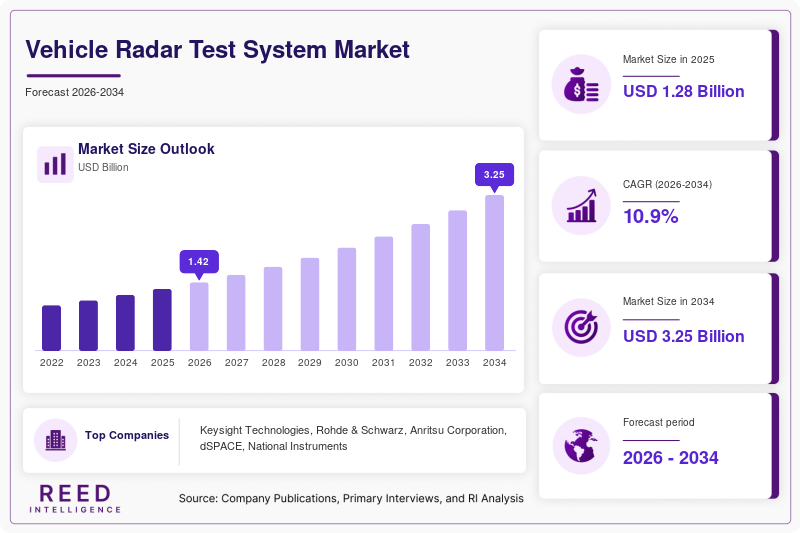
The global Vehicle Radar Test System Market size was valued at approximately USD 1.28 billion in 2026 and is projected to reach nearly USD 2.94 billion by 2034, expanding at a CAGR of 10.9% during the forecast period from 2026 to 2034. The market is experiencing consistent growth due to the rapid integration of advanced driver assistance systems (ADAS), autonomous driving technologies, and vehicle safety regulations across passenger and commercial vehicles. Radar testing systems have become essential for validating radar accuracy, sensor calibration, electromagnetic compatibility, and real-world detection performance before vehicle deployment.
The increasing production of electric vehicles and connected mobility platforms has further accelerated the demand for reliable radar validation systems. Automotive manufacturers are investing in high-frequency radar technologies such as 77 GHz and 79 GHz radar systems to improve collision avoidance, lane-keeping support, adaptive cruise control, and blind-spot detection. As radar modules become more complex, automakers and Tier-1 suppliers require sophisticated testing environments that simulate urban traffic, highway conditions, weather variations, and object detection scenarios.
Key Highlights
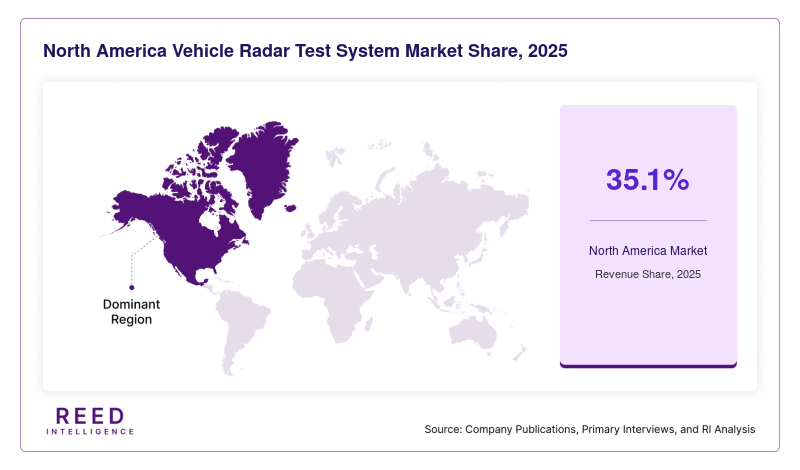
- North America dominated the market with a 35.1% share in 2025.
- Asia Pacific is expected to grow at the fastest CAGR of 11.8% during 2026–2034.
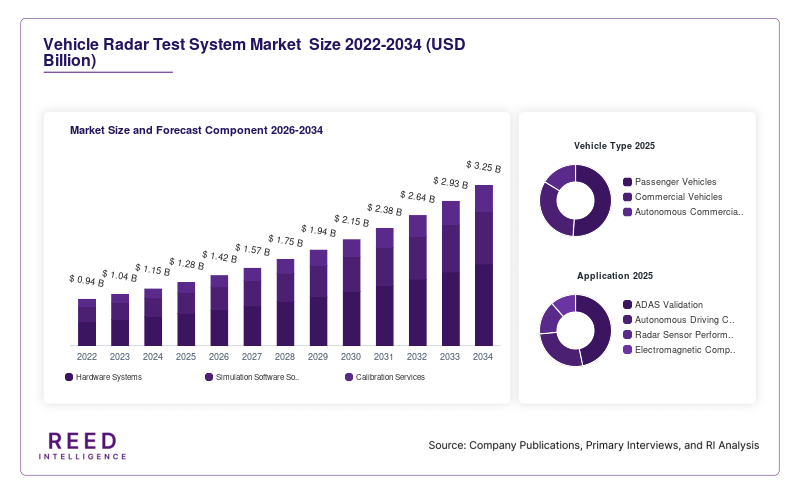
- By component, hardware systems accounted for the largest share of 42.6%.
- while simulation software solutions are projected to grow at a CAGR of 12.7%.
- By vehicle type, passenger vehicles led with a 63.8% share.
- whereas autonomous commercial vehicles are expected to expand at a CAGR of 13.1%.
- By application, ADAS validation held a 46.3% share.
- while autonomous driving calibration is anticipated to grow at a CAGR of 13.5%.
- The United States remained the dominant country, with market values of USD 410 million in 2024 and USD 458 million in 2025.
Market Trends
Expansion of Virtual Radar Simulation Platforms
Automotive manufacturers are increasingly adopting virtual radar simulation platforms to reduce testing complexity and shorten vehicle development cycles. Traditional physical testing methods often require large proving grounds, environmental chambers, and repeated field trials, which increase operational costs and extend product launch timelines. Virtual radar testing environments enable engineers to simulate multiple driving conditions, object behaviors, and environmental variables within controlled digital ecosystems. This approach improves radar validation accuracy while supporting faster software updates for autonomous vehicle platforms.
The growing use of digital twins and artificial intelligence within radar testing systems is also influencing market trends. Automotive companies are integrating cloud-based simulation tools with machine learning algorithms to identify radar interference patterns and optimize sensor performance. These advanced platforms allow real-time analysis of radar reflections, obstacle recognition, and lane tracking performance. The trend is particularly visible among electric vehicle manufacturers and autonomous mobility startups seeking scalable testing solutions that align with rapid product innovation cycles.
Rising Adoption of Multi-Sensor Fusion Testing
Vehicle manufacturers are increasingly implementing multi-sensor fusion systems that combine radar, cameras, LiDAR, and ultrasonic sensors to improve vehicle perception capabilities. This shift is creating higher demand for integrated radar test systems capable of validating the interaction between multiple sensing technologies. Automotive safety functions such as adaptive cruise control, emergency braking, and automated parking now depend on synchronized sensor performance under different operating environments.
The market is witnessing strong investment in compact anechoic chambers, over-the-air testing systems, and high-frequency radar emulators designed for sensor fusion validation. Manufacturers are focusing on testing platforms that can replicate dense urban traffic conditions, pedestrian movement, and complex road infrastructure scenarios. The adoption of multi-sensor architectures in premium vehicles and autonomous commercial fleets is expected to strengthen the demand for advanced radar testing technologies over the next decade.
Market Drivers
Increasing Deployment of Advanced Driver Assistance Systems
The growing integration of advanced driver assistance systems across passenger and commercial vehicles is a major factor driving the Vehicle Radar Test System Market. Automakers are equipping vehicles with radar-enabled features such as adaptive cruise control, blind-spot monitoring, lane departure warning, and collision avoidance systems to improve road safety and comply with government regulations. These technologies rely heavily on accurate radar performance, increasing the need for sophisticated radar validation systems throughout vehicle development and production stages.
Automotive OEMs are investing heavily in radar calibration facilities to ensure high-performance sensor operation in different driving conditions. Regulatory agencies in several countries are also mandating enhanced vehicle safety features, encouraging manufacturers to strengthen testing procedures before product commercialization. As the number of radar-equipped vehicles increases globally, the demand for reliable and scalable radar test systems is expected to rise steadily during the forecast period.
Expansion of Autonomous Vehicle Development Programs
The global push toward autonomous mobility is significantly increasing the need for advanced radar testing infrastructure. Autonomous vehicles require high-precision radar systems capable of detecting obstacles, vehicles, pedestrians, and road conditions in real time. To achieve reliable autonomous navigation, manufacturers must conduct extensive radar validation across multiple environments including highways, tunnels, urban roads, and adverse weather conditions.
Technology companies and automotive manufacturers are expanding partnerships to accelerate autonomous driving innovation, leading to greater investment in radar testing laboratories and simulation platforms. The emergence of Level 3 and Level 4 autonomous vehicle programs is further intensifying demand for advanced test systems capable of evaluating radar signal integrity, latency, object classification accuracy, and electromagnetic interference resistance. The rising commercialization of autonomous transportation services is expected to support long-term market growth.
Market Restraint
High Infrastructure and Equipment Costs Limiting Market Penetration
The high cost associated with radar testing infrastructure remains a significant challenge for market expansion. Advanced radar test systems require specialized facilities such as anechoic chambers, electromagnetic shielding equipment, signal analyzers, radar target simulators, and high-frequency calibration devices. These systems involve substantial capital expenditure, making adoption difficult for small automotive suppliers and independent testing facilities.
In addition to equipment costs, radar testing environments require continuous software upgrades, maintenance services, and highly skilled technical personnel to manage complex validation processes. The integration of autonomous driving technologies has further increased testing complexity, forcing manufacturers to invest in sophisticated simulation capabilities and large-scale validation programs. Smaller companies often face financial limitations when attempting to establish advanced radar testing infrastructure, which may slow technology adoption in emerging automotive markets.
The restraint is particularly visible in developing economies where automotive testing ecosystems remain underdeveloped. Limited access to advanced calibration technologies and high import costs for precision radar testing equipment create operational barriers for regional suppliers. As a result, market penetration remains concentrated among large automotive manufacturers and established Tier-1 technology providers with stronger investment capabilities.
Market Opportunities
Growth Potential in Electric and Connected Vehicle Platforms
The rapid expansion of electric and connected vehicle production is creating strong opportunities for radar testing solution providers. Electric vehicles increasingly rely on radar-enabled safety systems and intelligent driving technologies to improve navigation, collision prevention, and traffic awareness. Automotive manufacturers are focusing on integrating multiple radar sensors into electric vehicle architectures, increasing the demand for accurate testing and calibration systems.
Connected vehicle ecosystems also require reliable radar communication and sensor coordination to support vehicle-to-vehicle and vehicle-to-infrastructure interactions. This trend is encouraging testing equipment manufacturers to develop scalable radar validation platforms compatible with next-generation mobility networks. The rising deployment of smart transportation infrastructure and connected traffic management systems is expected to generate substantial demand for advanced radar testing solutions in both developed and emerging markets.
Emerging Demand for Compact and Portable Test Solutions
The development of compact and portable radar test systems presents another major growth opportunity for the industry. Automotive manufacturers are increasingly seeking flexible testing solutions that can be deployed across production lines, research facilities, and field-testing environments. Portable radar testing equipment enables faster validation procedures while reducing operational downtime and infrastructure dependency.
Manufacturers are introducing lightweight radar emulators, mobile calibration systems, and software-defined testing platforms capable of supporting real-time diagnostics and wireless connectivity. These innovations are particularly valuable for electric vehicle startups and mid-sized automotive suppliers looking for cost-efficient testing alternatives. The growing need for rapid prototyping and shorter vehicle development cycles is expected to accelerate demand for portable radar validation technologies throughout the forecast period.
Segmental Analysis
By Component
Hardware systems represented the dominant subsegment within the component category, accounting for nearly 42.6% of the global market share in 2024. The segment includes radar target simulators, signal generators, spectrum analyzers, anechoic chambers, and calibration equipment used for validating automotive radar performance. Automotive manufacturers and testing laboratories rely heavily on hardware infrastructure to conduct accurate radar measurements under controlled conditions. Increasing integration of high-frequency radar systems into passenger vehicles and autonomous mobility platforms has strengthened demand for advanced testing equipment. The growing adoption of 77 GHz and 79 GHz radar modules across ADAS applications has also contributed to the expansion of hardware-based validation systems. Automotive OEMs continue investing in sophisticated testing facilities to improve radar accuracy, reduce interference risks, and ensure compliance with safety regulations.
Simulation software solutions emerged as the fastest-growing subsegment and are projected to expand at a CAGR of 12.7% during the forecast period. The growth is driven by increasing demand for virtual testing environments capable of replicating real-world driving conditions and traffic scenarios. Automotive companies are integrating artificial intelligence and cloud computing technologies into radar simulation platforms to improve validation efficiency and reduce development costs. Software-defined radar testing enables engineers to analyze object detection accuracy, sensor fusion performance, and environmental interference patterns in real time. The rapid development of autonomous driving systems is accelerating the need for advanced simulation capabilities that support continuous software updates and faster validation cycles. Automotive manufacturers are increasingly adopting digital twin technologies to optimize radar calibration processes and shorten product launch timelines.
By Vehicle Type
Passenger vehicles accounted for the largest share within the vehicle type segment, representing approximately 63.8% of the global market in 2024. The dominance of this subsegment is linked to the widespread integration of ADAS features such as adaptive cruise control, lane-keeping assistance, automatic emergency braking, and blind-spot monitoring in modern passenger cars. Automotive manufacturers are equipping mid-range and premium vehicles with multiple radar sensors to enhance driving safety and improve consumer convenience. The rising production of electric passenger vehicles has further increased the demand for radar testing systems capable of supporting advanced mobility technologies. Regulatory mandates related to vehicle safety standards in North America and Europe are also encouraging automakers to strengthen radar validation capabilities before commercial deployment. As consumer preference for connected and intelligent vehicles grows, radar testing demand in the passenger vehicle segment is expected to remain strong.
Autonomous commercial vehicles are projected to witness the fastest CAGR of 13.1% during the forecast period. The increasing development of self-driving trucks, autonomous delivery vehicles, and connected logistics fleets is driving demand for advanced radar validation systems. Commercial autonomous vehicles require highly accurate radar performance to ensure safe navigation across highways, warehouses, and urban transportation networks. Radar testing systems are becoming critical for evaluating sensor reliability, long-range object detection, and operational safety under varying environmental conditions. Logistics companies and transportation service providers are investing in autonomous fleet technologies to improve operational efficiency and reduce labor dependency. The rapid expansion of smart logistics infrastructure and automated freight transportation programs is expected to accelerate the adoption of radar testing solutions in the commercial vehicle segment.
By Application
ADAS validation dominated the application segment with a market share of approximately 46.3% in 2024. The increasing adoption of radar-based driver assistance technologies has made validation processes essential for ensuring vehicle safety and performance reliability. Automotive manufacturers conduct extensive testing to evaluate radar sensor accuracy, obstacle detection capabilities, and system responsiveness under different road conditions. The segment is supported by rising regulatory pressure to integrate safety technologies into both passenger and commercial vehicles. Radar testing systems are widely used to validate adaptive cruise control, forward collision warning, lane departure alerts, and pedestrian detection systems. The growing complexity of multi-sensor vehicle architectures has also increased the need for advanced testing platforms capable of analyzing radar communication and electromagnetic compatibility. Continuous innovation in intelligent mobility technologies is expected to sustain strong demand for ADAS validation systems.
Autonomous driving calibration is anticipated to grow at the fastest CAGR of 13.5% during the forecast period due to increasing investment in self-driving mobility technologies. Autonomous vehicles rely heavily on radar systems for object recognition, navigation, and real-time environmental analysis. Testing and calibration systems play a critical role in optimizing radar sensor alignment, minimizing signal interference, and improving autonomous decision-making accuracy. Automotive companies are investing in high-frequency radar simulation platforms capable of replicating dense urban traffic environments and challenging weather conditions. The emergence of Level 4 autonomous mobility programs and robotaxi services is further accelerating the need for advanced radar calibration infrastructure. Technology firms and automakers are expanding partnerships to develop next-generation autonomous driving ecosystems supported by highly accurate radar testing capabilities.
Regional Analysis
North America
North America accounted for approximately 35.1% of the global Vehicle Radar Test System Market in 2025 and maintained a strong position due to significant investments in autonomous vehicle development and ADAS deployment. The region is projected to grow at a CAGR of 10.3% during the forecast period as automotive manufacturers continue expanding radar validation capabilities. The presence of established automotive OEMs, semiconductor companies, and testing technology providers supports steady market expansion across the United States and Canada.
Government safety regulations and increasing consumer demand for intelligent mobility systems are strengthening the adoption of radar-enabled vehicle technologies in the region. Automotive companies are heavily investing in over-the-air testing systems, radar chambers, and advanced simulation environments to improve vehicle safety compliance. The increasing commercialization of autonomous trucking and robotaxi services is expected to support long-term growth opportunities for radar testing solution providers.
Europe
Europe represented nearly 27.4% of the Vehicle Radar Test System Market in 2025 and is expected to register a CAGR of 10.1% through 2034. The region benefits from stringent vehicle safety standards and strong investments in automotive innovation. European automakers are actively incorporating radar-based safety systems into premium and mass-market vehicles, increasing the need for reliable testing platforms capable of supporting complex validation procedures.
The market is also driven by the presence of advanced automotive research institutions and testing laboratories across Germany, France, and the United Kingdom. Radar testing facilities in Europe are focusing on sensor fusion validation and electromagnetic compatibility analysis to meet evolving autonomous mobility standards. Increasing adoption of connected vehicles and smart transportation initiatives is expected to support market growth throughout the region.
Asia Pacific
Asia Pacific held around 24.8% of the global market share in 2025 and is projected to grow at the fastest CAGR of 11.8% during the forecast period. Rapid automotive production growth, increasing electric vehicle adoption, and expanding ADAS integration are driving regional demand for radar test systems. Countries such as China, Japan, South Korea, and India are investing heavily in smart mobility technologies and autonomous transportation infrastructure.
The region is witnessing strong expansion in semiconductor manufacturing and automotive electronics production, which supports radar sensor development and testing activities. Automotive manufacturers are increasing investment in localized testing facilities to reduce supply chain dependency and accelerate product development. Rising urbanization and growing road safety awareness are expected to strengthen market demand across Asia Pacific.
Middle East & Africa
The Middle East & Africa region accounted for approximately 6.1% of the Vehicle Radar Test System Market in 2025 and is anticipated to grow at a CAGR of 8.9% during the forecast period. The market is gradually expanding due to increasing investments in smart transportation infrastructure and premium vehicle adoption. Automotive distributors and technology providers are introducing radar-enabled safety systems to meet evolving consumer preferences and regulatory expectations.
Several countries in the region are focusing on intelligent mobility initiatives and smart city development projects, which support demand for advanced automotive technologies. Radar testing service providers are expanding regional operations to support imported luxury vehicles and commercial transportation fleets. The market remains in an emerging stage but demonstrates long-term growth potential as connected mobility adoption increases.
Latin America
Latin America captured nearly 6.6% of the global Vehicle Radar Test System Market in 2025 and is projected to grow at a CAGR of 9.2% over the forecast period. The regional market is supported by increasing automotive production and gradual adoption of advanced vehicle safety technologies. Automotive manufacturers operating in Brazil and Mexico are integrating radar-enabled systems into newer vehicle models to improve safety performance and regulatory compliance.
The expansion of automotive assembly facilities and increasing investment in connected mobility solutions are also supporting regional market growth. Radar testing demand is rising among automotive suppliers seeking to improve sensor reliability and production efficiency. The growing penetration of electric vehicles and imported premium vehicles is expected to create additional opportunities for radar testing solution providers.
Competitive Landscape
The Vehicle Radar Test System Market remains moderately consolidated with the presence of global testing equipment manufacturers, automotive technology providers, and specialized radar validation companies. Leading companies are focusing on strategic partnerships, software integration, product innovation, and geographic expansion to strengthen market competitiveness. The industry is witnessing increasing investment in AI-enabled radar simulation platforms and compact over-the-air testing solutions designed for autonomous vehicle applications.
Keysight Technologies emerged as one of the leading companies in the market due to its broad portfolio of automotive radar testing and signal analysis solutions. The company recently expanded its autonomous vehicle testing platform with enhanced radar scenario simulation capabilities aimed at supporting high-frequency ADAS validation requirements. Rohde & Schwarz, National Instruments, Anritsu Corporation, and dSPACE also maintain strong market positions through continuous innovation in radar calibration and electromagnetic compatibility testing technologies.
Market participants are increasingly collaborating with automotive OEMs and semiconductor manufacturers to develop integrated validation ecosystems for connected and autonomous vehicles. Companies are also investing in cloud-based simulation platforms and scalable testing environments to support rapid vehicle software development cycles and improve operational efficiency.
Key Players
- Keysight Technologies
- Rohde & Schwarz
- Anritsu Corporation
- dSPACE
- National Instruments
- Vector Informatik
- Viavi Solutions
- Averna
- Konrad Technologies
- Spirent Communications
- Teledyne Technologies
- Bosch
- Continental AG
Recent Developments
- In February 2026, Keysight Technologies introduced an upgraded automotive radar validation platform designed for high-frequency autonomous driving applications.
- In September 2025, Rohde & Schwarz expanded its over-the-air radar testing portfolio with advanced multi-sensor fusion simulation capabilities for connected vehicles.
- In June 2025, dSPACE partnered with an automotive OEM to develop AI-based radar calibration software for Level 4 autonomous mobility programs.
Vehicle Radar Test System Market Segments
Component
- Hardware Systems
- Simulation Software Solutions
- Calibration Services
Vehicle Type
- Passenger Vehicles
- Commercial Vehicles
- Autonomous Commercial Vehicles
Application
- ADAS Validation
- Autonomous Driving Calibration
- Radar Sensor Performance Testing
- Electromagnetic Compatibility Testing
Deployment Type
- On-Premise Testing Systems
- Cloud-Based Simulation Platforms
- Portable Radar Test Solutions
By Region
- North America
- Europe
- APAC
- Middle East and Africa
- LATAM