Vena Cava Clips Filters Market Size, Share & Demand Report By Product Type (Permanent Filters, Retrievable Filters, Biodegradable Filters), By Application (Pulmonary Embolism Prevention, Trauma-related Thrombosis Prevention, Surgical Procedures), By End-Use (Hospitals, Ambulatory Surgical Centers, Specialty Clinics) By Region & Segment Forecasts, 2026–2034
USD 3950
Market Overview
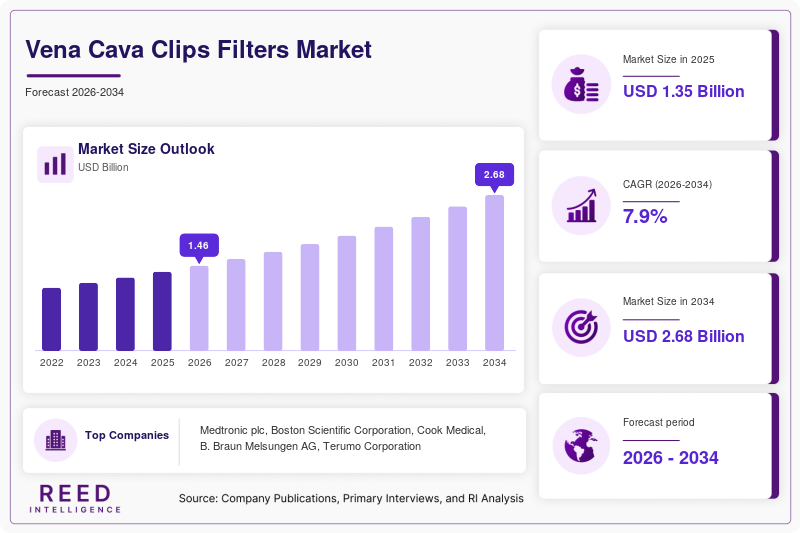
The Vena Cava Clips Filters Market size was valued at approximately USD 1.35 billion in 2026 and is projected to reach USD 2.48 billion by 2034, expanding at a CAGR of 7.9% during the forecast period (2026–2034). The market is witnessing steady expansion due to the rising prevalence of venous thromboembolism (VTE), increasing surgical procedures, and advancements in minimally invasive cardiovascular interventions. The demand for vena cava clips and filters has grown in parallel with the aging population and the rising incidence of lifestyle-related diseases such as obesity and cardiovascular disorders, which elevate the risk of deep vein thrombosis (DVT).
A key global factor supporting market growth is the increasing adoption of preventive healthcare practices and early diagnosis of thrombotic conditions. Healthcare systems across developed and developing regions are emphasizing risk management strategies to prevent pulmonary embolism, which has led to higher utilization of inferior vena cava (IVC) filters and clips in both emergency and elective procedures. Technological advancements in retrievable filters and biocompatible materials have also improved patient outcomes and reduced complications, further supporting market expansion.
Key Highlights
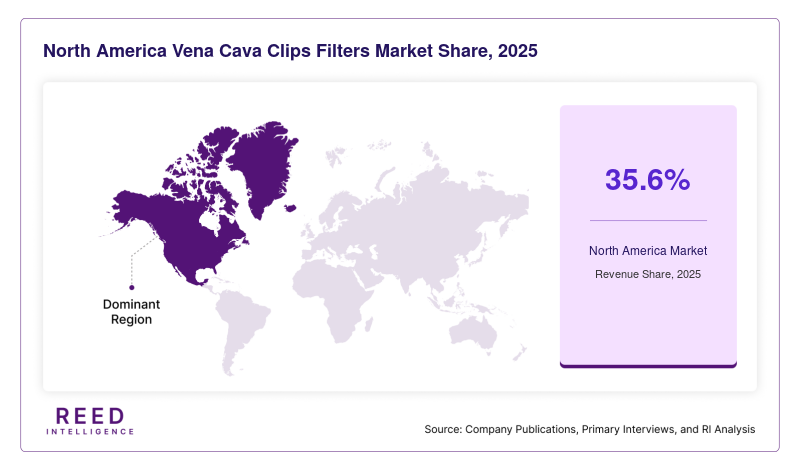
- North America dominated the market with a 35.6% share in 2025.
- Asia Pacific is expected to grow at the fastest CAGR of 9.8% during 2026–2034.
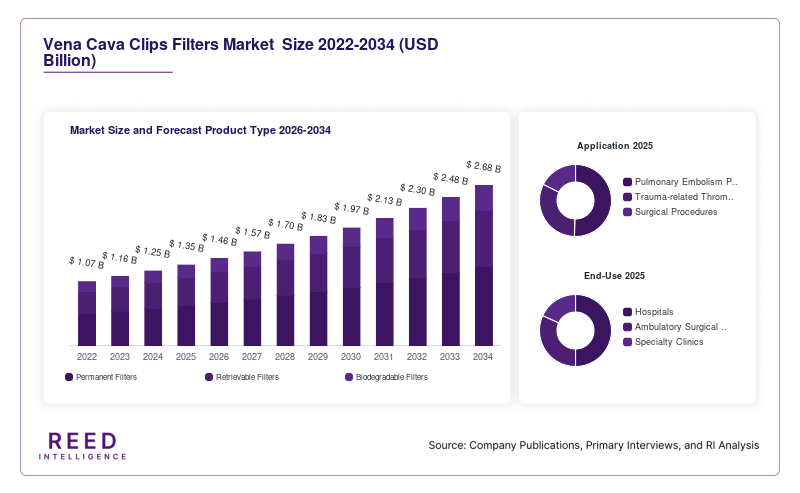
- By product type, retrievable filters accounted for the largest share of 42.3%, while biodegradable filters are projected to grow at a CAGR of 10.6%.
- By application, pulmonary embolism prevention led with a 48.1% share, whereas trauma-related thrombosis prevention is expected to expand at a CAGR of 9.4%.
- The United States remained the dominant country, with market values of USD 480 million in 2024 and USD 525 million in 2025.
Market Trends
Growing Adoption of Retrievable and Biodegradable Filters
The market is experiencing a shift toward retrievable and biodegradable vena cava filters due to their enhanced safety profiles and flexibility in clinical use. Retrievable filters allow physicians to remove the device once the risk of embolism subsides, reducing long-term complications such as filter migration and thrombosis. This adaptability has made them increasingly popular in both developed and emerging healthcare systems. Additionally, biodegradable filters are gaining attention as they eliminate the need for removal procedures, thereby minimizing patient discomfort and healthcare costs.
Manufacturers are investing in advanced materials such as polymer-based and hybrid structures that can safely degrade within the body. These innovations are aligning with regulatory expectations and clinical guidelines that emphasize patient safety and reduced intervention rates. As healthcare providers continue to adopt evidence-based practices, the demand for these advanced filter types is expected to accelerate, contributing significantly to market growth during the forecast period.
Increasing Integration of Imaging and Precision Placement Technologies
Another notable trend shaping the Vena Cava Clips Filters Market is the integration of advanced imaging technologies for precise device placement. The use of real-time imaging modalities such as fluoroscopy, ultrasound, and computed tomography has enhanced the accuracy of filter deployment, reducing procedural risks and improving patient outcomes. These technologies enable clinicians to assess anatomical variations and ensure optimal positioning of filters within the vena cava.
The trend is further supported by the growing adoption of hybrid operating rooms equipped with advanced imaging systems. Such environments facilitate minimally invasive procedures and enable real-time adjustments during filter placement. This integration not only enhances procedural efficiency but also reduces recovery times and hospital stays. As healthcare infrastructure continues to evolve, especially in emerging economies, the demand for technologically advanced placement techniques is expected to drive the market forward.
Market Drivers
Rising Incidence of Venous Thromboembolism and Related Conditions
The increasing prevalence of venous thromboembolism (VTE), including deep vein thrombosis and pulmonary embolism, is a primary driver of the Vena Cava Clips Filters Market. Factors such as sedentary lifestyles, obesity, aging populations, and the growing burden of chronic diseases have contributed to a higher incidence of thrombotic conditions globally. Patients undergoing major surgeries, trauma care, or prolonged immobilization are particularly at risk, necessitating preventive interventions such as vena cava filters.
Healthcare providers are increasingly adopting these devices as a preventive measure in high-risk patients who cannot tolerate anticoagulant therapy. The growing awareness among clinicians regarding early intervention and risk management has further fueled the adoption of vena cava clips and filters. As diagnostic capabilities improve and more cases are identified at earlier stages, the demand for these devices is expected to rise steadily over the forecast period.
Advancements in Minimally Invasive Surgical Techniques
Technological advancements in minimally invasive procedures have significantly contributed to the growth of the market. Modern vena cava filters are designed for percutaneous insertion, allowing for reduced surgical trauma, shorter recovery times, and lower complication rates. These benefits have made minimally invasive procedures the preferred choice among both patients and healthcare providers.
The development of innovative delivery systems and improved catheter technologies has enhanced the ease and precision of filter placement. Additionally, advancements in materials science have led to the production of more durable and biocompatible devices, reducing the risk of adverse reactions. As healthcare systems continue to prioritize patient-centric care and cost-effective treatment options, the adoption of minimally invasive vena cava filter procedures is expected to expand further, driving market growth.
Market Restraint
Risk of Complications and Regulatory Challenges
Despite the growing adoption of vena cava clips and filters, the market faces significant challenges related to device-related complications and stringent regulatory requirements. Complications such as filter migration, fracture, perforation of the vena cava wall, and long-term thrombosis have raised concerns among healthcare providers and regulatory authorities. These risks have led to increased scrutiny of device safety and performance, resulting in stricter approval processes and post-market surveillance requirements.
Regulatory bodies in major markets have issued guidelines emphasizing the timely removal of retrievable filters and careful patient selection. This has created additional compliance burdens for manufacturers and healthcare providers, potentially limiting market growth. For instance, delays in product approvals and the need for extensive clinical trials can increase development costs and extend time-to-market. As a result, smaller companies may face challenges in competing with established players, while healthcare providers may exercise caution in device usage, impacting overall market expansion.
Market Opportunities
Expansion in Emerging Healthcare Markets
Emerging economies present significant growth opportunities for the Vena Cava Clips Filters Market due to improving healthcare infrastructure and increasing access to advanced medical treatments. Countries in Asia Pacific, Latin America, and the Middle East are investing heavily in healthcare modernization, including the establishment of specialized cardiovascular centers. These developments are facilitating the adoption of advanced medical devices such as vena cava filters.
Rising healthcare expenditure, growing awareness of thrombotic conditions, and government initiatives aimed at improving patient outcomes are further supporting market expansion in these regions. Additionally, the increasing presence of multinational medical device companies in emerging markets is enhancing product availability and accessibility. As healthcare systems continue to evolve, these regions are expected to offer substantial growth potential for market players.
Development of Next-Generation Smart and Personalized Devices
The development of next-generation vena cava filters with smart and personalized features represents another promising opportunity for market growth. Innovations such as sensors for real-time monitoring, drug-eluting coatings, and patient-specific designs are gaining traction in the medical device industry. These advancements aim to improve device performance, reduce complications, and enhance patient outcomes.
Personalized medicine is becoming increasingly important in healthcare, and the integration of patient-specific data into device design is expected to revolutionize the market. Manufacturers are exploring the use of advanced technologies such as 3D printing and artificial intelligence to develop customized solutions tailored to individual patient needs. As these innovations become commercially viable, they are likely to drive significant growth in the Vena Cava Clips Filters Market.
Segmental Analysis
By Product Type
Retrievable filters emerged as the dominant subsegment in the Vena Cava Clips Filters Market, accounting for approximately 42.3% of the market share in 2024. These filters are widely used due to their flexibility and ability to be removed once the risk of pulmonary embolism subsides. Healthcare providers prefer retrievable filters as they reduce the likelihood of long-term complications associated with permanent devices. The increasing adoption of minimally invasive procedures has further boosted the demand for retrievable filters, as they can be easily inserted and removed using advanced catheter-based techniques.
Biodegradable filters are expected to be the fastest-growing subsegment, with a projected CAGR of 10.6% during the forecast period. These filters offer the advantage of naturally dissolving within the body, eliminating the need for removal procedures. The growing focus on patient safety and cost-effective treatment options is driving the adoption of biodegradable filters. Additionally, ongoing research and development activities aimed at improving the performance and reliability of these devices are expected to further accelerate their growth.
By Application
Pulmonary embolism prevention dominated the application segment, holding a market share of 48.1% in 2024. The high prevalence of pulmonary embolism and the increasing number of high-risk patients have driven the demand for vena cava filters in this application. These devices are widely used in patients who cannot undergo anticoagulant therapy, providing an effective alternative for preventing life-threatening complications. The growing awareness of early intervention and preventive healthcare has further supported the adoption of vena cava filters in this segment.
Trauma-related thrombosis prevention is anticipated to be the fastest-growing subsegment, with a CAGR of 9.4% during the forecast period. The increasing number of trauma cases and surgical procedures has created a growing need for preventive measures to reduce the risk of thrombotic complications. Healthcare providers are increasingly adopting vena cava filters in trauma care settings to improve patient outcomes. The development of advanced filter designs and improved placement techniques is expected to further drive growth in this segment.
By End-Use
Hospitals accounted for the largest share of the market in 2024, driven by the high volume of surgical procedures and the availability of advanced medical facilities. Hospitals are the primary settings for the placement of vena cava filters, as they offer access to specialized equipment and skilled healthcare professionals. The increasing adoption of minimally invasive procedures and the growing focus on patient safety have further contributed to the dominance of hospitals in this segment.
Ambulatory surgical centers are expected to be the fastest-growing subsegment, with a CAGR of 8.9% during the forecast period. The shift toward outpatient care and the increasing preference for cost-effective treatment options have driven the growth of this segment. Ambulatory surgical centers offer shorter hospital stays and reduced healthcare costs, making them an attractive option for patients and healthcare providers. The growing adoption of advanced medical technologies in these centers is expected to further support their growth.
Regional Analysis
North America
North America accounted for a significant share of the Vena Cava Clips Filters Market, holding approximately 35.6% in 2025, and is expected to maintain steady growth with a CAGR of 7.2% during the forecast period. The region’s dominance is attributed to advanced healthcare infrastructure, high adoption of minimally invasive procedures, and strong presence of leading medical device manufacturers. The increasing prevalence of venous thromboembolism and the rising number of surgical procedures further contribute to market growth in this region.
The United States remains the dominant country in North America, driven by a well-established healthcare system and high healthcare expenditure. A unique growth factor is the widespread adoption of preventive healthcare practices, including early screening and intervention for thrombotic conditions. This proactive approach has led to increased utilization of vena cava filters and clips, supporting market expansion.
Europe
Europe held a substantial share of the market in 2025 and is projected to grow at a CAGR of 7.0% during the forecast period. The region benefits from a strong regulatory framework and increasing awareness of thrombotic conditions among healthcare professionals. Countries such as Germany, France, and the United Kingdom are leading contributors to market growth, supported by advanced medical facilities and growing adoption of innovative medical devices.
Germany stands out as the dominant country in Europe due to its robust healthcare system and focus on technological innovation. A unique growth factor in this region is the increasing emphasis on clinical research and development, which has led to the introduction of advanced vena cava filter technologies. This focus on innovation is expected to drive market growth in Europe.
Asia Pacific
Asia Pacific is anticipated to witness the fastest growth in the Vena Cava Clips Filters Market, with a CAGR of 9.8% during the forecast period. The region’s growth is driven by improving healthcare infrastructure, rising healthcare expenditure, and increasing awareness of thrombotic conditions. Countries such as China, India, and Japan are major contributors to market expansion, supported by large patient populations and growing demand for advanced medical treatments.
China is the dominant country in the Asia Pacific region, driven by rapid urbanization and increasing investment in healthcare infrastructure. A unique growth factor is the expansion of private healthcare facilities, which are adopting advanced medical technologies to improve patient outcomes. This trend is expected to significantly boost market growth in the region.
Middle East & Africa
The Middle East & Africa region is expected to grow at a moderate CAGR of 6.5% during the forecast period. The market is supported by increasing healthcare investments and the development of modern medical facilities in countries such as the United Arab Emirates and South Africa. The rising prevalence of chronic diseases and improving access to healthcare services are also contributing to market growth.
The United Arab Emirates emerges as the dominant country in this region, driven by government initiatives to enhance healthcare infrastructure. A unique growth factor is the growing medical tourism industry, which attracts patients seeking advanced treatments. This has led to increased adoption of vena cava filters and clips in the region.
Latin America
Latin America is projected to experience steady growth with a CAGR of 6.8% during the forecast period. The market is driven by improving healthcare infrastructure and increasing awareness of thrombotic conditions. Countries such as Brazil and Mexico are key contributors to market growth, supported by rising healthcare expenditure and expanding access to medical services.
Brazil dominates the Latin American market due to its large population and growing healthcare sector. A unique growth factor is the increasing adoption of public-private partnerships in healthcare, which has improved access to advanced medical technologies. This trend is expected to support market growth in the region.
Competitive Landscape
The Vena Cava Clips Filters Market is characterized by the presence of several established players and emerging companies focusing on innovation and product development. Leading companies are investing in research and development to introduce advanced filter designs and improve patient outcomes. Strategic collaborations, mergers, and acquisitions are common strategies adopted by market players to strengthen their market position and expand their product portfolios.
One of the leading companies in the market is Medtronic plc, which has a strong presence in the cardiovascular devices segment. The company has recently focused on developing advanced retrievable filters with improved safety profiles. Other key players are also investing in technological advancements and expanding their global footprint to cater to the growing demand for vena cava filters.
Key Players
- Medtronic plc
- Boston Scientific Corporation
- Cook Medical
- B. Braun Melsungen AG
- Terumo Corporation
- Cardinal Health
- Argon Medical Devices
- C. R. Bard (BD)
- Cordis Corporation
- Merit Medical Systems
- Lifetech Scientific Corporation
- ALN Implants Chirurgicaux
- OptMed Inc.
- Braile Biomédica
- Sorin Group
Recent Developments
- Medtronic plc introduced an advanced retrievable vena cava filter with enhanced biocompatibility and improved retrieval success rates.
- Boston Scientific Corporation expanded its product portfolio by launching a next-generation filter designed for precise placement and reduced complication risks.
- Cook Medical announced a strategic collaboration with a research institution to develop biodegradable vena cava filters aimed at improving patient outcomes and reducing long-term complications.
Vena Cava Clips Filters Market Segments
Product Type
- Permanent Filters
- Retrievable Filters
- Biodegradable Filters
Application
- Pulmonary Embolism Prevention
- Trauma-related Thrombosis Prevention
- Surgical Procedures
End-Use
- Hospitals
- Ambulatory Surgical Centers
- Specialty Clinics
By Region
- North America
- Europe
- APAC
- Middle East and Africa
- LATAM