Vendor Management Systems Market Size, Share Demand Report By Deployment Mode (Cloud-Based, On-Premise, Hybrid), By Enterprise Size (Large Enterprises, Small and Medium Enterprises), By End-Use Industry (IT and Telecom, Healthcare, Manufacturing, BFSI, Retail and E-commerce, Government, Energy and Utilities, Others), By Region & Segment Forecasts, 2026–2034
USD 3950
Market Overview
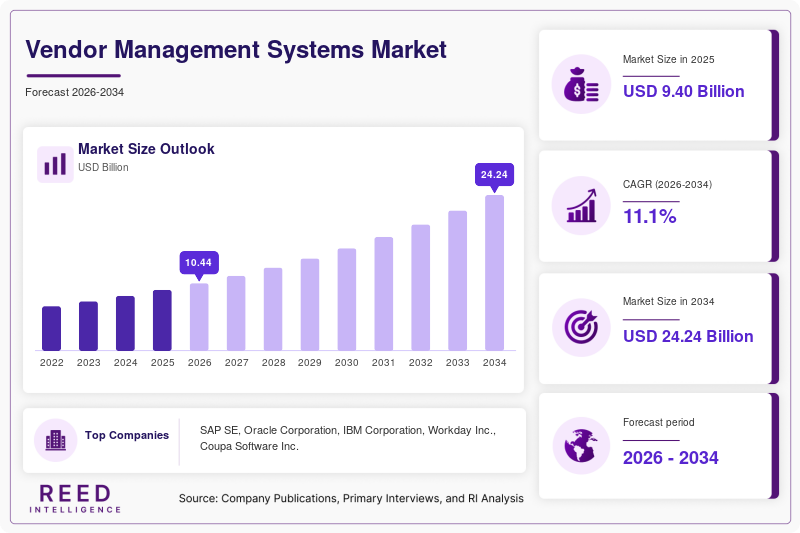
The global Vendor Management Systems Market size was valued at approximately USD 9.4 billion in 2026 and is projected to reach nearly USD 21.8 billion by 2034, expanding at a compound annual growth rate (CAGR) of 11.1% during the forecast period from 2026 to 2034. Vendor management systems are increasingly becoming essential for enterprises seeking to streamline supplier onboarding, contract administration, procurement workflows, workforce management, and compliance monitoring across global supply chains. Organizations across manufacturing, healthcare, retail, banking, and technology sectors are integrating cloud-based vendor management platforms to improve operational transparency and reduce procurement inefficiencies.
The growing shift toward digital procurement ecosystems has emerged as a major factor supporting market expansion. Businesses are managing larger supplier networks due to globalization and diversified sourcing strategies, creating demand for centralized systems that can automate vendor qualification, performance evaluation, invoicing, and risk analysis. The rapid adoption of artificial intelligence, predictive analytics, and robotic process automation within vendor management platforms is also improving workflow accuracy and reducing manual administrative burdens. In addition, regulatory compliance requirements related to data security, environmental standards, and supplier accountability are encouraging enterprises to invest in integrated vendor governance solutions.
Key Highlights
- North America dominated the market with a 36.4% share in 2025, while Asia Pacific is expected to grow at the fastest CAGR of 12.8% during 2026–2034.
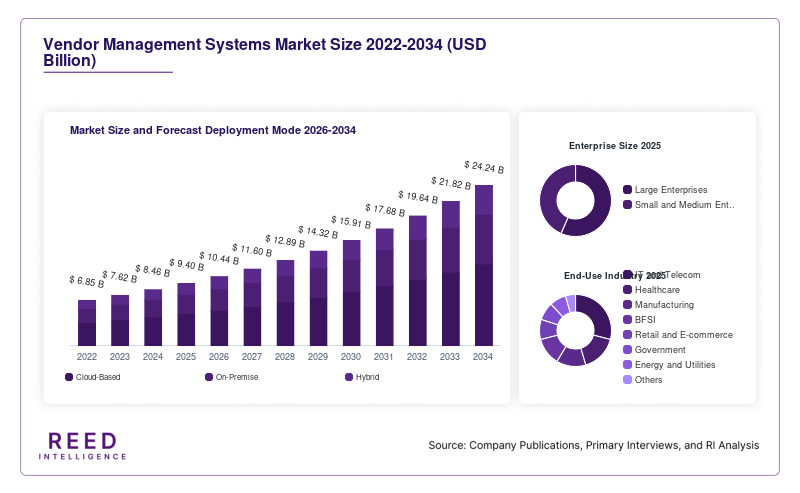
- By deployment mode, cloud-based solutions accounted for the largest share of 63.7%, while hybrid deployment models are projected to grow at a CAGR of 13.2%.
- By enterprise size, large enterprises led with a 58.9% share, whereas small and medium enterprises are expected to expand at a CAGR of 12.6%.
- By end-use industry, IT and telecom held a 27.4% share, while healthcare is anticipated to grow at a CAGR of 13.5% during the forecast period.
- The United States remained the dominant country, with market values of USD 2.4 billion in 2024 and USD 2.7 billion in 2025.
Market Trends
AI-Driven Vendor Analytics Becoming Central to Procurement Strategies
Enterprises are increasingly integrating artificial intelligence and advanced analytics into vendor management systems to improve procurement visibility and supplier decision-making. Modern platforms can evaluate vendor performance using real-time metrics related to pricing consistency, delivery timelines, contract compliance, sustainability scores, and operational reliability. Predictive analytics tools are also helping organizations identify supply chain risks before disruptions occur, allowing procurement teams to optimize sourcing decisions more effectively. AI-powered automation reduces repetitive administrative work, including invoice processing, supplier verification, and document management, which improves efficiency across procurement operations.
Large organizations operating across multiple countries are especially investing in intelligent vendor management solutions because they require scalable systems capable of managing thousands of supplier relationships simultaneously. The integration of machine learning algorithms with procurement platforms is also enabling companies to detect fraud patterns and non-compliance risks more accurately. As enterprises continue to prioritize data-driven procurement practices, software vendors are focusing on predictive dashboards, automated vendor scoring, and smart contract analysis features.
Expansion of Cloud-Based Vendor Management Platforms Across Mid-Sized Enterprises
Cloud deployment continues to reshape the Vendor Management Systems Market as organizations seek flexible and cost-efficient procurement technologies. Mid-sized enterprises are increasingly adopting software-as-a-service vendor management platforms because these solutions eliminate the need for high upfront infrastructure investments. Cloud-based systems provide remote accessibility, rapid scalability, automated software updates, and easier integration with enterprise resource planning platforms. These advantages are supporting broader adoption among companies with distributed procurement teams and geographically diversified suppliers.
Businesses are also prioritizing cloud-based vendor management systems to support hybrid work environments and global sourcing strategies. The growing use of mobile procurement applications and collaborative supplier portals is improving communication between enterprises and vendors in real time. Vendors in the market are responding by introducing modular cloud platforms with subscription pricing models tailored for industry-specific procurement needs. The increasing availability of cybersecurity-enhanced cloud infrastructure is further strengthening confidence among enterprises deploying cloud-native procurement ecosystems.
Market Drivers
Increasing Need for Supplier Risk and Compliance Management
Organizations are facing increasing pressure to maintain regulatory compliance and manage supplier-related risks effectively, which is significantly driving demand for vendor management systems. Companies operating in sectors such as healthcare, banking, manufacturing, and energy are required to monitor vendor certifications, data privacy standards, cybersecurity protocols, and sustainability commitments continuously. Traditional spreadsheet-based supplier management methods are becoming inefficient for handling large vendor ecosystems, leading enterprises to adopt automated compliance tracking platforms.
Vendor management systems help organizations centralize supplier information, monitor contract obligations, and generate audit-ready compliance reports. Businesses are also using these platforms to assess geopolitical risks, supplier financial stability, and environmental performance indicators. The rising frequency of supply chain disruptions and third-party cybersecurity incidents has further increased enterprise investment in proactive vendor risk monitoring solutions. As regulatory frameworks continue to evolve globally, companies are expected to rely more heavily on integrated vendor governance technologies.
Rising Digital Transformation Investments Across Procurement Operations
Digital transformation initiatives across procurement and supply chain departments are contributing significantly to the growth of the Vendor Management Systems Market. Enterprises are modernizing procurement operations to improve efficiency, reduce operational costs, and enhance supplier collaboration. Vendor management systems are increasingly integrated with enterprise resource planning software, procurement analytics platforms, and workforce management tools to create unified digital procurement ecosystems.
The expansion of remote work environments and global sourcing operations has also accelerated demand for automated procurement workflows. Organizations are prioritizing technologies that simplify vendor onboarding, electronic invoicing, contract lifecycle management, and purchase order tracking. Advanced vendor management systems improve transparency and enable real-time communication between suppliers and procurement teams. Governments and large corporations are additionally investing in digital procurement infrastructure to reduce manual paperwork and improve accountability. These modernization efforts are expected to sustain long-term market expansion across developed and emerging economies.
Market Restraint
Integration Complexity and Data Security Concerns Limiting Adoption
Despite strong market growth, integration complexity and cybersecurity concerns continue to restrain broader adoption of vendor management systems across several industries. Many enterprises still operate with legacy procurement infrastructure that lacks compatibility with modern cloud-based vendor management platforms. Integrating vendor management software with enterprise resource planning systems, accounting software, supplier databases, and human resource management tools often requires significant technical expertise, implementation time, and financial investment.
Data privacy concerns are another major challenge affecting procurement technology deployment. Vendor management platforms store sensitive supplier information, financial records, contracts, and compliance documentation, making them attractive targets for cyberattacks. Enterprises handling confidential procurement data are cautious about migrating systems to cloud environments due to fears related to unauthorized access and regulatory penalties. Small businesses in particular may delay implementation because of budget constraints associated with cybersecurity upgrades and software customization requirements. In industries with highly regulated procurement processes, lengthy deployment cycles and complex integration procedures can slow digital transformation initiatives and limit short-term market growth potential.
Market Opportunities
Growing Adoption Across Healthcare and Life Sciences Industries
The healthcare and life sciences sectors are creating substantial growth opportunities for vendor management system providers. Hospitals, pharmaceutical companies, diagnostic laboratories, and medical device manufacturers manage extensive supplier networks that require strict compliance monitoring and procurement transparency. Vendor management systems help healthcare organizations track supplier certifications, monitor quality standards, and maintain regulatory compliance related to patient safety and medical procurement processes.
The increasing digitization of healthcare operations is encouraging organizations to modernize supplier relationship management and procurement workflows. Healthcare providers are also using vendor management platforms to optimize inventory procurement and reduce operational delays caused by fragmented supplier coordination. Pharmaceutical companies involved in global clinical trials require centralized systems capable of managing international supplier relationships efficiently. As healthcare infrastructure investments continue to expand in emerging economies, demand for automated vendor management technologies is expected to increase significantly.
Expansion of Managed Services and Contingent Workforce Solutions
The rapid growth of contingent workforce management and managed service procurement is generating new opportunities within the Vendor Management Systems Market. Enterprises increasingly rely on contract workers, freelancers, consultants, and third-party service providers to improve workforce flexibility and reduce labor costs. Vendor management systems help organizations manage staffing vendors, automate contractor onboarding, monitor timesheets, and ensure labor compliance across distributed operations.
Industries such as information technology, telecommunications, logistics, and business process outsourcing are adopting workforce-focused vendor management solutions at a growing pace. Enterprises are also integrating workforce analytics tools into procurement platforms to improve labor cost forecasting and workforce utilization strategies. The rising popularity of hybrid work models is increasing demand for digital systems capable of managing geographically dispersed service providers efficiently. Software vendors are responding by introducing specialized modules designed for contingent workforce administration and managed service procurement.
Segmental Analysis
By Deployment Mode
Cloud-based vendor management systems accounted for the largest share of approximately 63.7% in 2024 due to their scalability, lower implementation costs, and remote accessibility benefits. Enterprises increasingly prefer cloud deployment because it enables procurement teams to access supplier information and contract databases from multiple locations in real time. Cloud platforms also simplify software updates and reduce internal information technology maintenance requirements. Large organizations with global supplier ecosystems are particularly adopting cloud-based procurement solutions to improve collaboration across geographically dispersed teams. Integration capabilities with enterprise resource planning systems and customer relationship management software are also contributing to widespread adoption. Additionally, subscription-based pricing models make cloud deployment more attractive for organizations seeking cost-efficient procurement modernization.
Hybrid deployment models are expected to register the fastest CAGR of 13.2% during the forecast period due to rising concerns regarding data security and regulatory compliance. Many enterprises prefer hybrid systems because they allow sensitive procurement data to remain within on-premise infrastructure while still benefiting from cloud-based analytics and remote accessibility features. Industries such as banking, healthcare, and government sectors are increasingly implementing hybrid vendor management systems to balance operational flexibility with strict compliance requirements. The growing complexity of enterprise procurement ecosystems is also driving demand for customizable deployment strategies. Vendors are introducing hybrid architectures capable of integrating legacy systems with advanced cloud applications, which is further supporting adoption among large multinational organizations.
By Enterprise Size
Large enterprises held the dominant market share of nearly 58.9% in 2024 due to their extensive supplier networks and high procurement transaction volumes. Multinational corporations operating across manufacturing, healthcare, technology, and retail sectors require sophisticated vendor management systems capable of handling contract administration, supplier risk analysis, and workforce management functions simultaneously. These organizations invest significantly in procurement automation to improve efficiency, maintain compliance standards, and reduce operational costs. Large enterprises are also more likely to deploy integrated procurement ecosystems connected with financial management and analytics platforms. The increasing focus on global supplier visibility and supply chain resilience is encouraging major corporations to adopt advanced vendor governance technologies with artificial intelligence and predictive analytics capabilities.
Small and medium-sized enterprises are projected to witness the fastest CAGR of 12.6% throughout the forecast period. The growing availability of affordable cloud-based vendor management software is enabling smaller businesses to adopt digital procurement technologies without significant infrastructure investments. SMEs are increasingly recognizing the importance of automated supplier onboarding, contract tracking, and procurement transparency to remain competitive in rapidly evolving markets. The expansion of subscription-based software pricing models and simplified implementation processes is further supporting adoption among resource-constrained organizations. Additionally, governments and financial institutions are promoting digital business transformation initiatives that encourage SMEs to modernize procurement operations and improve operational efficiency through cloud-native vendor management platforms.
By End-Use Industry
The IT and telecom sector accounted for the largest market share of approximately 27.4% in 2024 due to its heavy reliance on outsourced services, contract workers, and global supplier ecosystems. Technology companies manage extensive vendor relationships related to software development, hardware procurement, cybersecurity services, and cloud infrastructure management. Vendor management systems help these organizations centralize supplier data, automate contract administration, and monitor service-level agreements effectively. The growing adoption of managed services and contingent workforce models within the technology sector is further increasing demand for procurement automation solutions. Telecom operators are also implementing vendor management platforms to improve procurement efficiency across network infrastructure expansion projects and equipment sourcing operations.
Healthcare is anticipated to emerge as the fastest-growing end-use industry with a CAGR of 13.5% during the forecast period. Hospitals, pharmaceutical manufacturers, and medical device companies are increasingly investing in vendor management technologies to improve procurement transparency and maintain strict regulatory compliance. Healthcare organizations manage highly specialized supplier ecosystems involving medical equipment providers, pharmaceutical distributors, laboratory service vendors, and logistics partners. Vendor management systems support automated supplier qualification, contract tracking, and compliance monitoring related to patient safety standards. The growing digitization of healthcare infrastructure and increasing investments in telemedicine and medical supply chain modernization are expected to accelerate adoption of procurement automation platforms across the healthcare industry.
Regional Analysis
North America
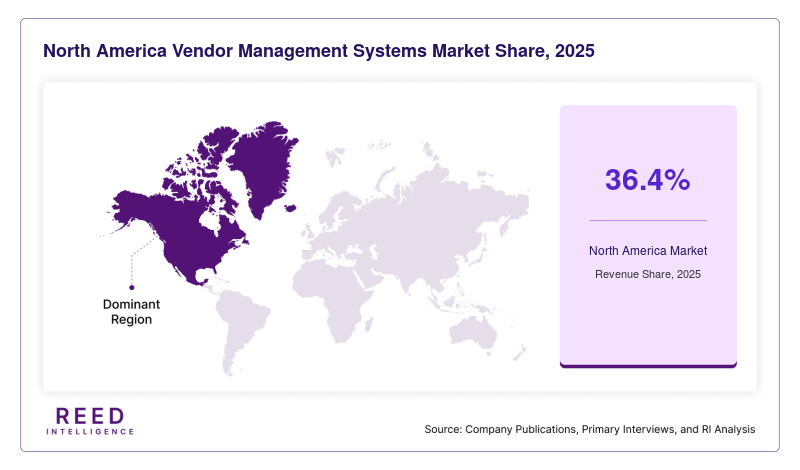
North America accounted for approximately 36.4% of the global Vendor Management Systems Market in 2025 and continues to maintain a strong position due to early technology adoption and widespread digital procurement transformation. The regional market is projected to expand at a CAGR of 10.2% during the forecast period. Enterprises across the United States and Canada are investing heavily in cloud procurement infrastructure, supplier analytics, and automated compliance management systems. The presence of large multinational corporations with extensive supplier networks is also supporting regional market growth.
The United States remains the dominant country within North America because of strong enterprise spending on procurement technologies and workforce management platforms. Large healthcare providers, financial institutions, and technology firms are increasingly deploying AI-enabled vendor management systems to improve operational visibility and supplier accountability. Another important growth factor is the increasing emphasis on third-party risk management, particularly related to cybersecurity and data protection regulations. Businesses are integrating vendor governance tools with broader enterprise risk management frameworks to strengthen compliance monitoring.
Europe
Europe represented nearly 27.1% of the global market in 2025 and is expected to grow at a CAGR of 9.6% through 2034. The region is witnessing steady adoption of vendor management systems due to strict regulatory frameworks governing procurement transparency, environmental compliance, and supplier accountability. Organizations across Germany, France, the United Kingdom, and the Nordic countries are modernizing procurement operations through digital platforms that support automated contract management and supplier performance tracking.
Germany remains the leading country in the European market due to its strong industrial base and advanced manufacturing ecosystem. Automotive manufacturers, engineering firms, and industrial equipment producers rely heavily on integrated vendor management systems to coordinate large supplier networks efficiently. An important regional growth factor is the increasing focus on sustainable procurement practices and environmental, social, and governance compliance. European enterprises are using vendor management platforms to monitor supplier sustainability metrics and ensure alignment with evolving corporate responsibility regulations.
Asia Pacific
Asia Pacific held approximately 22.5% of the Vendor Management Systems Market in 2025 and is anticipated to record the fastest CAGR of 12.8% during the forecast period. Rapid industrialization, digital transformation investments, and expanding cloud infrastructure are contributing significantly to regional market expansion. Countries such as China, India, Japan, South Korea, and Singapore are witnessing increased demand for automated procurement solutions across manufacturing, retail, healthcare, and information technology sectors.
China continues to dominate the regional market because of large-scale manufacturing activities and the presence of extensive supplier ecosystems. Enterprises are increasingly investing in centralized vendor management technologies to improve procurement transparency and reduce operational inefficiencies across complex supply chains. Another major growth factor is the rapid expansion of small and medium-sized enterprises adopting cloud-based software solutions. Government initiatives supporting digital business transformation and smart manufacturing are also encouraging organizations to modernize procurement infrastructure.
Middle East & Africa
The Middle East & Africa region accounted for nearly 7.2% of the global market in 2025 and is expected to grow at a CAGR of 9.1% between 2026 and 2034. Enterprises across the Gulf Cooperation Council countries and South Africa are increasingly adopting digital procurement platforms to improve supplier coordination and operational efficiency. Large infrastructure development projects, expanding healthcare investments, and public sector digitalization initiatives are contributing to growing demand for vendor management technologies.
Saudi Arabia remains the dominant country within the regional market due to ongoing economic diversification programs and large-scale smart city developments. Organizations in sectors such as oil and gas, construction, and logistics are deploying vendor management systems to manage supplier contracts and monitor procurement compliance more effectively. A unique growth factor supporting the market is the increasing implementation of government-led digital transformation strategies that encourage enterprises to adopt cloud-based enterprise software solutions and automated procurement systems.
Latin America
Latin America captured around 6.8% of the global Vendor Management Systems Market in 2025 and is projected to grow at a CAGR of 8.7% during the forecast period. The regional market is benefiting from growing enterprise awareness regarding procurement automation and supplier risk management. Organizations across Brazil, Mexico, Chile, and Colombia are gradually shifting from manual procurement processes toward integrated digital vendor management platforms.
Brazil dominates the Latin American market due to its large industrial sector and increasing investments in enterprise software modernization. Companies operating in retail, manufacturing, and banking industries are adopting vendor management systems to streamline procurement workflows and improve supplier performance evaluation. An important growth factor in the region is the increasing expansion of cloud computing infrastructure and internet connectivity. As more businesses transition toward digital operations, adoption of scalable cloud-based procurement solutions is expected to accelerate steadily.
Competitive Landscape
The Vendor Management Systems Market is moderately competitive, with global technology providers focusing on cloud innovation, procurement analytics, and artificial intelligence integration to strengthen their market presence. Leading companies are expanding product portfolios through strategic acquisitions, partnerships, and platform enhancements designed to improve supplier collaboration and workforce management capabilities. Vendors are also investing in cybersecurity features and industry-specific procurement modules to address growing enterprise concerns regarding compliance and data protection.
SAP SE remains one of the leading companies in the market due to its broad enterprise software ecosystem and extensive global customer base. The company recently introduced enhanced AI-driven procurement analytics capabilities within its vendor management portfolio to improve supplier risk assessment and contract visibility. Other major companies such as Oracle Corporation, Workday Inc., Coupa Software, and IBM Corporation are focusing on cloud-native procurement platforms and automation technologies to expand enterprise adoption.
Key Players
- SAP SE
- Oracle Corporation
- IBM Corporation
- Workday Inc.
- Coupa Software Inc.
- GEP Worldwide
- Jaggaer
- Beeline Inc.
- ADP LLC
- Infor Inc.
- ServiceNow Inc.
- Zycus Inc.
- Ivalua Inc.
- Basware Corporation
- Gatekeeper Holdings Ltd.
Recent Developments
- In February 2026, SAP SE launched an upgraded vendor intelligence module featuring predictive supplier risk analytics and automated compliance scoring capabilities for multinational enterprises.
- In September 2025, Coupa Software announced a strategic partnership with a global cybersecurity provider to enhance third-party risk monitoring within its cloud procurement platform.
- In June 2025, Workday Inc. expanded its contingent workforce management functionality through the integration of advanced contractor onboarding and time-tracking automation tools.
- In January 2026, Oracle Corporation introduced new generative AI features within its procurement cloud platform to improve contract analysis and supplier communication workflows.
Vendor Management Systems Market Segments
Deployment Mode
- Cloud-Based
- On-Premise
- Hybrid
Enterprise Size
- Large Enterprises
- Small and Medium Enterprises
End-Use Industry
- IT and Telecom
- Healthcare
- Manufacturing
- BFSI
- Retail and E-commerce
- Government
- Energy and Utilities
- Others
By Region
- North America
- Europe
- APAC
- Middle East and Africa
- LATAM