Vermicompost Market Size, Share Demand Report By Type (Pure Vermicompost, Enriched Vermicompost), By Application (Agriculture, Horticulture, Landscaping, Home Gardening), By End-Use (Farmers, Commercial Users, Residential Users) By Region & Segment Forecasts, 2026–2034
USD 3950
Market Overview
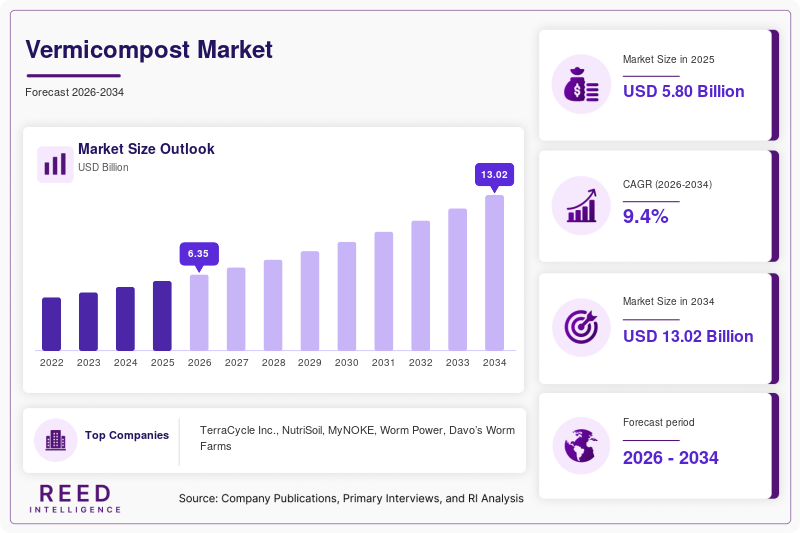
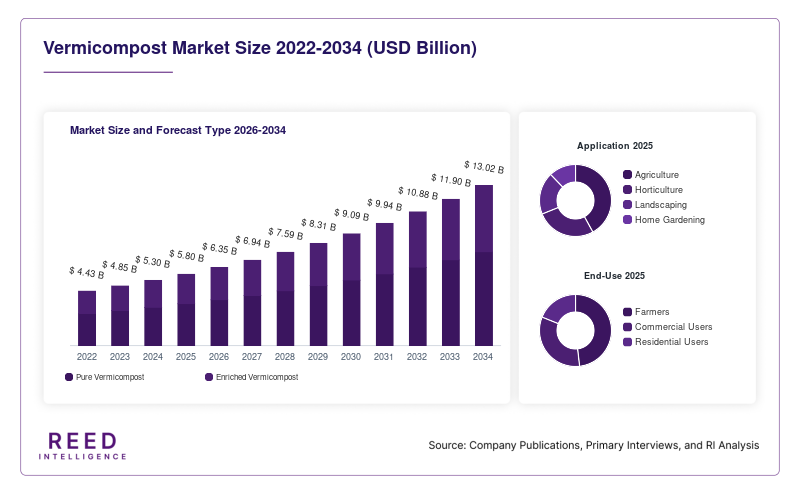
The global Vermicompost Market size was valued at approximately USD 5.8 billion in 2026 and is projected to reach around USD 11.9 billion by 2034, expanding at a CAGR of 9.4% during the forecast period (2026–2034). The market growth is primarily driven by the increasing global emphasis on sustainable agriculture and organic farming practices. Vermicompost, a nutrient-rich organic fertilizer produced through the decomposition of organic waste by earthworms, has gained traction as an environmentally friendly alternative to chemical fertilizers. Governments, agricultural institutions, and environmental organizations are actively promoting organic inputs to improve soil health and reduce environmental degradation.
A significant global factor supporting market growth is the rising demand for chemical-free food products. Consumers are increasingly aware of the adverse effects of synthetic fertilizers on health and ecosystems. This shift has encouraged farmers to adopt vermicompost as a natural soil enhancer, thereby boosting demand across agricultural and horticultural sectors. Additionally, favorable policies supporting waste recycling and circular economy practices further contribute to market expansion.
Key Highlights
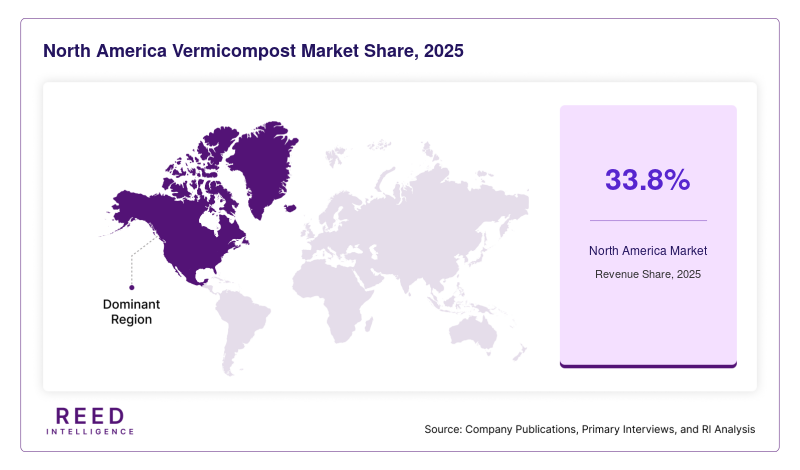
- North America dominated the market with a 33.8% share in 2025.
- Asia Pacific is expected to grow at the fastest CAGR of 10.8% during 2026–2034.
- By type, pure vermicompost accounted for the largest share of 46.2%.
- while enriched vermicompost is projected to grow at a CAGR of 10.6%.
- By application, agriculture led with a 52.5% share, whereas horticulture is expected to expand at a CAGR of 10.9%.
- India remained the dominant country, with market values of USD 640 million in 2024 and USD 705 million in 2025.
Market Trends
Rising adoption of organic farming practices
The increasing shift toward organic farming is shaping the Vermicompost Market significantly. Farmers across developed and developing economies are adopting vermicompost to improve soil fertility and crop yield without relying on synthetic inputs. Organic certification standards in regions such as Europe and North America encourage the use of natural fertilizers, which further supports market demand. Additionally, consumers are willing to pay premium prices for organically grown produce, creating a favorable environment for vermicompost producers. Governments are also offering subsidies and training programs to promote organic farming, which indirectly boosts the adoption of vermicompost. This trend is expected to continue as sustainability becomes a key priority in global agriculture systems.
Integration of waste management and composting solutions
Another notable trend is the integration of vermicomposting into municipal and industrial waste management systems. Organic waste from households, food processing units, and agricultural residues is increasingly being diverted to vermicomposting facilities. This approach helps reduce landfill waste while generating valuable compost. Urban local bodies are investing in decentralized composting systems to manage biodegradable waste efficiently. Furthermore, private companies are entering the market with innovative composting technologies and large-scale vermicompost production units. This integration not only supports environmental sustainability but also creates new revenue streams, contributing to the overall growth of the Vermicompost Market.
Market Drivers
Growing demand for sustainable agriculture inputs
The rising demand for sustainable agricultural inputs is a major driver of the Vermicompost Market. Farmers are increasingly seeking eco-friendly alternatives to chemical fertilizers due to concerns about soil degradation and declining crop productivity. Vermicompost enhances soil structure, improves water retention, and provides essential nutrients, making it an attractive option for farmers. Additionally, the long-term benefits of vermicompost, such as improved soil microbial activity, contribute to its widespread adoption. Agricultural extension programs and awareness campaigns are educating farmers about these benefits, further driving market growth. As global food demand continues to rise, sustainable farming practices will remain a key focus area, supporting the expansion of the vermicompost industry.
Government initiatives and subsidies for organic inputs
Government support plays a crucial role in driving the Vermicompost Market. Many countries have introduced policies and subsidies to promote organic farming and reduce dependence on chemical fertilizers. Financial incentives, training programs, and technical assistance are being provided to farmers to adopt vermicomposting techniques. In addition, regulations aimed at reducing chemical fertilizer usage are encouraging the shift toward organic alternatives. For instance, several governments are implementing programs to convert agricultural waste into compost, thereby supporting both waste management and soil health initiatives. These supportive policies create a conducive environment for market growth and encourage investments in vermicompost production facilities.
Market Restraint
Limited awareness and inconsistent product quality
Despite the growing popularity of vermicompost, limited awareness among small-scale farmers and inconsistent product quality act as significant restraints. In many rural areas, farmers lack access to proper training and information about vermicomposting techniques. This results in low adoption rates and inefficient production practices. Additionally, the absence of standardized quality parameters leads to variations in nutrient content, which affects product reliability. Farmers may hesitate to switch from chemical fertilizers due to uncertainty about the effectiveness of vermicompost. For example, improperly processed compost may contain pathogens or insufficient nutrients, reducing its appeal. Addressing these challenges requires investment in education, certification systems, and quality control measures to ensure consistent product performance and build trust among end users.
Market Opportunities
Expansion of urban farming and home gardening
The increasing popularity of urban farming and home gardening presents a significant opportunity for the Vermicompost Market. Urban consumers are actively engaging in small-scale gardening activities, including rooftop farming and balcony gardening. Vermicompost is widely preferred in these applications due to its organic nature and ease of use. Retail packaging and ready-to-use compost products are gaining traction in urban markets. E-commerce platforms are also facilitating the distribution of vermicompost products to individual consumers. This trend is expected to drive demand in residential segments, creating new growth avenues for manufacturers and suppliers.
Technological advancements in vermicomposting systems
Technological advancements in vermicomposting systems offer another promising opportunity for market growth. Innovations such as automated composting units, temperature-controlled systems, and large-scale industrial vermicomposting facilities are improving production efficiency. These technologies enable consistent quality and reduce labor requirements, making vermicomposting more accessible to commercial producers. Additionally, research and development activities are focusing on enhancing nutrient content and optimizing composting processes. The adoption of advanced technologies is expected to attract investments and expand production capacities, thereby supporting the overall growth of the Vermicompost Market.
Segmental Analysis
By Type
Pure vermicompost dominated the market in 2024, accounting for a share of 46.2%. This segment is widely preferred due to its natural composition and high nutrient content. Farmers use pure vermicompost to improve soil fertility and enhance crop yield. Its ability to retain moisture and support microbial activity makes it a valuable input in agriculture. Additionally, the growing demand for organic products has increased the adoption of pure vermicompost. The segment benefits from its ease of production and widespread availability, making it a cost-effective solution for farmers.
Enriched vermicompost is expected to be the fastest-growing subsegment, with a CAGR of 10.6% during the forecast period. This type of compost is fortified with additional nutrients and beneficial microorganisms, enhancing its effectiveness. The increasing demand for high-performance organic fertilizers is driving the growth of this segment. Farmers are willing to invest in enriched products to achieve better crop yields and improved soil health. Technological advancements in composting processes further support the growth of this segment.
By Application
Agriculture held the largest share of 52.5% in 2024, driven by the extensive use of vermicompost in crop production. Farmers rely on vermicompost to improve soil structure, enhance nutrient availability, and increase crop yield. The growing demand for organic food products has further boosted the adoption of vermicompost in agriculture. Additionally, government initiatives promoting sustainable farming practices contribute to the growth of this segment.
Horticulture is projected to grow at the fastest CAGR of 10.9% during the forecast period. The increasing demand for ornamental plants, fruits, and vegetables is driving the use of vermicompost in horticulture. Its ability to improve soil aeration and support plant growth makes it a preferred choice for gardeners and landscapers. The rise in urban gardening and landscaping activities further supports the growth of this segment.
By End-Use
Farmers represented the dominant end-use segment in 2024, accounting for a significant share of the Vermicompost Market. The widespread use of vermicompost in agriculture is the primary factor driving this segment. Farmers are increasingly adopting organic fertilizers to improve soil health and meet consumer demand for chemical-free produce. The availability of government subsidies and training programs further supports the adoption of vermicompost among farmers.
Commercial users, including landscaping companies and horticulture businesses, are expected to grow at the fastest CAGR of 10.7%. The increasing demand for organic soil conditioners in landscaping and gardening applications is driving this segment. Commercial users prefer vermicompost due to its effectiveness and environmental benefits. The growth of urban landscaping projects and green infrastructure initiatives further contributes to the expansion of this segment.
Regional Analysis
North America
North America held a market share of 33.8% in 2025 and is expected to grow at a CAGR of 8.7% during the forecast period. The region’s growth is driven by the increasing adoption of organic farming and sustainable agricultural practices. Farmers are shifting toward environmentally friendly inputs to comply with regulatory standards and meet consumer demand for organic products. The presence of well-established distribution networks and advanced agricultural infrastructure further supports market growth.
The United States dominates the regional market due to its strong focus on organic food production and waste management initiatives. A unique growth factor in the country is the integration of vermicomposting into municipal waste programs. Several cities are implementing composting systems to manage organic waste efficiently, creating a steady demand for vermicompost products.
Europe
Europe accounted for a significant share of the Vermicompost Market in 2025 and is projected to grow at a CAGR of 9.1% during the forecast period. The region’s strict environmental regulations and emphasis on sustainable agriculture are key factors driving market growth. Organic farming is widely practiced, and the use of natural fertilizers is strongly encouraged.
Germany leads the European market, supported by its advanced agricultural sector and strong environmental policies. A unique growth factor is the country’s focus on circular economy practices, where organic waste is recycled into compost. This approach not only reduces waste but also supports sustainable farming practices.
Asia Pacific
Asia Pacific is expected to witness the fastest growth, with a CAGR of 10.8% during 2026–2034. The region’s large agricultural base and increasing awareness of organic farming are major growth drivers. Governments are promoting sustainable farming practices through subsidies and training programs, which further boost market demand.
India dominates the Asia Pacific market due to its extensive agricultural activities and growing organic farming sector. A unique growth factor is the widespread adoption of vermicomposting among small and marginal farmers. Government initiatives promoting organic inputs and waste management contribute significantly to market expansion.
Middle East & Africa
The Middle East & Africa region is experiencing steady growth in the Vermicompost Market, with a projected CAGR of 8.3%. The region’s focus on improving soil fertility and agricultural productivity is driving demand for organic fertilizers. Limited arable land and water scarcity make sustainable farming practices essential.
South Africa leads the regional market, supported by its developing agricultural sector. A unique growth factor is the increasing adoption of vermicompost in horticulture and landscaping applications. The demand for organic soil conditioners in urban landscaping projects is contributing to market growth.
Latin America
Latin America is expected to grow at a CAGR of 8.9% during the forecast period. The region’s favorable climate and large agricultural sector create a strong demand for organic fertilizers. Farmers are increasingly adopting vermicompost to improve crop yield and soil health.
Brazil dominates the Latin American market due to its extensive agricultural activities. A unique growth factor is the growing export demand for organic produce. Farmers are adopting vermicompost to meet international standards, which supports market growth in the region.
Competitive Landscape
The Vermicompost Market is moderately fragmented, with several regional and global players competing based on product quality, pricing, and distribution networks. Leading companies are focusing on expanding their production capacities and investing in research and development to enhance product quality. Strategic partnerships and collaborations are also common, enabling companies to strengthen their market presence.
A leading player in the market is TerraCycle Inc., which has established a strong presence through its innovative waste management solutions. The company recently expanded its vermicomposting operations to cater to the growing demand for organic fertilizers. Other key players are focusing on developing enriched vermicompost products and adopting advanced composting technologies. The competitive landscape is characterized by continuous innovation and increasing investments in sustainable agriculture solutions.
Key Players
- TerraCycle Inc.
- NutriSoil
- MyNOKE
- Worm Power
- Davo’s Worm Farms
- Agrilife Vermicompost
- Sri Gayathri Biotec
- Saosis Vermiculture Farm
- Dirt Dynasty
- Earthworm Technologies
- BioCycle
- VermiCo
- Green Grower
- Organic Farming Solutions
- AgroGreen Compost
Recent Developments
- TerraCycle Inc. expanded its vermicomposting facilities in North America to increase production capacity.
- Worm Power introduced a new line of enriched vermicompost products targeting commercial agriculture.
- NutriSoil partnered with agricultural organizations to promote sustainable farming practices through vermicompost adoption.
Vermicompost Market Segments
Type
- Pure Vermicompost
- Enriched Vermicompost
Application
- Agriculture
- Horticulture
- Landscaping
- Home Gardening
End-Use
- Farmers
- Commercial Users
- Residential Users
By Region
- North America
- Europe
- APAC
- Middle East and Africa
- LATAM