Very Light Jet Market Size, Share, Growth Demand Report by End-Use (Private Ownership, Charter Services, Corporate Fleet, Air Taxi Services), By Application (Business Travel, Leisure Travel, Medical Evacuation), By Range (Up to 1000 Nautical Miles, 1000–1500 Nautical Miles, Above 1500 Nautical Miles), By Propulsion Type (Single-Engine VLJ, Twin-Engine VLJ), By Region & Segment Forecasts, 2026–2034
USD 3950
Market Overview
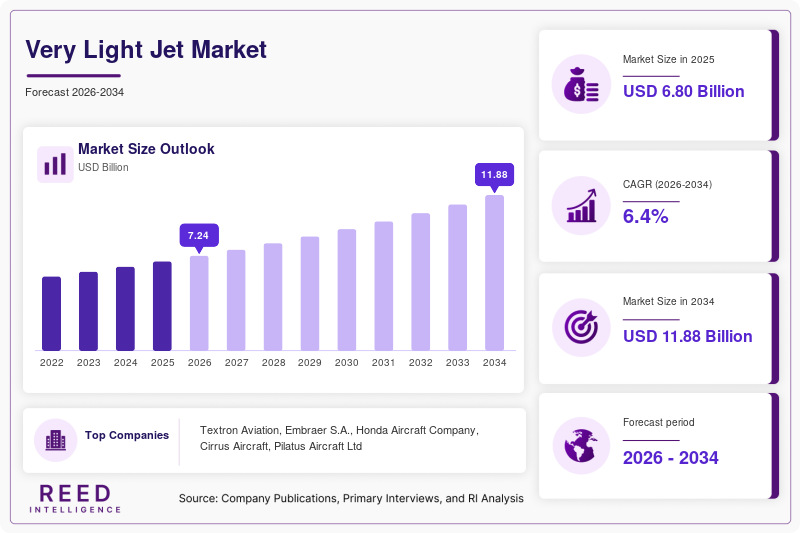
The Very Light Jet Market Sizewas valued at approximately USD 6.8 billion in 2026 and is projected to reach USD 11.2 billion by 2034, expanding at a CAGR of 6.4% during the forecast period (2026–2034). The market growth is primarily driven by the rising adoption of cost-efficient business aviation solutions, increasing demand for on-demand air mobility, and expanding corporate travel requirements across emerging economies.
A key global factor supporting the Very Light Jet Market size expansion is the rapid recovery and structural transformation of business aviation post-pandemic, which has shifted preference toward flexible, point-to-point private air travel solutions. Increasing congestion in commercial aviation hubs has further strengthened demand for VLJs as a time-efficient alternative for short-to-medium haul travel.
Key Highlights
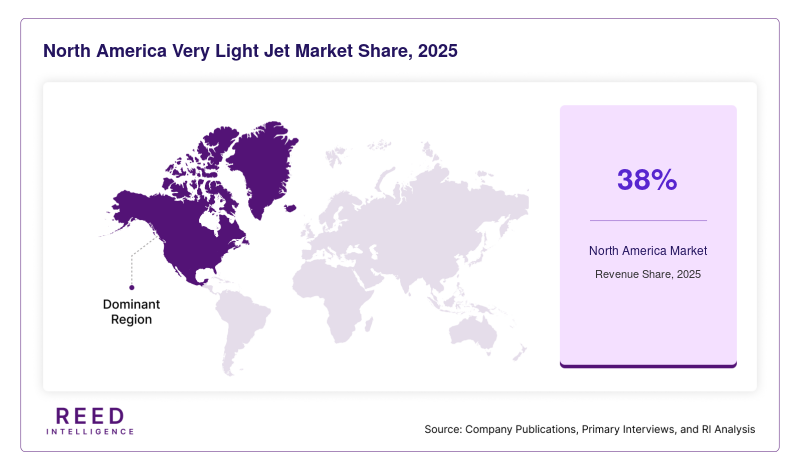
- Dominant Region (2025): North America held 38% share, supported by strong business aviation infrastructure and high private ownership rates.
- Fastest-Growing Region: Asia Pacific is projected to grow at a CAGR of 7.8% (2026–2034) due to rising ultra-high-net-worth individuals (UHNWIs) and expanding charter aviation networks.
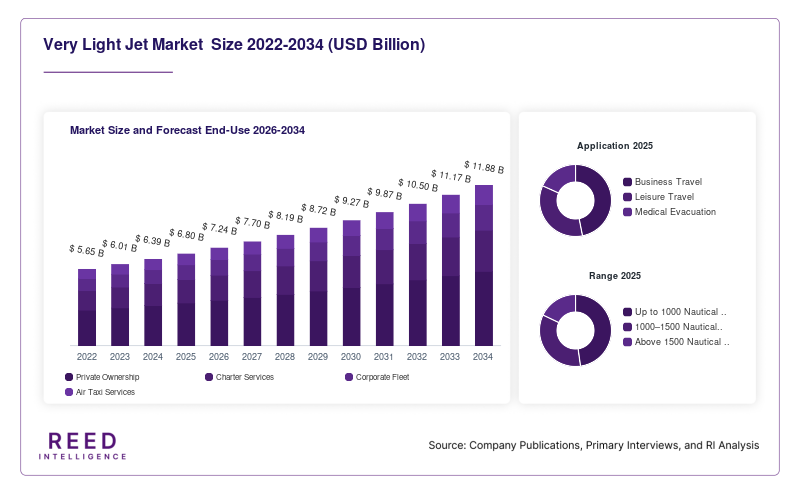
- Leading Subsegment (End-Use): Private ownership dominated with 46% share in 2025.
- Fastest-Growing Subsegment (End-Use): Air taxi/on-demand aviation is expected to grow at a CAGR of 8.3%, driven by urban air mobility integration.
- Dominant Country (2024): United States valued at USD 2.1 billion.
- Dominant Country (2025): United States increased to USD 2.3 billion, driven by fleet modernization and corporate travel demand.
Market Trends
Expansion of On-Demand Air Mobility Ecosystem
The Very Light Jet Market is increasingly influenced by the emergence of on-demand aviation platforms and digital charter aggregation services. These platforms allow users to book VLJs for short-duration travel with reduced lead time. Integration of mobile-based booking systems and AI-driven fleet optimization is enhancing aircraft utilization rates, making VLJs more commercially viable for operators. This trend is expected to significantly reshape fleet deployment models across urban corridors.
Adoption of Lightweight Materials and Fuel Efficiency Technologies
Manufacturers in the Very Light Jet Market are focusing on advanced composite materials, aerodynamic optimization, and fuel-efficient propulsion systems. The integration of carbon fiber structures and next-generation avionics is reducing overall aircraft weight and operational costs. Additionally, increasing interest in sustainable aviation fuel (SAF) is encouraging OEMs to design VLJs compatible with low-emission operations, aligning with global decarbonization goals.
Market Drivers
Rising Demand for Time-Efficient Business Aviation
The expansion of multinational corporations and SME globalization has significantly increased demand for flexible air travel solutions. The Very Light Jet Market benefits from the ability of VLJs to operate from shorter runways, enabling direct access to regional airports. This reduces overall travel time and enhances productivity for business travelers, supporting consistent market demand growth.
Growth of Fractional Ownership and Charter Services
Fractional ownership programs and charter aviation models are making VLJs more accessible to a wider customer base. Instead of full aircraft ownership, users can now access jets through shared ownership or subscription-based models. This shift is increasing aircraft utilization rates and expanding the customer base of the Very Light Jet Market, particularly among high-net-worth individuals and small enterprises.
Market Restraint
High Acquisition and Operational Costs
Despite their classification as cost-efficient jets, VLJs still involve substantial acquisition and maintenance expenses. Costs related to pilot training, maintenance infrastructure, insurance, and fuel significantly restrict adoption among mid-income business operators. Additionally, strict regulatory compliance requirements and airspace management restrictions further challenge market expansion, especially in developing regions.
Market Opportunities
Integration with Urban Air Mobility Networks
The evolution of urban air mobility (UAM) presents a significant opportunity for the Very Light Jet Market. VLJs are increasingly being considered for integration into regional air taxi ecosystems, connecting suburban and secondary cities. This integration is expected to unlock new revenue streams for operators through short-distance, high-frequency flights.
Expansion in Emerging Aviation Markets
Rapid economic development in Asia Pacific, the Middle East, and parts of Latin America is generating strong demand for business aviation. Increasing infrastructure investments in regional airports and aviation hubs are enabling better VLJ adoption. Rising disposable income and corporate expansion are further accelerating fleet acquisitions in these regions.
Segmental Analysis
By End-Use
The Very Light Jet Market is segmented into private ownership, charter services, corporate fleet, and air taxi operations.
Private ownership dominated with 46% share in 2025, driven by high-net-worth individuals and corporate executives preferring dedicated aircraft access.
Charter services are expected to grow at a CAGR of 7.2%, supported by increasing preference for pay-per-use aviation models and reduced ownership burden.
By Application
Applications include business travel, leisure travel, and medical evacuation.
Business travel held the largest share at 52% in 2025, driven by corporate mobility demand.
Medical evacuation is projected to grow at a CAGR of 7.5%, supported by increasing demand for rapid emergency transport and air ambulance capabilities.
By Range
VLJs are categorized into up to 1000 nautical miles, 1000–1500 nautical miles, and above 1500 nautical miles.
Up to 1000 nautical miles accounted for 49% share in 2025, due to dominance in short-haul regional connectivity.
Above 1500 nautical miles is expected to grow at a CAGR of 7.0%, driven by advancements in fuel efficiency and extended range capabilities.
By Propulsion Type
The market includes single-engine and twin-engine VLJs.
Single-engine VLJs dominated with 57% share in 2025, owing to lower acquisition and operational costs.
Twin-engine VLJs are projected to grow at a CAGR of 6.8%, driven by safety preferences and enhanced performance requirements in corporate aviation.
Regional Analysis
North America
North America accounted for 38% share of the Very Light Jet Market in 2025 and is projected to grow at a CAGR of 6.1% (2026–2034). The region benefits from established aviation infrastructure, high private aircraft ownership, and strong presence of OEM manufacturers. The United States dominates regional growth due to extensive corporate aviation usage and fleet modernization initiatives.
Europe
Europe held 27% market share in 2025 and is expected to grow at a CAGR of 5.8% (2026–2034). Growth is driven by increasing demand for cross-border business travel within the EU and rising adoption of charter aviation services. Germany leads the region, supported by strong industrial and corporate aviation demand.
Asia Pacific
Asia Pacific accounted for 18% share in 2025 and is projected to expand at a CAGR of 7.8% (2026–2034). The region’s growth is driven by increasing UHNWIs, rapid urbanization, and expansion of aviation infrastructure. China leads the region due to growing corporate aviation demand and expanding private wealth base.
Middle East & Africa
Middle East & Africa represented 9% share in 2025 and is expected to grow at a CAGR of 6.9% (2026–2034). The region benefits from strong demand for luxury aviation services, especially in Gulf countries. The United Arab Emirates dominates due to its established private aviation hubs and tourism-driven business travel.
Latin America
Latin America held 8% share in 2025 and is forecasted to grow at a CAGR of 6.2% (2026–2034). Brazil leads the region due to vast geography requiring regional air connectivity and increasing corporate aviation usage. Economic diversification and infrastructure development are supporting steady adoption.
Competitive Landscape
The Very Light Jet Market is moderately consolidated, with leading manufacturers focusing on technological innovation, fleet expansion, and strategic partnerships.
Textron Aviation leads the market with its Citation series, supported by continuous upgrades in avionics and cabin efficiency. The company recently introduced enhanced digital cockpit integration across its VLJ portfolio to improve pilot interface and operational safety.
Embraer remains a key competitor with its Phenom 100EV platform, emphasizing performance efficiency and cabin comfort enhancements. Honda Aircraft Company continues to focus on aerodynamic innovation and composite fuselage structures.
Cirrus Aircraft has strengthened its position in owner-pilot VLJ segments through its Vision Jet platform, while Daher continues to expand its presence through customized aviation solutions for niche operators.
Key Players List
- Textron Aviation
- Embraer S.A.
- Honda Aircraft Company
- Cirrus Aircraft
- Pilatus Aircraft Ltd
- Daher
- Piper Aircraft Inc.
- Diamond Aircraft Industries
- Eclipse Aerospace
- Nextant Aerospace
- Aero Vodochody
- SyberJet Aircraft
- Stratos Aircraft
- Bombardier Aviation
- Airbus Corporate Jets
Recent Developments
- Textron Aviation expanded Citation VLJ production capacity to meet rising demand in North America.
- Embraer introduced avionics and cabin upgrades across its Phenom series.
- Honda Aircraft Company strengthened global service and support networks.
- Cirrus Aircraft integrated advanced autopilot systems into its Vision Jet platform.
- Charter operators expanded VLJ fleets in Asia Pacific to support rising demand.
- Sustainable aviation fuel trials increased across European VLJ fleets.
- Digital VLJ booking platforms expanded in the Middle East, improving accessibility.
Very Light Jet Market Segments
End-Use
- Private Ownership
- Charter Services
- Corporate Fleet
- Air Taxi Services
Application
- Business Travel
- Leisure Travel
- Medical Evacuation
Range
- Up to 1000 Nautical Miles
- 1000–1500 Nautical Miles
- Above 1500 Nautical Miles
Propulsion Type
- Single-Engine Very Light Jets
- Twin-Engine Very Light Jets
Region
- North America
- Europe
- Asia Pacific
- Middle East & Africa
- Latin America
By Region
- North America
- Europe
- APAC
- Middle East and Africa
- LATAM