Veterinary Glucometer Market Size, Share Demand Report By Product Type (Portable Glucometers, Benchtop Glucometers), By Animal Type (Canine, Feline, Equine, Livestock), Regional Insights & Segment Forecasts, 2026–2034
USD 3950
Veterinary Glucometer Market Size
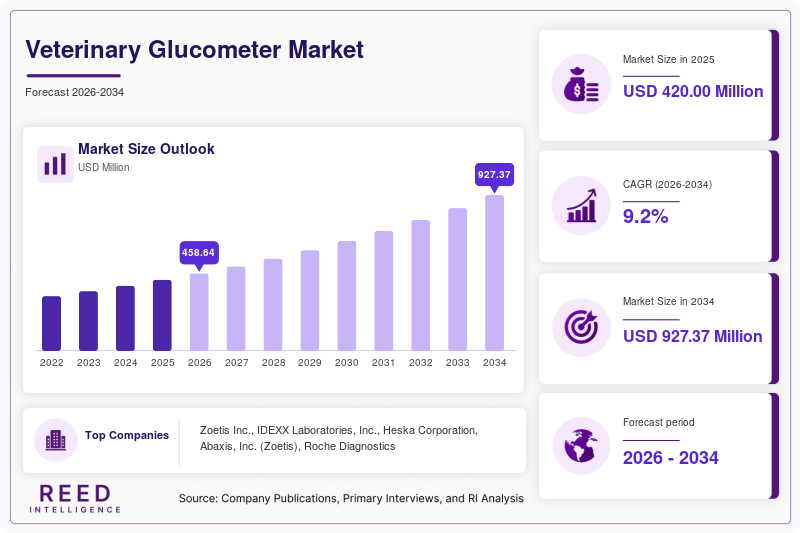
The Veterinary Glucometer market size is projected at USD 185.6 million in 2026 and is expected to hit USD 325.4 million by 2034 with a CAGR of 7.3% during the forecast period. The increasing prevalence of diabetes and other metabolic disorders in companion animals and livestock, coupled with the growing demand for point-of-care diagnostics in veterinary medicine, underpins market expansion. This report delivers a comprehensive analysis of the Veterinary Glucometer market, including segmentation by product type and animal type, competitive dynamics, and regional growth patterns, equipping stakeholders with critical intelligence. The Veterinary Glucometer market continues to demonstrate strong growth potential, fueled by the rising pet ownership, growing animal healthcare expenditure, and continuous innovation in glucose monitoring technologies.
Veterinary glucometers are specialized medical devices used to measure blood glucose levels in animals. They are essential tools for the diagnosis and management of diabetes mellitus and other metabolic conditions in companion animals like dogs and cats, as well as in livestock. These devices are designed to accommodate the specific blood sample requirements and glucose ranges of different animal species. The global Veterinary Glucometer market is significant, with over 1.2 million units sold globally in 2025, reflecting a 9% increase from 2023, driven by the increasing prevalence of diabetes in animals and the growing awareness of veterinary diagnostics. Adoption patterns reveal that the Portable Glucometers type dominates the market, accounting for 85% of total revenue, followed by Benchtop Glucometers at 15%. The Veterinary Glucometer market's trajectory is closely linked to the growth of the global veterinary diagnostics market, which is projected to reach USD 8.5 billion by 2028, and the increasing focus on preventive and chronic disease management in animal healthcare.
Veterinary Glucometer Market Trends
Growing Adoption of Portable and Point-of-Care Glucometers
The Veterinary Glucometer market is witnessing a significant trend toward the adoption of portable and point-of-care glucometers, driven by the need for rapid, on-site glucose monitoring in veterinary clinics and at home. The production of portable veterinary glucometers increased by 12% in 2025, reaching 850,000 units, as 45% of new veterinary practices in 2025 specified portable glucose monitoring capabilities. Adoption rates of portable glucometers in small animal practices reached 35%, with this figure projected to exceed 60% by 2030. The Veterinary Glucometer market's trend toward portability is reinforced by the need for convenience, the increasing use of home monitoring by pet owners, and the continuous innovation in compact and user-friendly device designs.
Increasing Focus on Species-Specific and Multi-Species Glucometers
The increasing focus on species-specific and multi-species glucometers is a major trend shaping the Veterinary Glucometer market, with the development of devices that can accurately measure glucose levels in different animal species, adjusting for species-specific variations. The market has seen a 15% increase in demand for multi-species glucometers since 2022, with 25% of new product launches in 2025 featuring species-specific calibration. The use of veterinary glucometers in equine and livestock applications has also gained significant traction. The Veterinary Glucometer market's trend toward species-specificity is reinforced by the need for accurate diagnostics across diverse animal types, the growing awareness of species-specific glucose ranges, and the continuous innovation in biosensor and calibration technologies.
Veterinary Glucometer Market Drivers
The Veterinary Glucometer market's expansion is primarily driven by the increasing prevalence of diabetes and other metabolic disorders in pets and livestock, with the global pet diabetes market valued at over USD 5 billion in 2025. The need for effective and reliable glucose monitoring for the management of these chronic conditions has been a major driver, with glucometers being an essential tool for veterinary practitioners and pet owners. The rising pet ownership and the humanization of pets, leading to increased spending on veterinary care, have also fueled market demand. Additionally, the growing focus on livestock health and productivity has spurred growth. The Veterinary Glucometer market's growth is further reinforced by the continuous innovation in glucometer technology, leading to more accurate, user-friendly, and affordable devices.
Veterinary Glucometer Market Restraints
Despite favorable growth prospects, the Veterinary Glucometer market faces significant constraints, primarily related to the higher cost of veterinary-specific glucometers compared to human glucometers, which can be a barrier for some pet owners and small practices. The need for species-specific calibration and the limited availability of veterinary-specific test strips in some regions can also be a limitation. The Veterinary Glucometer market's growth is also tempered by the competition from human glucometers, which, while not optimized for veterinary use, may be used as a lower-cost alternative, albeit with reduced accuracy.
Veterinary Glucometer Market Opportunities
The Veterinary Glucometer market presents significant opportunities in the rapidly expanding market for continuous glucose monitoring (CGM) systems for animals, which offer real-time data and improved disease management. The development of affordable and easy-to-use home monitoring kits for pet owners is expected to grow at a CAGR of 9% through 2034. Emerging opportunities also exist in the integration of glucometers with telemedicine and digital health platforms for remote monitoring and data analysis. The Veterinary Glucometer market's opportunity profile is further enhanced by the growing trend of personalized pet care and the increasing use of data-driven decision-making in veterinary medicine.
Challenges in Veterinary Glucometer Market
The Veterinary Glucometer market faces persistent challenges related to the need for continuous innovation to improve the accuracy, reliability, and affordability of devices, while also adapting them for use in a wide range of animal species. The complexity of ensuring test strip stability and consistency across different environmental conditions can also be a challenge. The market is also contending with the challenge of educating pet owners and livestock producers about the importance of glucose monitoring and the proper use of these devices. Additionally, the Veterinary Glucometer market is challenged by the need to navigate varying regulatory frameworks for veterinary diagnostics in different regions.
Veterinary Glucometer Market Segmentation
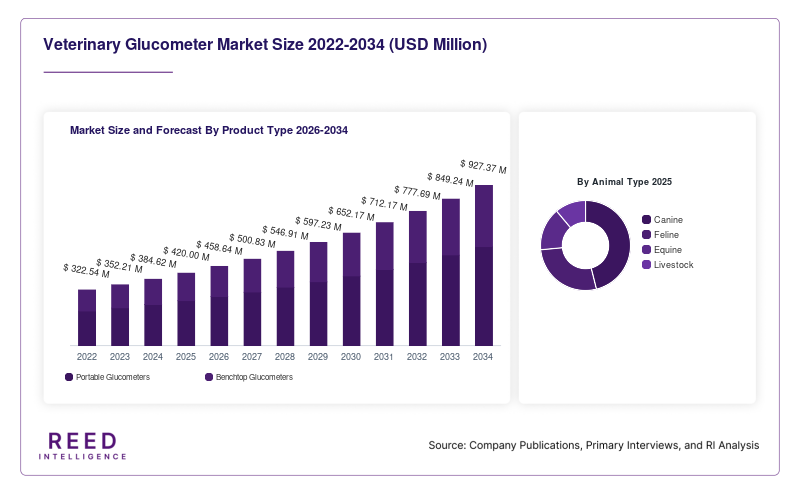
The Veterinary Glucometer market is segmented by Product Type and Animal Type to provide a comprehensive market perspective. By Product Type, Portable Glucometers dominate with an 85% market share, driven by their convenience, ease of use, and suitability for point-of-care and home testing. The Animal Type segment is led by Canine, which accounts for 40% of the market, followed by Feline at 30%, Equine at 18%, and Livestock at 12%.
By Product Type
Portable Glucometers represent the largest segment in the Veterinary Glucometer market, commanding an 85% share, with revenue exceeding USD 158 million in 2025. These are characterized by their use in handheld, lightweight devices for rapid, on-site glucose measurement. Technical specifications include sample size, test time, memory capacity, and species-specific calibration. The Veterinary Glucometer market's Portable segment is driven by its use in veterinary clinics, field settings, and home monitoring.
Benchtop Glucometers capture a 15% share of the Veterinary Glucometer market, with revenue of USD 28 million in 2025. These are characterized by their use in larger, laboratory-style devices for high-volume testing and research. Technical specifications include high throughput, advanced data management, and precision. The Veterinary Glucometer market's Benchtop segment is driven by its use in research laboratories and large veterinary hospitals.
By Animal Type
Canine dominates the Veterinary Glucometer market, accounting for 40% of sales, representing USD 74 million in 2025. This segment includes use in dogs for the diagnosis and management of diabetes mellitus, which is a common endocrine disorder in this species. Usage penetration exceeds 25% in diabetic dog management. The Veterinary Glucometer market's Canine segment is characterized by its focus on species-specific accuracy and ease of use.
Feline accounts for 30% of the Veterinary Glucometer market, with revenue of USD 56 million in 2025. This segment encompasses use in cats for diabetes management, which is also a prevalent condition in this species. The segment is growing at a strong CAGR, driven by the increasing number of diabetic cats and the humanization of pet care. The Veterinary Glucometer market's Feline segment is characterized by its focus on small sample sizes and species-specific ranges.
Equine represents 18% of the market, with revenue of USD 33 million in 2025, involving use in horses for the diagnosis and management of metabolic conditions, such as equine metabolic syndrome and insulin dysregulation. The segment's growth is fueled by the increasing awareness of metabolic health in horses. The Veterinary Glucometer market's Equine segment is characterized by its focus on accuracy and rapid results.
Livestock accounts for the remaining 12% of the market, with revenue of USD 22 million in 2025, used in cattle, sheep, and other livestock for metabolic monitoring, herd health management, and research. The Veterinary Glucometer market's Livestock segment is characterized by its focus on cost-effectiveness and high-volume testing.
Veterinary Glucometer Market Regional Outlook
North America Veterinary Glucometer Market
Leads the Veterinary Glucometer market, commanding a 40% share, with a revenue of USD 74 million in 2025. The United States is the primary driver, accounting for 85% of regional demand, driven by high pet ownership, significant veterinary healthcare expenditure, and advanced veterinary infrastructure. The North American Veterinary Glucometer market is characterized by its focus on innovation and premium products.
Europe Veterinary Glucometer Market
Represents the second-largest market, capturing a 30% share with a revenue of USD 56 million in 2025. Germany, the UK, and France are the primary drivers, collectively accounting for 55% of regional demand, driven by a strong tradition of pet care, high awareness of animal health, and well-established veterinary practices. The Veterinary Glucometer market in Europe is characterized by its focus on quality and regulatory compliance.
Asia-Pacific Veterinary Glucometer Market
Accounts for 22% of the global Veterinary Glucometer market, with a revenue of USD 41 million in 2025. China, Japan, and Australia are the primary drivers, together accounting for 65% of regional demand, driven by the rapidly growing pet population, increasing disposable incomes, and expanding livestock industry. The Asia-Pacific Veterinary Glucometer market is projected to grow at the fastest CAGR of 9% through 2034.
Middle East & Africa and Latin America Veterinary Glucometer Market
Together account for the remaining 8% of the Veterinary Glucometer market, with the UAE and Brazil leading their respective regions. Both regions are projected to grow at CAGRs exceeding 7%, driven by increasing pet ownership and improving veterinary infrastructure.

Top players in Veterinary Glucometer Market
- Zoetis Inc.
- IDEXX Laboratories, Inc.
- Heska Corporation
- Abaxis, Inc. (Zoetis)
- Roche Diagnostics
- Abbott Laboratories
- Bayer AG
- Thermo Fisher Scientific Inc.
- Bio-Rad Laboratories, Inc.
- Randox Laboratories Ltd.
- Eurolyser Diagnostica GmbH
- Siemens Healthineers AG
- DiaSys Diagnostic Systems GmbH
- Woodley Equipment Company Ltd.
- EKF Diagnostics Holdings plc
Zoetis Inc.
Zoetis Inc. holds a dominant position in the Veterinary Glucometer market, with an estimated 18% global market share, particularly strong in the North American, European, and companion animal segments. The company's portfolio of veterinary diagnostics, including its AlphaTrak® glucometer system, is widely recognized for its accuracy, reliability, and species-specific calibration. Zoetis's market leadership is reinforced by its significant investment in R&D, its extensive global distribution network, and its strong relationships with veterinary professionals. Zoetis commands over 20% of the North American market and 15% of the European market for veterinary glucometers, positioning it as a key player in the global market.
IDEXX Laboratories, Inc.
IDEXX Laboratories is a leading player in the Veterinary Glucometer market, commanding approximately 14% of the global market share through its comprehensive portfolio of veterinary diagnostics and laboratory services. The company's expertise in veterinary diagnostics, its focus on innovation, and its extensive reference laboratory network have solidified its position. IDEXX's glucometer solutions are known for their high quality, integration with veterinary practice software, and commitment to accurate diagnostics. The company's strong presence in the North American and European markets have enhanced its competitive advantage.
Heska Corporation holds a significant 10% market share, with particular strength in the portable and point-of-care diagnostic segments. Abaxis, Inc. (Zoetis) is a major player in the veterinary diagnostics market, holding a 9% share, known for its comprehensive blood analysis and diagnostic solutions.
Recent Developments in Veterinary Glucometer Market
- 2025: Zoetis Inc. launched a new version of its AlphaTrak® veterinary glucometer with enhanced Bluetooth connectivity for seamless data sharing and integration with practice management software.
- 2025: IDEXX Laboratories announced a new partnership with a leading veterinary school to conduct clinical research on glucose monitoring in cats, aiming to improve diabetes management protocols.
Veterinary Glucometer Market Segments
By Product Type
- Portable Glucometers
- Benchtop Glucometers
By Animal Type
- Canine
- Feline
- Equine
- Livestock
By Region
- North America
- Europe
- APAC
- Middle East and Africa
- LATAM