Veterinary Hematology Analyzer Market Size, Share Demand Report By Product Type (Automated Hematology Analyzers, Point-of-Care Hematology Analyzers), By Animal Type (Companion Animals, Livestock Animals), By End-Use (Veterinary Clinics, Veterinary Laboratories, Research Institutes), By Region & Segment Forecasts, 2025–2034
USD 3950
Market Overview
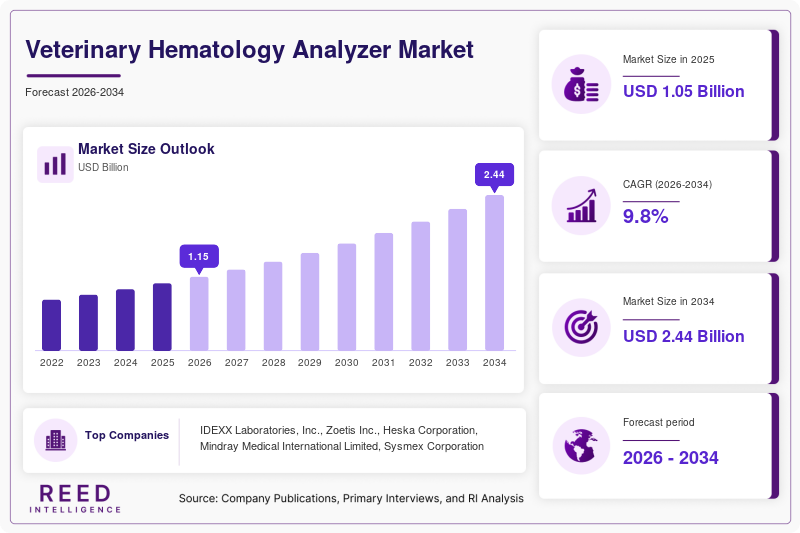
The Veterinary Hematology Analyzer Market size is estimated at USD 1.05 billion in 2025 and is expected to reach USD 1.15 billion in 2026. With continuous technological improvements and expanding veterinary services globally, the market is forecasted to reach approximately USD 2.65 billion by 2034, registering a compound annual growth rate (CAGR) of 9.8% during the forecast period from 2025 to 2034.
The growth of the Veterinary Hematology Analyzer Market is supported by several key factors. First, the rising adoption of companion animals and increasing pet ownership across urban and semi-urban regions has significantly boosted demand for routine diagnostic testing. Pet owners are increasingly willing to invest in preventive healthcare, which has led to higher usage of hematology analyzers in veterinary clinics and hospitals.
Key Highlights
- Market size reached USD 1.05 billion in 2025 and is projected to grow to USD 1.15 billion in 2026.
This reflects steady demand across veterinary practices supported by increasing diagnostic adoption. - The market is forecasted to reach USD 2.65 billion by 2034.
Growth is driven by rising diagnostic needs in both companion and livestock animals globally. - A CAGR of 9.8% from 2025 to 2034 is anticipated for the market.
This growth is supported by increasing pet ownership, disease prevalence, and technological advancements.
Market Trends
Growing Adoption of Point-of-Care Veterinary Diagnostics
One of the major trends shaping the Veterinary Hematology Analyzer Market is the increasing adoption of point-of-care (POC) diagnostic solutions. Veterinary clinics are shifting toward compact, portable analyzers that deliver rapid results at the site of care. These devices reduce the need for external laboratory testing and enable immediate clinical decisions, which is especially beneficial in emergency cases. The convenience of real-time data improves workflow efficiency and enhances patient outcomes. Additionally, advancements in microfluidics and miniaturized technology are enabling the development of highly accurate portable analyzers. This trend is particularly strong in small animal clinics and rural veterinary practices, where access to centralized laboratories may be limited.
Integration of Digital Technologies and Data Analytics
Another key trend is the integration of veterinary hematology analyzers with digital platforms and data management systems. Modern analyzers are equipped with software that allows seamless data storage, analysis, and sharing. This integration supports electronic health records and facilitates better tracking of animal health over time. Data analytics capabilities enable veterinarians to identify patterns, monitor disease progression, and make informed decisions. Cloud-based systems further enhance accessibility and collaboration among veterinary professionals. This trend is gaining traction as veterinary practices increasingly adopt digital transformation strategies to improve operational efficiency and patient care quality.
Market Drivers
Rising Pet Ownership and Companion Animal Healthcare Spending
The increasing number of pet owners globally is a major driver of the Veterinary Hematology Analyzer Market. Urbanization and changing lifestyles have led to a rise in companion animal adoption, particularly dogs and cats. Pet owners are becoming more aware of animal health and are investing in regular health check-ups and preventive care. This has significantly increased the demand for diagnostic services, including hematology testing. Veterinary clinics are expanding their diagnostic capabilities to meet this demand, leading to higher adoption of advanced analyzers. Furthermore, pet insurance penetration is encouraging owners to opt for comprehensive healthcare services, further supporting market growth.
Expansion of Livestock Farming and Disease Surveillance
The growth of the livestock industry is another important factor driving the market. Livestock producers are increasingly focusing on animal health to improve productivity and ensure food safety. Hematology analyzers play a critical role in disease detection, monitoring, and management in livestock populations. Governments and regulatory bodies are also emphasizing disease surveillance to prevent outbreaks and ensure public health safety. This has led to increased adoption of diagnostic tools in veterinary laboratories and farms. The integration of hematology testing in routine livestock management practices is expected to drive sustained demand for analyzers in the coming years.
Market Restraint
High Cost of Advanced Veterinary Hematology Analyzers
One of the primary restraints in the Veterinary Hematology Analyzer Market is the high cost associated with advanced diagnostic equipment. Automated and technologically advanced analyzers require significant initial investment, which can be a barrier for small veterinary clinics and practices with limited budgets. In addition to the purchase cost, ongoing maintenance, calibration, and reagent expenses further increase the total cost of ownership. This financial burden may limit the adoption of such devices, particularly in developing regions where veterinary infrastructure is still evolving.
The high cost also impacts adoption in rural and remote areas, where veterinary services are often underfunded. For example, small-scale livestock farmers may not have access to advanced diagnostic tools, relying instead on traditional methods that are less accurate. This gap in accessibility can affect disease detection and management, ultimately impacting animal health outcomes. Addressing cost-related challenges through affordable solutions and financing options remains critical for market expansion.
Market Opportunities
Growth in Emerging Markets and Veterinary Infrastructure Development
Emerging economies present significant opportunities for the Veterinary Hematology Analyzer Market. Countries in Asia, Latin America, and Africa are investing in veterinary infrastructure to support both companion animal care and livestock production. Increasing awareness about animal health and government initiatives to improve veterinary services are driving demand for diagnostic equipment. Additionally, the expansion of veterinary clinics and laboratories in these regions is creating a favorable environment for market growth. Manufacturers are focusing on developing cost-effective analyzers tailored to the needs of these markets, further enhancing adoption rates.
Advancements in AI and Automation in Veterinary Diagnostics
Technological advancements in artificial intelligence (AI) and automation offer promising opportunities for the market. AI-powered hematology analyzers can provide enhanced diagnostic accuracy by analyzing complex data patterns and identifying abnormalities with high precision. Automation reduces manual intervention, minimizes errors, and improves efficiency in veterinary laboratories. These innovations are expected to transform diagnostic practices, enabling faster and more reliable results. As veterinary professionals increasingly adopt advanced technologies, the demand for AI-integrated analyzers is likely to grow, creating new avenues for market expansion.
Segmental Analysis
By Product Type
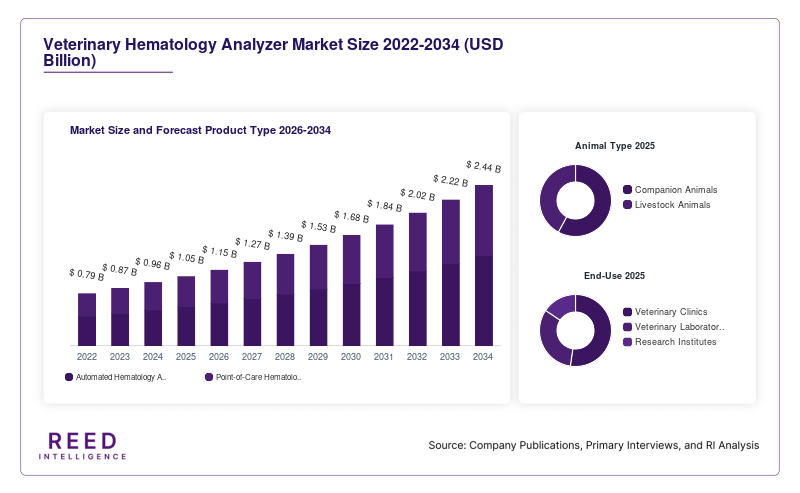
The automated hematology analyzers segment dominated the Veterinary Hematology Analyzer Market in 2024, accounting for approximately 62% of the total market share. These analyzers are widely used due to their high accuracy, efficiency, and ability to process large volumes of samples. Veterinary clinics and laboratories prefer automated systems as they reduce manual errors and provide consistent results. The growing demand for advanced diagnostic solutions and the increasing workload in veterinary practices are further supporting the dominance of this segment.
The point-of-care analyzers segment is expected to be the fastest-growing, with a projected CAGR of 11.5% during the forecast period. These analyzers offer portability, rapid results, and ease of use, making them ideal for small clinics and field applications. The increasing demand for on-site diagnostics and the need for quick decision-making in veterinary care are key factors driving the growth of this segment.
By Animal Type
The companion animals segment held the largest share of the market in 2024, contributing around 58% of the total revenue. The increasing adoption of pets and rising spending on their healthcare are major factors driving this segment. Veterinary clinics are expanding their diagnostic services to cater to the growing demand for preventive and routine health check-ups. The availability of advanced diagnostic tools specifically designed for small animals further supports this segment’s dominance.
The livestock animals segment is anticipated to grow at the fastest CAGR of 10.8% during the forecast period. The expansion of livestock farming and the need for disease monitoring and productivity optimization are key growth drivers. Hematology analyzers are increasingly used in farms and veterinary laboratories to ensure animal health and improve production efficiency. Government initiatives to support livestock health management are also contributing to this segment’s growth.
By End-Use
Veterinary clinics accounted for the largest share of the market in 2024, representing approximately 54% of the total revenue. Clinics are the primary point of care for animal health services and rely heavily on diagnostic tools for routine testing and disease management. The increasing number of veterinary clinics and the growing demand for advanced diagnostic capabilities are driving the adoption of hematology analyzers in this segment.
Veterinary laboratories are expected to be the fastest-growing segment, with a CAGR of 10.6% during the forecast period. Laboratories handle a high volume of diagnostic tests and require advanced analyzers for accurate and efficient processing. The growing trend of outsourcing diagnostic services and the increasing complexity of veterinary testing are key factors driving the growth of this segment.
Regional Analysis
North America
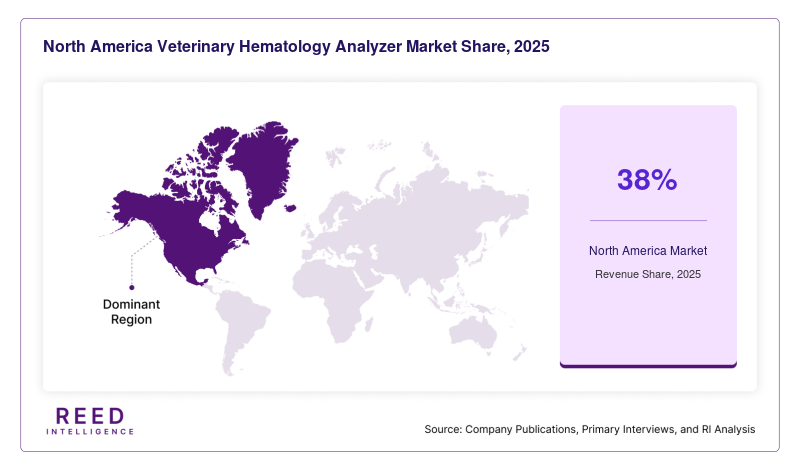
North America accounted for a significant share of the Veterinary Hematology Analyzer Market in 2025, contributing approximately 38% of the global revenue. The region is expected to maintain its dominance with a CAGR of 9.2% during the forecast period. The presence of advanced veterinary infrastructure, high pet ownership rates, and strong awareness about animal health are key factors driving market growth in this region.
The United States dominates the North American market due to its well-established veterinary healthcare system and high expenditure on pet care. A unique growth factor in the country is the increasing adoption of pet insurance, which encourages regular diagnostic testing and boosts demand for hematology analyzers.
Europe
Europe held around 27% market share in 2025 and is projected to grow at a CAGR of 8.9% through 2034. The region benefits from stringent animal health regulations and a strong focus on livestock disease management. Veterinary diagnostic services are widely adopted across both companion animal and livestock sectors.
Germany leads the European market, supported by its advanced veterinary research facilities and strong livestock industry. A unique growth factor is the emphasis on animal welfare regulations, which drives the adoption of advanced diagnostic tools to ensure compliance and improve health outcomes.
Asia Pacific
Asia Pacific accounted for approximately 22% of the market share in 2025 and is expected to register the highest CAGR of 11.2% during the forecast period. Rapid urbanization, increasing pet ownership, and expanding livestock farming are key drivers in this region.
China dominates the Asia Pacific market due to its large livestock population and growing veterinary infrastructure. A unique growth factor is the government’s focus on improving animal health standards, which is driving the adoption of diagnostic technologies, including hematology analyzers.
Middle East & Africa
The Middle East & Africa region held around 7% market share in 2025 and is projected to grow at a CAGR of 8.5%. The market is gradually expanding due to increasing awareness about animal health and the development of veterinary services.
South Africa is a leading market in this region, supported by its growing veterinary sector and livestock industry. A unique growth factor is the rising focus on disease control in livestock, which is driving demand for diagnostic tools and improving market penetration.
Latin America
Latin America accounted for approximately 6% of the market share in 2025 and is expected to grow at a CAGR of 9.0%. The region is witnessing steady growth due to increasing investments in veterinary healthcare and livestock management.
Brazil dominates the Latin American market, driven by its large agricultural sector and emphasis on livestock productivity. A unique growth factor is the increasing export demand for animal products, which necessitates strict health monitoring and boosts the adoption of hematology analyzers.
Competitive Landscape
The Veterinary Hematology Analyzer Market is moderately competitive, with several global and regional players focusing on product innovation and strategic collaborations. Leading companies are investing in research and development to introduce advanced analyzers with improved accuracy, automation, and connectivity features. The market is characterized by continuous technological advancements and a strong emphasis on expanding product portfolios.
One of the leading players in the market is IDEXX Laboratories, Inc., which holds a significant share due to its extensive product offerings and strong distribution network. The company recently introduced an advanced hematology analyzer with enhanced diagnostic capabilities and integration with digital veterinary platforms. Other key players are also focusing on expanding their presence in emerging markets through partnerships and acquisitions. The competitive landscape is expected to evolve further with the introduction of innovative solutions and increasing demand for veterinary diagnostics.
Key Players List
- IDEXX Laboratories, Inc.
- Zoetis Inc.
- Heska Corporation
- Mindray Medical International Limited
- Sysmex Corporation
- HORIBA Ltd.
- Boule Diagnostics AB
- Scil Animal Care Company GmbH
- Diatron MI Zrt.
- URIT Medical Electronic Co., Ltd.
- Drew Scientific Group
- Woodley Equipment Company Ltd.
- Clindiag Systems Co., Ltd.
- Abaxis (Zoetis)
- Randox Laboratories Ltd.
Recent Developments
- In 2024, a leading market player launched a next-generation veterinary hematology analyzer with AI-based diagnostic features to improve accuracy and efficiency.
- In 2023, a major company expanded its product portfolio by introducing portable hematology analyzers designed for point-of-care applications in veterinary clinics.
- In 2024, a strategic partnership between two diagnostic companies focused on enhancing distribution networks and expanding market reach in emerging economies.
Veterinary Hematology Analyzer Market Segments
Product Type
- Automated Hematology Analyzers
- Point-of-Care Hematology Analyzers
Animal Type
- Companion Animals
- Livestock Animals
End-Use
- Veterinary Clinics
- Veterinary Laboratories
- Research Institutes
By Region
- North America
- Europe
- APAC
- Middle East and Africa
- LATAM