Veterinary Scale Market Size, Share & Demand Report By Type (Digital Veterinary Scales, Mechanical Veterinary Scales, Smart Connected Scales), By Animal Type (Small Animals, Large Animals), By End-Use (Veterinary Clinics, Veterinary Hospitals, Research Institutes), By Distribution Channel (Direct Sales, Distributors, Online Sales), By Application (Dosage Calculation, Health Monitoring, Growth Tracking), By Region & Segment Forecasts, 2025–2034
USD 3950
Market Overview
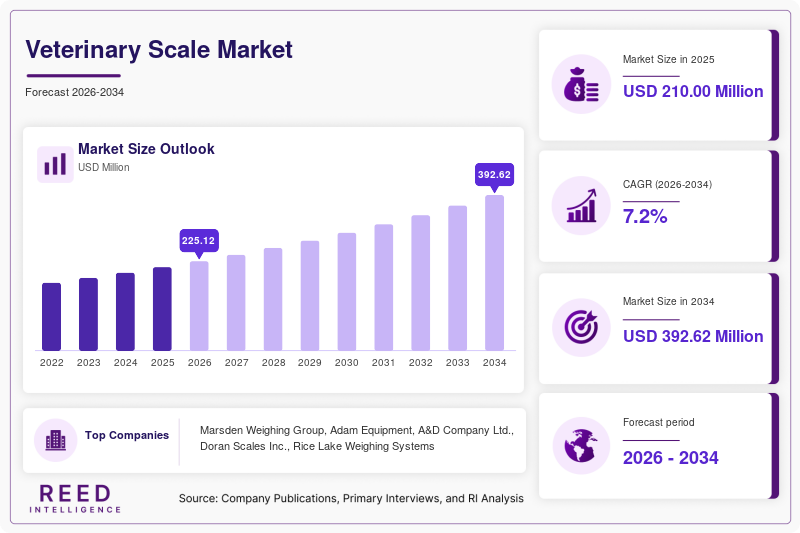
The Veterinary Scale Market was valued at approximately USD 210 million in 2025 and is projected to reach around USD 395 million by 2034, expanding at a CAGR of 7.2% during the forecast period (2025–2034). The market growth has been driven by the increasing demand for accurate animal weight measurement across veterinary clinics, livestock farms, and research institutions. Precision weighing is critical for dosage calculation, health monitoring, and treatment planning, making veterinary scales an essential component in animal healthcare infrastructure.
One of the key global factors supporting the Veterinary Scale Market growth is the rising awareness regarding animal health and welfare. Governments and animal welfare organizations have implemented stricter regulations for animal care, particularly in developed regions. This has led to increased adoption of advanced veterinary equipment, including digital and smart weighing systems, to ensure compliance and improve diagnostic accuracy.
Key Highlights:
- North America dominated the market with a share of 38% in 2025, while Asia Pacific is expected to grow at the fastest CAGR of 8.5%.
- Among segments, digital veterinary scales led with a 56% share, while smart connected scales are projected to grow at a CAGR of 9.1%.
- The United States remained the dominant country, with market values of USD 68 million in 2024 and USD 72 million in 2025.
Market Trends
Integration of Smart and Connected Weighing Systems
The Veterinary Scale Market has witnessed a shift toward smart weighing solutions integrated with cloud-based platforms and electronic medical record (EMR) systems. These systems allow veterinarians to track weight data over time, enabling predictive health analysis and improved treatment accuracy. The incorporation of Bluetooth and IoT-enabled scales has enhanced workflow efficiency in veterinary clinics and hospitals.
Rising Demand for Portable and Compact Veterinary Scales
Portable and lightweight veterinary scales have gained traction, particularly in field applications such as farm visits and mobile veterinary services. These devices offer ease of transport, quick setup, and reliable performance in diverse environments. The demand for compact scales has been further supported by the increasing number of small animal clinics and home-based veterinary services, where space optimization is essential.
Market Drivers
Increasing Veterinary Healthcare Expenditure
The global rise in veterinary healthcare spending has significantly boosted the Veterinary Scale Market. Pet owners are increasingly willing to invest in advanced medical care, leading to higher adoption of precision diagnostic tools, including veterinary scales. This trend is particularly strong in developed economies where pet insurance coverage and disposable income levels are higher.
Expansion of Livestock Farming and Commercial Animal Production
The growth of the livestock sector has driven demand for robust and high-capacity veterinary scales. Accurate weight monitoring is essential for feed optimization, growth tracking, and disease management in large-scale farming operations. As agricultural practices become more technology-driven, the integration of weighing systems into farm management processes has accelerated market growth.
Market Restraint
High Initial Cost of Advanced Veterinary Scales
One of the major challenges in the Veterinary Scale Market is the high initial cost associated with advanced digital and smart weighing systems. These devices often include features such as data connectivity, automated recording, and durable construction, which increase their price. Small veterinary clinics and farms, especially in developing regions, may find it difficult to invest in such equipment.
Additionally, maintenance and calibration requirements further add to the total cost of ownership. Limited awareness regarding the long-term benefits of precision weighing also restricts adoption in cost-sensitive markets. As a result, many end users continue to rely on traditional or less accurate weighing methods, hindering overall market penetration.
Market Opportunities
Growth in Emerging Markets
Emerging economies present significant growth opportunities for the Veterinary Scale Market. Increasing investments in veterinary infrastructure, coupled with rising awareness about animal health, are expected to drive demand. Governments in countries across Asia and Latin America are focusing on improving livestock productivity and disease control, creating a favorable environment for market expansion.
Technological Advancements in Weighing Solutions
Continuous innovation in weighing technologies offers new growth avenues. The development of AI-enabled scales capable of analyzing animal health parameters beyond weight is gaining attention. These advanced systems can provide insights into growth patterns and detect abnormalities early, enhancing their value proposition. Such innovations are expected to attract new customers and expand the application scope of veterinary scales.
Segmental Analysis
By Type
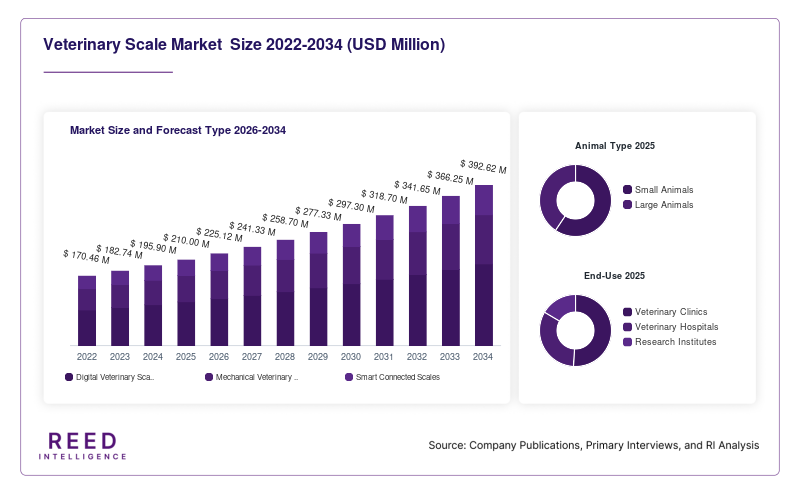
Digital veterinary scales dominated the Veterinary Scale Market with a share of 56% in 2024. These scales were widely adopted due to their accuracy, ease of use, and ability to provide quick readings. Their application in both small animal clinics and large veterinary hospitals contributed to their leading position.
Smart connected scales are expected to be the fastest-growing subsegment, registering a CAGR of 9.1% during the forecast period. Their growth will be driven by integration with digital health records and real-time data tracking capabilities, enhancing clinical efficiency.
By Animal Type
Small animals accounted for the largest share of 62% in 2024. The dominance of this segment was attributed to the increasing number of companion animals and frequent veterinary visits for routine check-ups and treatments.
Large animals are projected to grow at the fastest CAGR of 7.8%. The growth will be fueled by expanding livestock farming and the need for precise weight monitoring to optimize productivity and health management.
By End-Use
Veterinary clinics held the dominant share of 48% in 2024. These facilities required reliable weighing systems for routine diagnostics and treatment planning, making them a primary end-user segment.
Veterinary hospitals are expected to witness the fastest growth, with a CAGR of 7.6%. The increasing complexity of veterinary procedures and the need for advanced diagnostic tools will drive demand in this segment.
By Distribution Channel
Direct sales accounted for the largest share of 52% in 2024. Manufacturers preferred direct sales channels to establish strong relationships with end users and provide customized solutions.
Online distribution channels are projected to grow at the fastest CAGR of 8.3%. The increasing adoption of e-commerce platforms for purchasing medical equipment will support this growth.
By Application
Weight measurement for dosage calculation dominated the market with a share of 44% in 2024. Accurate dosing is critical in veterinary medicine, making this application essential.
Health monitoring applications are expected to grow at the fastest CAGR of 8.7%. Continuous tracking of animal weight will become increasingly important for early disease detection and preventive care.
Regional Analysis
North America
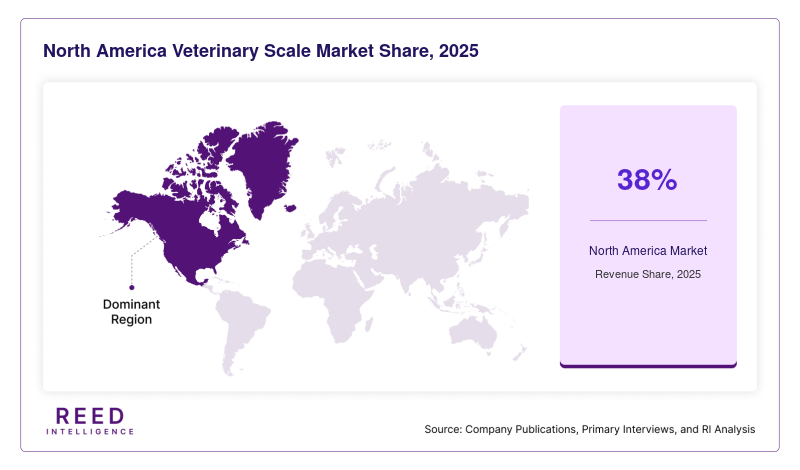
North America accounted for 38% of the Veterinary Scale Market share in 2025 and is expected to grow at a CAGR of 6.8% during the forecast period. The region benefited from well-established veterinary healthcare systems and high adoption of advanced medical equipment. The presence of large-scale veterinary hospitals and widespread use of digital technologies supported market expansion.
The United States remained the dominant country in this region due to its advanced veterinary infrastructure. A key growth factor was the increasing demand for preventive animal healthcare services, which required accurate and frequent weight monitoring.
Europe
Europe held a 27% share of the Veterinary Scale Market in 2025 and is projected to grow at a CAGR of 6.5% through 2034. The region experienced steady demand driven by stringent animal welfare regulations and strong emphasis on quality veterinary care. Adoption of technologically advanced scales was particularly notable in Western Europe.
Germany emerged as the leading country, supported by its strong livestock industry and emphasis on precision farming. The country’s focus on integrating technology into agriculture contributed to the increased use of veterinary scales.
Asia Pacific
Asia Pacific accounted for 20% of the market share in 2025 and is anticipated to register the fastest CAGR of 8.5% during the forecast period. The region’s growth was driven by expanding livestock populations, rising pet ownership, and increasing investments in veterinary healthcare infrastructure.
China dominated the regional market due to its large-scale animal farming industry. A key growth factor was the government's focus on improving livestock productivity and disease management through the adoption of modern equipment.
Middle East & Africa
The Middle East & Africa region held a 7% share of the Veterinary Scale Market in 2025 and is expected to grow at a CAGR of 6.9%. The market growth was supported by increasing awareness of animal health and gradual improvements in veterinary services.
South Africa emerged as the dominant country, driven by its relatively developed agricultural sector. The adoption of veterinary scales was influenced by efforts to improve livestock management practices.
Latin America
Latin America accounted for 8% of the market share in 2025 and is projected to grow at a CAGR of 7.1% over the forecast period. The region experienced growth due to the expansion of the livestock industry and increasing focus on animal health monitoring.
Brazil led the regional market, supported by its large cattle population. The need for efficient weight monitoring systems in commercial farming operations acted as a key growth driver.
Competitive Landscape
The Veterinary Scale Market is moderately fragmented, with several global and regional players competing based on product innovation, pricing, and distribution networks. Leading companies focus on developing advanced digital and connected weighing solutions to enhance user experience and accuracy.
One of the market leaders, Marsden Weighing Group, has strengthened its position through the launch of advanced veterinary scales with integrated data management features. The company continues to invest in research and development to expand its product portfolio.
Other key players are focusing on strategic partnerships, mergers, and geographic expansion to increase their market presence. Continuous innovation and customization remain key competitive strategies in this market.
Key Players List
- Marsden Weighing Group
- Adam Equipment
- A&D Company Ltd.
- Doran Scales Inc.
- Rice Lake Weighing Systems
- Cardinal Scale Manufacturing Company
- Detecto Scale Company
- Tanita Corporation
- Brecknell Scales
- Ohaus Corporation
- Avery Weigh-Tronix
- MyWeigh
- KERN & SOHN GmbH
- Radwag Balances and Scales
- Bosche GmbH & Co. KG
Recent Developments
- In 2025, Marsden Weighing Group introduced a new range of Bluetooth-enabled veterinary scales designed for seamless data integration.
- Adam Equipment expanded its product portfolio with portable veterinary scales targeting field applications.
- A&D Company Ltd. launched advanced digital scales with enhanced precision for small animal clinics.
- Rice Lake Weighing Systems partnered with distributors to strengthen its presence in emerging markets.
- Detecto Scale Company developed heavy-duty livestock scales with improved durability and load capacity.
Veterinary Scale Market Segments
Type
- Digital Veterinary Scales
- Mechanical Veterinary Scales
- Smart Connected Scales
Animal Type
- Small Animals
- Large Animals
End-Use
- Veterinary Clinics
- Veterinary Hospitals
- Research Institutes
Distribution Channel
- Direct Sales
- Distributors
- Online Sales
Application
- Dosage Calculation
- Health Monitoring
- Growth Tracking
By Region
- North America
- Europe
- APAC
- Middle East and Africa
- LATAM