Veterinary Ultrasound Market Size, Share & Demand Report By Product Type (Portable Ultrasound Systems, Cart-Based Ultrasound Systems, Handheld Ultrasound Devices), By Animal Type (Small Animals, Large Animals), By Application (General Imaging, Reproductive Imaging, Cardiology, Musculoskeletal), By Technology (2D Ultrasound, Doppler Ultrasound, 3D/4D Ultrasound), By End-Use (Veterinary Clinics, Veterinary Hospitals, Research Institutes), By Region & Segment Forecasts, 2026–2034
USD 3950
Market Overview
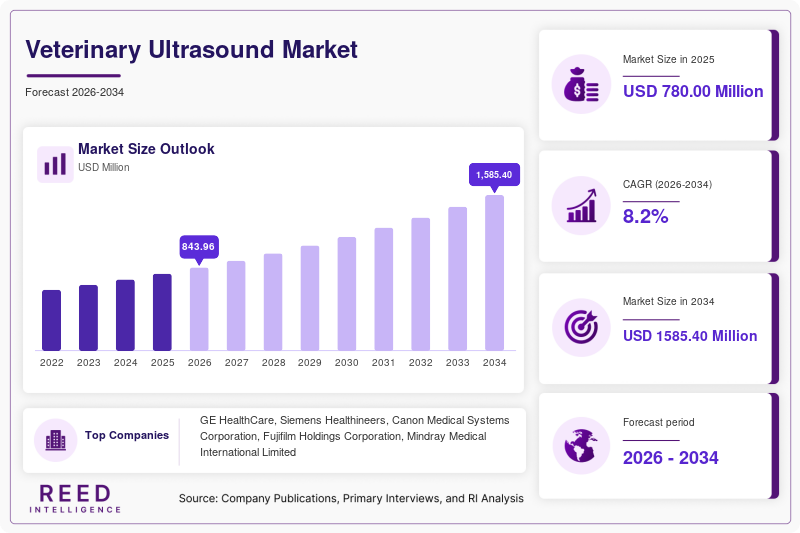
The global Veterinary Ultrasound Market size was valued at approximately USD 780 million in 2026 and is projected to reach USD 1.46 billion by 2034, expanding at a CAGR of 8.2% during the forecast period (2026–2034). The market continues to evolve as veterinary healthcare systems increasingly adopt advanced imaging technologies for accurate and timely diagnosis.
A major global factor supporting the growth of the Veterinary Ultrasound Market is the rising focus on preventive animal healthcare. Veterinary professionals and animal owners are prioritizing early detection of diseases to reduce long-term treatment costs and improve outcomes. Ultrasound imaging offers a non-invasive, real-time diagnostic solution, making it a preferred choice across companion animal care and livestock management.
Technological innovation is further strengthening market expansion. The emergence of portable ultrasound systems, wireless probes, and digital imaging platforms has enhanced accessibility and efficiency. These advancements are particularly beneficial in field-based veterinary applications, where mobility and speed are critical.
Key Highlights
- North America accounted for approximately 38% market share in 2025, while Asia Pacific is projected to grow at a CAGR of 9.4%
- Portable ultrasound systems dominated with a 52% share, while handheld devices are expected to grow at a CAGR of 10.1%
- Small animal imaging led the application segment, whereas livestock diagnostics is projected to expand at a CAGR of 8.9%
- The United States recorded market values of USD 250 million in 2024 and USD 268 million in 2025
Market Trends
Growing Demand for Portable and Handheld Ultrasound Systems
The Veterinary Ultrasound Market is experiencing a strong shift toward portable and handheld imaging solutions. These devices allow veterinarians to perform diagnostics across diverse environments, including clinics, farms, and remote areas. Their lightweight design and battery-powered operation enhance usability, especially in emergency and field settings. The ability to deliver real-time imaging without requiring large infrastructure has made these systems highly attractive for mobile veterinary services. This trend is particularly evident in large animal and equine diagnostics, where mobility plays a crucial role.
Increasing Integration of Artificial Intelligence in Imaging
The integration of artificial intelligence into ultrasound systems is transforming the Veterinary Ultrasound Market. AI-powered tools assist in image interpretation, automated measurements, and anomaly detection, improving diagnostic accuracy and reducing reliance on specialized expertise. These capabilities are especially valuable in regions with limited access to experienced veterinary radiologists. Additionally, AI supports telemedicine by enabling remote image analysis and consultations. As veterinary practices continue to digitize their operations, the demand for intelligent imaging systems is expected to increase steadily.
Market Drivers
Rising Companion Animal Ownership and Healthcare Spending
The increasing number of companion animals globally is significantly contributing to the growth of the Veterinary Ultrasound Market. Pet owners are becoming more proactive about animal health, leading to higher spending on advanced diagnostic procedures. Veterinary clinics are upgrading their capabilities to meet this demand, incorporating ultrasound systems for routine and emergency diagnostics. The non-invasive nature of ultrasound imaging and its ability to provide immediate results make it an essential tool in modern veterinary practice.
Expanding Focus on Livestock Health and Productivity
Livestock health management has become a critical priority, driving the adoption of ultrasound imaging in agricultural settings. Ultrasound systems are widely used for reproductive monitoring, pregnancy detection, and disease diagnosis in farm animals. The growing demand for animal-derived products has encouraged livestock producers to adopt advanced diagnostic tools to improve efficiency and reduce losses. Government initiatives supporting agricultural productivity and animal welfare are further contributing to market expansion.
Market Restraint
High Cost of Advanced Veterinary Ultrasound Systems
The high cost associated with advanced ultrasound equipment remains a key challenge for the Veterinary Ultrasound Market. Modern systems equipped with features such as Doppler imaging, 3D visualization, and AI integration require significant capital investment. This limits their adoption among smaller veterinary clinics, particularly in developing regions.
In addition to acquisition costs, maintenance expenses and the need for skilled professionals increase the overall financial burden. Many veterinary practices face budget constraints, preventing them from investing in high-end diagnostic technologies. Limited reimbursement frameworks for veterinary procedures in several countries also reduce the incentive for adopting advanced imaging systems. Addressing affordability challenges will be crucial for expanding market penetration.
Market Opportunities
Expansion of Telemedicine and Remote Diagnostics
The growing adoption of telemedicine in veterinary care is creating new growth avenues for the Veterinary Ultrasound Market. Remote diagnostics allow veterinarians to share ultrasound images with specialists for accurate interpretation and consultation. This approach enhances diagnostic efficiency and improves treatment outcomes, particularly in rural and underserved areas. Cloud-enabled ultrasound systems are facilitating seamless data sharing, supporting the broader adoption of telehealth solutions in veterinary medicine.
Growth Potential in Emerging Veterinary Markets
Emerging economies present significant opportunities for market expansion due to the rapid development of veterinary infrastructure. Increasing awareness of animal health, rising disposable incomes, and supportive government initiatives are driving demand for advanced diagnostic tools. Veterinary clinics and hospitals in these regions are investing in modern imaging equipment to improve service quality. Companies that offer cost-effective and adaptable solutions are well positioned to capitalize on this growing demand.
Segmental Analysis
By Product Type
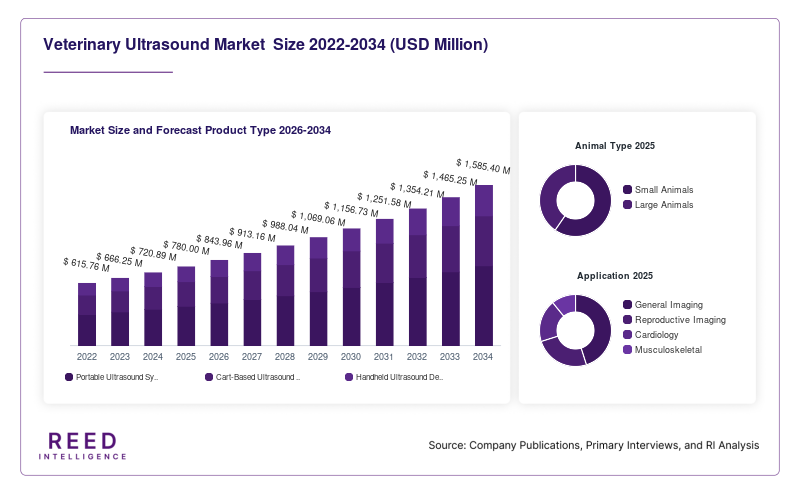
Portable ultrasound systems dominated the Veterinary Ultrasound Market in 2025, accounting for approximately 52% of the total share. Their versatility and ease of use across clinical and field environments have contributed to widespread adoption. These systems are particularly valuable in livestock diagnostics and mobile veterinary services.
Handheld ultrasound devices are expected to grow at the fastest pace, with a projected CAGR of 10.1%. Their compact design and integration with mobile platforms make them ideal for point-of-care diagnostics, especially in remote and resource-limited settings.
By Animal Type
The small animals segment held the largest share of 58% in 2025, driven by the increasing population of companion animals and rising veterinary visits. Ultrasound imaging is widely used for diagnosing internal conditions in pets, supporting segment dominance.
The large animals segment is anticipated to grow at a CAGR of 8.9%, supported by increasing adoption of ultrasound systems in livestock management. The need for efficient reproductive monitoring and disease detection continues to drive growth in this segment.
By Application
General imaging accounted for the largest share of 46% in 2025, reflecting the widespread use of ultrasound systems for routine diagnostic procedures. These systems play a critical role in identifying internal abnormalities and guiding treatment decisions.
Reproductive imaging is expected to expand at a CAGR of 9.2%, driven by the growing focus on breeding efficiency and herd productivity. Ultrasound technology enables accurate pregnancy detection and reproductive health monitoring.
By Technology
Two-dimensional ultrasound technology dominated the market with a 61% share in 2025 due to its affordability and widespread availability. It remains the standard imaging modality in veterinary diagnostics.
Three-dimensional and four-dimensional ultrasound technologies are projected to grow at a CAGR of 9.5%, supported by their ability to provide enhanced visualization and detailed imaging for complex cases.
By End-Use
Veterinary clinics held the largest share of 49% in 2025, serving as primary centers for animal diagnostics. The availability of trained professionals and diagnostic equipment supports their leading position.
Veterinary hospitals are expected to grow at a CAGR of 8.7%, driven by increasing investments in advanced healthcare infrastructure and specialized diagnostic services.
Regional Analysis
North America
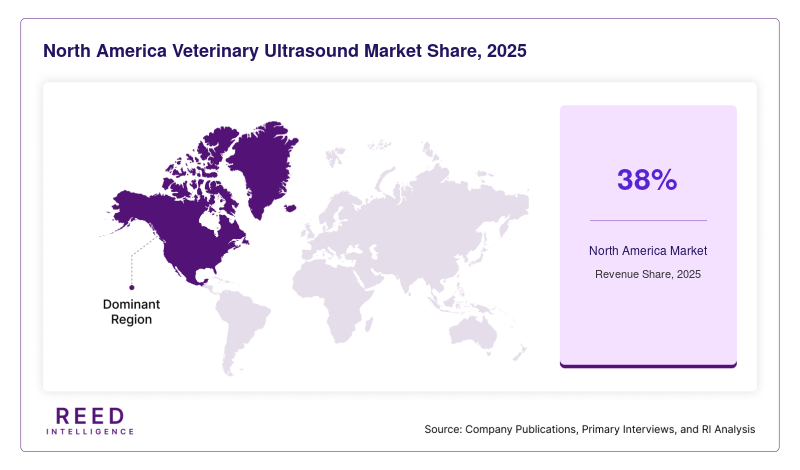
North America held approximately 38% of the Veterinary Ultrasound Market share in 2025, reflecting its well-established veterinary healthcare infrastructure and strong adoption of advanced diagnostic technologies. The region is expected to grow at a CAGR of 7.5% during the forecast period. High levels of pet healthcare expenditure and the presence of advanced veterinary facilities continue to support market demand.
The United States remained the dominant country in the region due to its advanced veterinary ecosystem and widespread use of imaging technologies. The increasing adoption of digital solutions in veterinary practices has enhanced diagnostic efficiency and contributed to sustained market growth.
Europe
Europe accounted for around 27% of the Veterinary Ultrasound Market share in 2025 and is projected to grow at a CAGR of 7.8% through 2034. Strong regulatory frameworks supporting animal welfare and healthcare standards have encouraged the adoption of advanced imaging technologies across the region.
Germany emerged as the leading country, supported by its focus on precision livestock farming. The use of ultrasound systems in agricultural practices has enabled improved monitoring of animal health and reproductive performance, contributing to market expansion.
Asia Pacific
Asia Pacific represented approximately 20% of the market share in 2025 and is expected to register the fastest CAGR of 9.4% during the forecast period. Rapid urbanization, increasing pet ownership, and expanding veterinary infrastructure are key factors driving growth in the region.
China dominated the regional market due to significant investments in veterinary healthcare and animal management systems. Government initiatives aimed at improving livestock productivity have further accelerated the adoption of ultrasound technologies.
Middle East & Africa
The Middle East & Africa accounted for about 8% of the Veterinary Ultrasound Market share in 2025 and is projected to grow at a CAGR of 8.0% during the forecast period. The region is witnessing gradual improvements in veterinary services and increasing awareness regarding animal health.
South Africa led the regional market, supported by relatively advanced veterinary facilities. The growing focus on livestock management and agricultural productivity has contributed to the adoption of ultrasound systems.
Latin America
Latin America held nearly 7% of the Veterinary Ultrasound Market share in 2025 and is expected to grow at a CAGR of 8.3% between 2026 and 2034. The region’s growth is driven by expanding livestock industries and improving veterinary infrastructure.
Brazil emerged as the dominant country, benefiting from large-scale livestock production and increasing use of ultrasound systems for reproductive monitoring and herd management.
Competitive Landscape
The Veterinary Ultrasound Market is moderately competitive, with several global and regional players focusing on innovation and product development. Companies are investing in portable and AI-enabled imaging solutions to strengthen their market position and meet evolving customer demands.
A leading player in the market has recently introduced advanced handheld ultrasound devices with cloud connectivity, enabling real-time data sharing and remote diagnostics. This development highlights the ongoing digital transformation in veterinary healthcare.
Other companies are expanding their geographic presence and enhancing product portfolios through strategic collaborations and partnerships. Continuous innovation and pricing strategies remain essential for maintaining competitiveness in the market.
Key Players List
- GE HealthCare
- Siemens Healthineers
- Canon Medical Systems Corporation
- Fujifilm Holdings Corporation
- Mindray Medical International Limited
- Esaote SpA
- Samsung Medison Co., Ltd.
- Clarius Mobile Health
- Sonoscape Medical Corp.
- BCF Technology Ltd.
- DRAMIŃSKI S.A.
- IMV Imaging
- Shenzhen Ricso Technology Co., Ltd.
- SIUI (Shantou Institute of Ultrasonic Instruments)
- Heska Corporation
Recent Developments
- In 2025, a manufacturer introduced a wireless handheld ultrasound device tailored for veterinary applications
- In 2025, companies expanded distribution networks across Asia Pacific to strengthen regional presence
- In 2024, AI-enabled imaging software was introduced to improve diagnostic accuracy
- In 2024, strategic collaborations between imaging companies and veterinary service providers increased adoption
- In 2023, product portfolios were expanded with new portable ultrasound systems for field-based diagnostics
Veterinary Ultrasound Market Segments
Product Type
- Portable Ultrasound Systems
- Cart-Based Ultrasound Systems
- Handheld Ultrasound Devices
Animal Type
- Small Animals
- Large Animals
Application
- General Imaging
- Reproductive Imaging
- Cardiology
- Musculoskeletal
Technology
- 2D Ultrasound
- Doppler Ultrasound
- 3D/4D Ultrasound
End-Use
- Veterinary Clinics
- Veterinary Hospitals
- Research Institutes
By Region
- North America
- Europe
- APAC
- Middle East and Africa
- LATAM