VHF Data Exchange System Market Size, Share Demand Report By Component (Hardware, Software, Services), By Application (Vessel Tracking & Navigation, Fleet Management, Coastal Surveillance, Port Operations), By End-Use (Commercial Shipping, Defense & Coast Guard, Fisheries, Offshore Industry) By Region & Segment Forecasts, 2025–2034
USD 3950
Market Overview
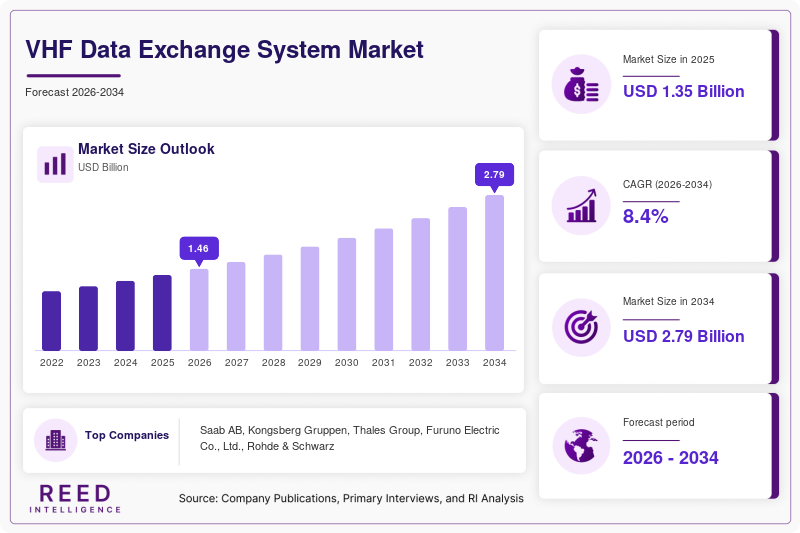
The VHF Data Exchange System Market size was valued at approximately USD 1.35 billion in 2025 and is projected to reach USD 1.48 billion in 2026. Over the forecast period, the market is expected to grow significantly, reaching USD 3.05 billion by 2034, registering a compound annual growth rate (CAGR) of 8.4% from 2025 to 2034. This growth reflects increasing reliance on digital maritime communication technologies to enhance safety, efficiency, and data-driven operations.
One of the primary growth factors is the rising emphasis on maritime safety regulations and compliance standards imposed by international organizations. Governments and maritime authorities are investing in VHF Data Exchange Systems (VDES) to support Automatic Identification Systems (AIS), enabling real-time vessel tracking and collision avoidance. Additionally, the growing volume of global seaborne trade is creating demand for efficient vessel traffic management systems, further supporting market expansion.
Key Highlights
- Asia Pacific dominated the market with an estimated share of around 38% in 2025, driven by strong maritime trade activity and rapid port modernization in countries like China, Japan, and South Korea.
- Middle East & Africa is projected to be the fastest-growing region, expanding at a CAGR of approximately 10.6% from 2025 to 2034 due to increasing investments in smart ports and maritime security infrastructure.
- By component, hardware segment held the largest share of about 46% in 2025, supported by high demand for onboard communication and navigation equipment.
- By solution, vessel tracking and monitoring systems accounted for nearly 34% share in 2025 owing to growing emphasis on real-time maritime safety and surveillance.
- By application, commercial shipping dominated with a share of around 52% in 2025 due to rising global trade volumes and fleet expansion.
Market Trends
Integration of Satellite-Based VDES Solutions
A notable trend in the VHF Data Exchange System Market is the increasing integration of satellite-based communication with traditional terrestrial VHF systems. This hybrid approach enhances communication coverage, especially in deep-sea and remote maritime regions where terrestrial signals are limited. Satellite-enabled VDES allows for uninterrupted data exchange, supporting applications such as vessel monitoring, weather data transmission, and route optimization. As maritime operators demand reliable and continuous connectivity, this integration is becoming a standard feature in modern communication systems, improving overall maritime situational awareness and operational efficiency.
Emergence of Smart Ports and Digital Maritime Ecosystems
The rise of smart ports is transforming the maritime industry, driving demand for advanced communication systems like VDES. Ports are increasingly adopting digital technologies to optimize cargo handling, vessel scheduling, and traffic management. VDES plays a key role by enabling real-time data exchange between ships, port authorities, and logistics providers. This trend is further supported by the adoption of IoT, artificial intelligence, and big data analytics in maritime operations. As ports aim to improve efficiency and reduce turnaround times, the deployment of VDES is becoming critical for seamless digital integration.
Market Drivers
Increasing Maritime Safety Regulations
The implementation of stringent maritime safety regulations is a major driver of the VHF Data Exchange System Market. Regulatory bodies are mandating the use of advanced communication systems to improve navigation safety and prevent maritime accidents. VDES enhances the capabilities of AIS by enabling higher data throughput and secure communication channels. This ensures accurate vessel tracking, collision avoidance, and emergency response coordination. As global maritime traffic continues to rise, compliance with safety standards is becoming essential, prompting shipowners and operators to invest in advanced communication infrastructure.
Growth in Global Maritime Trade
The expansion of global trade through maritime routes is significantly contributing to the demand for VDES. Shipping remains the most cost-effective mode for transporting large volumes of goods, leading to increased vessel traffic across major trade routes. This surge in maritime activity necessitates efficient communication systems to manage vessel movements and ensure operational efficiency. VDES supports real-time data exchange, enabling better route planning, congestion management, and fuel optimization. As international trade volumes continue to grow, the need for reliable maritime communication systems is expected to rise accordingly.
Market Restraint
High Implementation and Infrastructure Costs
One of the primary restraints in the VHF Data Exchange System Market is the high cost associated with system deployment and infrastructure development. Implementing VDES requires significant investment in hardware, software, and integration with existing maritime communication systems. Additionally, upgrading legacy systems to support VDES functionality can be complex and costly for ship operators and port authorities. Smaller maritime operators may find it challenging to justify such investments, limiting market adoption in certain regions.
The impact of this restraint is particularly evident in developing economies, where budget constraints hinder the deployment of advanced communication technologies. For example, smaller ports may continue to rely on traditional AIS systems due to cost considerations, delaying the transition to VDES. Furthermore, maintenance and operational costs add to the financial burden, affecting long-term scalability. Addressing these cost challenges through government support, subsidies, and technological innovation will be critical for broader market adoption.
Market Opportunities
Adoption of Autonomous Shipping Technologies
The development of autonomous and remotely operated vessels presents a significant opportunity for the VHF Data Exchange System Market. These vessels rely heavily on real-time communication and data exchange for navigation, monitoring, and decision-making. VDES provides the necessary infrastructure to support high-speed and secure data transmission between vessels and control centers. As the maritime industry moves toward automation, the demand for advanced communication systems is expected to increase, creating new growth avenues for VDES providers.
Expansion of Coastal Surveillance and Security Systems
The growing need for coastal surveillance and maritime security is another key opportunity for the market. Governments are investing in advanced monitoring systems to protect territorial waters, prevent illegal activities, and ensure environmental safety. VDES enhances surveillance capabilities by enabling efficient data exchange between vessels, coastal stations, and monitoring centers. This is particularly important in regions with high maritime traffic or security concerns. As investments in maritime security infrastructure continue to rise, the adoption of VDES is expected to expand significantly.
Segmental Analysis
By Component
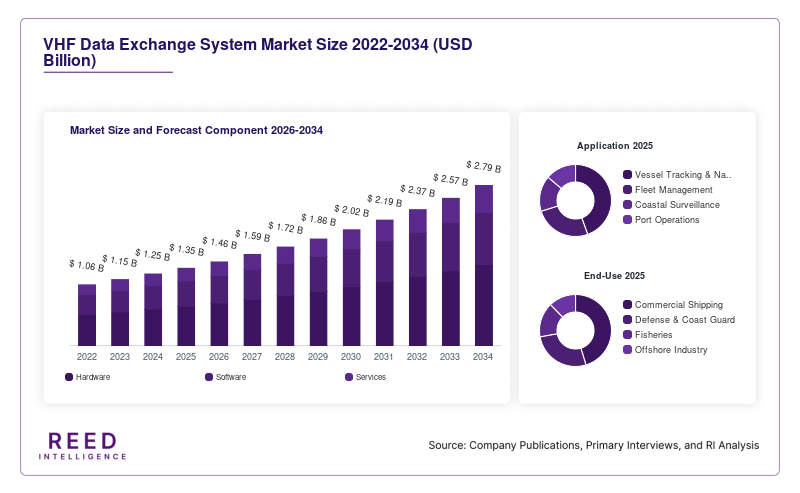
The hardware segment dominated the market in 2024, accounting for approximately 46% of the total share. This includes transceivers, antennas, and onboard communication systems that form the backbone of VDES infrastructure. The demand for reliable and durable hardware components is high, as maritime environments require robust systems capable of withstanding harsh conditions. Increasing investments in upgrading existing maritime communication systems further support the growth of this segment.
The software segment is expected to be the fastest-growing, with a CAGR of 9.2% during the forecast period. Software solutions enable data processing, analytics, and system integration, enhancing the functionality of VDES. The growing adoption of digital platforms and smart maritime systems is driving demand for advanced software solutions. Integration with AI and IoT technologies is further accelerating growth in this segment.
By Application
Vessel tracking and navigation dominated the application segment in 2024, holding a share of around 42%. This application relies heavily on VDES for real-time data exchange, enabling accurate vessel positioning and route planning. The increasing emphasis on maritime safety and efficient navigation systems is driving the adoption of VDES in this segment.
Fleet management is the fastest-growing application segment, with a projected CAGR of 9.5%. The need for efficient fleet operations and cost optimization is driving the adoption of VDES in fleet management systems. Real-time data exchange enables better decision-making, improving operational efficiency and reducing fuel consumption.
By End-Use
The commercial shipping segment dominated the market in 2024, accounting for approximately 48% of the total share. The increasing volume of global trade and the need for efficient maritime communication systems are driving demand in this segment. VDES supports real-time data exchange, enhancing operational efficiency and safety in commercial shipping operations.
The defense and coast guard segment is expected to be the fastest-growing, with a CAGR of 9.8%. The growing focus on maritime security and surveillance is driving the adoption of VDES in defense applications. Governments are investing in advanced communication systems to enhance coastal monitoring and security operations, supporting growth in this segment.
Regional Analysis
North America
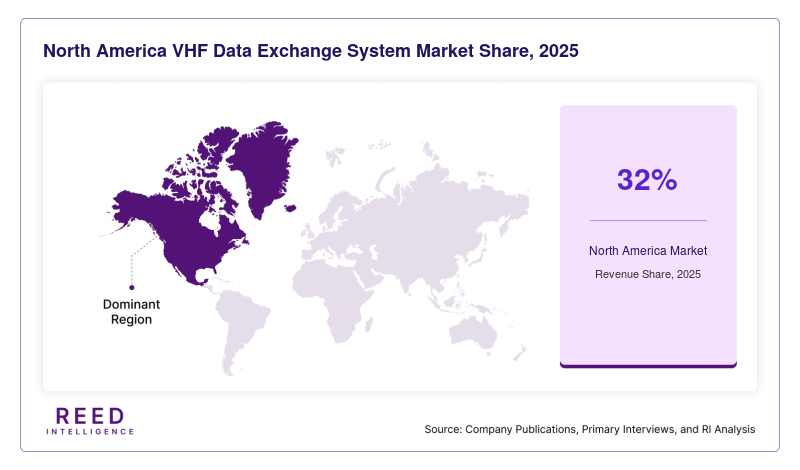
North America accounted for a significant share of the VHF Data Exchange System Market in 2025, holding approximately 32% of the global market. The region is expected to maintain steady growth with a projected CAGR of 7.8% through 2034. The presence of advanced maritime infrastructure, along with strong regulatory frameworks, supports the adoption of VDES technologies. Increasing investments in digital port systems and maritime safety initiatives are further driving market expansion across the region.
The United States dominates the North American market due to its extensive coastline and high maritime traffic. A key growth factor is the country’s focus on modernizing port infrastructure and enhancing coastal surveillance systems. Government initiatives aimed at improving maritime communication networks are accelerating the deployment of VDES solutions, ensuring efficient vessel management and safety compliance.
Europe
Europe held a market share of around 28% in 2025 and is projected to grow at a CAGR of 8.1% during the forecast period. The region’s strong emphasis on maritime safety and environmental regulations drives the adoption of advanced communication systems. European countries are actively investing in digital maritime infrastructure to support efficient shipping operations and reduce environmental impact.
Norway leads the European market, driven by its advanced maritime industry and focus on autonomous shipping technologies. A unique growth factor is the country’s investment in smart shipping corridors, where VDES plays a crucial role in enabling real-time communication between vessels and shore-based systems. This supports safer and more efficient maritime operations.
Asia Pacific
Asia Pacific is the fastest-growing region in the VHF Data Exchange System Market, with a CAGR of 9.6% from 2025 to 2034. The region accounted for approximately 24% of the global market share in 2025. Rapid growth in maritime trade, coupled with increasing investments in port infrastructure, is driving the demand for VDES solutions across the region.
China dominates the Asia Pacific market due to its large shipping industry and extensive port network. A key growth factor is the government’s focus on developing smart ports and digital logistics systems. The integration of VDES with advanced technologies such as AI and IoT is enhancing operational efficiency, supporting market growth in the region.
Middle East & Africa
The Middle East & Africa region held a market share of about 9% in 2025 and is expected to grow at a CAGR of 8.7% through 2034. The region’s strategic location along major shipping routes drives the need for efficient maritime communication systems. Investments in port development and logistics infrastructure are contributing to market expansion.
The United Arab Emirates leads the regional market, supported by its advanced port facilities and focus on innovation. A unique growth factor is the country’s investment in smart port initiatives, where VDES is used to improve vessel traffic management and operational efficiency. This enhances the region’s competitiveness in global trade.
Latin America
Latin America accounted for approximately 7% of the global market share in 2025 and is projected to grow at a CAGR of 7.5% during the forecast period. The region’s growing maritime trade and increasing focus on port modernization are driving the adoption of VDES technologies.
Brazil dominates the Latin American market due to its extensive coastline and active shipping industry. A key growth factor is the government’s investment in coastal surveillance and maritime safety systems. The adoption of VDES supports improved communication and monitoring capabilities, enhancing overall maritime operations.
Competitive Landscape
The VHF Data Exchange System Market is moderately consolidated, with several key players competing based on technology innovation, product offerings, and strategic partnerships. Leading companies are focusing on developing advanced VDES solutions that offer improved data capacity, reliability, and integration capabilities. Investments in research and development are driving technological advancements, enabling companies to maintain a competitive edge.
A leading player in the market is Saab AB, known for its strong portfolio of maritime communication systems. The company has recently introduced enhanced VDES solutions that support both terrestrial and satellite communication, improving data exchange capabilities. Other major players are also expanding their product portfolios and forming partnerships with maritime authorities to strengthen their market presence.
Key Players List
- Saab AB
- Kongsberg Gruppen
- Thales Group
- Furuno Electric Co., Ltd.
- Rohde & Schwarz
- Japan Radio Co., Ltd.
- Garmin Ltd.
- L3Harris Technologies
- Northrop Grumman Corporation
- Raytheon Technologies
- Cobham Limited
- Leonardo S.p.A.
- HENSOLDT AG
- Wärtsilä Corporation
- ORBCOMM Inc.
Recent Developments
- In 2024, Saab AB launched an upgraded VDES transceiver with enhanced data throughput capabilities.
- In 2025, Kongsberg Gruppen partnered with a European port authority to deploy VDES-based smart port solutions.
- In 2025, Thales Group introduced a hybrid satellite-terrestrial VDES communication system for maritime applications.
VHF Data Exchange System Market Segments
Component
- Hardware
- Software
- Services
Application
- Vessel Tracking & Navigation
- Fleet Management
- Coastal Surveillance
- Port Operations
End-Use
- Commercial Shipping
- Defense & Coast Guard
- Fisheries
- Offshore Industry
By Region
- North America
- Europe
- APAC
- Middle East and Africa
- LATAM