Vial Adaptors for Reconstitution Drug Market Size, Share Demand Report By Type (Closed System Vial Adaptors, Needle-Free Vial Adaptors, Standard Vial Adaptors), By Material (Plastic, Silicone, Others), By Application (Oncology Drug Reconstitution, Biologics Reconstitution, Anti-Infective Drug Reconstitution, Others), By End-Use (Hospitals, Clinics, Home Healthcare, Ambulatory Surgical Centers), By Distribution Channel & Segment Forecasts, 2026–2034
USD 3950
Market Overview
The global Vial Adaptors for Reconstitution Drug Market size was estimated at USD 1.18 billion in 2026 and is projected to reach approximately USD 2.21 billion by 2034, expanding at a CAGR of 8.1% during the forecast period (2026–2034). The market is experiencing steady expansion due to the rising demand for injectable therapeutics and increasing adoption of safe drug reconstitution practices across healthcare settings.
A key global factor supporting the growth of the Vial Adaptors for Reconstitution Drug Market is the increasing prevalence of chronic diseases requiring injectable medications, including oncology, autoimmune disorders, and infectious diseases. This trend has driven healthcare providers to prioritize sterile, efficient, and contamination-free drug preparation methods, thereby boosting the adoption of vial adaptors.
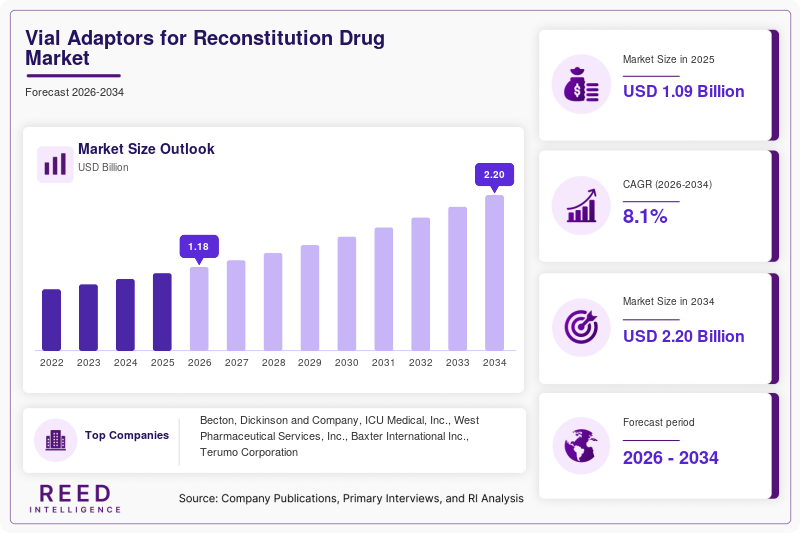
Key Highlights:
-
North America dominated the market with a 38.6% share, while Asia Pacific is projected to register the fastest CAGR of 9.5% during the forecast period.
-
By product type, closed system vial adaptors led with a 54.2% share, while needle-free adaptors are expected to grow at the fastest CAGR of 9.8%.
-
By application, oncology drug reconstitution dominated with a 41.3% share, while biologics reconstitution is projected to grow at a CAGR of 9.6%.
-
The U.S. remained the dominant country, with market values of USD 392 million in 2024 and USD 418 million in 2025.
Market Trends
Rise in Closed-System Drug Transfer Technologies
The integration of closed-system drug transfer devices (CSTDs) within vial adaptors is a notable trend in the Vial Adaptors for Reconstitution Drug Market. These systems are designed to prevent contamination and reduce exposure to hazardous drugs, making them increasingly preferred in hospitals and oncology centers. Regulatory support for safer drug handling practices is further accelerating adoption.
Shift Toward Biologics and Specialty Injectables
The growing pipeline of biologics and specialty injectable drugs has influenced demand for advanced reconstitution solutions. Vial adaptors are being designed with improved compatibility, precision, and ease of use to accommodate sensitive formulations, supporting market expansion.
Market Drivers
Increasing Demand for Injectable Drug Delivery Systems
The rising global burden of chronic diseases has led to increased reliance on injectable therapies. Vial adaptors provide a safer and more efficient method for reconstituting drugs, which has driven their adoption across healthcare settings. Their ability to minimize drug wastage and enhance dosing accuracy supports their growing use.
Focus on Healthcare Worker Safety and Infection Control
Healthcare facilities are prioritizing safety protocols to reduce occupational exposure to hazardous drugs and prevent infections. Vial adaptors, particularly closed-system variants, play a critical role in maintaining sterile environments during drug preparation, contributing to their widespread adoption.
Market Restraint
High Cost of Advanced Vial Adaptors
The relatively high cost of technologically advanced vial adaptors, particularly those integrated with closed-system features, may limit adoption in cost-sensitive healthcare systems, especially in developing regions.
Market Opportunities
Expansion in Emerging Healthcare Markets
Rapid improvements in healthcare infrastructure across emerging economies present significant growth opportunities. Increasing investments in hospitals and pharmaceutical distribution networks are expected to boost the demand for vial adaptors.
Technological Innovations in Drug Delivery Devices
Continuous advancements in device design, such as ergonomic features and compatibility with a wide range of drug formulations, are creating new opportunities for market players to differentiate their offerings and expand their customer base.
Segmental Analysis
By Type
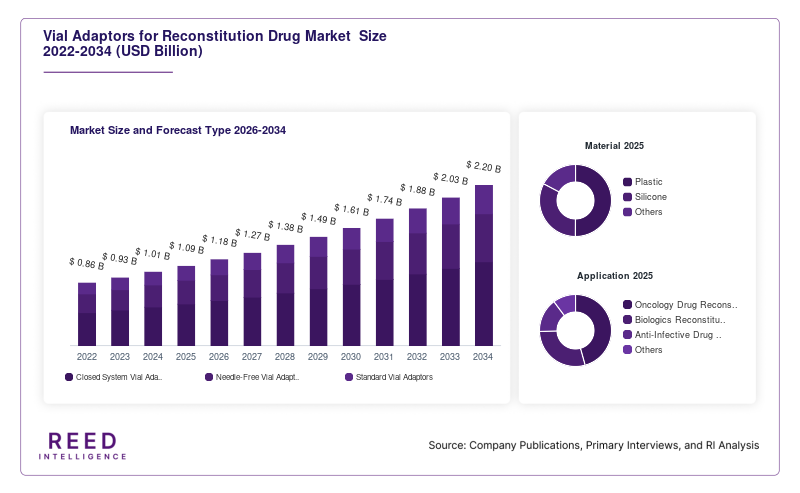
Closed system vial adaptors dominated the Vial Adaptors for Reconstitution Drug Market with a 54.2% share in 2025, as they provide enhanced safety by preventing contamination and exposure to hazardous drugs.
Needle-free adaptors are anticipated to grow at the fastest CAGR of 9.8%, driven by their ease of use and reduced risk of needle-stick injuries, which enhances their adoption in hospitals and outpatient settings.
By Material
Plastic-based adaptors held the dominant share of 62.7% in 2025, owing to their cost-effectiveness, durability, and compatibility with a wide range of drugs.
Silicone-based adaptors are projected to grow at a CAGR of 8.9%, supported by their superior sealing properties and increasing use in high-precision drug delivery applications.
By Application
Oncology drug reconstitution led the market with a 41.3% share in 2025, as cancer treatments often involve hazardous drugs requiring safe handling systems.
Biologics reconstitution is expected to grow at a CAGR of 9.6%, driven by the increasing development and use of biologic therapies across various therapeutic areas.
By End-Use
Hospitals accounted for the largest share of 58.5% in 2025, due to high patient volumes and the need for efficient drug preparation systems.
Home healthcare settings are projected to grow at a CAGR of 9.2%, supported by the increasing trend of home-based treatments and self-administration of injectable drugs.
By Distribution Channel
Direct sales dominated with a 49.8% share in 2025, as manufacturers prefer direct engagement with large healthcare institutions.
Online distribution channels are expected to grow at a CAGR of 10.1%, driven by the digitalization of procurement processes and increasing adoption of e-commerce platforms in the healthcare sector.
Regional Analysis
North America
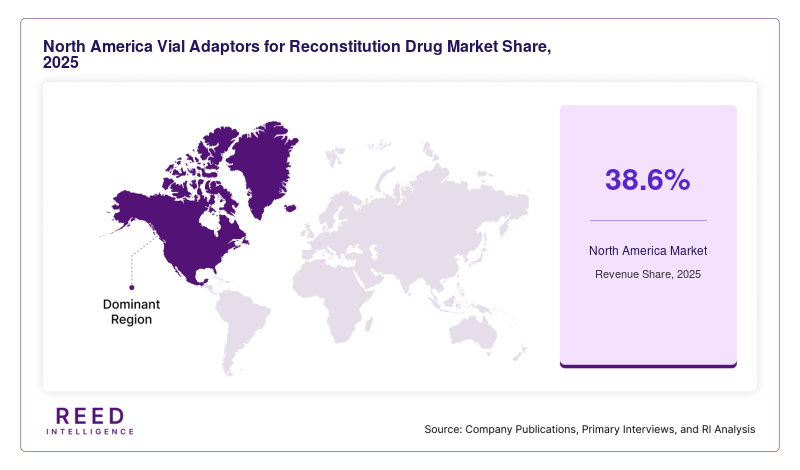
North America accounted for 38.6% of the Vial Adaptors for Reconstitution Drug Market share in 2025 and will grow at a CAGR of 7.8% through 2034. The United States dominated the region due to strong regulatory frameworks and high adoption of advanced healthcare technologies. The country’s growth is supported by increased demand for oncology drugs requiring safe handling systems.
Europe
Europe held 27.4% of the market share in 2025 and is expected to grow at a CAGR of 7.6%. Germany emerged as the leading country, driven by a well-established pharmaceutical sector and growing emphasis on workplace safety standards in healthcare environments.
Asia Pacific
Asia Pacific captured 21.8% of the market share in 2025 and will expand at the fastest CAGR of 9.5%. China led the regional market due to expanding healthcare infrastructure and increasing access to advanced medical devices, supported by government initiatives to improve healthcare services.
Middle East & Afric
The Middle East & Africa accounted for 6.1% of the market share in 2025 and is projected to grow at a CAGR of 8.3%. The United Arab Emirates dominated the region, driven by investments in healthcare modernization and rising adoption of advanced medical technologies.
Latin America
Latin America held 6.1% of the market share in 2025 and is expected to grow at a CAGR of 8.0%. Brazil led the regional market, supported by growing pharmaceutical manufacturing and increasing awareness regarding safe drug administration practices.
Competitive Landscape
The Vial Adaptors for Reconstitution Drug Market is moderately fragmented, with several global and regional players competing on product innovation and distribution capabilities. Leading companies focus on enhancing product safety, compatibility, and ease of use to strengthen their market position.
Becton, Dickinson and Company is recognized as a market leader, supported by its extensive portfolio and strong global presence. The company recently introduced an advanced closed-system vial adaptor designed to improve drug containment and reduce contamination risks. ICU Medical, Inc. and West Pharmaceutical Services, Inc. are also prominent players, focusing on expanding their product lines and strengthening partnerships with healthcare providers.
Other key participants such as Baxter International Inc. and Terumo Corporation are investing in research and development to introduce innovative solutions tailored to evolving healthcare needs. Strategic collaborations, product launches, and geographic expansion remain key strategies adopted by market players to enhance their competitive positioning.
Key Players List
- Becton, Dickinson and Company
- ICU Medical, Inc.
- West Pharmaceutical Services, Inc.
- Baxter International Inc.
- Terumo Corporation
- B. Braun Melsungen AG
- Nipro Corporation
- Vygon Group
- Fresenius Kabi AG
- Cardinal Health, Inc.
- Smiths Medical
- Stevanato Group
- Gerresheimer AG
- SCHOTT AG
- Elcam Medical
Recent Developments
- In 2025, Becton, Dickinson and Company launched a next-generation closed-system vial adaptor aimed at improving safety during hazardous drug handling.
- ICU Medical, Inc. expanded its manufacturing capacity to meet growing global demand for drug reconstitution devices.
- West Pharmaceutical Services, Inc. introduced a new line of vial adaptors compatible with biologic drug formulations.
- Baxter International Inc. partnered with healthcare providers to enhance the adoption of advanced drug delivery systems.
- Terumo Corporation focused on expanding its presence in Asia Pacific through strategic collaborations and product launches.
Vial Adaptors for Reconstitution Drug Market Segments
Type
- Closed System Vial Adaptors
- Needle-Free Vial Adaptors
- Standard Vial Adaptors
Material
- Plastic
- Silicone
- Others
Application
- Oncology Drug Reconstitution
- Biologics Reconstitution
- Anti-Infective Drug Reconstitution
- Others
End-Use
- Hospitals
- Clinics
- Home Healthcare
- Ambulatory Surgical Centers
Distribution Channel
- Direct Sales
- Distributors
- Online Channels
By Region
- North America
- Europe
- APAC
- Middle East and Africa
- LATAM