Video Event Data Recorder VEDR Market Size, Share Demand Report By Component (Hardware, Software, Services), By Vehicle Type (Commercial Vehicles, Passenger Vehicles), By Application (Fleet Management, Insurance Telematics, Law Enforcement, Public Transport Monitoring, Personal Safety), By Region & Segment Forecasts, 2026–2034
USD 3950
Market Overview
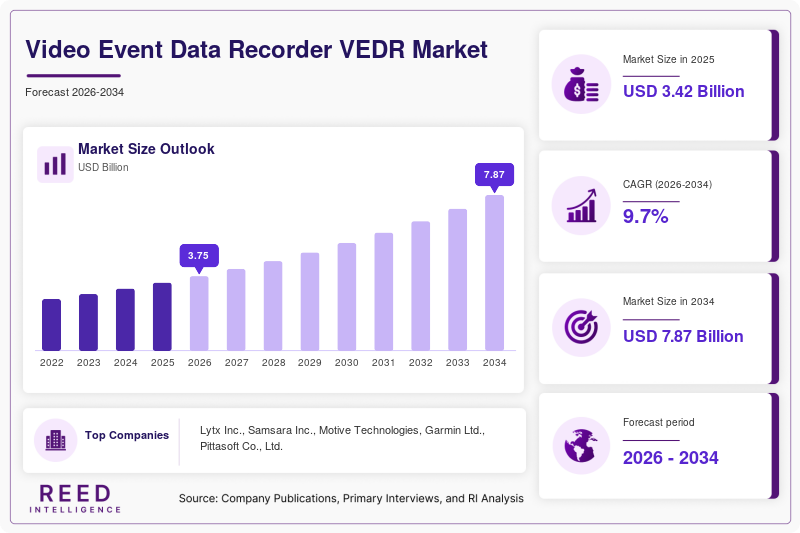
The global Video Event Data Recorder VEDR Market size was valued at USD 3.42 billion in 2026 and is projected to reach USD 7.18 billion by 2034, expanding at a CAGR of 9.7% during 2026–2034. Video event data recorders combine camera systems, sensors, telematics modules, and storage technologies to capture pre-event, in-event, and post-event driving data. These systems are increasingly adopted across passenger cars, commercial fleets, public transport, mining vehicles, logistics trucks, and emergency service fleets. Growing emphasis on road safety, driver accountability, accident reconstruction, insurance validation, and fleet optimization is accelerating product demand worldwide.
One major global factor supporting market expansion is the rapid digitization of transportation infrastructure. Fleet operators are integrating connected cameras, GPS tracking, AI analytics, and cloud platforms to improve operational visibility. Regulators in several countries are also tightening safety norms related to driver monitoring, heavy vehicle compliance, and incident documentation. As a result, VEDR solutions are moving from optional accessories to strategic fleet assets. Hardware improvements such as higher-resolution cameras, wider storage capacity, and low-light imaging are further enhancing adoption rates.
Key Highlights
- North America dominated the market with a 36.4% share in 2025.
- while Asia Pacific is expected to grow at the fastest CAGR of 11.6% during 2026–2034.
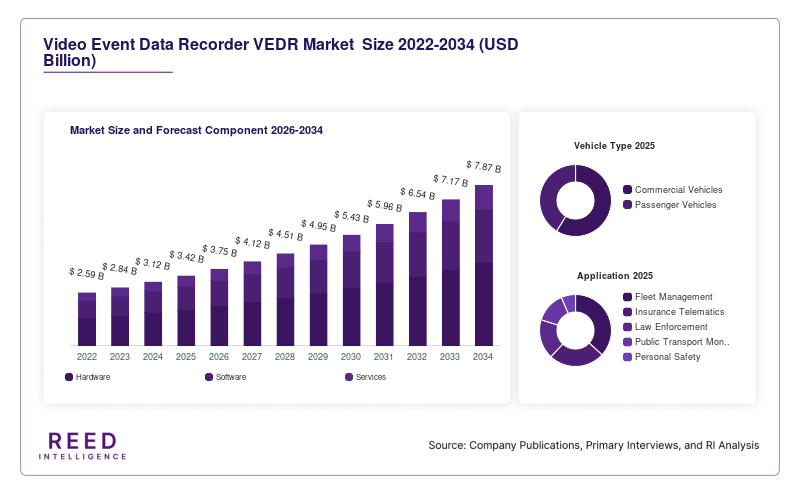
- By component, hardware accounted for the largest share of 58.1%, while software platforms are projected to grow at a CAGR of 12.3%.
- By vehicle type, commercial vehicles led with a 62.7% share, whereas passenger vehicles are expected to expand at a CAGR of 10.8%.
- By application, fleet management led with a 39.6% share, whereas insurance telematics is expected to expand at a CAGR of 12.1%.
- The United States remained the dominant country, with market values of USD 820 million in 2024 and USD 905 million in 2025.
Market Trends
AI-enabled video analytics gaining commercial traction
The Video Event Data Recorder VEDR Market is witnessing strong momentum toward AI-powered analytics platforms. Modern systems no longer only record footage; they identify distracted driving, tailgating, lane drifting, harsh braking, fatigue behavior, and collision risks in real time. This shift enables preventive action instead of only post-incident review. Fleet managers increasingly prefer systems with cloud dashboards, driver scorecards, and automated alerts. AI integration also reduces manual video review time and operating costs. As edge computing chips become more affordable, onboard intelligence is expected to become a standard feature across premium and mid-range VEDR products.
Migration from local storage to cloud-connected ecosystems
Traditional standalone recorders relied heavily on local memory cards and manual retrieval. The market is now transitioning toward cloud-connected ecosystems where footage uploads automatically after defined events. This trend supports remote diagnostics, centralized fleet compliance, instant claim verification, and scalable storage management. Logistics firms operating across multiple cities are especially adopting hybrid cloud models. Subscription-based software revenue is also rising due to remote access demand. Vendors are increasingly packaging hardware with recurring software services, improving long-term customer retention and creating more predictable revenue streams within the Video Event Data Recorder VEDR Market.
Market Drivers
Rising demand for fleet safety and liability protection
Commercial fleets face increasing pressure to lower accident frequency, reduce legal exposure, and manage insurance costs. VEDR systems provide timestamped video evidence and driving behavior data that help settle disputes quickly. This is particularly valuable in logistics, ride-hailing, construction transport, and public transit operations. Companies using VEDR solutions often report improved driver discipline because operators know incidents are recorded. Insurance providers in some regions also offer incentives for fleets deploying telematics-based safety systems. These measurable cost benefits continue to drive adoption among large and mid-sized fleet operators.
Expansion of regulatory compliance requirements
Governments and transport authorities are strengthening compliance standards for heavy vehicles, school buses, hazardous cargo fleets, and passenger transport services. Many operators now require cameras and event recorders for route monitoring, driver behavior assessment, and incident investigation. Safety mandates for advanced driver assistance and digital logging also complement VEDR demand. In several developing markets, smart city transport modernization programs include onboard surveillance investments. As regulation becomes more data-centric, VEDR solutions are increasingly viewed as essential compliance tools rather than optional monitoring equipment.
Market Restraint
Privacy concerns and high implementation complexity
Despite favorable growth prospects, privacy concerns remain a significant restraint for the Video Event Data Recorder VEDR Market. Drivers, labor groups, and fleet employees may resist continuous video monitoring due to concerns about misuse of footage, workplace surveillance, and personal data exposure. Regional data protection rules can also require strict consent management, storage limitations, and secure transfer protocols. In addition, full-scale deployment across large fleets may involve installation downtime, software integration, network configuration, and staff training costs. Small transport operators often delay purchases because they lack IT resources or budget flexibility. For example, a regional trucking company with hundreds of vehicles may need substantial upfront investment for cameras, connectivity plans, analytics subscriptions, and maintenance support before realizing savings. These barriers can slow adoption in price-sensitive markets.
Market Opportunities
Untapped passenger vehicle aftermarket demand
A major growth opportunity lies in the passenger vehicle aftermarket. Consumers are increasingly interested in dashboard cameras with event recording, parking surveillance, theft alerts, and smartphone connectivity. As urban congestion rises, motorists seek evidence tools for accident disputes and fraudulent claims. Automakers are adding integrated cameras in premium models, but millions of existing vehicles remain addressable through aftermarket channels. E-commerce availability, falling hardware prices, and easier plug-and-play installation are expected to expand this segment rapidly. Vendors that combine affordability with app-based convenience can capture broad consumer demand.
Emerging economies investing in connected transport
Developing countries across Asia, Latin America, and parts of Africa are modernizing transport systems and commercial logistics networks. Rapid e-commerce growth is increasing delivery fleets, while infrastructure investment is expanding bus and freight movement volumes. These markets often leapfrog directly to connected solutions rather than legacy systems. VEDR vendors can benefit by offering rugged hardware, multilingual software, and flexible pricing models suited to local operators. Partnerships with telecom providers, insurers, and vehicle distributors may further accelerate penetration in these high-growth regions.
Segmental Analysis
By Component
Hardware held the dominant share of 58.1% in 2024 within the Video Event Data Recorder VEDR Market. This segment includes cameras, storage devices, control units, sensors, wiring kits, and communication modules. Hardware leadership reflects the foundational role of recording devices in every deployment, especially among first-time fleet buyers prioritizing evidence capture over advanced analytics. Multi-channel camera systems are particularly popular in trucks, buses, and construction fleets where cabin and road views are required simultaneously. Continuous replacement demand for damaged or outdated devices also supports recurring hardware revenue.
Software platforms are the fastest-growing subsegment and are projected to expand at a CAGR of 12.3% through 2034. Cloud dashboards, driver scoring tools, AI event detection, remote video retrieval, and analytics subscriptions are driving momentum. Customers increasingly seek actionable insights rather than raw footage. Vendors offering open APIs and integration with fleet management systems are gaining traction. As connectivity improves and recurring revenue models become more accepted, software is expected to capture a rising share of industry value.
By Vehicle Type
Commercial vehicles represented the largest share of 62.7% in 2024. This includes trucks, vans, buses, taxis, construction vehicles, and specialized industrial fleets. Adoption is highest because commercial operators directly benefit from lower accident costs, improved route visibility, compliance reporting, and driver behavior management. Fleet-wide procurement contracts also generate higher average deal sizes than retail consumer sales. Public transport authorities and logistics providers remain key institutional buyers, particularly for multi-camera and telematics-integrated systems.
Passenger vehicles are projected to be the fastest-growing subsegment with a CAGR of 10.8% through 2034. Growth is driven by rising consumer awareness of accident evidence tools, parking surveillance demand, and declining device prices. Smartphone integration, voice commands, and app-based video access are improving user experience. In many urban markets, private motorists now view event recorders as practical safety accessories rather than niche gadgets. OEM integration in new vehicles will further accelerate this trend.
By Application
Fleet management accounted for the dominant 39.6% share in 2024. Organizations use VEDR systems to monitor route adherence, idle time, harsh braking, speeding, and unauthorized vehicle usage. Managers also benefit from real-time alerts and post-trip performance reports. Logistics fleets, municipal buses, utility service fleets, and rental operators increasingly combine VEDR data with dispatch systems to improve productivity. The measurable return on investment from fuel savings and risk reduction sustains segment leadership.
Insurance telematics is expected to be the fastest-growing application, advancing at a CAGR of 12.1% through 2034. Insurers increasingly seek objective evidence to validate claims and price risk more accurately. Video-supported telematics reduces fraud exposure and accelerates claims processing timelines. Usage-based insurance products can also incorporate safer driving behavior scores. Partnerships between VEDR vendors and insurers are expected to expand, particularly in markets with rising accident litigation costs.
Regional Analysis
North America
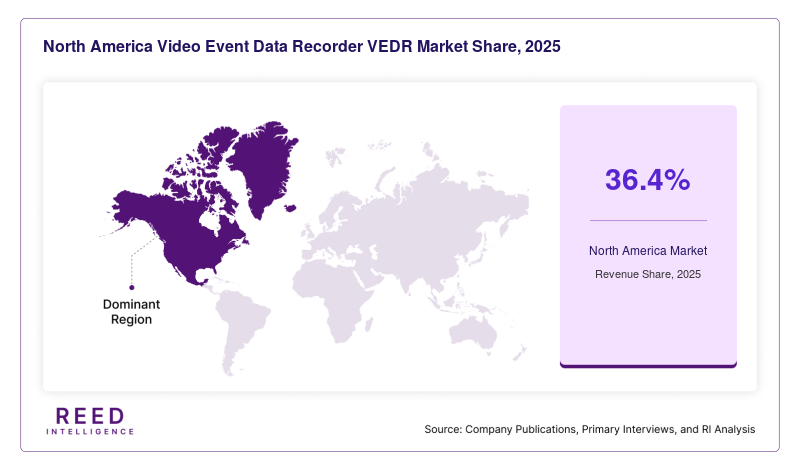
North America accounted for 36.4% of the Video Event Data Recorder VEDR Market in 2025 and is forecast to expand at a CAGR of 8.9% through 2034. Mature fleet telematics adoption, high insurance claim costs, and advanced connectivity infrastructure support strong regional demand. Commercial trucking, municipal transport, and school bus operators remain major buyers of multi-camera systems with analytics features.
The United States dominates the region due to its large logistics industry and extensive long-haul transport network. A unique growth factor is the strong presence of insurance-linked telematics programs that reward risk reduction. Fleets increasingly deploy VEDR platforms to negotiate lower premiums and strengthen legal defense in accident-related disputes.
Europe
Europe held 27.1% market share in 2025 and is projected to grow at a CAGR of 9.1% during the forecast period. Demand is supported by road safety standards, public transport modernization, and cross-border fleet operations. Transit buses, delivery vans, and construction fleets are key adopters across Western and Northern Europe.
Germany leads the European market due to its automotive technology ecosystem and commercial vehicle base. A unique growth factor is the region’s focus on industrial transport efficiency. Fleets increasingly use VEDR systems alongside route optimization and emissions planning tools, creating integrated digital fleet management demand.
Asia Pacific
Asia Pacific represented 23.8% of global revenue in 2025 and is expected to register the fastest CAGR of 11.6% through 2034. Rapid urbanization, e-commerce expansion, and growing vehicle parc volumes are supporting strong uptake. Price-competitive hardware manufacturing within the region also improves affordability.
China is the dominant country market because of its extensive logistics network and smart transportation investment. A unique growth factor is large-scale deployment across ride-hailing and urban delivery fleets. Operators use VEDR solutions to monitor service quality, driver conduct, and accident liability in dense cities.
Middle East & Africa
Middle East & Africa captured 7.2% share in 2025 and is forecast to grow at a CAGR of 9.8% through 2034. Demand is rising from public transport projects, mining fleets, oilfield logistics, and long-distance freight corridors. Harsh operating environments are increasing preference for ruggedized recorder systems.
Saudi Arabia leads the regional market due to transport diversification programs and infrastructure spending. A unique growth factor is fleet digitization linked to large construction and industrial developments. Contractors increasingly require onboard recording systems to manage safety compliance and vehicle utilization.
Latin America
Latin America accounted for 5.5% of market revenue in 2025 and is expected to expand at a CAGR of 10.1% during 2026–2034. Rising urban mobility demand, cargo security needs, and insurance fraud concerns are creating steady adoption across buses and commercial fleets.
Brazil dominates the region owing to its broad freight transportation sector and metropolitan bus networks. A unique growth factor is the need to improve cargo visibility across long domestic routes. Fleet operators increasingly deploy VEDR solutions to reduce theft claims and strengthen route accountability.
Competitive Landscape
The Video Event Data Recorder VEDR Market is moderately fragmented, with global telematics providers, camera specialists, and fleet software firms competing on hardware quality, analytics capability, and service networks. Lytx Inc. remains a market leader due to its broad commercial fleet customer base and advanced AI video safety platform. The company recently expanded predictive risk alert features for North American transport fleets.
Other notable participants include Samsara Inc., Motive Technologies, Garmin Ltd., and Pittasoft Co., Ltd. Vendors are increasingly launching subscription-led business models combining devices with cloud analytics. Strategic partnerships with insurers, OEMs, and logistics companies are common. Competition is also rising from lower-cost Asian manufacturers entering developing markets with compact connected recorder systems.
Key Players List
- Lytx Inc.
- Samsara Inc.
- Motive Technologies
- Garmin Ltd.
- Pittasoft Co., Ltd.
- Panasonic Holdings Corporation
- Honeywell International Inc.
- Bosch Mobility Solutions
- Continental AG
- Geotab Inc.
- Nauto Inc.
- Verizon Connect
- Azuga Inc.
- MiTAC Digital Technology
- DOD Tech Corporation
Recent Developments
- Lytx introduced upgraded AI collision-prevention alerts integrated with video evidence workflows.
- Samsara launched enhanced cloud video retrieval tools for multi-site fleet operators.
- Garmin expanded compact dual-camera recorder products for passenger and light commercial vehicles.
Video Event Data Recorder VEDR Market Segments
Component
- Hardware
- Software
- Services
Vehicle Type
- Commercial Vehicles
- Passenger Vehicles
Application
- Fleet Management
- Insurance Telematics
- Law Enforcement
- Public Transport Monitoring
- Personal Safety
By Region
- North America
- Europe
- APAC
- Middle East and Africa
- LATAM