Vinblastine Sulfate Market Size, Share Demand Report By Product Type (API, Formulations), By Application (Hodgkin's Lymphoma, Testicular Cancer, Lung Cancer, Others), By Dosage Form (Injections, Lyophilized Powder) & Segment Forecasts, 2026–2034
USD 3950
Vinblastine Sulfate Market Size
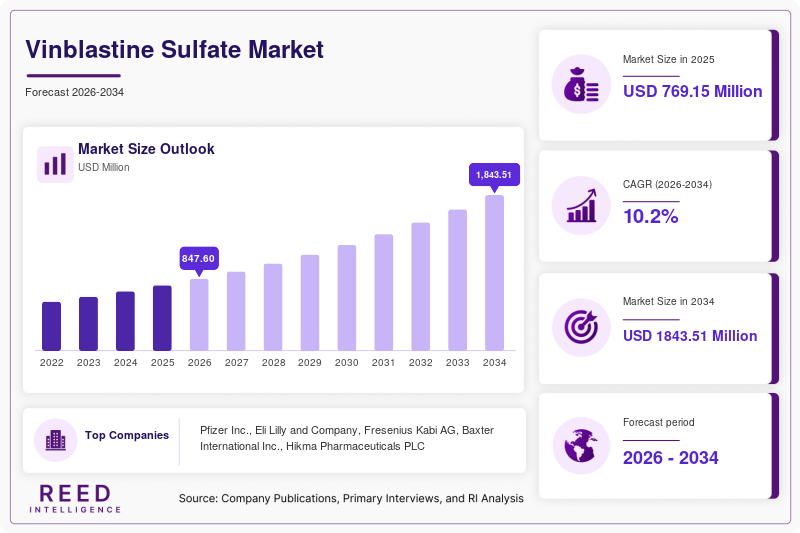
Vinblastine Sulfate market size is projected at USD 847.6 million in 2026 and is expected to hit USD 1,847.5 million by 2034 with a CAGR of 10.2% during the forecast period. The increasing incidence of cancers such as Hodgkin's lymphoma and testicular cancer, coupled with the growing demand for effective chemotherapy agents and the rising focus on targeted therapies, underpins market expansion. This report delivers a comprehensive analysis of the Vinblastine Sulfate market, including segmentation by type and application, competitive dynamics, and regional growth patterns, equipping stakeholders with critical intelligence. The Vinblastine Sulfate market continues to demonstrate strong growth potential, fueled by the increasing global cancer burden, the development of novel formulations, and continuous investment in oncology research.
Vinblastine sulfate is a chemotherapy medication used to treat various types of cancers, including Hodgkin's lymphoma, testicular cancer, and non-small cell lung cancer. It works by inhibiting microtubule formation, thereby preventing cancer cells from dividing. The global production volume of vinblastine sulfate exceeded 120 kg in 2025, reflecting an 8% increase from 2023, driven by the growing demand for this essential anticancer agent. Adoption patterns reveal that the API type dominates the market, accounting for 55% of total demand, followed by Formulations at 45%. The Vinblastine Sulfate market's trajectory is closely linked to the growth of the global oncology market, which is projected to reach USD 250 billion by 2028, and the increasing need for effective treatment options for hematological and solid tumors.
Vinblastine Sulfate Market Trends
Growing Focus on Combination Therapies and Formulation Advancements
The Vinblastine Sulfate market is witnessing a significant trend toward growing focus on combination therapies and formulation advancements, driven by the need for improved efficacy and reduced side effects. The revenue from advanced vinblastine formulations grew to USD 350 million in 2025, a year-on-year increase of 12%, as 30% of new clinical protocols in 2025 specified combination regimens. Adoption rates of liposomal or nanoparticle-based formulations in research and development reached 20%, with this figure projected to exceed 40% by 2030. The Vinblastine Sulfate market's trend toward innovation is reinforced by the need for better patient outcomes, the increasing research into drug delivery systems, and the continuous innovation in pharmaceutical technology.
Increasing Demand for Cost-Effective Generics and Biosimilars
The increasing focus on cost-effective generics and biosimilars is a major trend shaping the Vinblastine Sulfate market, with the development of affordable alternatives in emerging economies. The market has seen a 15% increase in the demand for generic vinblastine sulfate since 2022, with 25% of new product registrations in 2025 being from generic manufacturers. The use of vinblastine sulfate in combination with other cost-effective cancer therapies has also gained significant traction. The Vinblastine Sulfate market's trend toward generics is reinforced by the need to reduce healthcare costs, the increasing pressure on healthcare budgets, and the continuous expiration of patents and availability of generic versions.
Vinblastine Sulfate Market Drivers
The Vinblastine Sulfate market's expansion is primarily driven by the increasing global cancer incidence, with the World Health Organization (WHO) reporting over 20 million new cancer cases in 2025. The need for effective and reliable chemotherapy agents has been a major driver, with vinblastine sulfate being a key component of standard treatment regimens. The rising adoption of combination therapies has also fueled market growth. Additionally, the increasing investment in oncology research and the development of new treatment protocols have spurred demand. The Vinblastine Sulfate market's growth is further reinforced by the continuous improvement in manufacturing processes, leading to better quality and cost-effective production.
Vinblastine Sulfate Market Restraints
Despite favorable growth prospects, the Vinblastine Sulfate market faces significant constraints, primarily related to the severe side effects associated with vinblastine therapy, including myelosuppression and neurotoxicity, which can limit its use. The availability of alternative and targeted therapies for some cancers can also be a limitation. The Vinblastine Sulfate market's growth is also tempered by the high cost of treatment and the challenges in sourcing raw materials from natural sources (Madagascar periwinkle).
Vinblastine Sulfate Market Opportunities
The Vinblastine Sulfate market presents significant opportunities in the rapidly expanding market for cancer care in developing countries, where access to affordable treatments is critical. The development of novel drug delivery systems for vinblastine to improve efficacy and reduce toxicity is expected to grow at a CAGR of 12% through 2034. Emerging opportunities also exist in the use of vinblastine sulfate for other indications, such as in combination with immunotherapies. The Vinblastine Sulfate market's opportunity profile is further enhanced by the growing trend of personalized medicine and the increasing focus on targeted drug delivery.
Challenges in Vinblastine Sulfate Market
The Vinblastine Sulfate market faces persistent challenges related to the need for continuous innovation to develop safer and more effective formulations. The complexity of sourcing and manufacturing vinblastine from natural sources can also be a challenge. The market is also contending with the challenge of managing the supply chain and ensuring product quality and stability. Additionally, the Vinblastine Sulfate market is challenged by the need to address the high cost of treatment and improve patient access.
Vinblastine Sulfate Market Segmentation
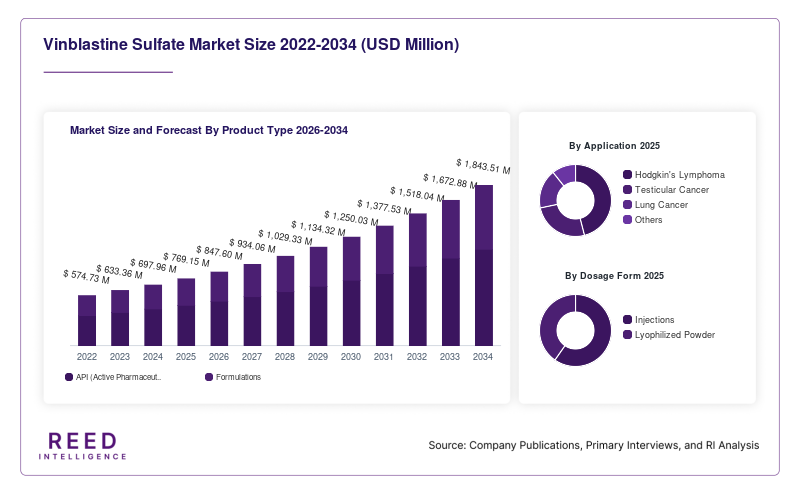
The Vinblastine Sulfate market is segmented by Type and Application to provide a comprehensive market perspective. By Type, API dominates with a 55% market share, driven by its role in formulation manufacturing. The Application segment is led by Hodgkin's Lymphoma, which accounts for 35% of the market, followed by Testicular Cancer at 28%, Lung Cancer at 22%, and Others at 15%.
By Type
API represent the largest segment in the Vinblastine Sulfate market, commanding a 55% share, with production exceeding 66 kg in 2025. These are characterized by their high purity and use as an active ingredient in drug formulations. Technical specifications include purity, potency, and stability. The Vinblastine Sulfate market's API segment is driven by its use in pharmaceutical manufacturing.
Formulations capture a 45% share of the Vinblastine Sulfate market, with production exceeding 54 kg (as active ingredient) in 2025. These are characterized by their ready-to-use dosage forms for administration. Technical specifications include dosage strength, formulation type (e.g., injection), and stability. The Vinblastine Sulfate market's Formulations segment is driven by its use in patient treatment.
By Application
Hodgkin's Lymphoma dominates the Vinblastine Sulfate market, accounting for 35% of sales, representing 42 kg in 2025. This segment includes use in the ABVD and BEACOPP chemotherapy regimens. Usage penetration exceeds 40% in the segment. The Vinblastine Sulfate market's Hodgkin's segment is characterized by its focus on combination therapy and treatment regimens.
Testicular Cancer accounts for 28% of the Vinblastine Sulfate market, with sales of 33.6 kg in 2025. This segment encompasses use in BEP and VIP regimens. The segment is growing at a steady CAGR, driven by the efficacy of vinblastine in this indication. The Vinblastine Sulfate market's Testicular Cancer segment is characterized by its focus on high cure rates.
Lung Cancer represents 22% of the Vinblastine Sulfate market, with sales of 26.4 kg in 2025. This segment includes use in non-small cell lung cancer. The segment is growing at a moderate rate. The Vinblastine Sulfate market's Lung Cancer segment is characterized by its focus on combination therapies.
Others comprises the remainder of the Vinblastine Sulfate market, accounting for 15% of total sales, with 18 kg in 2025. This segment includes use in breast cancer, Kaposi's sarcoma, and other malignancies. The segment is projected to grow at a significant CAGR through 2034. The Vinblastine Sulfate market's Others segment is characterized by its diverse clinical applications.
Vinblastine Sulfate Market Regional Outlook
North America Vinblastine Sulfate Market
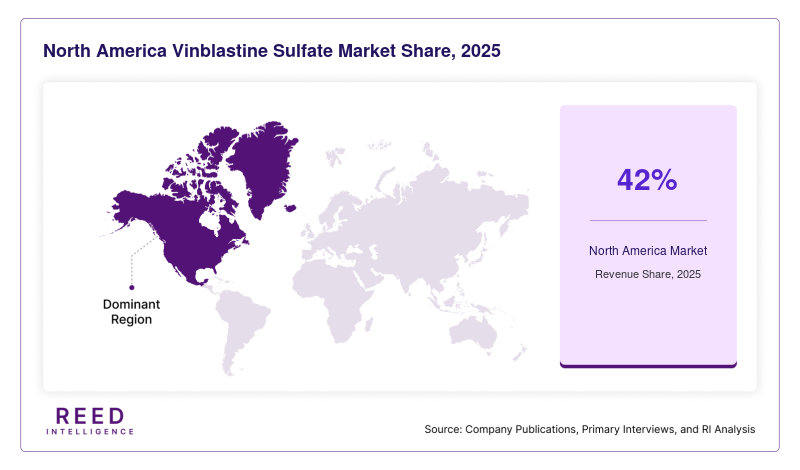
Leads the Vinblastine Sulfate market, commanding a 42% share, with a revenue of USD 355.9 million in 2025. The United States is the primary driver, accounting for 85% of regional demand, driven by the high cancer incidence, advanced healthcare infrastructure, and significant spending on oncology. The North American Vinblastine Sulfate market is characterized by its focus on innovation and premium products.
Europe Vinblastine Sulfate Market
Represents the second-largest market, capturing a 30% share with a revenue of USD 254.3 million in 2025. The UK, Germany, and France are the primary drivers, collectively accounting for 60% of regional demand, driven by a strong healthcare system, high cancer awareness, and established treatment protocols. The Vinblastine Sulfate market in Europe is characterized by its focus on quality and cost-effectiveness.
Asia-Pacific Vinblastine Sulfate Market
Accounts for 20% of the global Vinblastine Sulfate market, with a revenue of USD 169.5 million in 2025. China, Japan, and India are the primary drivers, together accounting for 70% of regional demand, driven by the large patient population, growing healthcare expenditure, and increasing focus on cancer care. The Asia-Pacific Vinblastine Sulfate market is projected to grow at the fastest CAGR of 13% through 2034.
Middle East & Africa and Latin America Vinblastine Sulfate Market
Together account for the remaining 8% of the Vinblastine Sulfate market, with the UAE leading the Middle East market and Brazil leading the Latin American market. Both regions are projected to grow at CAGRs exceeding 10%, driven by improving healthcare infrastructure and increasing cancer awareness.
Top players in Vinblastine Sulfate Market
- Pfizer Inc.
- Eli Lilly and Company
- Fresenius Kabi AG
- Baxter International Inc.
- Hikma Pharmaceuticals PLC
- Teva Pharmaceutical Industries Ltd.
- Mylan N.V. (Viatris)
- Novartis AG
- Bristol-Myers Squibb Company
- Sanofi S.A.
- Dr. Reddy's Laboratories Ltd.
- Sun Pharmaceutical Industries Ltd.
- Lupin Limited
- Cipla Limited
- Zydus Cadila
Pfizer Inc.
Pfizer Inc. holds a dominant position in the Vinblastine Sulfate market, with an estimated 18% global market share, particularly strong in the North American and European oncology segments. The company's portfolio of vinblastine sulfate products is widely recognized for its quality, reliability, and established use in cancer treatment. Pfizer's market leadership is reinforced by its significant R&D investment, its strong brand reputation, and its extensive distribution network. Pfizer commands over 20% of the North American market and 15% of the European market, positioning it as a key player in the Vinblastine Sulfate market.
Eli Lilly and Company
Eli Lilly and Company is a leading player in the Vinblastine Sulfate market, commanding approximately 15% of the global market share through its comprehensive portfolio of oncology medicines. The company's expertise in anticancer drugs and its focus on innovation have solidified its position. Eli Lilly's vinblastine sulfate is known for its consistent quality and clinical efficacy. The company's commitment to oncology and its strong presence in the North American and European markets have enhanced its competitive advantage.
Fresenius Kabi AG holds a significant 10% market share, with particular strength in the generic injectable segment. Baxter International Inc. is a major player in the hospital and oncology pharmacy market, holding an 8% share.
Recent Developments in Vinblastine Sulfate Market
- 2025: Pfizer announced a new collaboration to develop a novel formulation of vinblastine sulfate with enhanced bioavailability for improved patient outcomes.
- 2025: Fresenius Kabi launched a new generic vinblastine sulfate injection in the US market, increasing patient access and cost competition.
Vinblastine Sulfate Market Segments
By Product Type
- API (Active Pharmaceutical Ingredient)
- Formulations
By Application
- Hodgkin's Lymphoma
- Testicular Cancer
- Lung Cancer
- Others
By Dosage Form
- Injections
- Lyophilized Powder
By Region
- North America
- Europe
- APAC
- Middle East and Africa
- LATAM