Vinyl Acetate Ethylene Copolymer Powder Market Size, Share & Demand Report By Type (Standard VAE Powder, Modified VAE Powder), By Application (Tile Adhesives, Self-Leveling Compounds, Repair Mortars, Plasters, Others), By End-Use (Construction, Packaging, Textiles, Paints & Coatings, Others) By Region & Segment Forecasts, 2026–2034
USD 3950
Market Overview
The Vinyl Acetate Ethylene Copolymer Powder Market size was valued at USD 1.68 billion in 2026 and is projected to reach USD 2.96 billion by 2034, expanding at a CAGR of 7.3% during the forecast period (2026–2034). The market has experienced steady growth due to increasing demand across construction, packaging, textiles, and adhesives industries. Vinyl acetate ethylene (VAE) copolymer powders are widely utilized for their superior adhesion, flexibility, and water resistance properties, making them suitable for a wide range of industrial applications.
A significant global factor supporting market expansion is the consistent growth in infrastructure development and urbanization across emerging economies. Governments in Asia Pacific, the Middle East, and Latin America are investing heavily in housing and public infrastructure, thereby driving demand for construction chemicals, including tile adhesives, cement modifiers, and plasters where VAE powders play a crucial role. Additionally, rising awareness regarding eco-friendly materials has encouraged manufacturers to shift toward low-VOC polymer powders, further strengthening market demand.
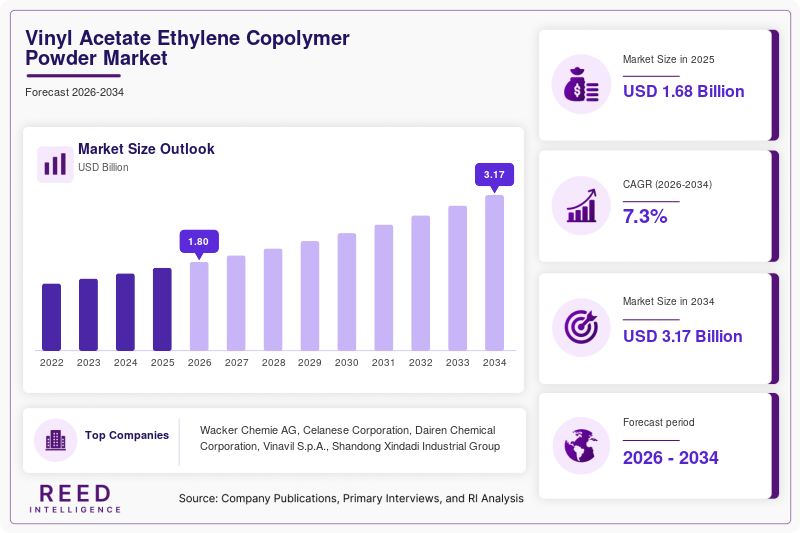
Key Highlights
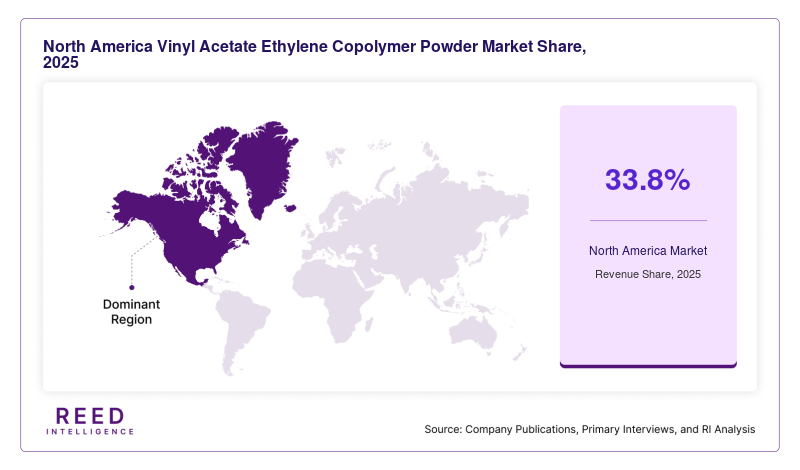
- North America dominated the market with a 33.8% share in 2025.
- Asia Pacific is expected to grow at the fastest CAGR of 8.6% during 2026–2034.
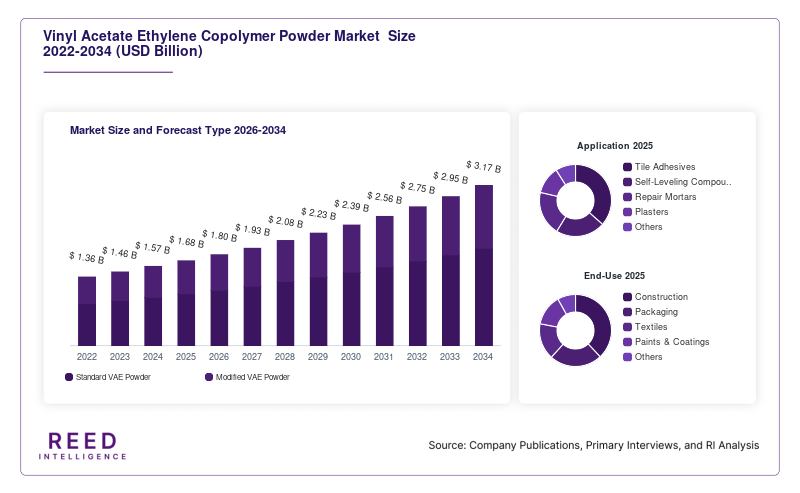
- By type, standard VAE powder accounted for the largest share of 44.2%, while modified VAE powder is projected to grow at a CAGR of 8.1%.
- By application, tile adhesives led with a 39.6% share, whereas self-leveling compounds are expected to expand at a CAGR of 8.4%.
- By end-use, construction dominated with a 51.3% share, while packaging is anticipated to grow at a CAGR of 7.9%.
- The United States remained the dominant country, with market values of USD 480 million in 2024 and USD 525 million in 2025.
Market Trends
Increasing Preference for Sustainable and Low-VOC Materials
The growing emphasis on environmentally friendly construction materials is shaping the Vinyl Acetate Ethylene Copolymer Powder Market. Manufacturers are focusing on producing low-volatile organic compound (VOC) formulations to comply with environmental regulations and green building standards. VAE powders are gaining traction as they offer reduced emissions while maintaining performance efficiency. This shift is particularly evident in developed markets where regulatory frameworks promote sustainable construction practices. Additionally, end-users are increasingly opting for eco-certified materials in residential and commercial projects, further driving the demand for environmentally compatible VAE products across applications such as tile adhesives, mortars, and coatings.
Expansion of Ready-Mix Construction Solutions
The increasing adoption of ready-mix and pre-formulated construction materials is another significant trend influencing the market. VAE copolymer powders are essential ingredients in dry-mix mortars and ready-to-use construction compounds due to their ability to improve flexibility, adhesion, and durability. Rapid urbanization and labor shortages in construction have encouraged contractors to use pre-mixed solutions that reduce on-site labor and enhance efficiency. This trend is especially strong in emerging economies where construction timelines are becoming shorter, and quality consistency is prioritized. As a result, manufacturers are developing customized VAE powder formulations tailored for specific ready-mix applications.
Market Drivers
Growth in Global Construction and Infrastructure Development
The expansion of the construction industry remains a primary driver for the Vinyl Acetate Ethylene Copolymer Powder Market. Increasing investments in residential housing, commercial complexes, and public infrastructure projects have created strong demand for construction chemicals. VAE powders are widely used in tile adhesives, wall putties, and cement-based formulations, where they enhance bonding strength and durability. Developing regions, particularly in Asia Pacific and the Middle East, are witnessing rapid urbanization, which is boosting construction activities. Government-led initiatives for affordable housing and smart city development further contribute to market growth by increasing consumption of VAE-based products.
Rising Demand from Adhesives and Packaging Industries
The growing use of VAE copolymer powders in adhesives and packaging applications is another key driver. These powders offer excellent film-forming properties and adhesion performance, making them suitable for paper, cardboard, and flexible packaging materials. The expansion of e-commerce and consumer goods industries has significantly increased the demand for efficient and durable packaging solutions. Additionally, VAE-based adhesives provide cost-effective and reliable bonding, which is essential for high-volume packaging operations. This increasing demand across multiple industries is expected to sustain long-term growth in the market.
Market Restraint
Volatility in Raw Material Prices and Supply Chain Challenges
Fluctuations in raw material prices pose a notable challenge to the Vinyl Acetate Ethylene Copolymer Powder Market. The production of VAE powders relies on petrochemical derivatives such as vinyl acetate monomer and ethylene, both of which are subject to price volatility due to changes in crude oil prices and global supply-demand dynamics. These fluctuations impact manufacturing costs and profit margins for producers. Additionally, disruptions in supply chains, particularly during geopolitical uncertainties or transportation constraints, can lead to inconsistent raw material availability. For instance, sudden price spikes or shortages can force manufacturers to adjust pricing strategies, affecting competitiveness and market stability.
Market Opportunities
Growing Adoption in Emerging Economies
Emerging economies present significant opportunities for the Vinyl Acetate Ethylene Copolymer Powder Market due to increasing industrialization and infrastructure development. Countries in Asia Pacific, Latin America, and Africa are experiencing rising demand for modern construction materials, driven by population growth and urban expansion. VAE powders are gaining popularity in these regions due to their cost-effectiveness and performance benefits. Manufacturers are expanding their presence in these markets through strategic partnerships and local production facilities to meet growing demand and reduce logistics costs.
Technological Advancements in Polymer Formulations
Continuous advancements in polymer technology are creating new growth opportunities in the market. Manufacturers are investing in research and development to enhance the performance characteristics of VAE powders, including improved water resistance, flexibility, and compatibility with various substrates. These innovations enable the development of specialized products tailored for niche applications such as high-performance coatings and advanced adhesives. Furthermore, the integration of nanotechnology and functional additives is expected to expand the application scope of VAE powders, providing additional growth avenues for industry players.
Segmental Analysis
By Type
Standard VAE powder emerged as the dominant subsegment, accounting for 44.2% of the market share in 2024. This segment benefits from its widespread use across construction and adhesive applications due to its balanced performance characteristics and cost-effectiveness. Standard VAE powders offer adequate adhesion, flexibility, and water resistance, making them suitable for general-purpose applications such as tile adhesives, plasters, and wall putties. Their ease of formulation and compatibility with various substrates further contribute to their high adoption. Additionally, the availability of standard grades in large volumes ensures consistent supply and competitive pricing, which supports their dominant position in the market.
Modified VAE powder is the fastest-growing subsegment, projected to expand at a CAGR of 8.1% during the forecast period. These powders are engineered to provide enhanced performance characteristics, including improved water resistance, higher tensile strength, and better flexibility. The increasing demand for high-performance construction materials in specialized applications, such as self-leveling compounds and advanced adhesives, is driving the growth of this segment. Manufacturers are focusing on developing customized formulations to meet specific industry requirements, further accelerating adoption.
By Application
Tile adhesives dominated the application segment, accounting for a 39.6% share in 2024. The widespread use of VAE powders in tile adhesives is attributed to their ability to enhance bonding strength, flexibility, and durability. With the growing demand for modern construction materials and increasing adoption of ceramic and porcelain tiles, the use of VAE-based tile adhesives has increased significantly. Additionally, the shift toward ready-mix construction solutions has further boosted the demand for VAE powders in this application.
Self-leveling compounds are expected to be the fastest-growing application segment, with a CAGR of 8.4% during the forecast period. These compounds require high-performance additives to ensure smooth surfaces and durability, making VAE powders an essential component. The increasing use of self-leveling compounds in commercial and residential construction projects is driving demand. Furthermore, the growing trend of modern flooring solutions and renovation activities is expected to support the expansion of this segment.
By End-Use
The construction sector dominated the end-use segment, accounting for 51.3% of the market share in 2024. VAE powders are extensively used in construction applications such as adhesives, mortars, and coatings due to their ability to improve performance characteristics. The growth of the construction industry, particularly in emerging economies, has significantly increased the demand for VAE-based products. Additionally, the shift toward sustainable and energy-efficient building materials has further strengthened the adoption of VAE powders in construction applications.
The packaging industry is projected to be the fastest-growing end-use segment, with a CAGR of 7.9% during the forecast period. The increasing demand for efficient and durable packaging solutions, driven by the growth of e-commerce and consumer goods industries, is a key factor supporting this segment. VAE powders are used in adhesives for paper and cardboard packaging, providing strong bonding and flexibility. The growing emphasis on sustainable packaging materials is also expected to drive demand for VAE-based adhesives.
Regional Analysis
North America
North America accounted for a 33.8% share of the Vinyl Acetate Ethylene Copolymer Powder Market in 2025 and is projected to grow at a CAGR of 6.5% during the forecast period. The region benefits from established construction and packaging industries, along with high adoption of advanced materials. Demand for VAE powders is driven by renovation and remodeling activities, particularly in residential and commercial buildings. Additionally, the presence of major manufacturers and technological advancements contributes to market stability and steady growth.
The United States dominates the regional market due to its strong construction sector and high demand for eco-friendly materials. A key growth factor is the increasing focus on sustainable building practices, supported by stringent environmental regulations. The country’s emphasis on green construction and energy-efficient buildings has accelerated the adoption of low-VOC VAE powders in various applications, including adhesives and coatings.
Europe
Europe held a 26.7% share of the market in 2025 and is expected to grow at a CAGR of 6.2% through 2034. The region’s growth is supported by stringent environmental regulations and high demand for sustainable construction materials. Countries such as Germany, France, and the UK are investing in infrastructure modernization and renovation projects, driving the demand for VAE-based products. Additionally, the presence of established chemical industries ensures consistent supply and innovation in polymer technologies.
Germany leads the European market due to its advanced manufacturing capabilities and strong construction sector. A unique growth factor is the country’s focus on energy-efficient buildings and sustainable infrastructure. Government initiatives promoting eco-friendly construction materials have significantly increased the adoption of VAE copolymer powders in adhesives and mortars, supporting long-term market growth.
Asia Pacific
Asia Pacific is the fastest-growing region, with a CAGR of 8.6% during 2026–2034, and accounted for 24.9% of the market in 2025. Rapid urbanization, population growth, and increasing construction activities are major factors driving demand in the region. Countries such as China, India, and Southeast Asian nations are witnessing significant investments in infrastructure and housing projects, which are boosting the consumption of VAE powders.
China dominates the Asia Pacific market due to its large-scale construction industry and manufacturing base. A key growth factor is the country’s extensive infrastructure development programs, including urban expansion and transportation projects. The increasing demand for high-performance construction materials has led to widespread adoption of VAE copolymer powders in various applications.
Middle East & Africa
The Middle East & Africa region accounted for 7.8% of the market in 2025 and is projected to grow at a CAGR of 7.1%. The market is driven by increasing investments in construction and infrastructure development, particularly in Gulf Cooperation Council countries. The demand for VAE powders is rising in applications such as tile adhesives and waterproofing solutions due to extreme climatic conditions.
Saudi Arabia is the leading country in the region, supported by large-scale construction projects and economic diversification initiatives. A unique growth factor is the country’s focus on mega infrastructure projects and smart city developments, which require high-quality construction materials. This has significantly increased the demand for VAE-based products.
Latin America
Latin America held a 6.8% share of the market in 2025 and is expected to grow at a CAGR of 6.9% during the forecast period. The region’s growth is supported by increasing construction activities and rising demand for modern building materials. Countries such as Brazil and Mexico are investing in infrastructure development, which is driving the consumption of VAE powders.
Brazil dominates the Latin American market due to its expanding construction sector and growing urban population. A key growth factor is the government’s focus on housing development programs and infrastructure improvements. These initiatives have increased the demand for cost-effective and high-performance construction materials, including VAE copolymer powders.
Competitive Landscape
The Vinyl Acetate Ethylene Copolymer Powder Market is moderately consolidated, with several global and regional players competing on product quality, innovation, and pricing. Leading companies are focusing on expanding their production capacities and strengthening their distribution networks to meet increasing demand. Strategic partnerships, mergers, and acquisitions are also common as companies aim to enhance their market presence and technological capabilities.
A prominent market leader is Wacker Chemie AG, which has a strong global presence and extensive product portfolio. The company has recently invested in expanding its production capacity for VAE powders to meet growing demand from the construction and adhesives industries. Other major players are also focusing on developing advanced polymer formulations and sustainable products to gain a competitive edge. Continuous innovation and investment in research and development remain key strategies among market participants.
Key Players
- Wacker Chemie AG
- Celanese Corporation
- Dairen Chemical Corporation
- Vinavil S.p.A.
- Shandong Xindadi Industrial Group
- Sinopec Corporation
- Hexion Inc.
- Akzo Nobel N.V.
- Arkema S.A.
- Dow Inc.
- BASF SE
- Hubei Xindadi Chemical Co., Ltd.
- Shanxi Sanwei Group
- Guangdong Broadwin Advanced Materials
- Zhejiang Wanwei Polymer
Recent Developments
- Wacker Chemie AG expanded its VAE powder production capacity in Asia to strengthen its regional supply chain and meet increasing demand.
- Celanese Corporation introduced a new range of high-performance VAE powders designed for advanced construction applications, focusing on improved durability and flexibility.
- Arkema S.A. invested in research and development to enhance sustainable polymer solutions, including low-VOC VAE powders for environmentally friendly construction materials.
Vinyl Acetate Ethylene Copolymer Powder Market Segments
Type
- Standard VAE Powder
- Modified VAE Powder
Application
- Tile Adhesives
- Self-Leveling Compounds
- Repair Mortars
- Plasters
- Others
End-Use
- Construction
- Packaging
- Textiles
- Paints & Coatings
- Others
By Region
- North America
- Europe
- APAC
- Middle East and Africa
- LATAM