Virtual Account System Market Size, Share & Demand Report By Component (Software Platforms, Managed Services, Professional Services), By Deployment Mode (Cloud-Based, On-Premise, Hybrid), By Enterprise Size (Large Enterprises, Small and Medium-Sized Enterprises), By End Use (Banking and Financial Services, Retail and E-Commerce, Manufacturing, Healthcare, Logistics and Transportation, IT and Telecommunications, Others), By Region & Segment Forecasts, 2026–2034
USD 3950
Market Overview
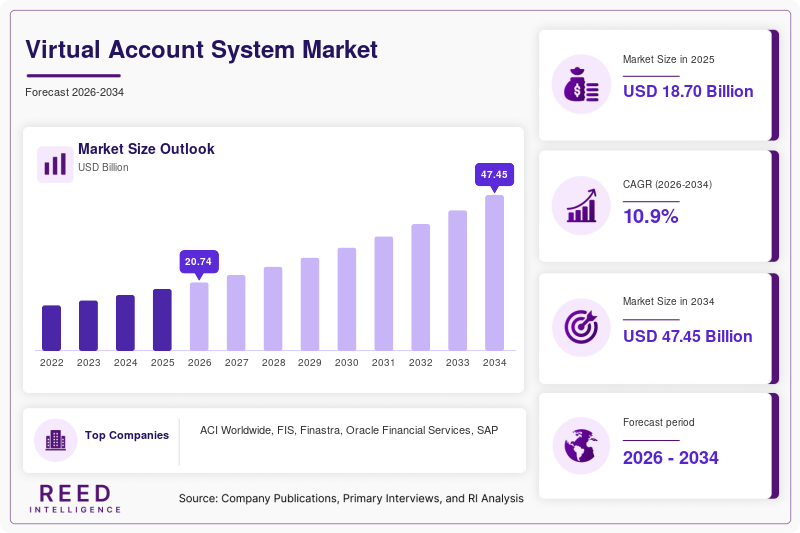
The global Virtual Account System Market size was valued at USD 18.7 billion in 2026 and is projected to reach USD 42.8 billion by 2034, expanding at a CAGR of 10.9% during the forecast period from 2026 to 2034. The market is witnessing strong momentum due to the growing demand for digital treasury management, automated reconciliation systems, and centralized payment infrastructure across multinational enterprises and financial institutions. Virtual account systems allow organizations to assign unique digital account identifiers to customers, business units, and payment streams while linking them to a centralized physical account structure. These systems improve transaction visibility, optimize liquidity management, and reduce operational complexity for enterprises handling large transaction volumes across multiple regions.
The rapid expansion of digital banking infrastructure and real-time payment ecosystems has remained a major global factor supporting the growth of the Virtual Account System Market. Enterprises operating in retail, manufacturing, logistics, healthcare, and financial services are increasingly investing in virtual account platforms to improve payment automation and treasury efficiency. Financial institutions are also expanding API-enabled banking capabilities to support embedded finance models and seamless transaction management. The growing use of cloud-based enterprise resource planning systems and cross-border digital payment solutions has further strengthened market demand across developed and emerging economies.
Key Highlights
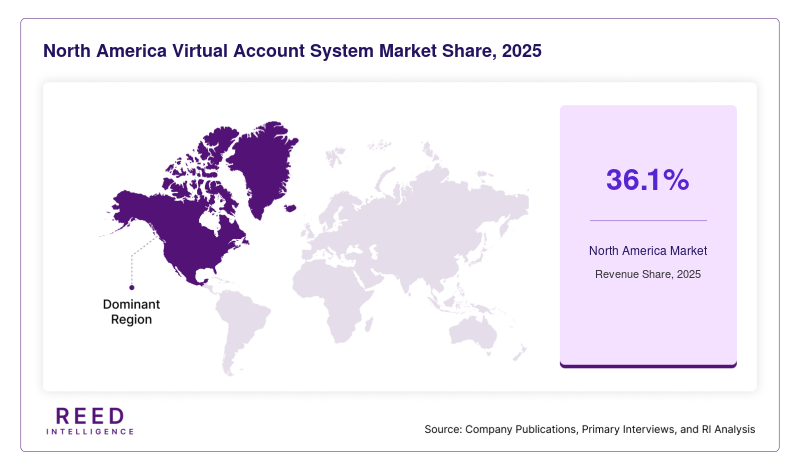
- North America dominated the market with a 36.1% share in 2025, while Asia Pacific is expected to grow at the fastest CAGR of 12.3% during 2026–2034.
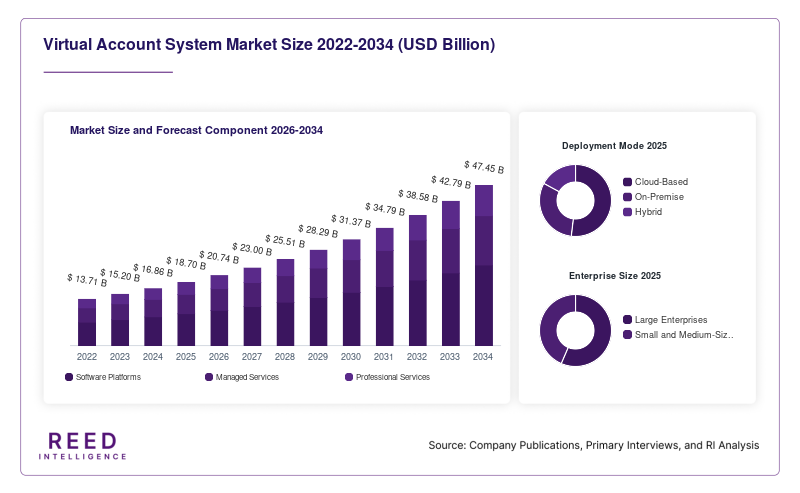
- By component, software platforms accounted for the largest share of 45.2%, while managed services are projected to grow at a CAGR of 13.1%.
- By deployment mode, cloud-based solutions led with a 59.4% share, whereas hybrid deployment is expected to expand at a CAGR of 11.8%.
- By end use, banking and financial services held a 40.3% share, while e-commerce and digital retail are anticipated to grow at a CAGR of 12.9%.
- The United States remained the dominant country, with market values of USD 5.1 billion in 2024 and USD 5.8 billion in 2025.
Market Trends
Rising Integration of Real-Time Payment Infrastructure
The increasing deployment of real-time payment infrastructure is shaping the growth trajectory of the Virtual Account System Market. Financial institutions and multinational enterprises are adopting real-time settlement capabilities to improve transaction speed, reduce reconciliation delays, and strengthen treasury visibility. Virtual account systems enable organizations to allocate incoming payments automatically while maintaining centralized liquidity control. Businesses operating across multiple geographic markets are increasingly using these platforms to manage large transaction volumes efficiently and minimize operational errors associated with traditional banking structures.
The trend has become particularly visible in regions implementing open banking regulations and instant payment frameworks. Financial institutions are integrating API-driven virtual account platforms with treasury management systems and digital banking services to improve customer experience and transaction transparency. Enterprises are also prioritizing automated cash allocation tools to strengthen working capital management and financial forecasting capabilities. The continued growth of e-commerce transactions and cross-border payment ecosystems is expected to accelerate the adoption of real-time virtual account solutions during the forecast period.
Growing Adoption of Artificial Intelligence in Treasury Operations
Artificial intelligence and advanced analytics technologies are becoming increasingly important within the Virtual Account System Market. Enterprises are deploying AI-enabled treasury management platforms capable of automating reconciliation workflows, identifying transaction anomalies, and forecasting liquidity requirements. Virtual account systems integrated with predictive analytics help organizations improve financial visibility while reducing manual intervention across payment management operations. Businesses handling complex transaction environments are increasingly adopting intelligent account management solutions to improve operational efficiency and minimize reconciliation errors.
Financial institutions are also investing in AI-driven fraud detection and compliance monitoring tools integrated within virtual account platforms. These technologies enable organizations to identify suspicious payment activity in real time and improve regulatory reporting capabilities. Automated reporting dashboards and intelligent transaction categorization systems are supporting faster financial decision-making across large enterprises. As digital payment volumes continue to increase globally, businesses are expected to prioritize scalable virtual account solutions equipped with intelligent automation and predictive treasury analytics capabilities.
Market Drivers
Increasing Demand for Automated Cash Management Systems
The growing complexity of global treasury operations is a major factor driving the Virtual Account System Market. Large enterprises operating across multiple regions and subsidiaries require centralized systems capable of improving cash visibility and automating payment reconciliation processes. Traditional account management structures often involve fragmented banking relationships and manual reconciliation workflows that increase operational inefficiencies. Virtual account systems simplify treasury operations by linking multiple digital account identifiers to a centralized physical account, allowing organizations to monitor payment flows more effectively.
Businesses in sectors including retail, logistics, healthcare, and manufacturing are increasingly adopting automated cash management platforms to improve financial transparency and reduce administrative workloads. Automated reconciliation capabilities help finance departments accelerate reporting cycles and improve liquidity forecasting accuracy. Financial institutions are also introducing advanced treasury services integrated with virtual account functionality to support corporate customers managing large transaction volumes. Rising demand for operational efficiency and centralized liquidity management is expected to continue supporting market growth throughout the forecast period.
Expansion of Digital Banking and Embedded Finance Platforms
The rapid expansion of digital banking services and embedded finance ecosystems is significantly contributing to the growth of the Virtual Account System Market. Financial institutions and fintech companies are increasingly offering integrated payment and banking solutions through digital platforms, creating demand for advanced account management infrastructure. Virtual account systems support automated payment tracking, customer-level transaction segregation, and real-time settlement visibility, making them essential for modern digital finance ecosystems.
The growth of subscription-based services, online marketplaces, and mobile commerce platforms has further increased the need for scalable payment management systems. Enterprises managing high transaction volumes require automated account structures capable of supporting multi-currency operations and seamless reconciliation. Financial technology providers are integrating virtual account functionality within digital wallets, payment gateways, and Banking-as-a-Service platforms to improve operational flexibility and customer engagement. As organizations continue adopting digital-first financial strategies, the market for virtual account systems is expected to experience sustained expansion across both developed and emerging economies.
Market Restraint
Data Privacy Risks and Complex Regulatory Compliance Requirements
Data privacy concerns and evolving financial regulations continue to restrain the growth of the Virtual Account System Market. Virtual account platforms process large volumes of sensitive financial information, making cybersecurity and regulatory compliance critical challenges for service providers and enterprise users. Financial institutions must comply with strict anti-money laundering regulations, payment security standards, and regional data protection frameworks while managing high transaction volumes across multiple jurisdictions. These compliance requirements often increase implementation complexity and operational expenses.
Organizations operating in highly regulated industries such as banking, healthcare, and insurance remain cautious about migrating treasury operations to cloud-based virtual account environments due to concerns regarding unauthorized access and cyber threats. Small and medium-sized enterprises may also face implementation barriers related to cybersecurity investment, employee training, and integration with legacy systems. For example, multinational corporations operating across Europe and Asia often require region-specific compliance configurations to meet varying financial reporting standards. These factors can extend deployment timelines and reduce adoption rates in markets where digital banking infrastructure and cybersecurity frameworks are still developing.
Market Opportunities
Expansion of Cross-Border Digital Commerce Ecosystems
The rapid expansion of cross-border digital commerce is creating substantial opportunities for the Virtual Account System Market. Multinational enterprises increasingly require centralized payment management systems capable of handling multi-currency transactions, international supplier payments, and regional tax structures. Virtual account systems simplify cross-border transaction management by enabling automated reconciliation and centralized liquidity visibility across global business operations. Businesses involved in e-commerce, manufacturing, logistics, and international trade are increasingly adopting these platforms to improve treasury efficiency and reduce transaction processing delays.
Financial institutions are introducing advanced cross-border payment services integrated with virtual account functionality to support faster settlements and transparent transaction tracking. Online marketplaces and global subscription-based businesses also require scalable payment infrastructure capable of managing high transaction volumes across multiple countries. The growing demand for digital trade finance and automated treasury management solutions is expected to create long-term growth opportunities for virtual account platform providers operating in international payment ecosystems.
Rising Adoption of Banking-as-a-Service Platforms
The increasing popularity of Banking-as-a-Service and embedded finance platforms is generating strong growth opportunities for the Virtual Account System Market. Fintech companies are collaborating with traditional financial institutions to deliver integrated payment services, digital wallets, and automated financial management capabilities to enterprise customers. Virtual account systems play an essential role within these ecosystems by supporting customer-level transaction segregation and automated cash allocation functions.
Cloud-native virtual account platforms enable fintech providers to deploy scalable payment infrastructure without maintaining extensive physical banking networks. Businesses operating digital marketplaces, travel platforms, insurance portals, and online subscription services increasingly rely on Banking-as-a-Service ecosystems to improve customer experience and payment transparency. Financial institutions are also investing in API-enabled virtual account services to expand revenue streams and strengthen digital banking capabilities. As open banking regulations continue to evolve globally, the demand for flexible virtual account infrastructure within embedded finance ecosystems is expected to increase significantly.
Segmental Analysis
By Component
Software platforms accounted for the largest share of the Virtual Account System Market in 2024, representing approximately 45.2% of total industry revenue. Enterprises across banking, retail, logistics, and healthcare sectors increasingly adopted software-based virtual account solutions to automate reconciliation and improve treasury visibility. These platforms support centralized transaction monitoring, customer-specific payment allocation, and real-time reporting capabilities. Large organizations managing high transaction volumes preferred integrated software systems because they improve operational efficiency and reduce manual accounting workloads. Financial institutions also invested heavily in API-driven virtual account software to strengthen cash management services and improve transaction transparency for enterprise customers.
Cloud-native software systems gained additional traction due to their scalability and compatibility with accounting software, payment gateways, and enterprise resource planning platforms. Businesses benefit from improved accessibility, automated updates, and centralized liquidity management within cloud-based environments. The increasing demand for digital treasury modernization and automated financial workflows significantly contributed to the dominant market position of software platforms throughout 2024. Rising adoption of artificial intelligence and predictive analytics within treasury management software is expected to continue supporting long-term segment growth.
By Deployment Mode
Cloud-based deployment held the dominant share of the Virtual Account System Market in 2024, accounting for approximately 59.4% of total market revenue. Organizations increasingly adopted cloud-hosted virtual account platforms because they provide scalability, lower infrastructure costs, remote accessibility, and simplified software management. Enterprises operating across multiple regions preferred cloud systems for centralized payment visibility and automated treasury management capabilities. Financial institutions also accelerated cloud migration initiatives to improve operational flexibility and strengthen digital banking services for corporate clients.
Cloud-based systems integrate efficiently with payment gateways, accounting software, and enterprise resource planning platforms, enabling seamless transaction automation and reconciliation. Businesses benefit from improved collaboration between finance departments and real-time access to treasury data across multiple business units. The growing adoption of software-as-a-service financial solutions and increasing investment in digital banking transformation significantly contributed to the leading position of cloud deployment models. Rising demand for centralized liquidity visibility and automated cash management is expected to continue supporting cloud adoption across global enterprises.
By End Use
Banking and financial services represented the leading end-use segment in the Virtual Account System Market in 2024, accounting for nearly 40.3% of global revenue. Banks and financial institutions increasingly adopted virtual account systems to improve customer payment tracking, automate reconciliation processes, and strengthen treasury management services. These platforms enable institutions to offer advanced liquidity management solutions for corporate clients managing large transaction volumes across domestic and international operations. Financial institutions also integrated virtual account capabilities within API-enabled digital banking ecosystems to improve transaction transparency and operational efficiency.
The increasing adoption of real-time payment infrastructure and embedded finance services further accelerated demand within the banking and financial services segment. Large commercial banks invested heavily in digital treasury modernization projects to reduce manual operational workloads and improve cash management capabilities. Rising competition within the financial services industry encouraged institutions to introduce innovative virtual account-based payment and reconciliation services. The continued expansion of digital banking and open finance ecosystems is expected to maintain strong growth within this segment during the forecast period.
Regional Analysis
North America
North America accounted for 36.1% of the global Virtual Account System Market in 2025 and is projected to grow at a CAGR of 10.1% during the forecast period. The region benefits from advanced digital banking infrastructure, high enterprise technology adoption, and strong demand for automated treasury management solutions. Financial institutions across the United States and Canada are investing heavily in API-driven payment systems and real-time transaction platforms to improve customer experience and operational efficiency. Large enterprises are increasingly adopting virtual account systems to streamline reconciliation processes and improve liquidity visibility across multi-entity operations.
The United States remained the dominant country in the regional market due to the strong presence of multinational banks, fintech firms, and enterprise software providers. A unique growth factor supporting market expansion is the increasing adoption of embedded finance solutions across digital commerce and subscription-based business models. Enterprises operating online marketplaces and SaaS platforms are integrating virtual account capabilities to automate customer payment tracking and improve transaction transparency. The rapid expansion of instant payment systems is also contributing to long-term market development.
Europe
Europe represented a significant share of the Virtual Account System Market in 2025 and is expected to expand at a CAGR of 9.7% through 2034. The region is benefiting from widespread implementation of open banking frameworks and strong regulatory support for digital financial innovation. Countries including Germany, the United Kingdom, France, and the Netherlands are witnessing increasing deployment of virtual account systems across banking, manufacturing, and retail industries. Financial institutions are modernizing treasury management infrastructure to improve transaction visibility and comply with evolving digital payment regulations.
The United Kingdom emerged as the dominant country within Europe due to its advanced fintech ecosystem and strong adoption of cloud-based banking technologies. One unique growth factor supporting regional market expansion is the increasing integration of virtual account functionality within digital treasury and cash management services offered by commercial banks. Enterprises are adopting these systems to automate reconciliation and improve working capital management. Rising investment in financial technology innovation and digital payment modernization continues to strengthen the market outlook across Europe.
Asia Pacific
Asia Pacific is expected to register the fastest CAGR of 12.3% in the Virtual Account System Market during the forecast period. Rapid digital transformation, expanding e-commerce ecosystems, and increasing adoption of mobile payment technologies are major contributors to regional growth. Countries such as China, India, Japan, Singapore, and Australia are investing heavily in real-time payment infrastructure and digital banking modernization initiatives. Enterprises operating across manufacturing, logistics, and retail sectors are increasingly implementing virtual account systems to improve treasury visibility and automate transaction management processes.
China remained the leading country in the Asia Pacific market due to the extensive scale of its digital commerce ecosystem and strong fintech innovation environment. A unique growth factor driving regional demand is the increasing adoption of virtual account systems by online marketplaces and platform-based businesses handling large customer transaction volumes. Organizations require automated reconciliation tools capable of managing multiple payment streams efficiently. Government support for digital financial infrastructure and smart payment technologies is expected to continue accelerating market growth across the region.
Middle East & Africa
The Middle East & Africa Virtual Account System Market is experiencing stable growth and is projected to expand at a CAGR of 8.9% from 2026 to 2034. The region is benefiting from rising investment in digital banking services, financial technology ecosystems, and smart infrastructure development projects. Financial institutions are increasingly adopting virtual account platforms to improve payment transparency and automate treasury operations for corporate customers. Businesses operating in sectors including logistics, energy, and international trade are implementing digital cash management systems to improve operational efficiency.
The United Arab Emirates emerged as the dominant country within the region due to its advanced banking infrastructure and expanding fintech investment landscape. One unique growth factor supporting regional market development is the increasing focus on smart government initiatives and cashless economy programs. Enterprises are integrating virtual account platforms with digital invoicing systems and automated payment services to strengthen transaction visibility. Growing adoption of electronic corporate banking services and cross-border trade platforms is expected to support continued market expansion across the Middle East and Africa.
Latin America
Latin America accounted for a moderate share of the Virtual Account System Market in 2025 and is projected to grow at a CAGR of 8.5% throughout the forecast period. The region is benefiting from increasing adoption of digital payment technologies, expanding fintech ecosystems, and growing investment in banking modernization initiatives. Countries including Brazil, Mexico, and Chile are witnessing rising deployment of cloud-based treasury management platforms across financial institutions and retail enterprises. Businesses are increasingly using virtual account systems to improve reconciliation efficiency and strengthen cash flow management operations.
Brazil remained the dominant country within the Latin American market due to the rapid growth of digital banking and instant payment ecosystems. A unique growth factor supporting regional market expansion is the increasing focus on financial inclusion initiatives encouraging digital transaction adoption among consumers and small businesses. Financial institutions are introducing innovative payment services integrated with virtual account functionality to improve customer engagement and operational efficiency. Expanding cross-border trade activity is also creating demand for scalable treasury management infrastructure across the region.
Competitive Landscape
The Virtual Account System Market is moderately consolidated, with global banking technology providers and fintech companies competing through cloud innovation, API integration, and automated treasury management capabilities. Major vendors are focusing on real-time payment processing, artificial intelligence integration, and cybersecurity enhancements to strengthen their competitive positioning. Strategic collaborations between financial institutions and technology providers are becoming increasingly common as organizations seek to expand digital banking services and improve customer transaction visibility.
ACI Worldwide remained one of the leading companies in the market due to its extensive portfolio of payment automation and digital banking solutions. In 2025, the company expanded its cloud-native treasury management capabilities to support multinational enterprises managing complex cross-border transaction environments. Other major participants including FIS, Finastra, Oracle Financial Services, SAP, and Temenos are actively investing in API-driven virtual account systems and AI-enabled treasury analytics platforms.
Key Players
- ACI Worldwide
- FIS
- Finastra
- Oracle Financial Services
- SAP
- Temenos
- Kyriba
- Trovata
- HSBC Holdings plc
- Citibank
- JPMorgan Chase & Co.
- DBS Bank Ltd.
- Standard Chartered
- Bottomline Technologies
- Infosys Finacle
Recent Developments
- In February 2026, Finastra introduced an upgraded cloud-native virtual account management platform designed to support automated reconciliation and real-time payment tracking for multinational enterprises.
- In July 2025, ACI Worldwide partnered with a major international bank to expand API-enabled virtual account services across North America and Europe for corporate treasury clients.
- In October 2025, Oracle Financial Services launched enhanced AI-powered treasury analytics capabilities within its digital transaction banking platform to improve liquidity forecasting and fraud monitoring.
- In March 2026, HSBC expanded its virtual account infrastructure across Asia Pacific to support cross-border digital commerce and multi-currency payment settlements for enterprise customers.
- In December 2025, SAP integrated advanced virtual account functionality into its enterprise finance management platform to improve centralized cash visibility and automated payment processing.
Virtual Account System Market Segments
Component
- Software Platforms
- Managed Services
- Professional Services
Deployment Mode
- Cloud-Based
- On-Premise
- Hybrid
Enterprise Size
- Large Enterprises
- Small and Medium-Sized Enterprises
By Region
- North America
- Europe
- APAC
- Middle East and Africa
- LATAM