Virtual Health Influencer Market Size, Share, Demand Report By Technology Type (AI-Generated Avatars, Hybrid Virtual-Human Models, Emotionally Responsive AI Personas), By Application (Health Education & Awareness, Mental Wellness Engagement,), By End-Use (Healthcare Providers, Pharmaceutical Companies, Insurance Firms, Digital Wellness Platforms, Government Health Agencies), By Region & Segment Forecasts, 2026–2034
USD 3950
Market Overview
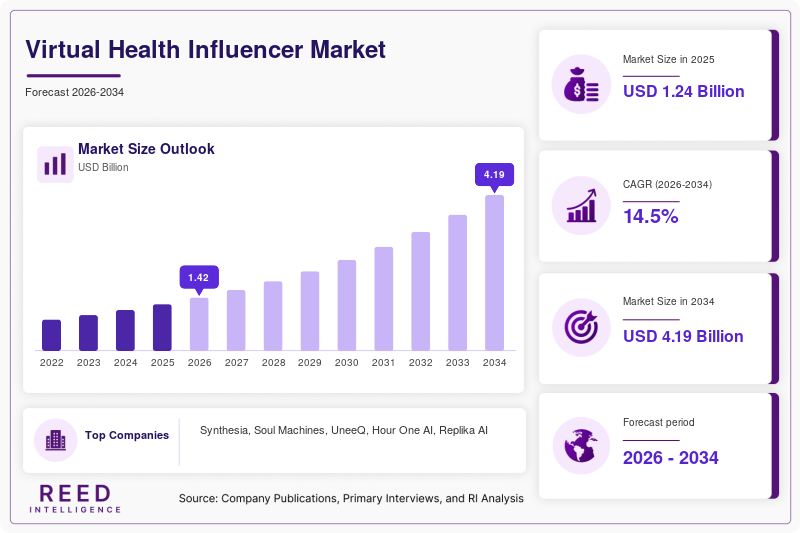
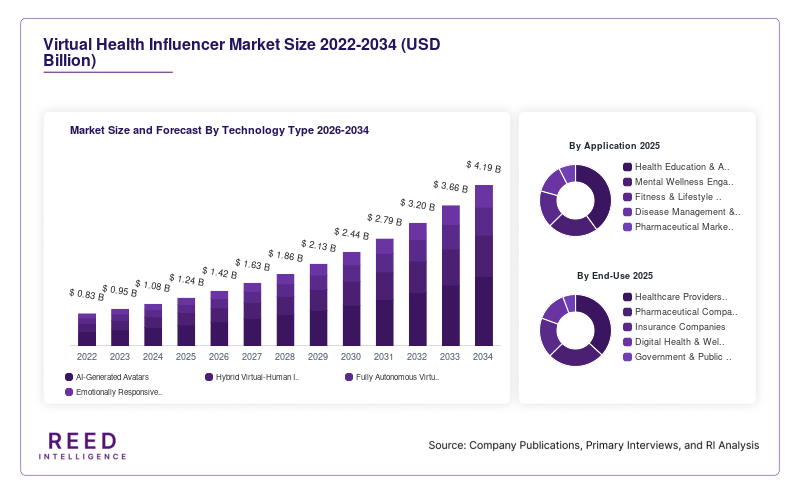
The Virtual Health Influencer Market size is estimated at USD 1.42 billion, and it is projected to reach USD 4.18 billion by 2034, registering a CAGR of 14.5% (2026–2034). Growth is primarily driven by the rapid adoption of digital health ecosystems, where healthcare providers, pharmaceutical companies, and wellness brands leverage virtual influencers to improve outreach efficiency and trust-building among digitally active populations.
One of the most influential global growth factors is the increasing penetration of artificial intelligence and immersive technologies such as augmented reality (AR) and virtual reality (VR) in healthcare marketing. These technologies enable the creation of highly personalized, multilingual, and always-available virtual health influencers that can educate users on preventive care, chronic disease management, and lifestyle improvements. Rising demand for scalable digital patient engagement tools, especially after the expansion of telehealth services, has further strengthened market adoption across developed and emerging economies.
Key Highlights
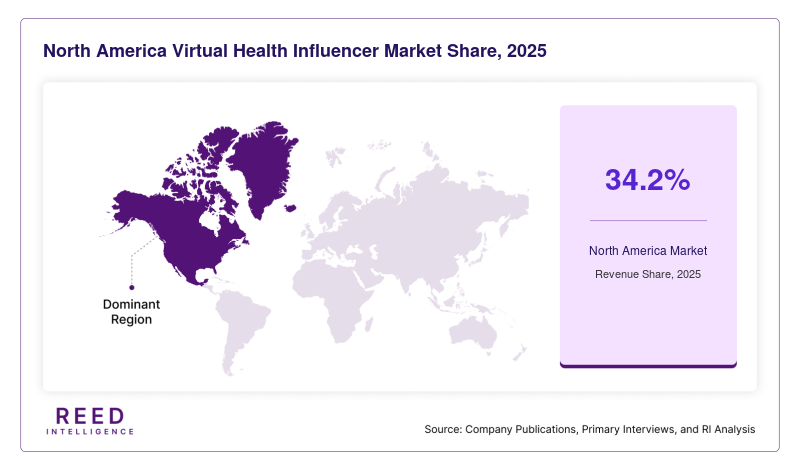
- North America dominated the market with a 34.2% share in 2025.
- Asia Pacific is expected to grow at the fastest CAGR of 11.2% during 2026–2034.
- By technology type, AI-generated avatars accounted for the largest share of 38.5%.
- while hybrid virtual-human influencer models are projected to grow at a CAGR of 12.4%.
- By application, health education and awareness campaigns led with a 41.7% share, whereas mental wellness engagement is expected to expand at a CAGR of 11.8%.
- The United States remained the dominant country, with market values of USD 510 million in 2024 and USD 560 million in 2025.
Market Trends
Rising Adoption of AI-Driven Health Personalities in Digital Healthcare Ecosystems
The Virtual Health Influencer Market is experiencing a strong shift toward AI-driven health personalities capable of simulating human-like communication, empathy, and behavioral adaptation. These virtual influencers are increasingly deployed by healthcare organizations, insurance providers, and pharmaceutical firms to disseminate preventive healthcare information and promote patient adherence programs. Advanced natural language processing and generative AI technologies enable these influencers to respond in real time to user queries across multiple languages. Their integration into mobile health apps and social media platforms is expanding their reach among younger and tech-savvy demographics. This trend is further reinforced by the need for cost-efficient health communication strategies that reduce dependence on traditional outreach models while ensuring consistency in messaging.
Expansion of Immersive and Interactive Virtual Health Engagement Platforms
Another significant trend shaping the Virtual Health Influencer Market is the rise of immersive engagement platforms powered by AR, VR, and mixed reality technologies. These platforms allow users to interact with virtual health influencers in simulated clinical or wellness environments, enhancing understanding of medical conditions and treatment pathways. Healthcare institutions are increasingly using these tools for patient education, rehabilitation guidance, and mental health counseling simulations. The integration of gamification elements into virtual health influencer experiences is also improving user retention and behavioral change outcomes. As digital ecosystems evolve, the convergence of immersive technologies with AI-powered influencers is expected to redefine how healthcare education and engagement are delivered globally.
Market Drivers
Increasing Demand for Scalable Digital Health Communication Solutions
The growing need for scalable and cost-effective health communication solutions is a major driver for the Virtual Health Influencer Market. Healthcare providers and public health organizations are under increasing pressure to deliver consistent messaging across large populations, particularly in preventive care and chronic disease management. Virtual health influencers offer the ability to reach millions of users simultaneously without geographical or operational constraints. Their availability 24/7, combined with multilingual capabilities, enhances accessibility in both developed and emerging regions. Additionally, the reduction in operational costs compared to traditional human-led campaigns is encouraging adoption across insurance firms, telehealth platforms, and pharmaceutical marketing divisions.
Rising Integration of Social Media and Digital Wellness Ecosystems
The expansion of social media platforms and digital wellness ecosystems has significantly contributed to market growth. Virtual health influencers are increasingly being deployed on platforms such as Instagram, YouTube, TikTok, and dedicated health apps to deliver engaging content on fitness, nutrition, mental health, and disease prevention. Their ability to blend entertainment with educational content makes them highly effective in influencing health-related behavior, especially among younger audiences. Healthcare brands are leveraging influencer marketing strategies powered by virtual personas to improve campaign reach and engagement metrics. The growing acceptance of AI-generated digital identities in mainstream media is further strengthening this driver across global markets.
Market Restraint
Ethical Concerns and Trust Deficit in AI-Generated Health Communication
Despite strong growth potential, the Virtual Health Influencer Market faces a notable restraint in the form of ethical concerns and trust issues related to AI-generated health communication. Many users remain skeptical about the credibility of virtual influencers when compared to human healthcare professionals. Concerns regarding misinformation, algorithmic bias, and lack of regulatory oversight in AI-generated medical content pose significant challenges. In sensitive areas such as mental health counseling or chronic disease advice, the absence of human empathy can limit user acceptance. Regulatory bodies are still developing frameworks to govern digital health influencers, creating uncertainty for large-scale commercial deployment.
Market Opportunities
Expansion of Personalized Preventive Healthcare Campaigns
One of the most promising opportunities in the Virtual Health Influencer Market lies in the expansion of personalized preventive healthcare campaigns. Virtual influencers powered by AI analytics can analyze user data such as lifestyle habits, wearable device inputs, and medical history to deliver customized health recommendations. This level of personalization enables more effective engagement in preventive care programs, including vaccination awareness, nutrition guidance, and fitness coaching. Healthcare organizations can leverage these capabilities to reduce long-term treatment costs and improve population health outcomes. The growing focus on preventive healthcare models globally is expected to accelerate the adoption of such personalized virtual influencer systems.
Integration with Wearable Devices and Health IoT Ecosystems
Another major opportunity is the integration of virtual health influencers with wearable devices and Internet of Things (IoT)-enabled health ecosystems. Smartwatches, fitness trackers, and connected medical devices can feed real-time health data into virtual influencer platforms, enabling continuous monitoring and personalized interaction. This integration allows virtual influencers to provide timely health alerts, medication reminders, and behavioral nudges based on real-time physiological data. The convergence of IoT and AI-driven virtual personas is expected to create highly interactive healthcare ecosystems that enhance patient engagement and adherence. As digital health infrastructure expands globally, this opportunity is likely to become a key growth pillar.
Segmental Analysis
By Technology Type
AI-generated avatars accounted for approximately 38.5% share in 2024, making them the dominant subsegment within the Virtual Health Influencer Market. Their ability to generate real-time responses and simulate human-like interaction makes them widely adopted in healthcare communication campaigns. These avatars are increasingly integrated into mobile health apps and digital wellness platforms, improving patient engagement and accessibility.
Hybrid virtual-human influencer models are expected to grow at a CAGR of 12.4% during 2026–2034. These models combine human expertise with AI-generated digital personas, enhancing authenticity and trust. Their growth is supported by increasing demand for credible yet scalable healthcare communication solutions.
By Application
Health education and awareness campaigns accounted for around 41.7% share in 2024, driven by widespread use in preventive healthcare initiatives. Virtual influencers are extensively used to promote vaccination awareness, hygiene practices, and chronic disease education across digital platforms.
Mental wellness engagement is expected to grow at a CAGR of 11.8%, supported by rising global focus on mental health support systems. Virtual influencers are being used in therapy simulations, stress management guidance, and emotional support applications.
By End-Use
Healthcare providers represented approximately 36.2% share in 2024, making them the dominant end-use segment. Hospitals and clinics utilize virtual influencers for patient onboarding, treatment guidance, and post-care engagement.
Pharmaceutical companies are expected to grow at a CAGR of 13.1%, driven by increasing adoption of digital marketing strategies. Virtual influencers help these companies improve drug awareness campaigns and patient adherence programs.
Regional Analysis
North America
North America accounted for approximately 34.2% of the Virtual Health Influencer Market in 2025 and is projected to grow at a steady CAGR through 2034. The region benefits from advanced healthcare infrastructure, high digital literacy, and strong adoption of AI-driven health technologies. Growth is further supported by widespread integration of virtual influencers in pharmaceutical marketing and telehealth platforms.
The United States remains the most influential country in the region, supported by strong investments in digital health startups and AI-based healthcare communication tools. A key growth factor is the increasing use of virtual influencers in public health awareness campaigns, particularly for chronic disease management and mental health education initiatives.
Europe
Europe holds a significant share of the market, accounting for approximately 26.8% in 2025, with steady growth expected during the forecast period. The region’s expansion is driven by strong regulatory support for digital healthcare innovation and increasing adoption of AI-based patient engagement tools.
Germany and the United Kingdom are the primary contributors to regional growth. A major growth factor is the integration of virtual health influencers into national healthcare awareness programs aimed at improving preventive care participation and digital health literacy.
Asia Pacific
Asia Pacific is expected to register the fastest growth with a CAGR of 11.2% during 2026–2034, supported by rapid digitalization and expanding healthcare access. The region is witnessing increased adoption of mobile health platforms and AI-powered wellness applications.
China and India are key markets, driven by large population bases and rising smartphone penetration. A significant growth factor is the use of virtual influencers in multilingual health education campaigns targeting rural and semi-urban populations.
Middle East & Africa
The Middle East & Africa region holds a smaller but growing share of the market, accounting for 8.9% in 2025. Growth is supported by increasing investments in digital healthcare infrastructure and smart city initiatives.
The United Arab Emirates and South Africa are leading contributors. A key growth factor is the deployment of virtual health influencers in government-led telehealth programs aimed at improving healthcare accessibility.
Latin America
Latin America represents an emerging market with a 7.1% share in 2025, showing gradual expansion driven by rising digital adoption in healthcare services. Brazil and Mexico are the primary growth contributors.
A major growth factor is the increasing use of social media-based health campaigns featuring virtual influencers to promote preventive healthcare awareness and lifestyle improvement programs.
Competitive Landscape
The Virtual Health Influencer Market is moderately fragmented, with a mix of AI startups, healthcare technology firms, and digital marketing companies. Key players focus on developing advanced AI models, enhancing realism in virtual avatars, and expanding multilingual capabilities. Leading companies include Synthesia, Soul Machines, UneeQ, Hour One, and Replika AI. These firms are investing heavily in generative AI and healthcare-focused digital engagement tools. A recent development includes the launch of advanced emotionally responsive AI health avatars by a leading market participant to improve patient interaction quality.
Key Players List
- Synthesia
- Soul Machines
- UneeQ
- Hour One AI
- Replika AI
- DeepBrain AI
- NVIDIA Corporation
- Meta Platforms Inc.
- Microsoft Corporation
- IBM Corporation
- Google LLC
- Amazon Web Services
- Zebra Medical Vision
- Baidu Inc.
- Tencent Holdings
- Accenture Interactive
Recent Developments
- A leading AI company launched a healthcare-focused virtual influencer capable of multilingual patient interaction across telehealth platforms.
- A global pharmaceutical firm integrated virtual influencers into its digital marketing strategy to improve patient awareness campaigns for chronic disease drugs.
- A health-tech startup introduced an AR-based virtual wellness influencer designed for immersive fitness coaching and mental health support applications.
Virtual Health Influencer Market Segments
By Technology Type
- AI-Generated Avatars
- Hybrid Virtual-Human Influencer Models
- Fully Autonomous Virtual Influencers
- Emotionally Responsive AI Health Personas
By Application
- Health Education & Awareness Campaigns
- Mental Wellness Engagement
- Fitness & Lifestyle Coaching
- Disease Management & Chronic Care Support
- Pharmaceutical Marketing & Patient Engagement
By End-Use
- Healthcare Providers (Hospitals & Clinics)
- Pharmaceutical Companies
- Insurance Companies
- Digital Health & Wellness Platforms
- Government & Public Health Organizations
By Region
- North America
- Europe
- APAC
- Middle East and Africa
- LATAM