Viscosity Reducing Agent Market Size, Share & Demand Report By Type (Polymer-Based, Surfactant-Based, Solvent-Based, Bio-Based), By Application (Crude Oil Transportation, Enhanced Oil Recovery, Wastewater Treatment, Mining Slurry Transportation, Industrial Processing), By End-Use Industry (Oil & Gas, Chemicals, Mining, Water & Wastewater Treatment, Paints & Coatings, Food Processing) By Region & Segment Forecasts, 2026–2034
USD 3950
Market Overview
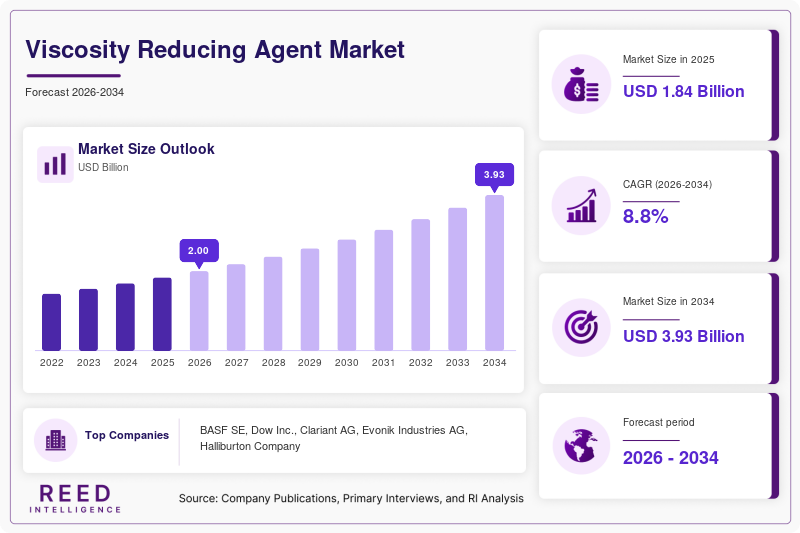
The global Viscosity Reducing Agent Market size was valued at USD 1.84 billion in 2026 and is projected to reach USD 3.61 billion by 2034, expanding at a CAGR of 8.8% during the forecast period from 2026 to 2034. The market growth is being supported by rising industrial demand for efficient fluid management solutions across oil & gas, paints and coatings, chemicals, mining, and wastewater treatment industries. Viscosity reducing agents are widely used to improve flow characteristics, reduce pumping resistance, and enhance processing efficiency in high-density fluids. Increasing energy production activities and the growing need for cost-effective transportation of crude oil and industrial liquids continue to strengthen product adoption globally.
The expansion of unconventional oil extraction projects and enhanced oil recovery operations has created substantial demand for advanced rheology modifiers and drag-reducing formulations. Industries are focusing on reducing operational downtime and energy consumption during transportation and processing activities, which has increased the use of polymer-based and surfactant-based viscosity reducing agents. In addition, manufacturers are investing in environmentally compatible additives to comply with tightening industrial emission and waste management regulations.
Key Highlights
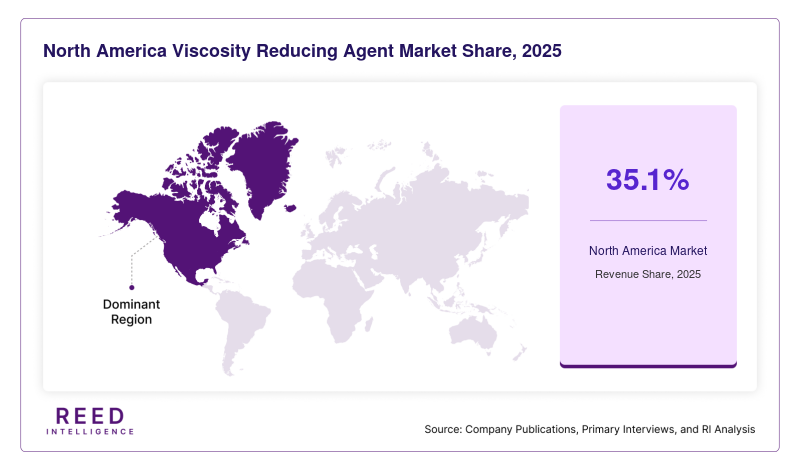
- North America dominated the market with a 35.1% share in 2025.
- Asia Pacific is expected to grow at the fastest CAGR of 10.9% during 2026–2034.
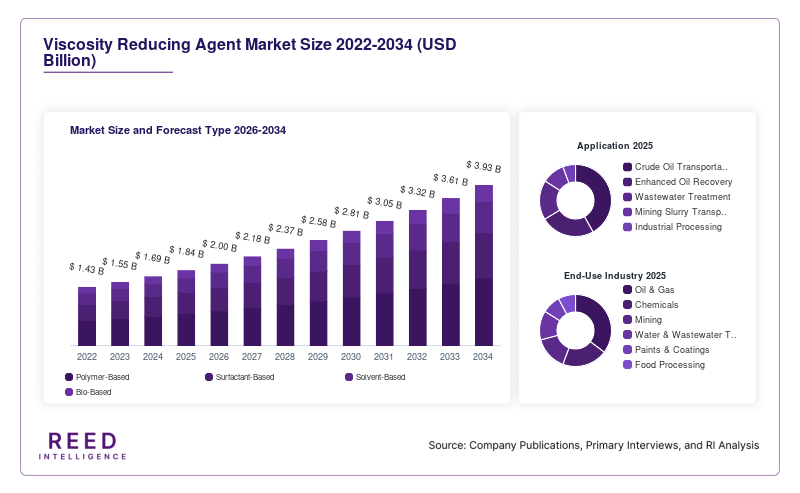
- By type, polymer-based agents accounted for the largest share of 39.4%, while bio-based agents are projected to grow at a CAGR of 11.6%.
- By application, crude oil transportation led with a 43.2% share, whereas wastewater treatment is expected to expand at a CAGR of 10.8%.
- The United States remained the dominant country, with market values of USD 462 million in 2024 and USD 509 million in 2025.
Market Trends
Increasing Adoption of Bio-Based Formulations
The Viscosity Reducing Agent Market is witnessing growing demand for bio-based and environmentally compatible formulations across multiple industries. Manufacturers are shifting toward renewable raw materials and low-toxicity additives due to increasing environmental compliance requirements and sustainability targets. Oil & gas operators are actively testing biodegradable viscosity modifiers to minimize environmental impact during extraction and transportation processes. This trend is particularly visible in North America and Europe, where environmental regulations regarding chemical discharge and industrial waste management have become stricter.
Bio-based products are also gaining traction in wastewater treatment and industrial cleaning applications because they reduce chemical residue formation and improve process safety. Chemical companies are investing in research to develop plant-derived polymers and surfactants that provide efficient viscosity reduction without compromising fluid stability. The trend is further supported by rising customer preference for sustainable industrial chemicals and increasing corporate investments in green manufacturing initiatives. As industries focus on reducing carbon emissions and improving operational efficiency, demand for advanced eco-friendly viscosity reducing agents is expected to increase steadily during the forecast period.
Rising Integration of Advanced Pipeline Technologies
The integration of advanced pipeline monitoring and flow optimization technologies is emerging as a significant trend in the Viscosity Reducing Agent Market. Energy companies are increasingly combining smart pipeline systems with advanced drag-reducing additives to improve crude oil transportation efficiency and reduce operational costs. High-viscosity crude transportation requires effective viscosity control solutions to maintain steady flow rates and reduce energy consumption during pumping operations.
Digital monitoring systems and automated flow management tools are enabling operators to optimize additive dosage levels in real time, improving overall system performance. This trend is especially important in long-distance oil transportation projects where even small improvements in flow efficiency can generate major cost savings. Industrial operators are also deploying viscosity reducing agents in chemical processing plants to improve throughput and reduce equipment wear. As infrastructure modernization projects continue across oil-producing regions, demand for technologically advanced and high-performance viscosity reduction solutions is expected to rise considerably.
Market Drivers
Expansion of Oil and Gas Transportation Infrastructure
The continuous expansion of oil and gas transportation infrastructure is one of the major factors driving the Viscosity Reducing Agent Market. Governments and private companies are investing heavily in pipeline projects to support rising global energy demand and improve supply chain efficiency. Heavy crude oil and unconventional hydrocarbon resources often possess high viscosity levels, making transportation difficult without chemical assistance. Viscosity reducing agents help improve flow characteristics, reduce friction losses, and lower energy consumption during pumping operations.
Large-scale pipeline projects in the United States, Canada, China, and the Middle East are creating sustained demand for high-performance drag-reducing additives and rheology modifiers. Offshore drilling activities and enhanced oil recovery operations are also increasing the use of specialty chemicals designed to improve fluid mobility. Furthermore, rising investments in refinery modernization and petrochemical infrastructure are encouraging the adoption of advanced viscosity management solutions. The growing emphasis on reducing operational costs and improving transportation efficiency is expected to support long-term market expansion.
Growing Demand from Industrial Processing Applications
Industrial processing industries are increasingly adopting viscosity reducing agents to improve manufacturing efficiency and optimize fluid handling systems. Sectors such as paints and coatings, mining, chemicals, food processing, and wastewater treatment rely on viscosity control additives to maintain smooth production operations and improve product consistency. High-viscosity materials often create processing challenges, including equipment clogging, increased energy use, and reduced throughput.
Manufacturers are utilizing advanced viscosity modifiers to enhance pumping efficiency and reduce processing time in industrial facilities. In the paints and coatings industry, viscosity reducing agents improve product application and formulation stability. Mining companies use these additives to manage slurry transportation and improve material handling efficiency. Rapid industrialization in Asia Pacific and Latin America is increasing the need for efficient fluid management technologies across multiple sectors. As industrial production volumes continue to rise globally, the demand for advanced viscosity reduction solutions is expected to strengthen significantly.
Market Restraint
Volatility in Raw Material Prices and Environmental Compliance Costs
Fluctuating raw material prices and increasing environmental compliance costs are limiting the growth potential of the Viscosity Reducing Agent Market. Many viscosity reducing formulations rely on petrochemical derivatives, specialty polymers, and surfactants that are vulnerable to changes in crude oil prices and supply chain disruptions. Sudden increases in raw material costs directly impact manufacturing expenses and reduce profit margins for producers. Smaller manufacturers often face difficulties maintaining competitive pricing during periods of raw material volatility.
Environmental regulations regarding chemical handling, wastewater disposal, and industrial emissions are also becoming more stringent across major economies. Companies must invest heavily in regulatory testing, certification, and sustainable product development to comply with changing environmental standards. These compliance requirements can delay product commercialization and increase operational expenditures. For example, several industrial operators in Europe have shifted away from conventional solvent-based formulations due to tightening restrictions on hazardous chemical usage. Such regulatory pressures may slow product adoption among cost-sensitive industries, particularly in developing markets where environmental compliance investments remain limited.
Market Opportunities
Rising Demand for Enhanced Oil Recovery Operations
The increasing adoption of enhanced oil recovery techniques presents substantial growth opportunities for the Viscosity Reducing Agent Market. Mature oil fields across North America, the Middle East, and Latin America are experiencing declining production rates, encouraging operators to deploy advanced recovery technologies. Viscosity reducing agents play an important role in improving crude mobility and supporting efficient extraction from challenging reservoirs. Heavy oil reserves and unconventional shale formations particularly require effective flow enhancement chemicals to improve production efficiency.
Oil producers are investing in advanced chemical formulations capable of operating under extreme reservoir temperatures and pressures. The expansion of offshore drilling projects and unconventional hydrocarbon exploration activities is expected to further increase product demand. Companies are also developing multifunctional additives that combine viscosity reduction with corrosion protection and flow assurance capabilities. As global energy demand continues to rise and operators seek to maximize production from existing fields, enhanced oil recovery applications are expected to create long-term growth opportunities for market participants.
Expansion of Wastewater Treatment and Industrial Recycling
Growing investments in wastewater treatment and industrial recycling infrastructure are generating new opportunities for the Viscosity Reducing Agent Market. Industrial facilities increasingly require efficient sludge handling and fluid processing systems to comply with environmental discharge regulations. Viscosity reducing agents are being widely used to improve sludge transportation, optimize filtration processes, and reduce energy consumption in wastewater treatment plants.
Rapid urbanization and industrial development in emerging economies are increasing the demand for advanced water treatment technologies. Governments are introducing stricter wastewater management regulations, encouraging industries to modernize processing facilities and adopt efficient chemical treatment solutions. Food processing, pulp and paper, mining, and textile industries are among the major end users investing in improved wastewater handling systems. Manufacturers are responding by introducing low-toxicity and biodegradable viscosity reduction formulations suitable for environmental applications. As sustainability initiatives and water recycling programs continue to expand globally, demand for innovative viscosity management solutions is expected to rise steadily.
Segmental Analysis
By Type
Polymer-based viscosity reducing agents dominated the market in 2024, accounting for 39.4% of the global revenue share. These products are widely used across oil and gas transportation, mining slurry handling, and industrial fluid processing applications due to their strong drag reduction capabilities and high operational efficiency. Polymer-based formulations help improve flow dynamics in heavy crude transportation systems and reduce energy consumption during pumping operations. Their compatibility with a broad range of industrial fluids has increased their adoption across chemical processing and wastewater treatment industries. Manufacturers continue to introduce advanced polymer technologies with improved thermal stability and enhanced performance under extreme operating conditions. Strong demand from pipeline operators and petrochemical facilities has further reinforced the market leadership of this segment.
Bio-based viscosity reducing agents are projected to register the fastest CAGR of 11.6% during the forecast period. Increasing environmental awareness and tightening industrial chemical regulations are encouraging industries to shift toward sustainable alternatives. Bio-based formulations derived from renewable sources are gaining traction in wastewater treatment, food processing, and environmentally sensitive oilfield applications. These products offer lower toxicity levels and reduced environmental impact while maintaining effective viscosity reduction performance. Manufacturers are investing heavily in research and development activities to improve formulation efficiency and commercial scalability. Rising corporate sustainability initiatives and growing adoption of green manufacturing practices are expected to support rapid segment growth across developed and emerging economies over the coming years.
By Application
Crude oil transportation emerged as the dominant application segment in 2024, holding 43.2% of the global Viscosity Reducing Agent Market share. The increasing production of heavy crude oil and unconventional hydrocarbon resources has significantly increased demand for efficient flow assurance solutions. Viscosity reducing agents are widely used to lower pumping resistance, improve pipeline throughput, and reduce operational energy consumption during crude transportation. Oil producers and pipeline operators rely on these additives to maintain stable flow conditions and minimize maintenance costs. Rising investments in cross-border pipeline projects and enhanced oil recovery operations continue to strengthen segment demand. Furthermore, ongoing expansion of refinery and petrochemical infrastructure across North America, the Middle East, and Asia Pacific is contributing to sustained product adoption in crude transportation applications.
Wastewater treatment is expected to witness the fastest growth, registering a CAGR of 10.8% during the forecast period. Industrial facilities are increasingly investing in advanced sludge management and water recycling systems to comply with stricter environmental regulations. Viscosity reducing agents help improve sludge flow characteristics, optimize pumping efficiency, and reduce processing energy requirements in treatment plants. Rapid urbanization and industrial development in emerging economies are increasing pressure on water infrastructure systems, encouraging investments in efficient treatment technologies. Industries such as mining, food processing, pulp and paper, and chemicals are adopting specialized viscosity modifiers to improve wastewater handling efficiency. The growing emphasis on sustainable water management and industrial recycling practices is expected to drive strong long-term growth for this application segment.
By End-Use Industry
The oil and gas industry accounted for the largest share of the Viscosity Reducing Agent Market in 2024 due to extensive usage in crude extraction, transportation, and refinery operations. High-viscosity hydrocarbons require efficient flow enhancement chemicals to support pipeline transportation and optimize production processes. Oilfield operators increasingly rely on viscosity reducing agents to improve reservoir mobility, reduce operational downtime, and enhance pumping efficiency. The expansion of shale exploration, offshore drilling activities, and enhanced oil recovery projects has further increased demand for advanced rheology modifiers. Major energy-producing countries are investing in infrastructure modernization and transportation efficiency improvements, supporting continued segment growth. In addition, the need to reduce operational costs and energy consumption remains a key factor driving product adoption within the oil and gas sector.
The water and wastewater treatment industry is anticipated to register the fastest CAGR of 10.5% during the forecast period. Increasing industrial wastewater generation and rising environmental compliance requirements are encouraging investments in modern treatment infrastructure worldwide. Viscosity reducing agents are increasingly used in sludge management, filtration systems, and industrial recycling operations to improve processing efficiency and reduce equipment strain. Governments across Asia Pacific, Europe, and Latin America are implementing stricter discharge regulations, prompting industries to adopt advanced treatment chemicals. The growing focus on water conservation and circular economy initiatives is also supporting market demand. Manufacturers are introducing biodegradable and low-residue formulations tailored for environmental applications, which is expected to accelerate adoption across municipal and industrial wastewater treatment facilities.
Regional Analysis
North America
North America accounted for 35.1% of the global Viscosity Reducing Agent Market share in 2025 and is expected to maintain a stable growth trajectory with a CAGR of 8.1% through 2034. The region benefits from extensive oil and gas infrastructure, high industrial chemical consumption, and continuous investments in pipeline modernization projects. Strong demand for enhanced oil recovery chemicals and flow assurance solutions continues to support product adoption across the United States and Canada. Industrial processing sectors such as chemicals, mining, and wastewater treatment also contribute significantly to regional demand.
The United States remains the dominant market within North America due to its large shale oil production capacity and advanced petrochemical industry. Growing investments in unconventional oil extraction projects and crude transportation networks are creating sustained demand for drag-reducing additives and rheology modifiers. The presence of major specialty chemical manufacturers and increasing focus on sustainable industrial operations further strengthen regional market development. In addition, ongoing investments in smart pipeline technologies and industrial automation are supporting wider adoption of advanced viscosity management solutions.
Europe
Europe represented a significant share of the Viscosity Reducing Agent Market in 2025 and is forecast to grow at a CAGR of 7.4% during the assessment period. The region’s growth is driven by stringent environmental regulations, increasing adoption of sustainable industrial chemicals, and strong investments in wastewater treatment infrastructure. European manufacturers are emphasizing the development of low-toxicity and biodegradable formulations to meet changing regulatory standards. Demand from chemical processing, paints and coatings, and industrial recycling sectors continues to support market expansion across the region.
Germany remains the leading country in the European market due to its advanced industrial manufacturing base and strong specialty chemicals sector. The country is investing heavily in industrial modernization and energy-efficient processing technologies, creating demand for high-performance viscosity reduction additives. Germany’s growing focus on circular economy initiatives and sustainable manufacturing practices is also encouraging the use of environmentally compatible chemical solutions. In addition, the expansion of industrial recycling facilities and wastewater treatment projects is supporting product demand throughout the country.
Asia Pacific
Asia Pacific is expected to record the fastest CAGR of 10.9% in the Viscosity Reducing Agent Market during the forecast period. Rapid industrialization, increasing energy demand, and expanding infrastructure projects are contributing significantly to regional market growth. Countries across the region are investing in oil refining capacity, pipeline networks, and industrial manufacturing facilities, driving demand for efficient fluid handling technologies. The growth of mining, chemicals, textiles, and wastewater treatment industries is further supporting product adoption across emerging economies.
China dominates the Asia Pacific market due to its extensive industrial production capacity and growing petrochemical infrastructure. The country is rapidly expanding its pipeline transportation systems and enhanced oil recovery projects to support rising energy requirements. Increasing investments in industrial wastewater management and environmental protection initiatives are also encouraging the use of advanced viscosity reduction chemicals. Domestic manufacturers are focusing on developing cost-effective formulations suitable for large-scale industrial applications, further strengthening market growth within the country.
Middle East & Africa
The Middle East & Africa region is witnessing steady growth in the Viscosity Reducing Agent Market and is projected to expand at a CAGR of 8.5% through 2034. The market is strongly supported by extensive oil production activities and increasing investments in crude transportation infrastructure. Oil-rich economies are focusing on improving extraction efficiency and reducing transportation costs for heavy crude reserves. Demand for drag-reducing additives and flow enhancement chemicals remains high across upstream and midstream oil operations in the region.
Saudi Arabia represents the dominant country in the regional market due to its large crude oil production capacity and ongoing investments in energy infrastructure projects. The country is expanding enhanced oil recovery operations and pipeline networks to strengthen export capabilities and improve operational efficiency. Growing investments in petrochemical manufacturing and industrial diversification programs are also contributing to market demand. Furthermore, government initiatives supporting industrial modernization and water management infrastructure are creating additional opportunities for viscosity reducing agent manufacturers.
Latin America
Latin America held a moderate share of the global Viscosity Reducing Agent Market in 2025 and is anticipated to grow at a CAGR of 8.7% during the forecast period. The region is benefiting from increasing oil exploration activities, mining sector expansion, and rising industrialization levels. Countries across Latin America are investing in pipeline infrastructure and refinery upgrades to improve energy transportation efficiency. Demand for industrial processing chemicals and wastewater treatment additives is also increasing steadily across manufacturing industries.
Brazil remains the leading market within Latin America due to its growing offshore oil production activities and expanding industrial base. The country is investing in advanced extraction technologies and transportation systems to support heavy crude production from offshore reserves. Rising mining activities and increasing wastewater management requirements are also encouraging the adoption of viscosity reducing agents across industrial sectors. Additionally, government initiatives supporting infrastructure development and industrial productivity improvement are expected to contribute to continued market growth.
Competitive Landscape
The Viscosity Reducing Agent Market is moderately consolidated, with major specialty chemical manufacturers focusing on product innovation, strategic partnerships, and geographic expansion to strengthen market position. Leading companies are investing in sustainable formulations and high-performance additives designed for complex industrial applications. Competition is largely based on product efficiency, environmental compatibility, operational stability, and pricing strategies.
BASF SE remains one of the leading players in the market due to its extensive specialty chemicals portfolio and strong global distribution network. The company recently expanded its industrial performance chemicals division to support growing demand from oilfield and wastewater treatment applications. Other prominent participants are increasing investments in bio-based formulations and advanced polymer technologies to improve product differentiation and regulatory compliance.
Key Players
- BASF SE
- Dow Inc.
- Clariant AG
- Evonik Industries AG
- Croda International Plc
- Halliburton Company
- Schlumberger Limited
- Baker Hughes Company
- Innospec Inc.
- Nouryon
- Chevron Phillips Chemical Company
- Huntsman Corporation
- Solvay SA
- SNF Group
- Kemira Oyj
Recent Developments
- BASF SE introduced a new low-residue viscosity reducing formulation in 2025 designed for heavy crude pipeline transportation applications.
- Clariant AG expanded its specialty chemicals production facility in Asia Pacific in 2024 to support growing regional demand for industrial flow enhancement additives.
- Halliburton Company partnered with a Middle Eastern oil producer in 2025 to deploy advanced drag-reducing technologies for enhanced oil recovery operations.
- Evonik Industries AG launched a biodegradable viscosity modifier portfolio in 2024 targeting wastewater treatment and industrial recycling applications.
- Baker Hughes Company announced the development of high-temperature resistant rheology control additives for offshore drilling projects in 2025.
Viscosity Reducing Agent Market Segments
Type
- Polymer-Based
- Surfactant-Based
- Solvent-Based
- Bio-Based
Application
- Crude Oil Transportation
- Enhanced Oil Recovery
- Wastewater Treatment
- Mining Slurry Transportation
- Industrial Processing
End-Use Industry
- Oil & Gas
- Chemicals
- Mining
- Water & Wastewater Treatment
- Paints & Coatings
- Food Processing
By Region
- North America
- Europe
- APAC
- Middle East and Africa
- LATAM