Vmat2 Inhibitor Market Size, Share & Demand Report By Type (Tetrabenazine, Deutetrabenazine, Valbenazine), By Application (Tardive Dyskinesia, Huntington’s Disease, Other Neurological Disorders), By End-Use (Hospitals, Specialty Clinics, Others), By Region & Segment Forecasts, 2025–2034
USD 3950
Market Overview
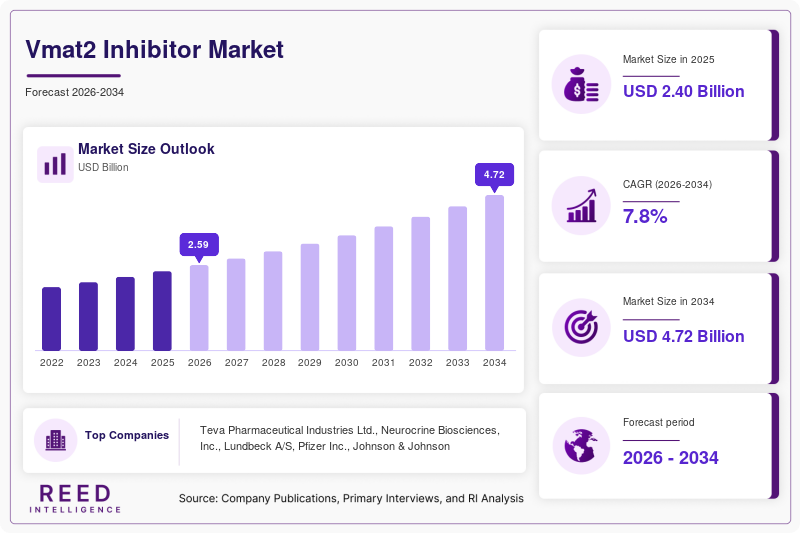
The Vmat2 Inhibitor Market size was estimated at USD 2.4 billion in 2025 and is projected to reach approximately USD 2.7 billion in 2026. Over the forecast period from 2025 to 2034, the market is expected to grow at a compound annual growth rate (CAGR) of 7.8%, reaching an estimated value of USD 5.1 billion by 2034. This growth reflects a consistent increase in treatment adoption for conditions such as tardive dyskinesia, Huntington’s disease, and other hyperkinetic movement disorders.
One of the primary growth factors is the rising prevalence of neurological disorders worldwide, particularly among aging populations. As life expectancy increases, the incidence of movement disorders linked to long-term medication use or neurodegenerative diseases is also rising. Additionally, advancements in drug development and improved diagnostic capabilities are enabling earlier identification and treatment of these conditions, thereby boosting demand for VMAT2 inhibitors.
Key Highlights
- Market size was valued at USD 2.4 billion in 2025 and is estimated to reach USD 2.7 billion in 2026, reflecting steady year-on-year growth. This increase is supported by rising treatment adoption and improved diagnostic capabilities across healthcare systems.
- The market is projected to reach USD 5.1 billion by 2034, expanding at a CAGR of 7.8% during the forecast period. Consistent growth is driven by ongoing innovation in drug development and increasing demand for targeted neurological therapies.
- The rising prevalence of neurological disorders, including tardive dyskinesia and Huntington’s disease, is significantly driving market demand. An aging population and long-term use of antipsychotic medications are further contributing to higher diagnosis rates.
- Increasing adoption of targeted therapies is improving treatment outcomes by offering better efficacy and fewer side effects. This shift toward precision medicine is encouraging healthcare providers to prefer VMAT2 inhibitors over traditional alternatives.
Market Trends
Expansion of Indications Beyond Movement Disorders
The Vmat2 Inhibitor Market is witnessing a trend toward expanding therapeutic indications beyond traditional movement disorders. Initially developed for conditions such as tardive dyskinesia and Huntington’s disease, VMAT2 inhibitors are now being explored for psychiatric and neurological conditions involving dopamine dysregulation. This includes research into their potential use in schizophrenia-related side effects and certain mood disorders. Clinical trials are underway to evaluate the broader applicability of these drugs, which could significantly increase the addressable patient population. This trend is supported by growing investments in neuroscience research and the need for innovative treatment approaches that offer improved safety profiles.
Shift Toward Long-Acting and Patient-Friendly Formulations
Another notable trend in the Vmat2 Inhibitor Market is the development of long-acting and patient-friendly formulations. Pharmaceutical companies are focusing on improving patient adherence by reducing dosing frequency and enhancing drug delivery systems. Extended-release formulations and orally disintegrating tablets are being introduced to simplify treatment regimens, particularly for elderly patients who may have difficulty with complex medication schedules. This shift not only improves compliance but also enhances overall treatment effectiveness. The trend aligns with the broader industry focus on patient-centric care and personalized medicine, which is expected to drive sustained growth in the market.
Market Drivers
Increasing Prevalence of Tardive Dyskinesia and Huntington’s Disease
The growing incidence of tardive dyskinesia and Huntington’s disease is a major driver of the Vmat2 Inhibitor Market. Tardive dyskinesia, often caused by long-term use of antipsychotic medications, is becoming more prevalent due to the increasing number of patients receiving psychiatric treatment. Similarly, Huntington’s disease, a genetic neurodegenerative disorder, continues to require effective symptom management. VMAT2 inhibitors have emerged as a preferred treatment option due to their targeted mechanism and ability to reduce involuntary movements. As awareness and diagnosis rates improve, the demand for these therapies is expected to rise significantly, supporting market growth over the forecast period.
Advancements in Drug Development and Regulatory Approvals
Advancements in pharmaceutical research and the increasing number of regulatory approvals are accelerating the growth of the Vmat2 Inhibitor Market. Companies are investing in innovative drug development strategies, including novel compounds and improved formulations. Regulatory bodies are also providing support through expedited approval pathways for treatments addressing unmet medical needs. These factors are enabling faster commercialization of new products and expanding the range of available treatment options. Additionally, collaborations between pharmaceutical firms and research institutions are fostering innovation, further driving market expansion and enhancing competitive dynamics.
Market Restraint
High Cost of Treatment and Limited Accessibility
One of the primary restraints affecting the Vmat2 Inhibitor Market is the high cost associated with these therapies, which limits accessibility, particularly in low- and middle-income regions. VMAT2 inhibitors are often priced at a premium due to the complexity of their development and the specialized nature of their use. This creates a financial burden for patients and healthcare systems, especially in countries with limited insurance coverage or reimbursement policies. As a result, many patients may not have access to these treatments, leading to underutilization despite clinical need.
The high cost also impacts market penetration in emerging economies, where healthcare budgets are constrained and priority is often given to more common or life-threatening conditions. For example, in certain regions, patients with tardive dyskinesia may continue to rely on older, less effective therapies due to affordability issues. This restraint not only limits market growth but also highlights the need for cost-effective solutions, including generic alternatives and improved reimbursement frameworks. Addressing these challenges will be critical for expanding the global reach of VMAT2 inhibitors.
Market Opportunities
Expansion in Emerging Markets
Emerging markets present significant growth opportunities for the Vmat2 Inhibitor Market. Countries in Asia Pacific, Latin America, and parts of the Middle East are experiencing improvements in healthcare infrastructure and increased awareness of neurological disorders. Governments and private healthcare providers are investing in advanced treatment options, creating a favorable environment for the adoption of VMAT2 inhibitors. Additionally, the growing middle-class population in these regions is contributing to increased healthcare spending. Companies that focus on strategic partnerships, local manufacturing, and pricing strategies tailored to these markets can capitalize on this opportunity and expand their global footprint.
Development of Combination Therapies
The development of combination therapies represents another promising opportunity in the Vmat2 Inhibitor Market. Combining VMAT2 inhibitors with other therapeutic agents can enhance treatment efficacy and address multiple symptoms simultaneously. This approach is particularly relevant for complex neurological and psychiatric conditions where monotherapy may not be sufficient. Ongoing research is exploring the potential of such combinations, which could lead to improved patient outcomes and expanded indications. As clinical evidence supporting these therapies grows, they are likely to gain acceptance among healthcare providers, driving market growth and innovation.
Segmental Analysis
By Type
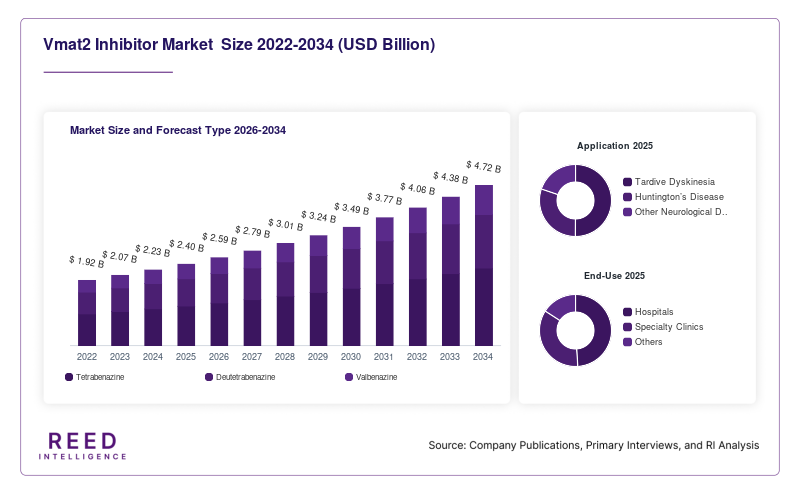
The dominant subsegment in the Vmat2 Inhibitor Market by type is tetrabenazine-based therapies, which accounted for approximately 55% of the market share in 2024. These therapies have been widely used due to their established efficacy in treating movement disorders such as Huntington’s disease. Their long-standing presence in the market and availability in multiple formulations have contributed to their dominance. Healthcare providers are familiar with these drugs, and they are often included in treatment guidelines, further supporting their widespread use.
The fastest-growing subsegment is deutetrabenazine-based therapies, projected to grow at a CAGR of 8.6% during the forecast period. This growth is driven by improved safety profiles and reduced dosing frequency compared to older formulations. Deutetrabenazine offers better tolerability, which enhances patient adherence and overall treatment outcomes. Increasing adoption of these advanced therapies is expected to drive significant growth in this segment.
By Application
In terms of application, tardive dyskinesia is the dominant subsegment, accounting for approximately 48% of the market share in 2024. The high prevalence of this condition, particularly among patients undergoing long-term antipsychotic treatment, is a key factor driving demand. VMAT2 inhibitors have become a standard treatment option for managing symptoms, contributing to their strong market presence.
Huntington’s disease is the fastest-growing application segment, with a projected CAGR of 8.2%. The increasing focus on rare disease treatment and the availability of targeted therapies are driving growth in this segment. Improved diagnostic capabilities and growing awareness are also contributing to increased treatment rates, supporting market expansion.
By End-Use
Hospitals represent the dominant end-use segment, accounting for around 52% of the market share in 2024. Hospitals are the primary point of care for patients with severe neurological conditions, and they offer access to specialized treatments and expert healthcare professionals. This makes them a key channel for the administration of VMAT2 inhibitors.
Specialty clinics are the fastest-growing end-use segment, with a CAGR of 8.9%. These clinics focus on neurological and psychiatric disorders, providing specialized care and personalized treatment plans. The growing number of such facilities and increasing patient preference for specialized care are driving growth in this segment.
Regional Analysis
North America
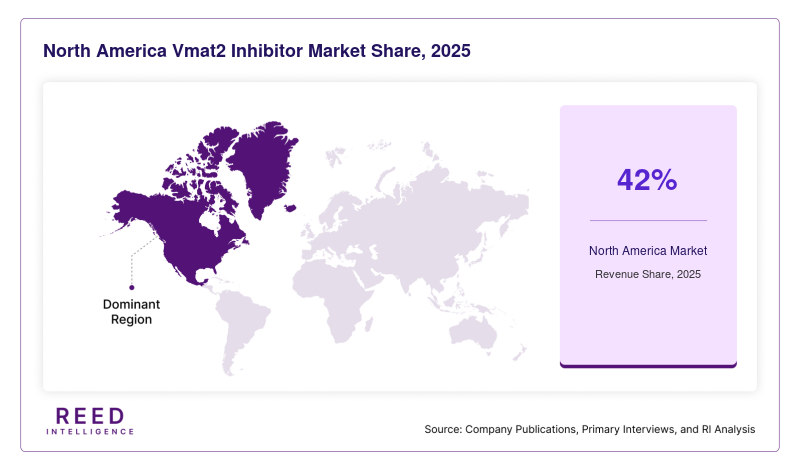
North America accounted for the largest share of the Vmat2 Inhibitor Market in 2025, representing approximately 42% of global revenue. The region is expected to maintain its dominance, with a projected CAGR of 7.2% through 2034. This growth is driven by advanced healthcare infrastructure, high awareness of neurological disorders, and strong adoption of innovative therapies. The presence of leading pharmaceutical companies and favorable reimbursement policies further support market expansion.
The United States dominates the North American market due to its well-established healthcare system and high prevalence of tardive dyskinesia. A key growth factor is the strong focus on research and development, supported by government funding and private investments. This has led to the rapid introduction of new therapies and continuous improvement in treatment outcomes.
Europe
Europe held a significant share of the Vmat2 Inhibitor Market in 2025, accounting for around 28% of global revenue, with a forecast CAGR of 6.9%. The region benefits from robust healthcare systems and increasing awareness of movement disorders. Government initiatives aimed at improving neurological care are also contributing to market growth.
Germany is the leading country in Europe, driven by its advanced medical infrastructure and strong focus on healthcare innovation. A unique growth factor is the increasing adoption of personalized medicine, which is encouraging the use of targeted therapies such as VMAT2 inhibitors. This trend is expected to drive sustained demand across the region.
Asia Pacific
Asia Pacific is expected to witness the fastest growth in the Vmat2 Inhibitor Market, with a CAGR of 9.1% during the forecast period. The region accounted for approximately 18% of the market share in 2025. Rapid economic development, increasing healthcare spending, and rising awareness of neurological disorders are key factors driving growth.
China dominates the Asia Pacific market due to its large population and expanding healthcare infrastructure. A unique growth factor is the increasing investment in domestic pharmaceutical manufacturing, which is improving the availability and affordability of advanced therapies. This is expected to accelerate market penetration in the region.
Middle East & Africa
The Middle East & Africa region held a smaller share of the Vmat2 Inhibitor Market in 2025, accounting for around 7%, but is expected to grow at a CAGR of 6.5%. The market is gradually expanding due to improvements in healthcare infrastructure and increasing awareness of neurological conditions.
Saudi Arabia leads the region, supported by government initiatives to enhance healthcare services. A unique growth factor is the rising investment in specialized medical facilities, which is improving access to advanced treatments such as VMAT2 inhibitors. This is expected to drive market growth over the forecast period.
Latin America
Latin America accounted for approximately 5% of the Vmat2 Inhibitor Market in 2025 and is projected to grow at a CAGR of 6.8%. The region is experiencing gradual improvements in healthcare access and increasing awareness of movement disorders.
Brazil is the dominant country in Latin America, driven by its large population and expanding healthcare sector. A unique growth factor is the growing focus on public healthcare programs, which are improving access to essential treatments. This is expected to support the adoption of VMAT2 inhibitors in the region.
Competitive Landscape
The Vmat2 Inhibitor Market is moderately consolidated, with a few key players dominating the global landscape. Companies are focusing on research and development, strategic collaborations, and product innovation to strengthen their market position. The competitive environment is characterized by continuous efforts to improve drug efficacy and expand therapeutic applications.
One of the leading companies in the market is Teva Pharmaceutical Industries Ltd., which has established a strong presence through its portfolio of VMAT2 inhibitors. A recent development includes the expansion of its product indications to address additional neurological conditions, enhancing its market reach. Other major players are also investing in clinical trials and partnerships to gain a competitive edge.
Key Players
- Teva Pharmaceutical Industries Ltd.
- Neurocrine Biosciences, Inc.
- Lundbeck A/S
- Pfizer Inc.
- Johnson & Johnson
- Novartis AG
- Sun Pharmaceutical Industries Ltd.
- Dr. Reddy’s Laboratories Ltd.
- Mylan N.V.
- Hikma Pharmaceuticals PLC
- Amneal Pharmaceuticals, Inc.
- Zydus Lifesciences Ltd.
- Cipla Limited
- Aurobindo Pharma Limited
- Torrent Pharmaceuticals Ltd.
Recent Developments
- A leading pharmaceutical company announced the successful completion of a Phase III clinical trial for a next-generation VMAT2 inhibitor with improved safety and efficacy.
- A strategic collaboration between two major players was established to expand research into new therapeutic indications for VMAT2 inhibitors.
- Regulatory approval was granted for an extended-release formulation, aimed at improving patient adherence and treatment outcomes.
Vmat2 Inhibitor Market Segments
Type
- Tetrabenazine
- Deutetrabenazine
- Valbenazine
Application
- Tardive Dyskinesia
- Huntington’s Disease
- Other Neurological Disorders
End-Use
- Hospitals
- Specialty Clinics
- Others
By Region
- North America
- Europe
- APAC
- Middle East and Africa
- LATAM