Voice of the Customer (VoC) Software Market Size, Share & Trends Analysis Report by Component, Deployment Mode, Organization Size, Application, Industry Vertical, and Region, Forecasts, 2026–2034
USD 3950
Voice of the Customer (VoC) Software Market Size
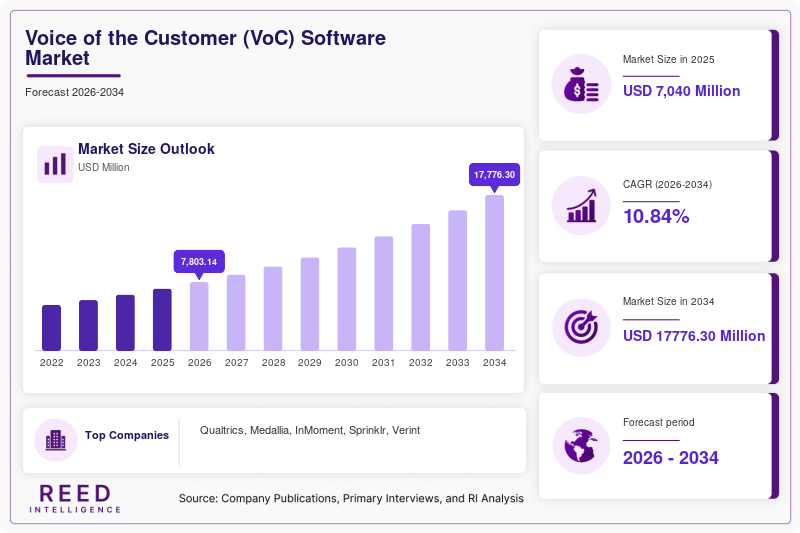
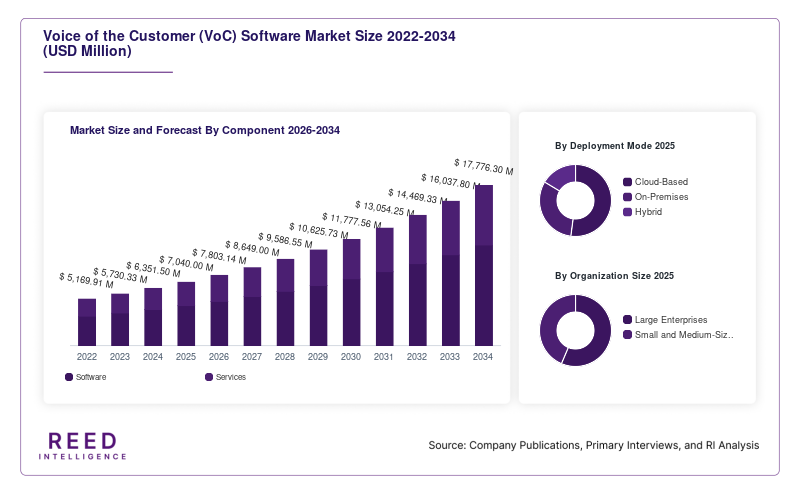
The global voice of the customer (VoC) software market was valued at USD 7,040 million in 2025 and is projected to grow from USD 7,803.14 million in 2026 to USD 17,776.30 million by 2034, registering a CAGR of 10.84% during the forecast period from 2026 to 2034.
The voice of the customer (VoC) software market comprises digital platforms that collect, organize, analyze, and interpret customer feedback across multiple touchpoints. These solutions help organizations understand customer expectations, measure satisfaction, identify recurring service issues, assess brand perception, and translate customer feedback into improvements in products, services, and customer experiences.
VoC software combines structured feedback methods, such as surveys and questionnaires, with unstructured information from customer service conversations, online reviews, social media, email, digital interactions, and in-app feedback. Increasingly, these platforms use artificial intelligence (AI), natural language processing (NLP), sentiment analysis, and automated text analytics to identify patterns across large datasets.
Voice of the Customer (VoC) Software MarketMarket Drivers
Organizations across retail, financial services, healthcare, telecommunications, travel, and technology are using customer feedback to understand dissatisfaction and improve service delivery. VoC platforms help identify friction points, monitor satisfaction, and prioritize improvements that can support customer retention and loyalty.
The expansion of e-commerce, mobile applications, digital payments, online support, and self-service channels has increased the volume and variety of customer feedback. Businesses require centralized platforms that can combine information from multiple touchpoints and turn fragmented feedback into actionable insights.
AI and NLP technologies improve the ability to analyze unstructured information, including customer comments, reviews, chat transcripts, and call recordings. Automation can reduce manual review requirements and help teams identify emerging concerns more quickly, although accuracy depends on data quality, context, and model performance.
Companies increasingly use customer feedback to inform product development, service design, marketing campaigns, customer support, and brand management. Connecting VoC insights with operational and commercial data helps decision-makers prioritize changes based on recurring customer needs rather than isolated feedback.
Voice of the Customer (VoC) Software Market Restraints
VoC platforms may process personal information, sensitive customer comments, call recordings, and behavioral data. Organizations must manage consent, retention, access controls, data residency, and applicable privacy requirements. These obligations can increase implementation costs and limit how information is collected, combined, and analyzed.
Businesses may operate disconnected CRM platforms, contact center applications, survey tools, data warehouses, and customer databases. Integrating these systems can require additional engineering, data mapping, workflow redesign, and ongoing maintenance, delaying deployment and reducing the consistency of insights.
Enterprise VoC programs can involve software subscriptions, integration services, data preparation, employee training, analytics configuration, and ongoing platform administration. Smaller organizations may find it difficult to justify the full cost when feedback volumes are limited or when benefits cannot be measured clearly.
Incomplete responses, low participation, biased feedback, duplicate records, and excessive survey requests can weaken the reliability of customer insights. Organizations need suitable sampling, thoughtful survey design, and multiple feedback channels to reduce these limitations.
Voice of the Customer (VoC) Software Market Opportunities
Simplified cloud subscriptions, ready-made integrations, and AI-assisted analytics create opportunities to serve smaller businesses that lack dedicated research and customer experience teams. More accessible platforms can help these organizations formalize feedback programs without maintaining extensive technical infrastructure.
VoC providers can expand beyond descriptive reporting toward early identification of churn risks, emerging complaints, and changes in customer sentiment. Predictive models and workflow automation can help teams prioritize interventions, provided the underlying data and model outputs are appropriately validated.
Healthcare providers, insurers, banks, and other regulated organizations can use VoC tools to understand patient, member, and customer experiences across complex service journeys. Solutions that offer appropriate security controls, auditability, and deployment flexibility may address specialized requirements in these sectors.
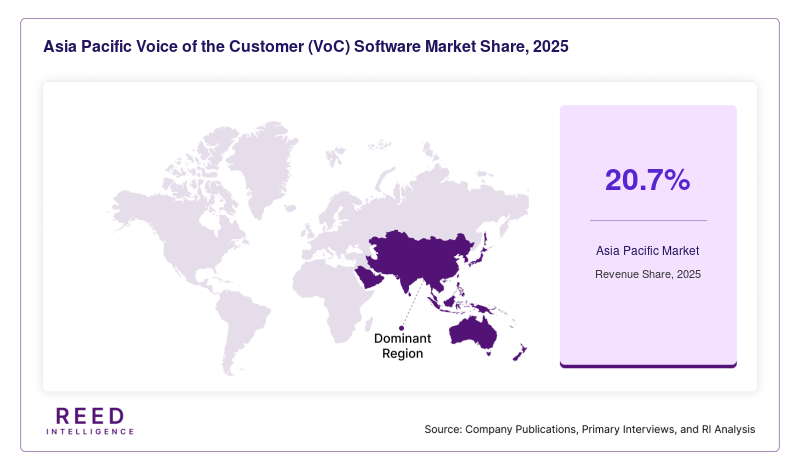
Growing digital commerce, mobile engagement, and online service delivery are creating opportunities for VoC vendors across Asia Pacific, Latin America, and the Middle East. Local-language analytics, regional data handling, and integrations with locally used platforms can help providers address differences in customer behavior and business requirements.
Voice of the Customer (VoC) Software Market Segmental Analysis
By Component
The software segment represents the core of the VoC market because it provides the tools required to capture feedback, analyze customer sentiment, visualize trends, and distribute insights across business functions. Organizations increasingly prefer platforms that combine survey management, text analytics, reporting, and workflow automation within a common environment. AI-enabled categorization and integrations with CRM and contact center applications further support the adoption of consolidated software platforms.
The services segment includes implementation, integration, consulting, customization, training, and managed support. Services are relevant when organizations need to connect feedback sources, migrate existing survey data, configure reporting models, or introduce closed-loop workflows. Large enterprises with complex technology environments may require ongoing professional services to align VoC programs with their customer experience and data governance strategies.
Dominant subsegment: Software is the leading component in a published third-party market assessment, which estimated that it accounted for 72.41% of the market in 2025. Services remain important for deployment and integration requirements.
By Deployment Mode
Cloud-based deployment supports centralized feedback collection, remote access, scalable data processing, and recurring software updates. It allows organizations to introduce VoC programs without managing all the underlying infrastructure themselves. Cloud platforms are particularly relevant to businesses operating across multiple locations and digital channels, where customer experience teams need consistent access to feedback and reporting.
On-premises deployment remains relevant for organizations that need greater control over data storage, infrastructure, or security configurations. Hybrid deployment combines cloud capabilities with selected on-premises systems, allowing businesses to retain sensitive information or existing applications within controlled environments while using cloud-based analytics for suitable workloads.
Dominant subsegment: Cloud-based deployment was the largest deployment category in the referenced 2025 assessment, accounting for 68.19% of the market. Fastest-growing subsegment: Hybrid deployment was projected to grow at an 18.43% CAGR over that assessment's 2026–2031 forecast period. These figures are third-party benchmarks and may differ from estimates based on the market definition and size figures supplied for this report.
By Organization Size
Large enterprises use VoC platforms to consolidate feedback across business units, regions, brands, and customer interaction channels. Their requirements often include advanced analytics, role-based access, integrations with enterprise applications, workflow automation, and reporting that supports centralized and regional decision-making. Large organizations may also require customization to meet internal security, governance, and reporting standards.
Small and medium-sized enterprises are adopting more accessible cloud-based tools to formalize customer feedback programs without building extensive analytics infrastructure. Subscription-based pricing, ready-to-use survey templates, automated reporting, and simplified integrations can help smaller organizations monitor customer satisfaction and respond to feedback with limited internal resources.
Large enterprises are an important customer group because of their broad customer bases and complex operating structures. SMEs offer additional expansion opportunities as platforms become easier to deploy and administer. A comparable, independently verified market-share and CAGR breakdown for organization size was not available in the sources reviewed for this report.
By Application
Customer experience management helps businesses monitor satisfaction across multiple stages of the customer journey. By consolidating feedback from surveys, support interactions, digital channels, and other sources, organizations can identify recurring friction points and coordinate improvements across departments.
Customer feedback management focuses on gathering, categorizing, and responding to feedback. Customer journey optimization evaluates interactions across the customer lifecycle, while product and service development uses customer insights to inform feature priorities, quality improvements, and new offerings. Brand and reputation management combines feedback and public reviews to identify changes in customer perception.
Customer retention and churn management uses satisfaction signals and recurring complaints to help identify customers who may require intervention. Campaign performance and experience measurement evaluates how customers respond to marketing activity and brand interactions.
Dominant subsegment: Customer journey optimization accounted for 26.74% of the application market in the referenced 2025 assessment. Fastest-growing subsegment: Campaign performance and experience measurement was projected to grow at a 20.16% CAGR over 2026–2031. These figures are specific to that third-party assessment and are not presented as measurements of the supplied market-size series.
By Data Source
Surveys and questionnaires remain a fundamental source of structured customer feedback. They allow organizations to measure satisfaction, recommendation intent, and responses to specific products or service interactions. Standardized questions also make it easier to compare feedback across customer groups and time periods.
Customer service conversations, including calls, chats, and support messages, provide contextual information about customer needs and service failures. Digital behavior and web analytics help identify friction during online journeys, while in-app feedback captures experiences closer to product use. Social media, ratings, reviews, email, messaging, and in-person interactions add further perspectives on customer expectations and brand perception.
Dominant subsegment: Surveys and questionnaires represented 24.83% of the data-source category in the referenced 2025 assessment. Fastest-growing subsegment: In-app behavior and feedback was projected to grow at a 21.34% CAGR during 2026–2031.
By Industry Vertical
Retail and e-commerce businesses use VoC software to understand purchasing friction, product satisfaction, delivery experiences, returns, and support quality. Customer feedback can inform product assortment, website usability, personalization, and post-purchase engagement. Financial services organizations use VoC tools to monitor digital banking, payment experiences, claims, account servicing, and complaint resolution.
Healthcare and life sciences organizations apply feedback tools to patient experience, appointment access, communication, and service coordination. IT and telecommunications companies monitor network and service experiences, technical support, billing, and customer onboarding. Travel and hospitality providers use customer feedback to evaluate booking, check-in, accommodation, and service interactions.
Industrial manufacturers can use VoC platforms to collect feedback from business customers, distributors, service teams, and equipment users. Media and entertainment businesses monitor audience sentiment and subscription experiences, while public-sector organizations can use feedback to assess the accessibility and quality of public services.
Voice of the Customer (VoC) Software Market Competitive Landscape
The Voice of the Customer Software Market features established customer experience management providers, enterprise software companies, and specialized feedback analytics vendors. Competition is shaped by the breadth of feedback channels supported, analytical capabilities, AI functionality, integration options, deployment flexibility, security controls, and the ability to translate insights into operational action.
Leading providers are expanding beyond conventional survey tools toward integrated experience management platforms that combine customer feedback, digital behavior, conversational data, text analytics, and automated workflows. AI-based capabilities are becoming an important area of product development, particularly for analyzing unstructured feedback, identifying recurring issues, summarizing customer sentiment, and recommending follow-up actions.
Key Market Players
- Qualtrics
- Medallia
- InMoment
- Sprinklr
- Verint
- NICE
- Forsta
- Alchemer
- SurveyMonkey
- Sogolytics
- Chattermill
Voice of the Customer (VoC) Software Market Recent Developments
- September , 2026 - Medallia customer feedback management evaluation: Medallia announced recognition in a customer feedback management and analytics evaluation. The development reflects the continued role of customer feedback collection and analytics in the competitive experience-management market.
- September, 2026 - Medallia customer and employee listening deployment: Medallia announced that Santalucía was creating a connected listening ecosystem to capture and act on customer and employee feedback. The announcement illustrates enterprise interest in bringing feedback programs together across stakeholder groups.
Voice of the Customer (VoC) Software Market Segments
By Component
- Software
- Services
By Deployment Mode
- Cloud-Based
- On-Premises
- Hybrid
By Organization Size
- Large Enterprises
- Small and Medium-Sized Enterprises (SMEs)
By Application
- Customer Experience Management
- Customer Feedback Management
- Customer Journey Optimization
- Product and Service Development
- Brand and Reputation Management
- Customer Retention and Churn Management
- Campaign Performance and Experience Measurement
By Data Source
- Surveys and Questionnaires
- Customer Service Conversations
- Digital Behavior and Web Analytics
- In-App Behavior and Feedback
- Social Media, Ratings and Reviews
- Email and Messaging
- Store and In-Person Interactions
By Industry Vertical
- Retail and E-Commerce
- Banking, Financial Services and Insurance (BFSI)
- Healthcare and Life Sciences
By Region
- North America
- Europe
- APAC
- Middle East and Africa
- LATAM