VR Grips Market Size, Share & Demand Report By Product Type (Silicone Grips, Adjustable Knuckle Grips, Textured Rubber Grips, Protective Full-Cover Grips, Hybrid Material Grips), By Application (Gaming, Enterprise Training, Healthcare Rehabilitation, Education, Virtual Collaboration), By Distribution Channel (Online Retail, Specialty Gaming Stores, Consumer Electronics Stores, Direct Sales, Third-Party Distributors), By Region & Segment Forecasts, 2026–2034
USD 3950
Market Overview
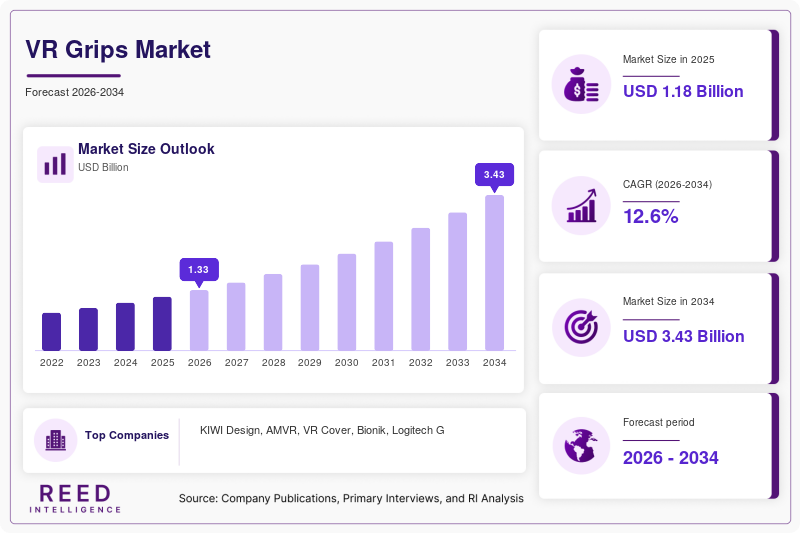
The global VR Grips Market size was valued at USD 1.18 billion in 2026 and is projected to reach USD 3.04 billion by 2034, expanding at a CAGR of 12.6% during the forecast period. The market is witnessing stable expansion due to the growing adoption of virtual reality gaming, enterprise simulation platforms, and immersive digital training environments across multiple industries. VR grips are designed to improve controller handling, reduce hand fatigue, and increase immersion during extended virtual reality sessions. The increasing use of VR devices in gaming centers, educational institutions, military simulation programs, and healthcare rehabilitation has accelerated demand for ergonomic and customizable VR accessories.
A major global factor supporting market growth is the rapid expansion of the immersive entertainment ecosystem. Gaming developers, headset manufacturers, and accessory companies are increasingly investing in user comfort and precision-based gameplay experiences. Consumers now seek accessories that improve controller stability, sweat resistance, tracking accuracy, and long-session usability. In addition, the growing popularity of competitive VR gaming and fitness-based VR applications has strengthened product demand across developed and emerging economies. The integration of adjustable straps, anti-slip materials, pressure-sensitive controls, and lightweight polymer designs has also improved product performance and replacement cycles.
Key Highlights
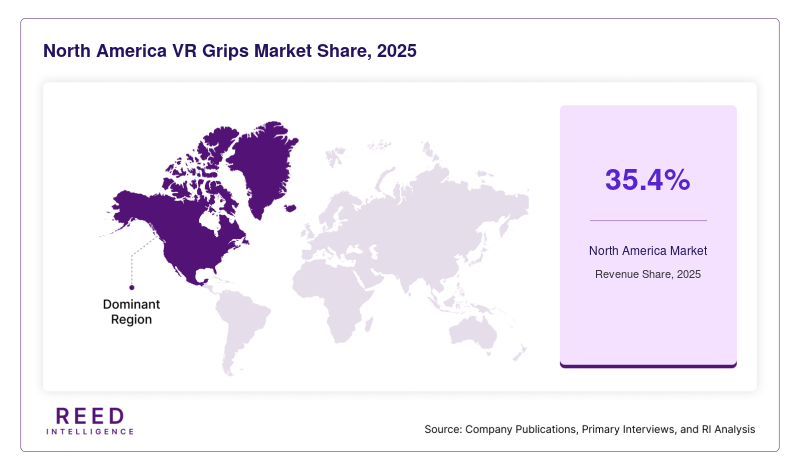
- North America dominated the market with a 35.4% share in 2025, while Asia Pacific is expected to grow at the fastest CAGR of 14.1% during 2026–2034.
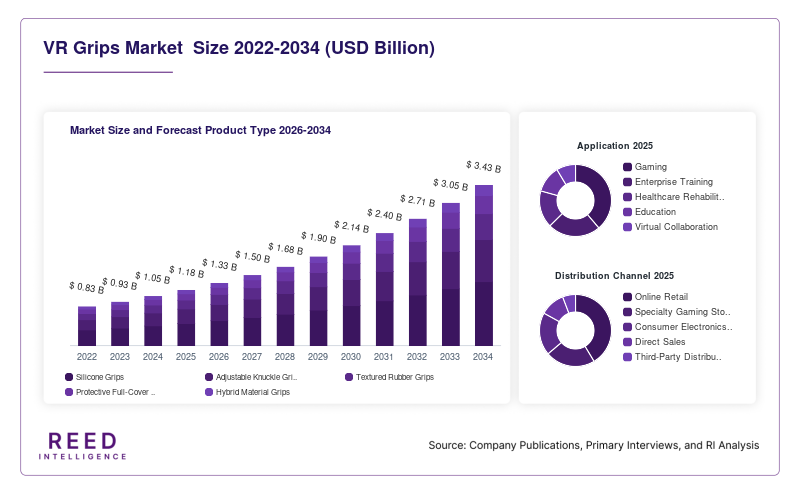
- By product type, silicone grips accounted for the largest share of 39.6%, while adjustable knuckle grips are projected to grow at a CAGR of 15.2%.
- By application, gaming applications led with a 48.3% share, whereas enterprise training applications are expected to expand at a CAGR of 14.7%.
- By distribution channel, online retail dominated with a 56.1% share, while specialty gaming stores are projected to grow at a CAGR of 13.1%.
- The United States remained the dominant country, with market values of USD 410 million in 2024 and USD 465 million in 2025.
Market Trends
Expansion of VR Fitness and Interactive Wellness Platforms
The growing popularity of VR fitness applications is creating sustained demand for advanced VR grips with secure hand retention systems and sweat-resistant materials. Consumers are increasingly using virtual reality for exercise routines, interactive wellness sessions, and motion-based gaming experiences that require long usage periods and repetitive hand movement. This shift has increased the need for grips that improve comfort, reduce strain, and support accurate motion tracking. Fitness-focused VR applications often require aggressive movement intensity, which has encouraged manufacturers to develop anti-slip textures, breathable straps, and lightweight grip attachments. The trend is particularly visible among younger consumers and urban households that are adopting connected fitness technologies as alternatives to conventional gym memberships.
The increasing integration of gamification into wellness programs is also influencing product innovation. Companies are introducing grips with enhanced tactile feedback and adjustable wrist support to improve exercise engagement and safety. Subscription-based VR fitness platforms are collaborating with accessory manufacturers to promote bundled ecosystems that improve user retention. As consumers continue to prioritize home-based entertainment and wellness technologies, the adoption of durable and ergonomic VR grips is expected to strengthen across developed markets and gradually expand in emerging economies.
Increasing Focus on Cross-Platform Accessory Compatibility
Manufacturers in the VR Grips Market are increasingly prioritizing universal compatibility across different headset and controller ecosystems. Consumers prefer accessories that can function across multiple VR devices without requiring extensive modifications or replacements. This trend is encouraging companies to develop adaptable grip systems with adjustable attachment mechanisms, modular structures, and flexible material engineering. The availability of multi-platform grips reduces accessory replacement costs and improves convenience for gamers who own more than one VR device.
Cross-platform compatibility is also becoming important for commercial users, including gaming arcades, educational centers, and simulation facilities that operate multiple VR systems simultaneously. Enterprises prefer accessories that simplify maintenance and reduce inventory complexity. In response, manufacturers are investing in standardized product dimensions and interchangeable components that support broad controller compatibility. The trend is further supported by the increasing number of third-party accessory brands entering the market with competitively priced products. As VR ecosystems continue to diversify, compatibility-focused innovation is expected to remain an important factor shaping purchasing decisions.
Market Drivers
Rising Adoption of Immersive Gaming Technologies
The rapid expansion of immersive gaming technologies is a major driver supporting growth in the VR Grips Market. Consumers are increasingly investing in advanced gaming accessories that improve gameplay precision, controller stability, and hand comfort. Modern VR games involve extensive motion tracking, fast physical interaction, and extended playing sessions, creating strong demand for grips with secure retention systems and ergonomic designs. Gaming developers are also introducing highly interactive environments that require enhanced controller responsiveness, which encourages consumers to upgrade accessories more frequently.
The growth of esports tournaments, multiplayer VR experiences, and social gaming platforms has strengthened consumer engagement with virtual reality hardware. Professional and competitive gamers are particularly focused on accessories that improve grip consistency and reduce accidental controller drops during active gameplay. Manufacturers are responding by launching textured materials, finger strap systems, and lightweight grip structures that improve user control. The increasing affordability of standalone VR headsets and broader digital game distribution channels are expected to sustain long-term product demand.
Growing Enterprise and Educational VR Applications
The increasing use of virtual reality in enterprise training, industrial simulation, and educational environments is accelerating demand for VR grip accessories. Organizations across healthcare, aviation, manufacturing, defense, and technical education are implementing VR-based learning systems to improve operational training efficiency. These environments require accessories that support repeated daily usage, maintain hygiene standards, and provide secure handling during simulation exercises.
Educational institutions and corporate training centers are investing in immersive technologies to improve practical learning outcomes and reduce operational costs associated with physical training infrastructure. VR grips play an important role in enhancing user interaction and reducing fatigue during prolonged simulation sessions. Enterprises also prioritize accessories with durable materials and adjustable sizing to accommodate multiple users. The rise of remote collaboration tools and virtual workspace technologies has further expanded commercial VR adoption. As businesses continue integrating immersive technologies into workforce development strategies, demand for professional-grade VR grips is expected to increase steadily.
Market Restraint
Limited Compatibility Standards and Product Fragmentation
The absence of universal compatibility standards remains a significant restraint affecting the VR Grips Market. Different VR headset manufacturers use proprietary controller designs, dimensions, and tracking systems, creating challenges for accessory manufacturers attempting to develop standardized products. As a result, many VR grips are compatible with only specific controller models, limiting consumer flexibility and increasing replacement costs when users upgrade devices. This fragmentation creates purchasing hesitation among consumers who are uncertain about long-term accessory usability.
The issue is more pronounced in emerging markets where consumers often seek affordable accessories that can function across multiple platforms. Retailers also face inventory management challenges because they must stock a wide range of model-specific products. Smaller accessory companies may struggle to maintain profitability due to frequent product redesign requirements associated with new VR hardware launches. In commercial environments such as gaming centers and educational institutions, compatibility limitations increase operational complexity and maintenance costs. The rapid pace of VR hardware innovation further intensifies this restraint, as accessory manufacturers must continuously adapt to changing controller specifications and tracking technologies.
Market Opportunities
Growth Potential in Healthcare Rehabilitation Applications
The increasing use of virtual reality technologies in healthcare rehabilitation presents a major opportunity for the VR Grips Market. Rehabilitation centers and hospitals are adopting VR-based therapy programs for physical recovery, motor skill improvement, and cognitive training. These programs require comfortable and reliable controller accessories that support repeated patient interaction during therapy sessions. VR grips designed with antimicrobial materials, soft-touch textures, and adaptive support features are gaining attention in medical environments.
Healthcare professionals are increasingly using immersive therapy systems for stroke recovery, pain management, and neurological rehabilitation. Patients participating in long therapy sessions benefit from ergonomic grip designs that reduce hand fatigue and improve movement control. The expansion of home-based rehabilitation solutions is also supporting accessory demand among individual consumers. Manufacturers have opportunities to develop medically optimized grips with adjustable support mechanisms and lightweight structures tailored for elderly or mobility-limited users. As digital healthcare infrastructure expands globally, rehabilitation-focused VR accessory demand is expected to increase.
Expansion of VR Entertainment Centers and Arcades
The growing number of VR entertainment centers and immersive gaming arcades creates favorable growth opportunities for accessory manufacturers. Commercial VR facilities require durable accessories capable of supporting continuous daily usage by multiple customers. Operators prioritize grips that improve controller safety, minimize accidental drops, and maintain hygiene standards under high-frequency operation. This demand is encouraging manufacturers to introduce reinforced materials, washable grip covers, and quick-adjust retention systems.
Location-based entertainment businesses are expanding across shopping malls, tourism hubs, and urban recreation centers, particularly in Asia Pacific and the Middle East. These facilities often use multiplayer VR experiences that require reliable accessories for active motion-based gameplay. Commercial operators also prefer products that simplify maintenance and replacement procedures. As tourism-driven entertainment investments increase, demand for commercial-grade VR grips is likely to rise steadily. The emergence of immersive esports arenas and experiential entertainment venues is expected to create additional opportunities for premium accessory providers.
Segmental Analysis
By Product Type
Silicone grips accounted for the largest share of the VR Grips Market in 2024, representing 39.6% of total revenue. The segment benefits from widespread consumer preference for lightweight, affordable, and sweat-resistant accessories that improve controller handling during extended VR sessions. Silicone materials provide enhanced flexibility, comfortable texture, and easy installation, making them suitable for both casual and professional users. Gaming enthusiasts prefer silicone grips because they reduce accidental slippage and improve hand stability during fast-motion gameplay. Manufacturers are also introducing textured silicone surfaces and antimicrobial coatings to improve hygiene and long-term usability. Strong availability through online marketplaces and gaming accessory retailers has further strengthened adoption across developed and emerging economies.
Adjustable knuckle grips are expected to witness the fastest growth during the forecast period, expanding at a CAGR of 15.2%. These products are gaining popularity because they allow users to release controller pressure without dropping the device, improving comfort and immersion during interactive gameplay. The segment is benefiting from increasing demand for advanced motion tracking and physically active VR experiences, particularly in fitness applications and multiplayer gaming. Manufacturers are integrating adjustable straps, breathable fabrics, and reinforced attachment systems to improve durability and user convenience. Commercial gaming centers and VR arcades are also adopting knuckle grip systems to reduce controller damage and improve user safety. The growing popularity of premium VR accessories is expected to support long-term segment growth.
By Application
Gaming applications held the dominant share of the VR Grips Market in 2024, accounting for 48.3% of global revenue. The segment continues to benefit from strong consumer engagement with immersive entertainment platforms and competitive VR gaming environments. Modern VR games involve extensive motion interaction and prolonged gameplay sessions, increasing demand for accessories that improve comfort, precision, and controller retention. Consumers frequently upgrade grips to enhance gameplay performance and personalize their gaming setups. Game streaming culture and online multiplayer ecosystems are also influencing accessory purchasing behavior. Manufacturers are introducing themed grip designs, enhanced tactile textures, and customizable accessories to attract gaming communities. The growing availability of standalone VR headsets and affordable gaming bundles continues to support segment expansion.
Enterprise training applications are projected to grow at the fastest CAGR of 14.7% during the forecast period. Businesses across healthcare, defense, aviation, manufacturing, and logistics are increasingly implementing VR-based training systems to improve operational efficiency and reduce training costs. These applications require durable and ergonomic accessories capable of supporting extended simulation sessions and repeated daily usage. Enterprises prioritize accessories with adjustable designs and easy maintenance features to accommodate multiple users. The increasing use of VR collaboration tools and remote simulation platforms is also strengthening demand for professional-grade grips. Governments and educational institutions are supporting digital training initiatives, which is expected to create additional opportunities for enterprise-focused accessory manufacturers.
By Distribution Channel
Online retail dominated the VR Grips Market in 2024 with a revenue share of 56.1%. The segment benefits from broad product availability, competitive pricing, and access to global consumer bases through e-commerce platforms. Online marketplaces allow consumers to compare products, read reviews, and access customized accessories from international brands. Manufacturers increasingly rely on direct-to-consumer digital channels to improve brand visibility and reduce distribution costs. Social media marketing, gaming influencers, and live-streaming product demonstrations also contribute to stronger online sales performance. Consumers prefer online platforms because they offer access to limited-edition designs, bundled accessories, and promotional discounts. The increasing penetration of mobile commerce and digital payment systems continues to support long-term growth within the segment.
Specialty gaming stores are expected to expand at the fastest CAGR of 13.1% during the forecast period. Consumers seeking premium accessories and personalized purchasing experiences often prefer physical retail outlets where they can evaluate product quality and compatibility before purchase. Specialty retailers provide expert recommendations, installation assistance, and product demonstrations that improve consumer confidence. The growth of experiential retail strategies is encouraging gaming stores to create immersive product display environments featuring VR equipment and accessories. Commercial gaming operators and professional gamers also rely on specialty retailers for high-performance products and technical support services. As premium VR ecosystems expand globally, specialty gaming stores are expected to strengthen their role in the distribution landscape.
Regional Analysis
North America
North America accounted for 35.4% of the global VR Grips Market share in 2025 and is expected to maintain stable growth at a CAGR of 11.4% during the forecast period. The region benefits from high consumer spending on gaming accessories, advanced digital infrastructure, and widespread adoption of virtual reality technologies. Strong demand from gaming enthusiasts, esports communities, and commercial entertainment operators continues to support accessory sales. Major VR hardware launches and early adoption of immersive technologies have strengthened regional product penetration.
The United States remains the dominant country within the region due to its large gaming population and advanced consumer electronics ecosystem. One unique growth factor supporting the market is the increasing use of VR technologies in military and industrial training programs. Government agencies and private enterprises are investing in simulation systems that require durable and ergonomic accessories for extended operational use. The presence of leading gaming hardware manufacturers and accessory developers further supports innovation and distribution expansion.
Europe
Europe represented 26.1% of the global VR Grips Market share in 2025 and is projected to grow at a CAGR of 10.8% through 2034. The region is experiencing rising adoption of VR technologies across gaming, education, automotive simulation, and healthcare applications. Consumers in Western European countries increasingly prefer premium gaming accessories with advanced ergonomic features and sustainable materials. Strong e-commerce penetration and organized retail distribution channels continue to improve product accessibility across the region.
Germany emerged as the leading country in the European market due to its strong consumer electronics industry and expanding industrial VR ecosystem. A unique growth factor supporting regional expansion is the integration of VR-based vocational training programs in manufacturing and engineering sectors. Companies are implementing immersive training modules to improve workforce efficiency and reduce operational errors. This trend has increased demand for professional-grade VR accessories capable of supporting long-duration simulation sessions.
Asia Pacific
Asia Pacific held 22.8% of the global VR Grips Market share in 2025 and is anticipated to register the fastest CAGR of 14.1% during 2026–2034. Rapid growth in gaming populations, expanding smartphone connectivity, and increasing affordability of VR devices are supporting market expansion across the region. Countries including China, Japan, South Korea, and India are witnessing growing demand for immersive entertainment products among younger consumers. Domestic accessory manufacturers are also introducing competitively priced products to capture expanding consumer demand.
China remains the dominant country in the regional market due to its large consumer electronics manufacturing base and growing esports ecosystem. One unique growth factor supporting market expansion is the rapid development of VR-based entertainment parks and commercial gaming venues. Urban entertainment operators are increasingly adopting immersive technologies to attract younger audiences and differentiate customer experiences. Government initiatives promoting digital innovation and smart entertainment infrastructure are also contributing to long-term regional market growth.
Middle East & Africa
The Middle East & Africa region accounted for 7.2% of the global VR Grips Market share in 2025 and is projected to expand at a CAGR of 12.3% during the forecast period. Market growth is supported by increasing investments in digital entertainment infrastructure, smart city initiatives, and tourism-focused immersive experiences. Consumers in Gulf countries are adopting premium gaming technologies at a steady pace, while educational institutions are gradually integrating virtual reality learning tools into academic programs.
The United Arab Emirates is the leading country within the region due to strong investments in technology-driven entertainment projects and retail innovation. A unique growth factor supporting regional demand is the expansion of immersive tourism attractions and VR-based visitor experiences. Entertainment operators and shopping destinations are increasingly integrating virtual reality zones to improve consumer engagement. The growing popularity of family entertainment centers and gaming lounges is expected to create additional demand for commercial-grade VR accessories.
Latin America
Latin America captured 8.5% of the global VR Grips Market share in 2025 and is forecast to grow at a CAGR of 11.6% through 2034. Rising internet penetration, increasing smartphone gaming adoption, and expanding digital entertainment consumption are supporting regional market growth. Consumers are gradually adopting affordable VR devices and related accessories, particularly in urban areas. Online retail platforms and gaming marketplaces are improving product availability across several Latin American countries.
Brazil remains the dominant country in the region due to its large gaming community and growing consumer electronics market. One unique growth factor driving demand is the increasing popularity of social gaming events and esports competitions in metropolitan areas. Gaming cafes and entertainment venues are integrating VR technologies to attract younger consumers and diversify services. The rise of local accessory distributors and regional e-commerce expansion is expected to improve long-term market accessibility.
Competitive Landscape
The VR Grips Market is moderately fragmented, with established gaming accessory manufacturers and emerging third-party developers competing across premium and mid-range product categories. Companies are focusing on ergonomic innovation, controller compatibility, material durability, and strategic partnerships with VR hardware brands to strengthen market presence. Product differentiation remains a key competitive strategy, particularly in premium gaming and enterprise application segments.
KIWI Design emerged as one of the leading companies in the market due to its extensive portfolio of ergonomic controller accessories and strong online distribution network. The company recently introduced an upgraded adjustable grip system designed for next-generation standalone VR headsets, improving controller stability and user comfort during active gameplay sessions.
Key Players
- KIWI Design
- AMVR
- VR Cover
- Bionik
- Logitech G
- Hyperkin
- DESTEK
- Rebuff Reality
- Oculus Accessories Co.
- ZyberVR
- Controller Gear
- Anker Innovations
- PowerA
- Sony Interactive Entertainment
- HTC Corporation
Recent Developments
- In February 2026, KIWI Design launched an upgraded breathable knuckle grip series designed for extended VR fitness sessions and high-motion gaming environments.
- In August 2025, AMVR expanded its distribution partnership network across Southeast Asia to improve product availability through regional e-commerce platforms.
- In November 2025, Rebuff Reality introduced antimicrobial VR grip accessories targeting healthcare simulation centers and shared commercial gaming facilities.
- In January 2026, ZyberVR announced a modular grip attachment system compatible with multiple standalone VR controller models.
VR Grips Market Segments
Product Type
- Silicone Grips
- Adjustable Knuckle Grips
- Textured Rubber Grips
- Protective Full-Cover Grips
- Hybrid Material Grips
Application
- Gaming
- Enterprise Training
- Healthcare Rehabilitation
- Education
- Virtual Collaboration
Distribution Channel
- Online Retail
- Specialty Gaming Stores
- Consumer Electronics Stores
- Direct Sales
- Third-Party Distributors
By Region
- North America
- Europe
- APAC
- Middle East and Africa
- LATAM