Vulkollan Wheels Market Size, Share, Demand Report By Product Type (Drive Wheels, Load Wheels, Guide Wheels, Caster Wheels), By Application (Material Handling Equipment, Automated Guided Vehicles, Airport Ground Support Equipment, Industrial Trailers, Robotics Systems), By End Use Industry (Logistics & Warehousing, Automotive, Manufacturing, Aerospace, Food & Beverage, Pharmaceuticals) By Region & Segment Forecasts, 2026–2034
USD 3950
Market Overview
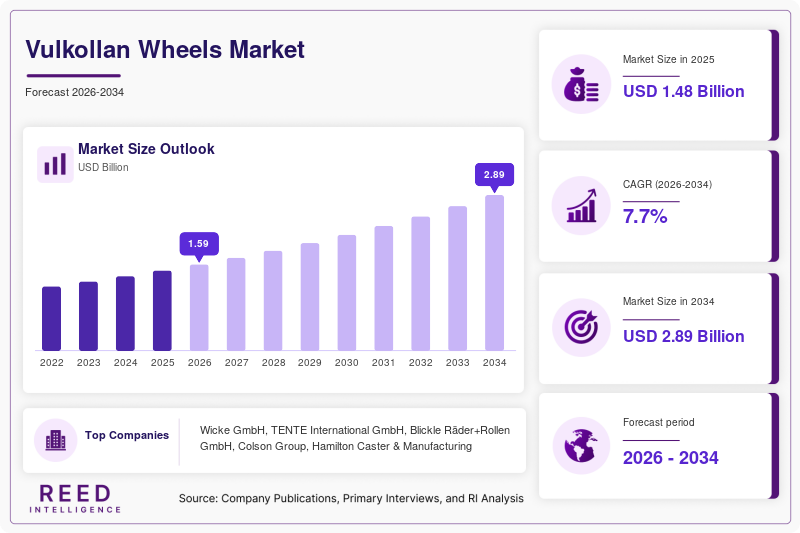
The global Vulkollan Wheels Market size was valued at USD 1.48 billion in 2026 and is projected to reach USD 2.67 billion by 2034, expanding at a CAGR of 7.7% during the forecast period. The market is gaining momentum due to the rising use of heavy-duty material handling systems across logistics centers, warehouses, manufacturing plants, and automated industrial facilities. Vulkollan wheels are known for their high load-bearing capacity, low rolling resistance, abrasion resistance, and durability under extreme operating conditions. These properties make them suitable for forklifts, automated guided vehicles, pallet trucks, industrial trailers, and airport ground support equipment.
The rapid growth of e-commerce distribution networks and warehouse automation continues to support market expansion. Industrial operators are increasingly investing in durable wheel systems that reduce downtime, minimize maintenance frequency, and improve operational efficiency. Vulkollan-based wheels are being adopted in environments where continuous operations and high floor protection are essential. Demand is also rising from the automotive and food processing sectors, where precision mobility equipment and low-noise wheel solutions are becoming standard operational requirements.
Key Highlights
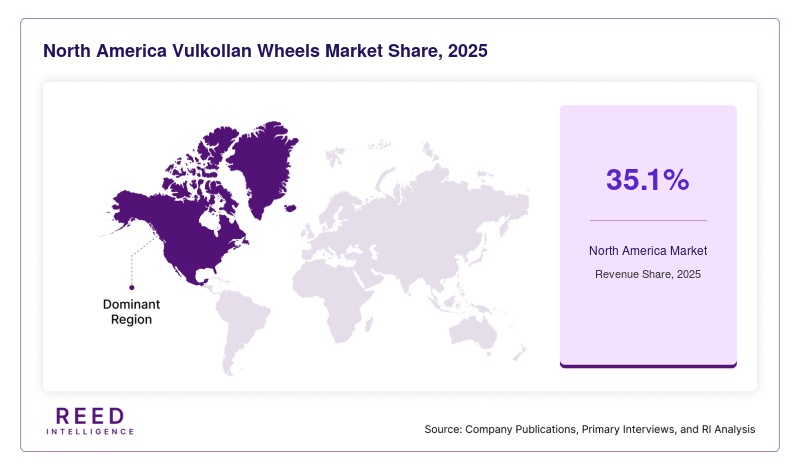
- North America dominated the market with a 35.1% share in 2025, while Asia Pacific is expected to grow at the fastest CAGR of 9.4% during 2026–2034.
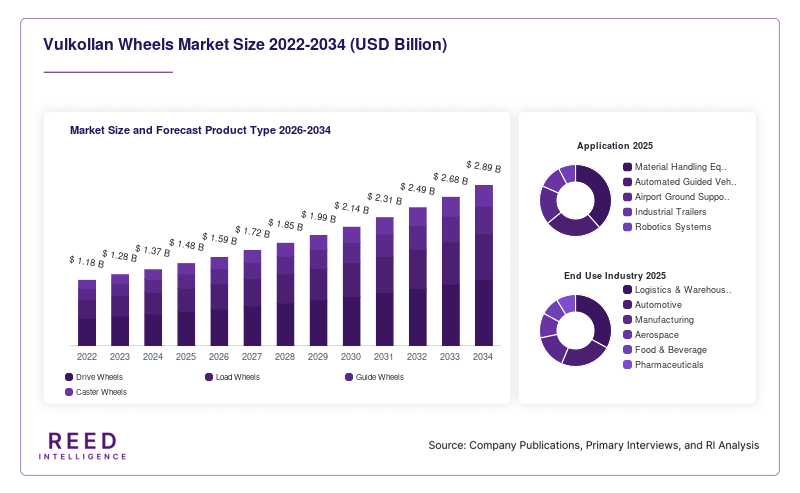
- By product type, drive wheels accounted for the largest share of 39.3%, while load wheels are projected to grow at a CAGR of 9.1%.
- By application, material handling equipment led with a 44.8% share, whereas automated guided vehicles are expected to expand at a CAGR of 10.2%.
- The United States remained the dominant country, with market values of USD 412 million in 2024 and USD 447 million in 2025.
Market Trends
Expansion of Warehouse Automation and Smart Logistics
The increasing deployment of warehouse automation systems is shaping the growth trajectory of the Vulkollan Wheels Market. Distribution facilities and logistics operators are adopting automated guided vehicles, robotic forklifts, and intelligent pallet transport systems to improve operational productivity and reduce labor dependency. These systems require high-performance wheels capable of supporting heavy loads while maintaining stable movement and reduced floor wear. Vulkollan wheels are widely preferred because of their ability to perform efficiently in continuous operating cycles and high-speed industrial environments. The rise of same-day delivery models and large-scale fulfillment centers is also increasing demand for durable wheel systems that support uninterrupted logistics operations. Manufacturers are responding by developing wheels with improved heat resistance, lower vibration levels, and stronger polyurethane compounds suitable for automated material handling equipment.
Rising Preference for Low-Maintenance Industrial Components
Industrial operators are increasingly focusing on maintenance optimization and lifecycle cost reduction, creating strong demand for long-lasting wheel systems. Vulkollan wheels are gaining preference due to their extended service life, resistance to abrasion, and ability to maintain structural integrity under high mechanical stress. Manufacturing facilities are prioritizing components that reduce downtime and improve equipment reliability, particularly in sectors such as automotive production, pharmaceuticals, food processing, and metal fabrication. The trend toward predictive maintenance and operational efficiency is encouraging procurement teams to invest in premium wheel materials instead of lower-cost alternatives that require frequent replacement. In addition, industrial safety standards are driving the use of wheels with improved traction, lower rolling noise, and reduced floor damage, further strengthening market demand across advanced industrial environments.
Market Drivers
Growth of E-Commerce Fulfillment Infrastructure
The rapid expansion of global e-commerce operations is a major factor supporting the Vulkollan Wheels Market. Retailers and logistics companies are increasing investments in large-scale fulfillment centers, automated warehouses, and cross-docking facilities to handle growing parcel volumes and improve delivery timelines. Material handling equipment such as forklifts, pallet movers, and automated transport systems rely heavily on durable wheel components to sustain continuous operations. Vulkollan wheels offer advantages including high elasticity, low rolling resistance, and strong load-bearing capability, making them suitable for high-traffic warehouse environments. As online retail penetration rises across emerging economies, warehouse operators are scaling infrastructure capacity and replacing conventional mobility systems with advanced industrial transport equipment, resulting in higher demand for premium industrial wheel solutions.
Increasing Industrial Automation Across Manufacturing Sectors
The growing adoption of industrial automation technologies is accelerating the use of high-performance mobility components in production facilities. Manufacturers are integrating robotic transport systems, conveyor-linked vehicles, and automated guided carts into assembly lines to improve precision, reduce labor costs, and enhance productivity. These automated systems require wheels capable of handling repetitive movement, heavy dynamic loads, and demanding operational cycles without performance degradation. Vulkollan wheels provide superior resilience and floor protection, which makes them appropriate for advanced manufacturing environments. Industries such as automotive, aerospace, electronics, and chemicals are expanding automation investments to maintain production efficiency and quality standards. This industrial transition is expected to sustain long-term demand for reliable wheel systems with consistent operational durability.
Market Restraint
High Production Costs and Dependence on Specialized Raw Materials
The Vulkollan Wheels Market faces challenges related to elevated manufacturing costs and dependence on specialized polyurethane formulations. Vulkollan material requires controlled production processes and advanced engineering standards, resulting in higher product pricing compared to conventional rubber or standard polyurethane wheels. Small and medium-sized industrial operators in cost-sensitive regions often prefer lower-cost alternatives despite their shorter operational lifespan. Fluctuations in raw material prices, especially petrochemical derivatives used in polyurethane production, can also affect profit margins and supply chain stability for manufacturers. In addition, limited availability of specialized production expertise restricts manufacturing scalability in some developing markets. Industrial buyers with budget limitations may delay replacement cycles or select standard wheel systems for non-critical operations. These pricing pressures can slow adoption rates, particularly in industries with limited capital expenditure capacity or lower automation penetration.
Market Opportunities
Expansion of Automated Guided Vehicle Applications
The increasing use of automated guided vehicles across warehouses, hospitals, airports, and manufacturing plants presents a significant growth opportunity for the Vulkollan Wheels Market. Automated guided vehicles require wheel systems with high precision movement, low vibration, and consistent traction to ensure safe and efficient navigation. Vulkollan wheels are suitable for these applications because they offer stable performance under continuous operational conditions and minimize floor damage in sensitive facilities. The rising integration of robotics in logistics operations and industrial automation systems is expected to accelerate demand for specialized wheels designed for autonomous mobility platforms. Manufacturers are introducing customized wheel designs for different load capacities and operating environments, creating additional revenue opportunities across commercial and industrial sectors.
Rising Infrastructure Development in Emerging Economies
Industrial infrastructure development across Asia Pacific, Latin America, and the Middle East is generating new opportunities for industrial mobility equipment manufacturers. Governments and private investors are expanding manufacturing hubs, logistics parks, ports, and transportation facilities to strengthen supply chain networks and industrial productivity. These projects increase demand for forklifts, heavy-duty trolleys, warehouse systems, and airport ground support equipment that depend on durable wheel solutions. Vulkollan wheels are gaining attention in emerging markets due to their ability to improve equipment lifespan and operational reliability in demanding industrial conditions. Growing foreign direct investment in manufacturing sectors and increasing adoption of automated logistics systems are expected to create sustained demand for high-performance industrial wheels throughout the forecast period.
Segmental Analysis
By Product Type
Drive wheels accounted for the largest share of the Vulkollan Wheels Market in 2024, representing 39.3% of global revenue. These wheels are widely used in forklifts, electric pallet trucks, and industrial transport systems because they provide high traction, durability, and consistent performance under heavy loads. Industrial facilities operating in demanding environments require drive wheels capable of supporting continuous movement while reducing vibration and floor wear. The increasing use of electric forklifts in logistics centers and automated warehouses has further strengthened demand for Vulkollan-based drive wheels. Manufacturers are focusing on advanced polyurethane formulations and reinforced wheel structures to improve load capacity and operational lifespan. The segment continues to benefit from the growing preference for high-efficiency mobility systems across industrial and commercial applications.
Load wheels are projected to witness the fastest growth during the forecast period, expanding at a CAGR of 9.1% from 2026 to 2034. Demand for load wheels is increasing as automated material handling equipment becomes more common across manufacturing plants and distribution centers. These wheels are designed to support substantial vertical loads while ensuring stable equipment movement and reduced maintenance frequency. Growth is particularly strong in automated guided vehicles and robotic transport systems, where operational reliability and low rolling resistance are essential performance requirements. Manufacturers are developing customized load wheel solutions with improved heat resistance and wear protection for high-speed industrial applications. Rising investments in warehouse automation and smart logistics infrastructure are expected to support long-term expansion of this segment.
By Application
Material handling equipment represented the dominant application segment in 2024, accounting for 44.8% of the global Vulkollan Wheels Market. Forklifts, pallet trucks, industrial trolleys, and warehouse transport systems require durable wheel solutions capable of operating under heavy mechanical stress. Vulkollan wheels are preferred in these applications because they provide superior load-bearing performance, abrasion resistance, and reduced floor damage compared to standard rubber wheels. The expansion of global logistics networks and fulfillment centers has significantly increased the use of material handling systems in industrial operations. Companies are also replacing older wheel systems with high-performance polyurethane alternatives to improve equipment efficiency and reduce downtime. The growth of industrial warehousing and e-commerce distribution activities continues to strengthen demand for advanced wheel technologies within this segment.
Automated guided vehicles are expected to register the fastest CAGR of 10.2% during the forecast period. The increasing integration of robotics and autonomous mobility systems across warehouses, airports, and manufacturing facilities is creating substantial demand for specialized wheel components. Automated guided vehicles require precision movement, low noise generation, and consistent traction to ensure efficient navigation and operational safety. Vulkollan wheels are suitable for these requirements because they deliver stable performance under repetitive operating conditions. The adoption of smart factory technologies and autonomous logistics systems is accelerating across developed and emerging economies, supporting segment growth. Manufacturers are introducing lightweight and high-durability wheel designs optimized for automated transport equipment, further expanding market opportunities in this category.
By End Use Industry
The logistics and warehousing segment held the largest share of the Vulkollan Wheels Market in 2024, accounting for 37.6% of total revenue. Rapid growth in global trade and e-commerce activities has increased demand for high-capacity distribution centers and advanced warehouse infrastructure. These facilities rely heavily on forklifts, pallet movers, and automated transport systems equipped with durable wheel solutions capable of supporting continuous operations. Vulkollan wheels are widely used in logistics applications because they reduce equipment vibration, improve floor protection, and extend operational lifespan. Companies operating large fulfillment networks are increasingly investing in premium industrial wheel systems to reduce maintenance costs and improve productivity. The segment is also benefiting from rising adoption of electric material handling equipment in environmentally regulated industrial facilities.
The automotive industry segment is projected to grow at the fastest CAGR of 8.8% during the forecast period. Automotive manufacturers are increasing the use of automated guided vehicles, robotic assembly systems, and industrial transport platforms to improve production efficiency and streamline material flow. These operations require wheel systems capable of handling precise movement and high dynamic loads within demanding manufacturing environments. Vulkollan wheels offer superior resilience and low rolling resistance, making them suitable for automotive assembly plants and component transport systems. The expansion of electric vehicle production facilities and modernization of manufacturing infrastructure are further supporting demand for advanced industrial mobility components. Growing investments in smart manufacturing technologies are expected to sustain growth across this segment throughout the forecast timeline.
Regional Analysis
North America
North America accounted for 35.1% of the global Vulkollan Wheels Market in 2025 and is expected to maintain steady growth during the forecast period, registering a CAGR of 6.8% from 2026 to 2034. The region benefits from widespread adoption of automated warehousing systems, strong industrial automation infrastructure, and significant investments in logistics modernization. Large-scale fulfillment centers operated by retail and transportation companies continue to support demand for premium industrial wheel systems. In addition, the presence of established material handling equipment manufacturers contributes to the consistent use of advanced polyurethane wheel technologies across industrial operations.
The United States remained the dominant country in North America due to strong investments in warehouse automation and manufacturing modernization. Industrial operators are increasingly replacing conventional wheel systems with Vulkollan-based products to improve equipment performance and reduce maintenance requirements. Growth is also supported by rising demand for automated guided vehicles in automotive and aerospace manufacturing facilities. Canada is witnessing steady expansion in logistics infrastructure, while Mexico is experiencing higher adoption of industrial mobility systems as manufacturing activities continue to expand across export-oriented production facilities.
Europe
Europe represented 28.4% of the global Vulkollan Wheels Market in 2025 and is forecast to grow at a CAGR of 7.1% during the assessment period. The region is characterized by advanced manufacturing capabilities, strict workplace safety standards, and strong adoption of energy-efficient industrial equipment. Demand for durable industrial wheel systems is increasing across automotive production facilities, pharmaceuticals, and food processing industries. European manufacturers are also focusing on sustainable material handling operations, encouraging the use of wheels with lower rolling resistance and extended operational lifespan.
Germany dominated the regional market due to its strong industrial machinery sector and high concentration of automated manufacturing facilities. The country continues to invest in Industry 4.0 technologies, creating strong demand for advanced mobility components in robotics and automated transport systems. France and Italy are witnessing increasing demand from warehouse automation projects and airport logistics operations. In Eastern Europe, industrial expansion and modernization of logistics facilities are contributing to growing adoption of high-performance wheel systems across manufacturing and transportation sectors.
Asia Pacific
Asia Pacific held 22.7% of the global Vulkollan Wheels Market in 2025 and is projected to register the fastest CAGR of 9.4% through 2034. Rapid industrialization, expanding manufacturing activity, and strong growth in e-commerce logistics are major contributors to regional demand. Countries across the region are investing heavily in warehouse automation, transportation infrastructure, and industrial robotics to improve productivity and support export-oriented industries. The increasing number of fulfillment centers and smart factories is driving demand for durable wheel solutions capable of operating under intensive industrial conditions.
China remained the leading country in the Asia Pacific market due to its large manufacturing base and extensive logistics infrastructure development. Industrial operators are increasingly adopting automated material handling systems to improve operational efficiency and reduce labor dependency. India is emerging as a significant growth market because of rapid warehouse expansion, rising industrial automation investments, and growth in organized retail logistics. Japan and South Korea continue to support demand through advanced robotics manufacturing and precision industrial equipment applications that require high-quality mobility components.
Middle East & Africa
The Middle East & Africa region accounted for 7.2% of the global Vulkollan Wheels Market in 2025 and is expected to grow at a CAGR of 7.6% during the forecast period. The market is supported by increasing investments in industrial diversification, logistics infrastructure, and airport modernization projects. Governments across Gulf countries are investing in smart industrial zones and automated warehousing facilities to strengthen regional trade capabilities. Industrial mobility equipment demand is increasing as manufacturing, construction, and transportation activities continue to expand throughout the region.
Saudi Arabia dominated the regional market due to large-scale industrial development programs and growing investments in logistics infrastructure. The country is expanding warehousing and manufacturing capacity to support economic diversification strategies, increasing demand for advanced material handling systems. The United Arab Emirates is also experiencing rising demand from airport operations and automated logistics facilities. In Africa, countries such as South Africa are gradually increasing adoption of industrial automation technologies, creating new opportunities for premium wheel manufacturers serving mining, manufacturing, and transportation industries.
Latin America
Latin America captured 6.6% of the global Vulkollan Wheels Market in 2025 and is anticipated to expand at a CAGR of 7.3% during 2026–2034. The region is benefiting from gradual industrial modernization and rising investments in logistics infrastructure. Distribution centers, retail warehouses, and manufacturing facilities are adopting advanced material handling equipment to improve operational productivity. Demand for durable industrial wheel systems is also increasing in the food processing, beverage, and automotive sectors, where continuous equipment operation is essential for maintaining production efficiency.
Brazil remained the dominant country in Latin America due to its strong industrial base and expanding logistics sector. The country is witnessing higher investments in warehouse development and industrial transportation systems to support growing domestic consumption and export activities. Mexico is also experiencing growth in industrial automation because of increasing manufacturing investments linked to international supply chains. In addition, regional port modernization projects and transportation infrastructure upgrades are creating additional opportunities for suppliers of high-performance industrial wheel systems.
Competitive Landscape
The Vulkollan Wheels Market is moderately consolidated, with several international and regional manufacturers competing through product innovation, customization capabilities, and long-term supply agreements with industrial equipment providers. Companies are focusing on improving wheel durability, load capacity, and wear resistance to address the growing demand from automated logistics and industrial automation sectors. Strategic partnerships with forklift manufacturers and warehouse automation providers are also becoming common as companies aim to strengthen their distribution networks and customer relationships.
Wicke GmbH remains one of the leading companies in the market due to its broad industrial wheel portfolio and strong presence across Europe and North America. The company recently expanded its polyurethane wheel production capacity to support rising demand from automated material handling applications. Other major participants are increasing investments in advanced manufacturing technologies and customized wheel solutions for robotics and automated guided vehicles. Competition is also intensifying in Asia Pacific as regional manufacturers focus on cost-effective industrial wheel products while improving quality standards to compete with global suppliers.
Key Players
- Wicke GmbH
- TENTE International GmbH
- Blickle Räder+Rollen GmbH
- RWM Casters
- Hamilton Caster & Manufacturing
- Colson Group
- Tellure Rôta
- Revvo Caster Company
- Rhombus Rollen Holding GmbH
- Durastar Casters
- Bharat Rubber Works Pvt. Ltd.
- Kastalon Inc.
- Sunray Inc.
- Stellana AB
- Caster Concepts Inc.
Recent Developments
- In February 2026, Wicke GmbH introduced a new high-load Vulkollan wheel series designed for automated guided vehicles operating in smart warehouse facilities.
- In September 2025, Blickle Räder+Rollen GmbH expanded its polyurethane wheel manufacturing operations in Eastern Europe to improve supply chain efficiency and regional product availability.
- In June 2025, TENTE International GmbH launched an upgraded industrial wheel range featuring enhanced abrasion resistance and lower rolling noise for logistics and healthcare applications.
- In November 2025, Colson Group partnered with an automation equipment provider to develop customized wheel systems for autonomous warehouse transport platforms.
Vulkollan Wheels Market Segments
Product Type
- Drive Wheels
- Load Wheels
- Guide Wheels
- Caster Wheels
Application
- Material Handling Equipment
- Automated Guided Vehicles (AGVs)
- Airport Ground Support Equipment
- Industrial Trailers
- Robotics Systems
End Use Industry
- Logistics & Warehousing
- Automotive
- Manufacturing
- Aerospace
- Food & Beverage
- Pharmaceuticals
By Region
- North America
- Europe
- APAC
- Middle East and Africa
- LATAM