Wall Panels Market Size, Share & Growth Report By Material Type (Wood Panels, PVC Panels, Metal Panels), By Application (Residential, Commercial, Industrial), By Region & Segment Forecasts, 2026–2034
USD 3950
Wall Panels Market Size
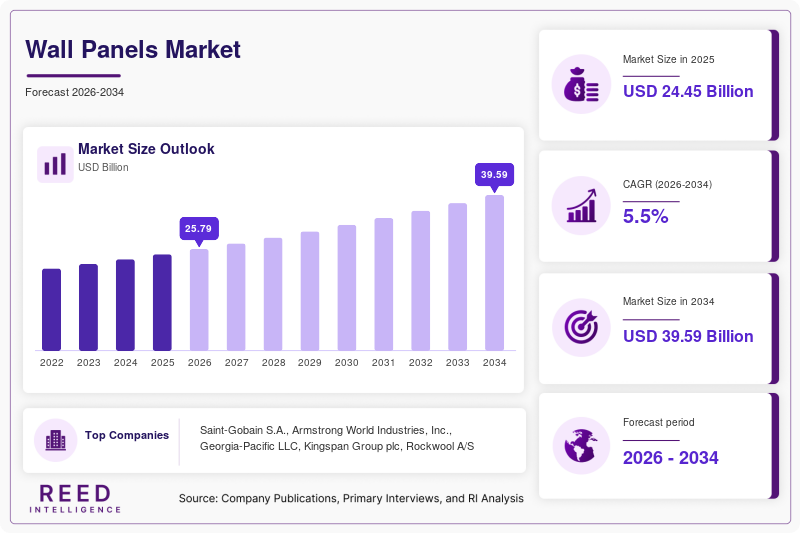
Global wall panels market size is projected at USD 25.8 billion in 2026 and is expected to hit USD 39.59 billion by 2034 with a CAGR of 5.5%. Market intelligence covering historical demand, material-level consumption, application penetration, production volumes, pricing, regional performance, and competitive positioning is increasingly important as construction companies and property owners adopt lightweight, decorative, insulated, sustainable, and rapidly installable wall systems.
Key takeaways
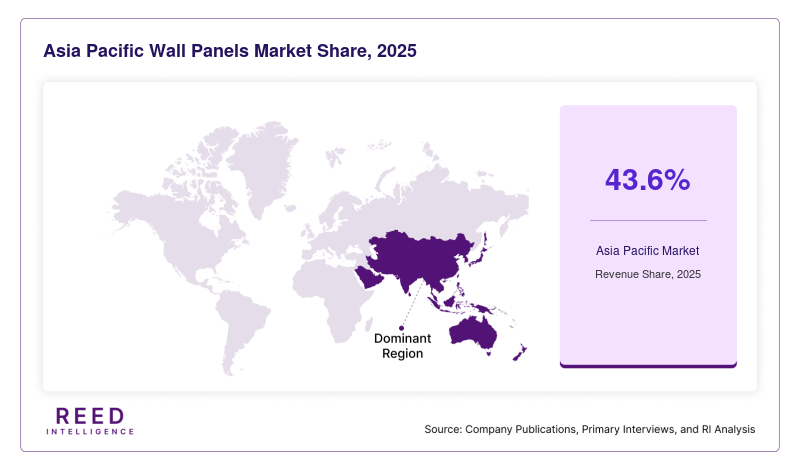
- Asia Pacific dominated the global market with approximately 43.6% revenue share in 2025 and is expected to remain the fastest-growing major region, expanding at approximately 6.4% CAGR through 2034.
- Wood Panels represented the largest material segment with approximately 34.8% share in 2025, while PVC Panels are projected to record one of the fastest growth rates at approximately 6.2% CAGR.
- Residential applications accounted for approximately 48.5% of global demand in 2025, supported by remodeling, new housing construction, interior decoration, and demand for quick-installation materials.
- India is an emerging high-growth country, with the wall panels market projected to reach approximately USD 2.9 billion by 2034, expanding at around 7.2% CAGR.
- North America and Europe collectively contributed approximately 43% of global revenue in 2025, supported by renovation activity, energy-efficiency requirements, premium interiors, and advanced panel technologies.
The global wall panels market comprises prefabricated or manufactured panels used for interior and exterior wall construction, decoration, insulation, acoustic management, and structural applications. Products include wood-based panels, PVC and polymer panels, metal panels, composite panels, stone panels, glass panels, and other engineered systems. Global production is estimated at more than 2.5 billion square meters annually, with residential and commercial construction representing the largest consumption bases. Adoption is increasing as builders seek lightweight systems, reduced installation time, improved thermal performance, and enhanced architectural aesthetics. Wood panels contribute about 34.8% of revenue, followed by PVC panels at 24.7%, metal panels at 17.9%, composite panels at 13.5%, and other materials at 9.1%.
Wall Panels Market Trends
Shift Toward Lightweight, Sustainable, and High-Performance Panels
Technology development is shifting the wall panels industry toward lightweight composite structures, recycled polymers, engineered wood, insulated sandwich panels, digitally printed decorative surfaces, and improved fire- and moisture-resistant materials. Manufacturers are integrating multilayer constructions, high-density cores, acoustic layers, concealed fastening systems, and low-VOC finishes. Automated cutting, CNC processing, and modular manufacturing are also improving dimensional consistency while reducing installation waste.
Sector-specific demand is increasing for decorative panels in residential renovation, acoustic panels in offices and hospitality spaces, insulated systems in industrial buildings, and moisture-resistant products in kitchens and bathrooms. Commercial developers increasingly favor prefabricated panels because they can shorten installation schedules. Sustainable construction is additionally supporting demand for recyclable, renewable, low-emission, and energy-efficient wall systems across developed and rapidly urbanizing markets.
Wall Panels Market Drivers
Expansion of Construction and Renovation Activity
Growth in residential construction, commercial real estate, hospitality projects, institutional buildings, and renovation activity is driving demand for wall panels. Compared with conventional wall finishing systems, prefabricated panels can reduce installation time and labor requirements while providing decorative and functional performance. Increasing urbanization and investment in modern interiors are further supporting consumption of modular wall solutions.
Wall Panels Market Restraints
Raw Material Price Volatility and Installation Standards
Volatility in timber, polymers, aluminum, steel, adhesives, and specialty coating prices can affect manufacturing costs and product prices. Some advanced wall panels also require specialized installation, skilled labor, and strict adherence to fire, moisture, structural, and building-code requirements. These factors can increase project costs and slow adoption in price-sensitive construction markets, particularly where conventional masonry and plaster remain inexpensive.
Wall Panels Market Opportunities
Growing Demand for Energy-Efficient and Sustainable Buildings
Energy-efficient construction creates opportunities for insulated wall panels, recycled-content products, bio-based materials, and high-performance composite systems. Increasing green-building activity is encouraging developers to evaluate lifecycle emissions, recyclability, thermal insulation, and indoor-air-quality performance. Decorative digital printing, customized dimensions, antimicrobial surfaces, and integrated acoustic properties also provide manufacturers with opportunities to expand premium product portfolios.
Challenges in Wall Panels Market
Competition from Conventional Construction Materials
Wall panels compete with brick, concrete, plasterboard, stone, paint, wallpaper, and other established wall-finishing materials. Contractors and consumers may remain hesitant to adopt unfamiliar systems because of installation practices, perceived durability concerns, replacement requirements, and differences in upfront costs. Fragmented construction standards across countries can further complicate international product commercialization and increase certification and compliance expenses.
Wall Panels Market Segmentation Analysis
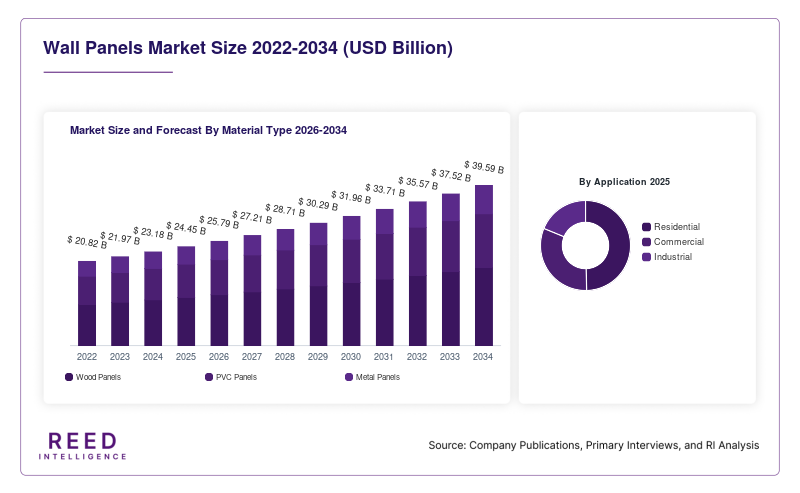
Material type is the leading segmentation framework, with Wood Panels accounting for approximately 34.8% of 2025 revenue. PVC Panels represented 24.7%, while Metal Panels contributed 17.9%. By application, Residential construction dominated with about 48.5% share, followed by Commercial at 32.4% and Industrial at 19.1%. The market continues shifting toward engineered materials offering lower weight, improved thermal and acoustic performance, rapid installation, and customized aesthetics.
By Type
Wood Panels
Wood Panels held approximately 34.8% of global revenue in 2025 and represent the largest material category. The segment includes MDF, plywood, veneer panels, solid wood panels, and engineered wood systems. Global production exceeds 850 million square meters annually. Products commonly feature thicknesses of approximately 6–25 mm, moisture-resistant treatments, decorative laminates, veneer surfaces, and engineered cores. Demand is particularly strong for residential interiors, hospitality, offices, and premium architectural applications.
PVC Panels
PVC Panels accounted for approximately 24.7% of the global market and benefit from lightweight construction, moisture resistance, ease of cleaning, and comparatively low installation costs. Annual production is estimated at more than 600 million square meters. Typical products use hollow or solid PVC structures with thicknesses of approximately 5–10 mm and interlocking or tongue-and-groove installation. They are widely used in bathrooms, kitchens, residential interiors, retail spaces, and commercial renovation projects.
Metal Panels
Metal Panels contributed approximately 17.9% of market revenue in 2025, with demand concentrated in commercial, industrial, infrastructure, and exterior applications. Global production exceeds 400 million square meters annually. Aluminum, galvanized steel, and coated steel are widely used, with panel thickness commonly ranging from 0.5–3 mm depending on the application. Advanced systems can incorporate insulated cores, corrosion-resistant coatings, concealed fastening, fire resistance, and enhanced weather performance.
By Application
Residential
Residential applications generated approximately 48.5% of global revenue in 2025 and represent the largest end-use segment. New homes, apartment developments, kitchens, bathrooms, bedrooms, living spaces, and renovation projects generate substantial demand. Annual consumption exceeds 1.1 billion square meters globally. Decorative wood and PVC panels dominate volume, while acoustic, waterproof, fire-resistant, and textured panels are gaining adoption among homeowners seeking faster installation and customized interiors.
Commercial
Commercial applications represented approximately 32.4% of market demand, supported by offices, hotels, restaurants, retail outlets, healthcare facilities, educational buildings, and entertainment venues. Global annual consumption is estimated at more than 750 million square meters. Commercial projects increasingly specify acoustic, fire-rated, antimicrobial, impact-resistant, and decorative panels. Modular construction and renovation schedules further encourage panel adoption because factory-finished systems can reduce on-site labor and project disruption.
Industrial
Industrial applications accounted for approximately 19.1% of revenue and include factories, warehouses, processing facilities, cold-storage buildings, workshops, and logistics centers. Annual consumption is estimated at more than 450 million square meters. Insulated metal and composite panels are particularly important because of their thermal efficiency, structural performance, durability, and rapid installation. Panels with polyurethane or mineral-wool cores are commonly selected where temperature management and fire performance are critical.
Wall Panels Market Outlook
Asia Pacific Wall Panels Market
Asia Pacific accounted for approximately 43.6% of global revenue in 2025 and remains the largest regional market. China, India, Japan, South Korea, and Southeast Asian economies are the primary contributors. Residential construction contributes the largest sector share, followed by commercial and industrial projects. China represents the largest regional consumer, while India is experiencing rapid growth because of urban housing, infrastructure investment, commercial development, and renovation activity.
China's large manufacturing base supports competitive production of PVC, metal, wood-based, and composite panels. Japan and South Korea show stronger demand for high-performance, fire-resistant, acoustic, and premium decorative products. Southeast Asia is expanding through hotel construction, residential development, retail infrastructure, and industrial facilities, creating additional demand for cost-effective modular wall systems.
North America Wall Panels Market
North America contributed approximately 24.5% of global revenue in 2025, led by the United States and Canada. Residential renovation represents a major demand sector, while commercial construction supports premium architectural and acoustic panels. The region has increasing demand for energy-efficient insulated systems, sustainable materials, recycled-content products, and decorative wall solutions. United States construction and remodeling activity remains the principal regional growth contributor.
Europe Wall Panels Market
Europe represented approximately 18.5% of global revenue, with Germany, the United Kingdom, France, Italy, and Spain among the leading contributors. Renovation, energy-efficiency upgrades, commercial interiors, and sustainable building practices are important demand generators. Wood-based and recycled-material panels are particularly relevant in residential and commercial construction, while mineral-wool and metal sandwich panels support industrial and infrastructure applications.
Latin America Wall Panels Market
Latin America accounted for approximately 7.2% of global revenue. Brazil and Mexico are the largest contributors, supported by residential construction, commercial development, hospitality projects, and industrial expansion. PVC and wood-based panels represent major volume categories because of their cost and installation advantages. Improving organized retail and distribution networks are increasing access to decorative and functional panel products.
Middle East and Africa Wall Panels Market
The Middle East and Africa represented approximately 6.2% of global revenue in 2025. Gulf countries are important markets for premium decorative, fire-resistant, insulated, and architectural panels used in hospitality, retail, offices, and large infrastructure projects. South Africa and selected African economies contribute through residential and commercial construction. Industrial facilities, warehouses, and temperature-controlled buildings are supporting demand for insulated metal and composite panels.
Top players in Wall Panels Market
- Saint-Gobain S.A.
- Armstrong World Industries, Inc.
- Georgia-Pacific LLC
- Kingspan Group plc
- Rockwool A/S
- Owens Corning
- Knauf Gips KG
- USG Corporation
- James Hardie Industries plc
- Fletcher Building Limited
- Etex Group
- Cornerstone Building Brands, Inc.
- Panasonic Housing Solutions Co., Ltd.
- 3A Composites GmbH
- Wilsonart LLC
Recent Developments in Wall Panels Market
- January 2026: Kingspan expanded its insulated panel manufacturing capabilities in Europe to support increasing demand for energy-efficient building envelopes and faster construction systems.
- March 2026: Saint-Gobain expanded its sustainable construction product portfolio with increased emphasis on lower-carbon building materials and circular construction solutions.
- April 2026: ROCKWOOL continued investments in insulation capacity and sustainable building solutions, strengthening its position in high-performance wall and building-envelope applications.
- September 2025: James Hardie expanded its fiber-cement building product initiatives, emphasizing durable exterior cladding and low-maintenance construction solutions.
- November 2025: Armstrong World Industries expanded its architectural systems portfolio, targeting commercial interiors with decorative and performance-oriented wall and ceiling solutions.
Wall Panels Market Segments
By Material Type
- Wood Panels
- PVC Panels
- Metal Panels
By Application
- Residential
- Commercial
- Industrial
By Region
- North America
- Europe
- APAC
- Middle East and Africa
- LATAM