Warming Drawer Market Size, Share, Demand Report By Product Type (Built-in Warming Drawers, Freestanding Warming Drawers), By Application (Residential, Commercial), By Distribution Channel (Offline Retail, Online Retail), By End-Use (Household Kitchens, Hospitality Industry, Foodservice & Institutional Kitchens) – Global Forecast 2026–2034
USD 3950
Market Overview
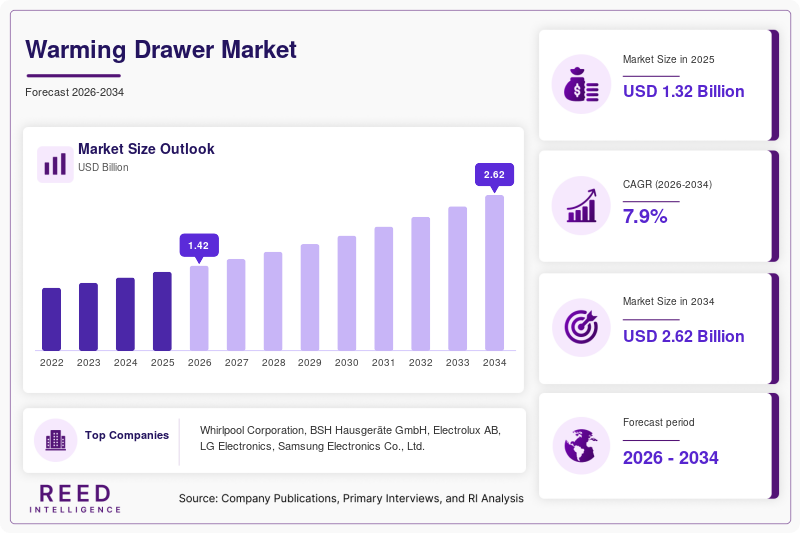
The global Warming Drawer Market size is estimated at USD 1.42 billion, and it is projected to reach USD 2.61 billion by 2034, registering a CAGR of 7.9% during 2026–2034.Growth in the Warming Drawer Market is primarily supported by rising demand for luxury kitchen appliances, driven by urbanization, premium housing development, and increasing consumer preference for smart kitchen ecosystems. The integration of connected appliances and modular kitchen designs has further accelerated adoption across residential and commercial sectors.
Growth in the Warming Drawer Market is primarily driven by the global shift toward modular kitchen infrastructure and increasing consumer preference for smart, energy-efficient appliances. Expansion of urban housing projects, coupled with rising disposable incomes, has encouraged the adoption of integrated kitchen systems where warming drawers are used to maintain food temperature and improve cooking efficiency. Additionally, commercial kitchens are increasingly incorporating warming drawers to optimize food service timing and operational consistency.
Key Highlights
- Dominant Region (2025): Europe held 34.2% share of the global Warming Drawer Market
- Fastest-Growing Region (2026–2034): Asia Pacific is expected to grow at a CAGR of 9.1%
- Leading Subsegment (Type): Built-in warming drawers accounted for the largest share in 2025
- Fastest-Growing Subsegment (Application): Commercial food service segment is projected to grow at the highest CAGR
- Dominant Country (2024–2025): United States market value increased from USD 310 million (2024) to USD 335 million (2025)
Market Trends
Smart Kitchen Integration
The Warming Drawer Market is increasingly influenced by the adoption of smart home ecosystems. Manufacturers are embedding Wi-Fi connectivity, temperature sensors, and app-based controls into warming drawers. This trend is driven by consumer demand for seamless kitchen automation and precise food temperature control. Integration with voice assistants and smart ovens is further strengthening adoption in premium residential segments.
Energy-Efficient Built-in Appliances
Sustainability-focused appliance design is emerging as a major trend in the Warming Drawer Market. Energy-efficient insulation systems, low-power heating elements, and eco-friendly materials are being widely adopted. This shift is aligned with stricter energy regulations in developed economies and growing consumer awareness about reducing household energy consumption.
Market Drivers
Expansion of Premium Residential Construction
Rising investments in luxury housing projects are significantly driving the Warming Drawer Market. High-end residential developers are increasingly offering modular kitchens equipped with integrated warming drawers as standard premium features. This trend is particularly strong in urban regions where space optimization and aesthetic kitchen design are key purchase factors.
Growth in Food Service and Hospitality Sector
The hospitality industry is another major growth driver for the Warming Drawer Market. Restaurants, hotels, and catering services rely on warming drawers to maintain consistent food temperature during peak service hours. The need for operational efficiency and food quality consistency is pushing adoption in commercial kitchens globally.
Market Restraints
High Product and Installation Cost
A key restraint in the Warming Drawer Market is the relatively high cost of premium built-in appliances. Installation complexity, kitchen customization requirements, and advanced feature integration increase total ownership cost. This limits adoption in price-sensitive markets and among middle-income consumers, particularly in emerging economies.
Market Opportunities
Expansion in Emerging Economies
The Warming Drawer Market presents significant growth opportunities in emerging economies across Asia and Latin America. Rising disposable incomes, urban housing development, and increasing exposure to global kitchen trends are creating new demand channels. Manufacturers are expected to introduce cost-effective models tailored to these regions.
Technological Innovation in Modular Kitchens
Advancements in modular kitchen systems offer another strong opportunity for the Warming Drawer Market. Integration with compact kitchen designs, multi-function appliances, and space-saving solutions is expected to drive adoption. Smart home developers are increasingly bundling warming drawers with other built-in appliances.
Segmental Analysis
By Product Type
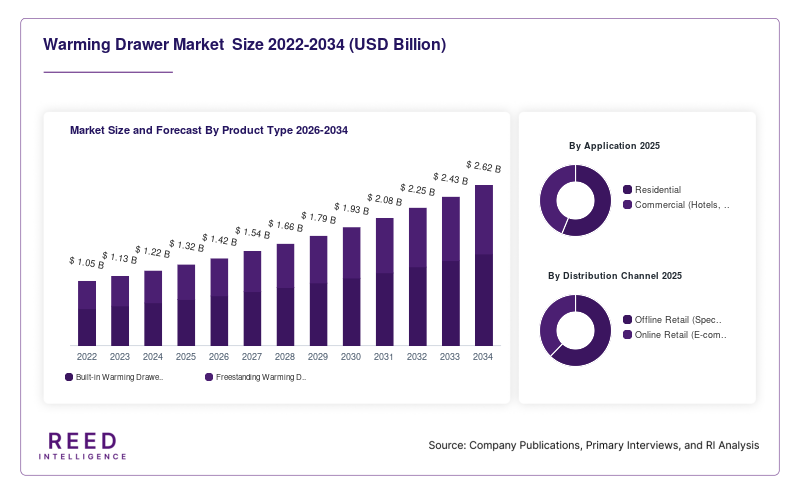
Built-in warming drawers dominated the Warming Drawer Market in 2025 with a share of 63.5%, driven by increasing adoption in modular kitchen designs and luxury residential projects. Their seamless integration with ovens and cabinetry makes them a preferred choice among premium consumers.
Freestanding warming drawers are expected to be the fastest-growing segment, registering a CAGR of 8.4% during 2026–2034, due to affordability and flexibility in installation. Growing demand from small households and commercial kitchens is accelerating segment expansion in the Warming Drawer Market.
By Application
Residential applications accounted for 58.7% share of the Warming Drawer Market in 2025, supported by rising home renovation activities and increasing consumer focus on kitchen aesthetics and convenience.
The commercial application segment is projected to grow at the highest CAGR of 8.9% during 2026–2034. Expansion of restaurants, hotels, and cloud kitchens is driving demand for consistent food temperature management solutions in the Warming Drawer Market.
By Distribution Channel
Offline distribution channels held 72.1% share in 2025 of the Warming Drawer Market, as consumers prefer physical inspection and professional installation support for high-value appliances.
Online distribution channels are expected to grow at a CAGR of 9.3% during 2026–2034, driven by rising e-commerce penetration and digital appliance retail platforms offering wider product selection and competitive pricing.
Regional Analysis
North America
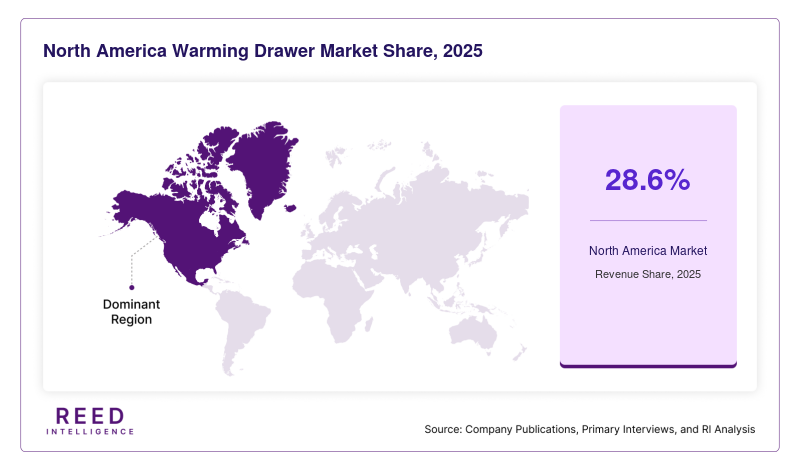
In 2025, North America accounted for approximately 28.6% share of the Warming Drawer Market, and it is projected to grow at a CAGR of 7.4% from 2026 to 2034. Strong demand for premium kitchen appliances and high adoption of smart home systems support regional growth.
The United States dominates the regional Warming Drawer Market due to strong consumer spending on home renovation and luxury kitchen upgrades. Increasing preference for open kitchen layouts and integrated appliances further strengthens market penetration.
Europe
Europe held 34.2% share of the Warming Drawer Market in 2025, making it the leading regional contributor. The region is expected to expand at a CAGR of 7.1% during 2026–2034.
Germany leads the European Warming Drawer Market, driven by strong manufacturing capabilities and early adoption of energy-efficient appliances. Strict energy efficiency regulations and high demand for premium kitchen systems further support market growth.
Asia Pacific
Asia Pacific accounted for 22.8% share in 2025 of the Warming Drawer Market, and it is projected to register the fastest CAGR of 9.1% through 2034.
China dominates the regional Warming Drawer Market due to rapid urbanization and expansion of high-rise residential developments. Rising middle-class income and increasing exposure to Western-style kitchens are key growth drivers.
Middle East & Africa
The Middle East & Africa region held 8.1% share in 2025 of the global Warming Drawer Market, and it is expected to grow at a CAGR of 7.8% during 2026–2034.
The United Arab Emirates leads the regional Warming Drawer Market, supported by luxury real estate developments and strong hospitality sector growth. High demand for premium kitchen installations in hotels and residential villas contributes significantly.
Latin America
Latin America represented 6.3% share in 2025 of the Warming Drawer Market, with a projected CAGR of 7.5% from 2026 to 2034.
Brazil is the dominant country in the regional Warming Drawer Market, driven by increasing urban housing projects and rising adoption of modular kitchens in metropolitan cities.
Competitive Landscape
The competitive structure of the Warming Drawer Market is characterized by moderate consolidation, where a few global appliance manufacturers collectively account for a significant portion of market revenue, while several regional and niche players compete through differentiated product offerings. Leading companies are focusing on product innovation, particularly in smart connectivity, energy efficiency, and seamless integration with modular kitchen systems to strengthen their market positioning. Strategic initiatives such as mergers, acquisitions, and long-term partnerships with kitchen designers, real estate developers, and hospitality chains are increasingly shaping competitive intensity. In addition, manufacturers are expanding their geographic presence in emerging markets through localized production and distribution networks, while also investing in premium product lines to capture high-margin residential and commercial segments.
Key Players List
- Whirlpool Corporation
- BSH Hausgeräte GmbH
- Electrolux AB
- LG Electronics
- Samsung Electronics
- Sub-Zero Group, Inc.
- Miele & Cie. KG
- Panasonic Corporation
- Haier Group Corporation
- GE Appliances
- Dacor Inc.
- Viking Range, LLC
- Fisher & Paykel Appliances
- Thermador
- Smeg S.p.A.
- Bosch Home Appliances
- Siemens Home Appliances
- Arçelik A.Ş.
Recent Developments
- Leading manufacturers have increased investment in IoT-enabled kitchen appliances to strengthen smart home integration.
- Premium appliance brands are expanding production capacity in Asia Pacific to meet rising regional demand.
- Companies are introducing energy-efficient heating systems compliant with updated environmental standards.
- Partnerships between appliance manufacturers and real estate developers are increasing for bundled kitchen installations.
- E-commerce platforms are launching dedicated premium appliance categories to improve accessibility for consumers.
Warming Drawer Market Segments
By Product Type
- Built-in Warming Drawers
- Freestanding Warming Drawers
By Application
- Residential
- Commercial (Hotels, Restaurants, Catering Services)
By Distribution Channel
- Offline Retail (Specialty Stores, Showrooms)
- Online Retail (E-commerce Platforms, Brand Websites)
By End-Use
- Household Kitchens
- Hospitality Industry
- Foodservice & Institutional Kitchens
By Region
- North America
- Europe
- APAC
- Middle East and Africa
- LATAM