Warts Therapeutics Market Size, Share, Demand Report By Treatment Type (Topical Treatments, Cryotherapy, Immunotherapy, Surgical Treatments), By Application (Common Warts, Plantar Warts, Genital Warts, Flat Warts), By End-Use (Hospitals, Dermatology Clinics, Homecare Settings) By Region & Segment Forecasts, 2026–2034
USD 3950
Market Overview
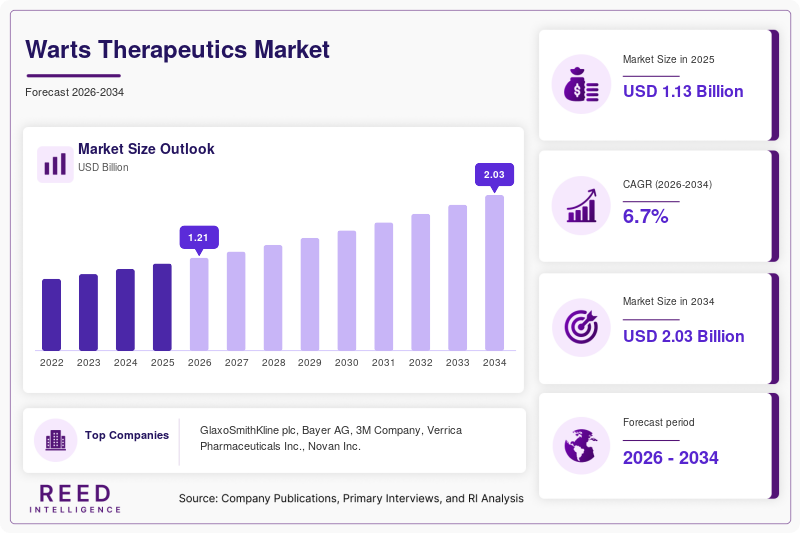
The Warts Therapeutics Market is projected to reach USD 1.21 billion in 2026 and is anticipated to attain USD 2.03 billion by 2034, registering a CAGR of 6.7% during 2026–2034. Growth in this market is primarily supported by the increasing global prevalence of human papillomavirus (HPV)-related infections, which remain a major etiological factor behind common, plantar, and genital warts across diverse population groups. Rising awareness of dermatological health, combined with expanding access to over-the-counter and prescription-based topical therapies, has strengthened treatment adoption across both developed and emerging economies.
Another key factor influencing market expansion is the continuous advancement in minimally invasive and immunotherapy-based treatment modalities, which are increasingly replacing conventional cryotherapy and surgical excision methods. Healthcare providers are also focusing on early-stage treatment interventions to reduce recurrence rates and improve patient compliance.
Key Highlights
- North America accounted for approximately 34% market share in 2025, supported by strong healthcare infrastructure and high treatment adoption rates.
- Asia Pacific is projected to expand at a CAGR of 8.2%, driven by rising dermatology awareness and improving healthcare accessibility.
- Topical treatments dominate the market with wide availability and cost-effectiveness.
- Immunotherapy-based treatments are growing at a CAGR of 9.1% due to improved clinical outcomes and reduced recurrence rates.
- The United States market was valued at approximately USD 410 million in 2024 and USD 435 million in 2025, driven by high diagnosis rates and advanced dermatology care systems.
Market Trends
Increasing Shift Toward Immunotherapy-Based Treatments
One of the most significant trends shaping the Warts Therapeutics Market is the gradual shift from conventional destructive therapies toward immunotherapy-based treatment approaches. These therapies stimulate the body’s immune response to target HPV-infected cells more effectively, reducing recurrence rates compared to traditional methods such as cryotherapy or salicylic acid applications. Clinicians are increasingly adopting intralesional immunotherapeutic agents, especially for resistant and recurrent wart cases. This transition is also supported by ongoing clinical research evaluating improved safety profiles and long-term efficacy outcomes. Pharmaceutical companies are investing in next-generation immunomodulators that offer localized action with minimal systemic side effects. As patient preference shifts toward less painful and more durable treatment solutions, immunotherapy adoption is expected to expand further across dermatology clinics and specialty hospitals.
Expansion of OTC and Home-Based Treatment Solutions
Another key trend is the rising availability and adoption of over-the-counter (OTC) wart treatment products, including salicylic acid-based formulations, cryotherapy kits, and natural extract-based solutions. Consumers are increasingly opting for self-care treatment approaches due to convenience, cost-effectiveness, and reduced dependency on clinical visits for mild cases. E-commerce platforms and digital pharmacies have significantly expanded the reach of these products, particularly in urban and semi-urban regions. Additionally, manufacturers are focusing on improving product formulations to enhance safety, ease of application, and treatment success rates. The growing preference for home-based care is also being driven by increased awareness of dermatological hygiene and early intervention practices, which help prevent the spread and recurrence of warts.
Market Drivers
Rising Prevalence of HPV-Related Infections
A major driver of the Warts Therapeutics Market is the increasing prevalence of HPV infections globally, which are directly associated with the development of various types of warts. Factors such as poor hygiene practices, weakened immune systems, and close skin-to-skin contact in communal environments contribute to the rising incidence rates. Schools, gyms, and public bathing facilities have been identified as common transmission zones, particularly for plantar warts. Healthcare systems are witnessing a steady increase in dermatology consultations related to wart conditions, especially among pediatric and young adult populations. This rising patient pool is creating sustained demand for effective treatment solutions, ranging from topical medications to advanced immunotherapies. Governments and healthcare organizations are also increasing awareness programs focused on early detection and prevention, indirectly supporting market expansion.
Advancements in Dermatological Treatment Technologies
Technological advancements in dermatology are another significant growth driver for the market. Innovations in laser-based therapies, cryosurgical devices, and immunomodulatory drugs have improved treatment precision and reduced healing time. These advancements are particularly important for patients with recurrent or treatment-resistant warts. The integration of digital dermatology and telemedicine has further enhanced access to professional consultation, enabling early diagnosis and treatment planning. Pharmaceutical research is also focusing on developing combination therapies that enhance efficacy while minimizing side effects. As healthcare providers adopt more advanced and patient-friendly treatment protocols, demand for modern wart therapeutics is expected to rise steadily across both clinical and home-care settings.
Market Restraint
High Recurrence Rates and Limited Long-Term Efficacy
A key restraint affecting the Warts Therapeutics Market is the high recurrence rate associated with many existing treatment options. Despite the availability of multiple therapeutic approaches, including cryotherapy, topical agents, and surgical removal, warts often reappear due to incomplete viral clearance or re-exposure to HPV. This limitation reduces patient satisfaction and increases the need for repeated treatment cycles, thereby elevating overall healthcare costs. In many cases, patients discontinue treatment prematurely due to discomfort or perceived inefficacy, particularly with painful procedures like cryotherapy. Additionally, variability in immune response among individuals further complicates treatment outcomes. This persistent challenge places pressure on pharmaceutical companies and healthcare providers to develop more durable and long-lasting solutions. Until more definitive antiviral therapies are introduced, recurrence will continue to act as a constraint on market growth and treatment efficiency.
Market Opportunities
Growth in Emerging Healthcare Markets
Emerging economies present a substantial opportunity for the Warts Therapeutics Market due to improving healthcare infrastructure, rising disposable incomes, and increasing awareness of dermatological conditions. Countries in Asia Pacific, Latin America, and parts of the Middle East are witnessing rapid expansion in healthcare access, enabling broader adoption of wart treatment solutions. Government initiatives aimed at strengthening primary healthcare systems are further supporting market penetration. Additionally, the increasing presence of international pharmaceutical companies in these regions is enhancing product availability and affordability. Local manufacturing and distribution partnerships are also helping reduce treatment costs, making advanced therapies more accessible to a larger population base. As awareness campaigns continue to highlight the importance of early treatment, demand for both OTC and prescription-based solutions is expected to grow significantly.
Development of Advanced Immunotherapeutic Pipeline
Another major opportunity lies in the development of advanced immunotherapeutic agents targeting HPV-related wart conditions. Ongoing research in dermatological immunology is leading to the discovery of novel compounds that enhance localized immune responses while minimizing systemic effects. These therapies are expected to address the limitations of existing treatments by reducing recurrence rates and improving long-term outcomes. Biotechnology firms are increasingly investing in clinical trials focused on intralesional and topical immune-activating formulations. Additionally, combination therapies integrating antiviral agents with immune modulators are gaining traction in research pipelines. As regulatory approvals progress and clinical evidence strengthens, these advanced therapies are expected to reshape the treatment landscape and create new revenue streams for market participants.
Segmental Analysis
Type Segment
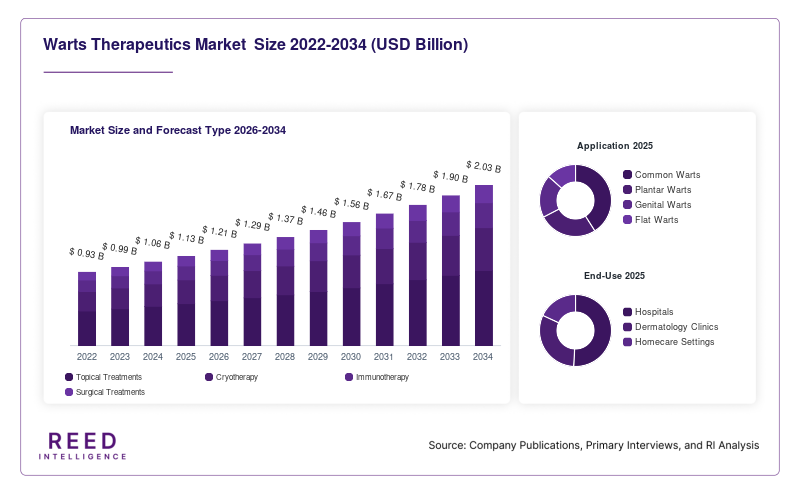
The Type segment of the Warts Therapeutics Market includes topical treatments, cryotherapy, immunotherapy, and surgical methods. Topical treatments dominated the market with approximately 42% share in 2024, driven by their ease of availability, affordability, and suitability for mild to moderate wart conditions. These treatments are widely used in both prescription and OTC categories, making them highly accessible across global markets.
Immunotherapy-based treatments are emerging as the fastest-growing subsegment, projected to register a CAGR of 9.1% during the forecast period. Growth is driven by improved clinical outcomes, reduced recurrence rates, and increasing adoption in treatment-resistant cases. Pharmaceutical innovation and expanding clinical trials are further supporting this segment’s expansion.
Application Segment
The Application segment includes common warts, plantar warts, genital warts, and flat warts. Common warts accounted for the dominant share of approximately 38% in 2024, as they are the most frequently occurring type across all age groups. These warts are commonly treated in outpatient settings using topical and cryotherapy solutions.
Genital warts represent the fastest-growing subsegment, with a projected CAGR of 8.5%, driven by rising HPV infection rates and increasing awareness of sexually transmitted infections. Improved diagnostic practices and early intervention programs are further supporting demand for effective therapeutic solutions in this category.
End-Use Segment
The End-Use segment comprises hospitals, dermatology clinics, and homecare settings. Dermatology clinics held the dominant share of approximately 45% in 2024, as they are the primary point of care for specialized wart treatment procedures. These clinics offer advanced treatment options, including laser therapy and immunotherapy-based interventions.
Homecare settings are expected to be the fastest-growing subsegment, registering a CAGR of 7.8%, driven by increasing adoption of OTC products and digital healthcare awareness. Convenience, cost savings, and improved product formulations are encouraging patients to manage mild cases at home.
Regional Analysis
North America
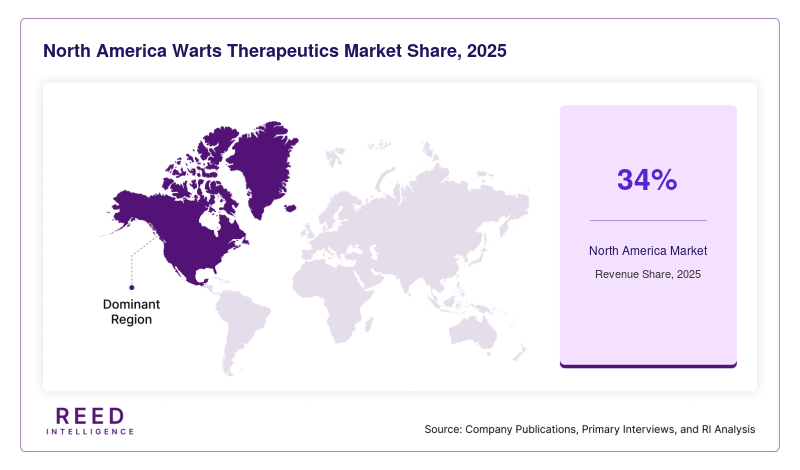
North America accounted for approximately 34% market share in 2025, and is expected to maintain steady growth with a moderate CAGR through 2034. The region benefits from advanced healthcare infrastructure, high dermatology consultation rates, and widespread availability of both prescription and OTC wart treatment solutions. Strong insurance coverage and high awareness levels further support market penetration across the United States and Canada.
The United States remains the dominant country in this region, driven by a high incidence of HPV-related skin conditions and strong adoption of advanced treatment technologies. Increasing demand for immunotherapy-based solutions and continuous clinical research activities are also contributing to market development. Additionally, the presence of leading pharmaceutical companies enhances product innovation and accessibility.
Europe
Europe holds a significant share of the global Warts Therapeutics Market, accounting for nearly 27% in 2025, with stable growth expected over the forecast period. Regulatory support for dermatological drug approvals and strong public healthcare systems contribute to sustained demand. Countries such as Germany, France, and the United Kingdom are key contributors to regional revenue generation.
Germany leads the European market due to its strong dermatology research ecosystem and high healthcare expenditure. Increasing focus on minimally invasive treatments and early diagnosis programs is further driving demand. Additionally, rising patient awareness regarding skin health is supporting adoption of advanced therapeutic options.
Asia Pacific
Asia Pacific is projected to be the fastest-growing region, registering a CAGR of approximately 8.2% during 2026–2034. Rising population density, improving healthcare infrastructure, and increasing awareness of HPV-related conditions are key growth drivers. Expanding access to dermatology clinics in urban and semi-urban areas is also enhancing treatment adoption.
China dominates the regional market due to its large patient base and growing healthcare investments. Increasing availability of affordable OTC products and government-led healthcare initiatives are further accelerating growth. Additionally, rising disposable incomes are enabling greater access to advanced treatment options.
Middle East & Africa
The Middle East & Africa region is witnessing gradual growth, supported by improving healthcare infrastructure and increasing dermatology awareness. The region accounted for a modest market share in 2025 but is expected to show steady expansion over the forecast period. Investments in healthcare modernization are improving access to dermatological treatments.
Saudi Arabia is the leading country in this region, driven by healthcare reforms and expanding hospital networks. Increased focus on preventive healthcare and growing medical tourism are also contributing to demand for advanced wart therapies.
Latin America
Latin America represents a developing market with steady growth potential, supported by rising healthcare awareness and improving access to dermatology services. The region accounted for a small but growing share of the global market in 2025.
Brazil leads the regional market due to its large population base and expanding healthcare infrastructure. Increasing availability of affordable treatment options and rising awareness campaigns are key growth drivers supporting market expansion.
Competitive Landscape
The Warts Therapeutics Market is moderately fragmented, with several pharmaceutical and dermatology-focused companies operating across global and regional levels. Key players include GlaxoSmithKline, Verrica Pharmaceuticals, Bayer AG, 3M Company, and Novan Inc. These companies are focusing on product innovation, clinical trials, and expansion of dermatology portfolios to strengthen market presence. Strategic collaborations with healthcare providers and distribution networks are also common approaches to enhance market reach.
Verrica Pharmaceuticals is recognized as a notable leader in developing dermatology-focused therapies, particularly for wart treatment innovations. Recent developments include advancements in topical immune-activating formulations aimed at improving treatment efficacy and reducing recurrence rates. Companies are also investing in expanding OTC product lines and strengthening e-commerce distribution channels to capture growing consumer demand.
Key Players
- GlaxoSmithKline plc
- Bayer AG
- 3M Company
- Verrica Pharmaceuticals
- Novan Inc.
- Pfizer Inc.
- Teva Pharmaceutical Industries
- Sun Pharmaceutical Industries
- Johnson & Johnson
- Almirall S.A.
- Cipla Ltd.
- Glenmark Pharmaceuticals
- Bausch Health Companies
- Meda Pharmaceuticals
- Lumenis Ltd.
- Galderma S.A.
Recent Developments
- A biotechnology company initiated Phase III trials for a novel immunotherapy-based wart treatment targeting recurrent HPV lesions.
- A leading dermatology firm expanded its OTC wart treatment portfolio across Asia Pacific through digital pharmacy partnerships.
- A global pharmaceutical company announced a strategic collaboration to develop combination therapies integrating antiviral and immune-modulating agents for improved clinical outcomes.
Warts Therapeutics Market Segments
Type
- Topical Treatments
- Cryotherapy
- Immunotherapy
- Surgical Treatments
Application
- Common Warts
- Plantar Warts
- Genital Warts
- Flat Warts
End-Use
- Hospitals
- Dermatology Clinics
- Homecare Settings
By Region
- North America
- Europe
- APAC
- Middle East and Africa
- LATAM