Waste Oil Market Size, Share & Demand Report By Source (Automotive Waste Oil, Industrial Waste Oil, Marine Waste Oil, Hydraulic Waste Oil, Transformer Waste Oil), By Treatment Method (Distillation, Chemical Treatment, Direct Reuse), By End-Use Industry (Industrial Manufacturing, Power Generation, Marine Industry, Construction Equipment), By Region & Segment Forecasts, 2026–2034
USD 3950
Market Overview
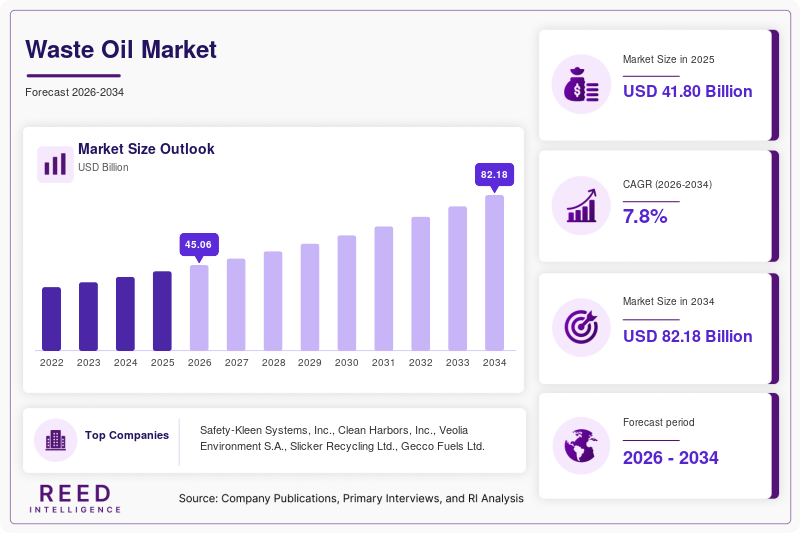
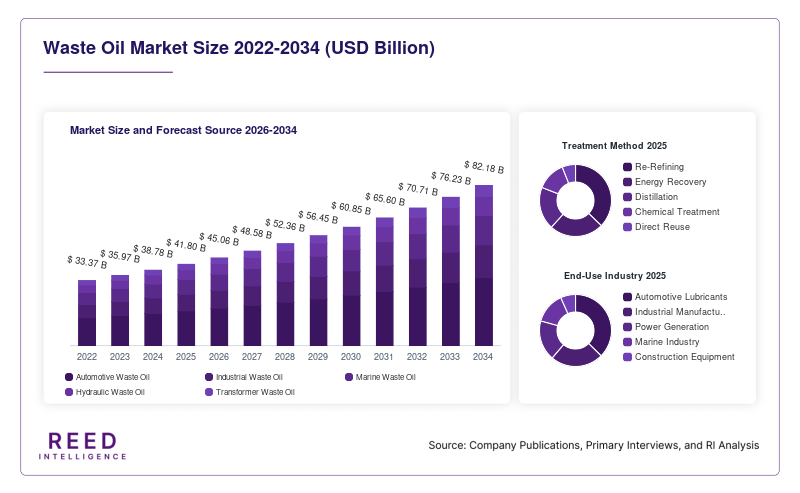
The global Waste Oil Market size was valued at USD 41.8 billion in 2026 and is projected to reach USD 76.4 billion by 2034, expanding at a CAGR of 7.8% during 2026–2034. Waste oil refers to used lubricating oils, industrial oils, hydraulic fluids, transformer oils, and other petroleum-based products that have reached the end of their operational life. These materials are collected, processed, re-refined, recycled, or converted into alternative fuels for industrial and commercial applications.
The market has gained momentum due to increasing environmental regulations focused on reducing hazardous waste disposal and promoting circular economy practices. Governments across developed and developing economies are strengthening waste management frameworks, encouraging industries to recover and reuse valuable oil resources. Rising industrialization, growing vehicle fleets, and expanding manufacturing activities continue to generate substantial volumes of waste oil, creating a steady feedstock supply for recyclers and re-refining facilities.
Key Highlights
- North America dominated the market with a 34.2% share in 2025.
- while Asia Pacific is expected to grow at the fastest CAGR of 9.8% during 2026–2034.
- By source, automotive waste oil accounted for the largest share of 44.8%.
- while industrial waste oil is projected to grow at a CAGR of 8.9%.
- By treatment method, re-refining held the largest share of 46.5%.
- whereas energy recovery is anticipated to expand at a CAGR of 8.7%.
- By end-use industry, automotive lubricants led with a 39.6% share.
- while industrial manufacturing is expected to grow at a CAGR of 9.1%.
- The United States remained the dominant country, with market values of USD 12.7 billion in 2024 and USD 13.5 billion in 2025.
Market Trends
Expansion of Advanced Re-Refining Technologies
The Waste Oil Market is witnessing increasing adoption of advanced re-refining technologies designed to maximize resource recovery and improve the quality of regenerated base oils. Modern vacuum distillation, hydrotreating, and solvent extraction processes are enabling recyclers to produce high-grade lubricants that meet stringent industrial and automotive performance standards. These technological improvements are helping companies reduce dependence on virgin crude oil-derived products while lowering overall production costs. As industries seek sustainable procurement strategies, demand for premium re-refined oils continues to increase. Market participants are investing in automation, digital monitoring systems, and energy-efficient processing facilities to improve operational performance and environmental compliance, making advanced re-refining a significant trend shaping future industry development.
Rising Integration of Circular Economy Principles
Circular economy initiatives are becoming increasingly important across industrial sectors, creating favorable conditions for waste oil collection, recovery, and reuse. Businesses are implementing sustainability programs that prioritize resource efficiency and waste minimization throughout operational processes. Waste oil is being recognized as a recoverable asset capable of generating economic value through recycling and reprocessing activities. Large corporations are establishing closed-loop lubricant management systems that facilitate oil collection and re-refining. Growing pressure from investors, regulators, and consumers to improve environmental performance is encouraging organizations to adopt circular business models. This transition supports long-term demand for waste oil processing services while creating new partnerships between waste generators, collectors, recyclers, and lubricant manufacturers across global markets.
Market Drivers
Increasing Environmental Regulations on Hazardous Waste Management
Governments worldwide are strengthening environmental regulations governing the collection, storage, transportation, and disposal of waste oil. Improper disposal of used oil can contaminate soil, water resources, and ecosystems, leading regulatory agencies to enforce stricter compliance requirements. Industries generating waste oil are increasingly required to implement responsible recovery and recycling practices. These regulations create a strong incentive for organizations to partner with certified waste oil collectors and processors. Regulatory frameworks supporting extended producer responsibility and recycling targets are further accelerating market growth. As compliance costs associated with improper disposal continue to rise, industries are investing more heavily in waste oil management solutions, creating sustained demand for collection, treatment, and re-refining services worldwide.
Growing Automotive and Industrial Lubricant Consumption
The expansion of automotive fleets, industrial equipment installations, construction machinery, and manufacturing operations is contributing significantly to waste oil generation. Lubricants require periodic replacement to maintain equipment performance and operational reliability, resulting in substantial volumes of used oil. Emerging economies are experiencing rapid industrialization and infrastructure development, leading to higher lubricant consumption rates across multiple sectors. As lubricant usage increases, the availability of recyclable waste oil also expands. Waste oil processors benefit from a larger feedstock supply, enabling greater economies of scale and improved operational efficiency. This continuous generation of used lubricants supports long-term market growth while encouraging investment in collection networks and advanced treatment facilities.
Market Restraint
High Collection and Processing Costs Across Fragmented Supply Chains
Despite favorable environmental policies and growing sustainability awareness, the Waste Oil Market faces challenges related to collection, transportation, and processing expenses. Waste oil is generated across diverse locations including vehicle service centers, industrial facilities, manufacturing plants, marine operations, and construction sites. Establishing efficient collection networks requires substantial logistical investments and regulatory compliance measures. Small-scale waste generators often produce limited volumes, increasing transportation costs per unit collected. In addition, contamination from water, chemicals, and other waste materials can complicate processing operations and reduce recovery efficiency. Re-refining facilities must invest in sophisticated treatment technologies and quality control systems to produce marketable products. These cost pressures can affect profitability, particularly in regions with underdeveloped collection infrastructure and limited recycling incentives, potentially slowing market expansion in certain developing economies.
Market Opportunities
Expansion of Industrial Waste Oil Recovery Programs
Industrial sectors are increasingly adopting structured waste oil recovery programs to improve sustainability performance and reduce operational waste. Manufacturing facilities, power plants, mining operations, and heavy engineering industries generate considerable quantities of used oils that can be recovered and reprocessed. Companies are implementing comprehensive waste management systems to improve resource utilization and comply with environmental regulations. This trend is creating opportunities for specialized service providers offering collection, transportation, treatment, and recycling solutions. The development of dedicated industrial recovery networks is expected to improve feedstock availability and support market growth. As industrial operators seek cost-effective sustainability initiatives, demand for professional waste oil management services is likely to expand significantly throughout the forecast period.
Growing Demand for Alternative Fuels Derived from Waste Oil
Energy recovery applications are creating new opportunities within the Waste Oil Market. Processed waste oil can serve as an alternative fuel for industrial boilers, cement kilns, power generation facilities, and other energy-intensive operations. Rising energy costs and increasing pressure to reduce dependence on conventional fossil fuels are encouraging industries to explore waste-derived energy solutions. Technological improvements have enhanced the efficiency and environmental performance of waste oil fuel conversion processes. Emerging economies with expanding industrial sectors are particularly attractive markets for alternative fuel adoption. As organizations pursue energy diversification strategies and carbon reduction goals, demand for waste oil-based fuel products is expected to increase steadily, generating additional revenue streams for market participants.
Segmental Analysis
By Source
Automotive waste oil represented the dominant subsegment and accounted for approximately 44.8% of the market share in 2024. The segment includes used engine oils, transmission fluids, brake fluids, and other lubricant products generated through vehicle maintenance activities. Rising global vehicle ownership and increasing transportation activity contribute significantly to waste oil generation. Automotive service centers, fleet operators, and vehicle maintenance facilities generate substantial volumes of recoverable oil annually. Established collection systems and consistent lubricant replacement cycles support the availability of feedstock for recyclers. Demand for sustainable automotive maintenance practices and stricter environmental regulations continue to strengthen the importance of automotive waste oil within the overall market structure.
Industrial waste oil is expected to register the fastest CAGR of 8.9% during the forecast period. Industrial operations utilize lubricants in manufacturing equipment, hydraulic systems, turbines, compressors, and heavy machinery. Rapid industrialization in emerging economies is increasing lubricant consumption across diverse sectors. Growing emphasis on sustainability and resource efficiency encourages manufacturers to implement waste oil recovery programs. Many industrial organizations are partnering with specialized recycling companies to improve compliance and reduce disposal costs. The expansion of mining, construction, energy, and manufacturing activities worldwide is expected to support continuous growth in industrial waste oil generation and recovery initiatives.
By Treatment Method
Re-refining accounted for the largest market share of approximately 46.5% in 2024. This process converts used oil into high-quality base oils suitable for lubricant production. Re-refining has gained widespread acceptance due to technological advancements that improve product quality and recovery efficiency. Industries increasingly recognize the environmental and economic advantages of using re-refined lubricants. Regulatory support for recycling and circular economy initiatives further strengthens demand. Compared with disposal alternatives, re-refining provides a sustainable pathway for recovering valuable resources while reducing dependence on virgin crude oil. Growing investments in modern re-refining facilities continue to enhance processing capacity and market competitiveness.
Energy recovery is anticipated to be the fastest-growing subsegment, expanding at a CAGR of 8.7% through 2034. Processed waste oil can be utilized as an alternative fuel in industrial applications requiring high thermal energy output. Rising energy costs and increasing interest in waste-to-energy solutions are supporting demand. Industries such as cement manufacturing, power generation, and heavy processing are adopting waste oil-derived fuels to improve operational efficiency and diversify energy sources. Technological innovations have improved combustion performance and environmental compliance standards. As organizations pursue carbon reduction objectives and seek alternative fuel options, energy recovery applications are expected to gain significant traction.
By End-Use Industry
Automotive lubricants emerged as the dominant end-use subsegment, accounting for 39.6% of the market share in 2024. Re-refined base oils are increasingly used in the production of automotive lubricants due to their performance characteristics and sustainability benefits. Vehicle manufacturers and lubricant producers are incorporating recycled content into product portfolios to meet environmental objectives. Growing awareness regarding circular economy principles is encouraging broader acceptance of re-refined lubricants among consumers and fleet operators. The extensive size of the global automotive sector ensures consistent demand for lubricant products, reinforcing the importance of this end-use segment within the Waste Oil Market.
Industrial manufacturing is projected to record the fastest CAGR of 9.1% during the forecast period. Manufacturing facilities require large volumes of lubricants for machinery operation and maintenance. Companies are increasingly adopting sustainable procurement strategies that prioritize recycled and re-refined products. Rising environmental compliance requirements and corporate sustainability commitments are driving greater utilization of recovered oil products within industrial applications. Technological improvements in lubricant formulation have enhanced the performance of products derived from recycled oils. Continued growth in global manufacturing output and industrial modernization initiatives is expected to support strong demand from this end-use category.
Regional Analysis
North America
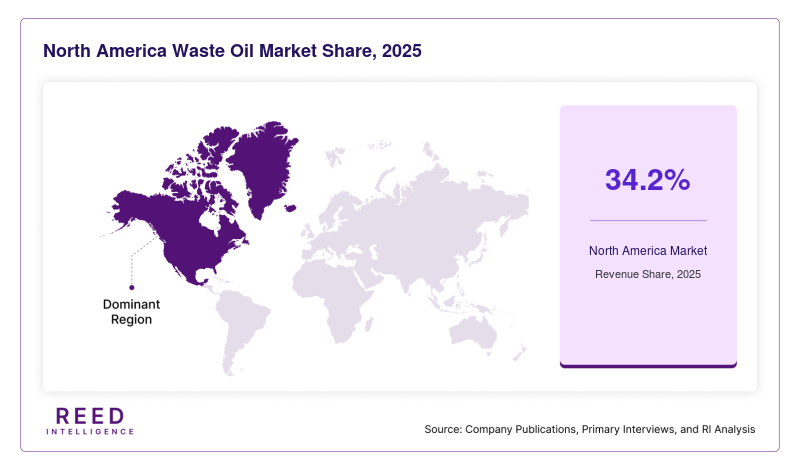
North America accounted for approximately 34.2% of the global Waste Oil Market in 2025 and maintained its position as the leading regional market. The region benefits from well-established waste collection infrastructure, strong environmental regulations, and widespread adoption of recycling practices. Market growth is supported by significant volumes of waste oil generated from automotive, industrial, and transportation sectors. The region is expected to register a CAGR of 7.2% through 2034 as investment continues in advanced re-refining technologies and sustainable resource management programs.
The United States represents the dominant country within the regional market. A major growth factor is the extensive network of licensed waste oil collection and recycling facilities operating across industrial and commercial sectors. Strong regulatory oversight, coupled with high lubricant consumption levels, creates a reliable supply of recyclable waste oil. Increasing corporate sustainability commitments further encourage organizations to adopt responsible oil recovery practices.
Europe
Europe held an estimated 28.4% market share in 2025, making it one of the most mature waste oil recycling markets globally. The region benefits from comprehensive environmental legislation and ambitious circular economy initiatives. Countries across Europe have established structured collection systems and recycling targets that encourage waste oil recovery. The market is forecast to grow at a CAGR of 7.4% during the forecast period as industries prioritize resource efficiency and environmental compliance.
Germany remains the dominant country in the European market. A key growth factor is the country's advanced industrial base and strong commitment to sustainable manufacturing practices. Extensive adoption of re-refined lubricants and investment in innovative recycling technologies support market development. Regulatory frameworks promoting waste minimization and resource recovery continue to strengthen the position of waste oil recycling within Germany's industrial ecosystem.
Asia Pacific
Asia Pacific represented approximately 24.6% of the global market in 2025 and is projected to record the fastest CAGR of 9.8% through 2034. Rapid industrialization, urbanization, and vehicle ownership growth are increasing lubricant consumption and waste oil generation across the region. Governments are introducing environmental policies aimed at improving waste management practices and reducing pollution. Expanding industrial activities create substantial opportunities for waste oil collection and processing companies.
China dominates the regional market due to its large manufacturing sector and extensive transportation network. A significant growth factor is the country's ongoing investment in industrial sustainability initiatives and recycling infrastructure. Increasing environmental awareness among businesses and regulatory authorities is encouraging greater adoption of waste oil recovery solutions. These developments are expected to strengthen regional market growth throughout the forecast period.
Middle East & Africa
The Middle East & Africa accounted for approximately 6.5% of the global market in 2025 and is anticipated to grow at a CAGR of 7.1% through 2034. Growth is supported by expanding industrial activities, increasing vehicle ownership, and rising awareness regarding environmental protection. Governments are gradually implementing waste management regulations that encourage proper collection and recycling of used oils. Investments in industrial infrastructure further contribute to market expansion.
Saudi Arabia is the leading country within the region. One major growth factor is the ongoing diversification of the economy beyond traditional oil production activities. Industrial development programs and investments in manufacturing facilities are increasing lubricant consumption and waste oil generation. As sustainability initiatives gain momentum, opportunities for organized collection and recycling services continue to expand across the country.
Latin America
Latin America captured around 6.3% of the global Waste Oil Market in 2025 and is expected to expand at a CAGR of 7.5% through 2034. Growing industrialization, expanding transportation networks, and improving environmental regulations are supporting market growth. Several countries are developing formal waste management frameworks to address concerns related to hazardous waste disposal. Increasing participation from private recycling companies is also improving collection efficiency across the region.
Brazil dominates the Latin American market due to its large automotive sector and extensive industrial operations. A unique growth factor is the country's expanding network of licensed waste oil collection programs designed to improve recycling rates. Government initiatives encouraging environmental compliance and resource recovery are creating favorable conditions for investment in waste oil treatment and re-refining infrastructure.
Competitive Landscape
The Waste Oil Market is characterized by the presence of international recycling companies, environmental service providers, lubricant manufacturers, and regional waste management firms. Competition is driven by collection network efficiency, processing technology, environmental compliance capabilities, and long-term industrial contracts. Companies continue to invest in facility modernization and capacity expansion to improve recovery rates and product quality.
Safety-Kleen Systems, Inc. remains a leading market participant due to its extensive collection infrastructure and re-refining capabilities. The company recently expanded processing capacity through upgrades at a major North American re-refining facility. Other significant participants include Veolia, Clean Harbors, Slicker Recycling, and Gecco Fuels. Strategic partnerships between recyclers and lubricant manufacturers are becoming increasingly common as demand for sustainable products grows. Market participants are also leveraging digital tracking technologies to improve waste oil collection efficiency and regulatory reporting. Continued investment in advanced treatment technologies is expected to shape competitive dynamics over the coming years.
Key Players
- Safety-Kleen Systems, Inc.
- Clean Harbors, Inc.
- Veolia Environment S.A.
- Slicker Recycling Ltd.
- Gecco Fuels Ltd.
- FCC Environment
- Tradebe Environmental Services
- Heritage-Crystal Clean, Inc.
- Enva Group
- Puraglobe GmbH
- Oil Salvage Limited
- Green Oil Inc.
- Avista Oil AG
- J.J. Richards & Sons Pty Ltd.
- Hydrodec Group plc
Recent Developments
- Safety-Kleen Systems expanded re-refining capacity at its North American processing facility to increase production of high-quality base oils.
- Veolia introduced enhanced digital waste tracking solutions to improve collection efficiency and regulatory compliance monitoring.
- Heritage-Crystal Clean announced investment in advanced oil recovery technologies aimed at increasing recycling yields and operational efficiency.
- Puraglobe expanded partnerships with lubricant manufacturers to support greater adoption of re-refined oil products.
- Clean Harbors strengthened its waste oil collection network through strategic acquisitions in regional recycling markets.
Waste Oil Market Segments
Source
- Automotive Waste Oil
- Industrial Waste Oil
- Marine Waste Oil
- Hydraulic Waste Oil
- Transformer Waste Oil
Treatment Method
- Re-Refining
- Energy Recovery
- Distillation
- Chemical Treatment
- Direct Reuse
End-Use Industry
- Automotive Lubricants
- Industrial Manufacturing
- Power Generation
- Marine Industry
- Construction Equipment
By Region
- North America
- Europe
- APAC
- Middle East and Africa
- LATAM