Waste to Hydrogen Market Size, Share & Demand Report By Technology (Gasification, Pyrolysis, Plasma Gasification, Anaerobic Digestion), By Feedstock (Municipal Solid Waste, Agricultural Waste, Industrial Waste, Plastic Waste), By Application (Energy Generation, Transportation, Industrial Use, Residential Use), By Region & Segment Forecasts, 2026–2034
USD 3950
Market Overview
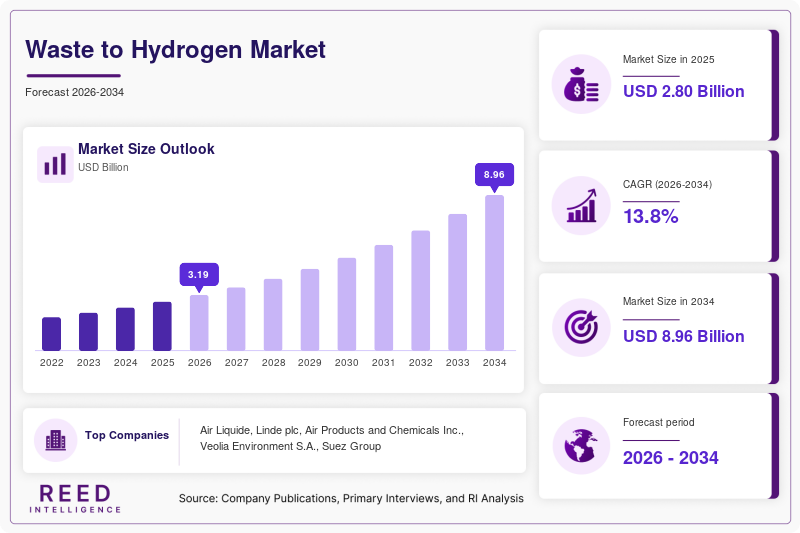
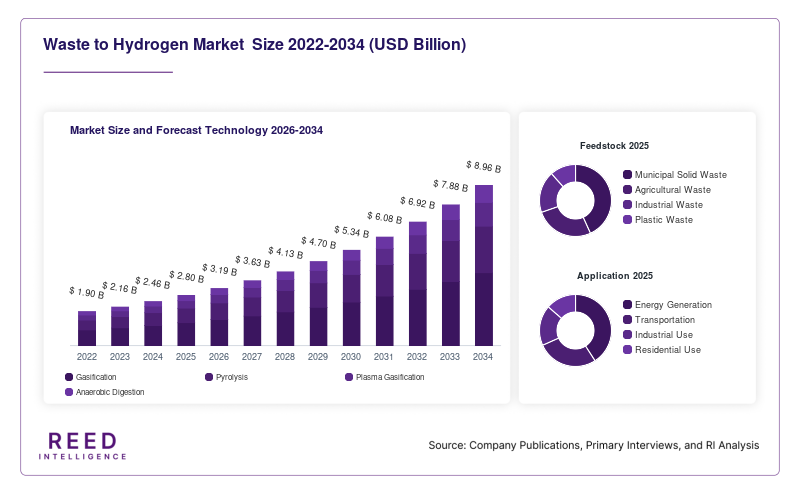
The Waste to Hydrogen Market size was valued at USD 2.8 billion in 2026 and is projected to reach USD 7.9 billion by 2034, expanding at a CAGR of 13.8% during the forecast period from 2026 to 2034. The market is gaining momentum as industries and governments seek sustainable solutions for waste management and clean energy generation. The integration of advanced gasification, pyrolysis, and anaerobic digestion technologies has enabled efficient conversion of municipal solid waste, agricultural residues, and industrial byproducts into hydrogen fuel.
A key global factor supporting market growth is the rising emphasis on decarbonization and circular economy initiatives. Governments worldwide are implementing stringent regulations to reduce landfill dependency and greenhouse gas emissions, encouraging investments in waste-to-energy infrastructure. Hydrogen derived from waste offers a dual benefit by addressing waste disposal challenges while producing a low-carbon energy carrier, thereby aligning with climate neutrality goals.
Key Highlights
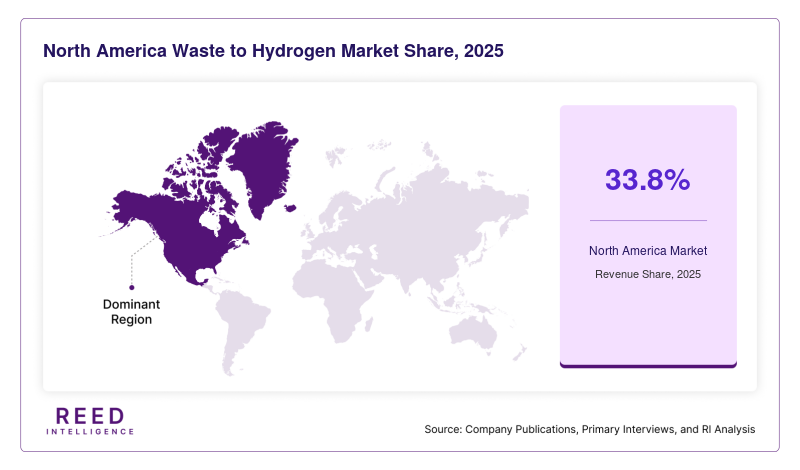
- North America dominated the market with a 33.8% share in 2025.
- Asia Pacific is expected to grow at the fastest CAGR of 14.6% during 2026–2034.
- By technology, gasification accounted for the largest share of 42.7%.
- while plasma gasification is projected to grow at a CAGR of 15.2%.
- By feedstock, municipal solid waste led with a 46.3% share, whereas industrial waste is expected to expand at a CAGR of 14.1%.
- The United States remained the dominant country, with market values of USD 620 million in 2024 and USD 690 million in 2025.
Market Trends
Increasing integration of advanced conversion technologies
The Waste to Hydrogen Market is witnessing significant transformation through the integration of advanced conversion technologies such as plasma gasification, catalytic reforming, and hybrid thermochemical processes. These technologies enhance hydrogen yield, reduce emissions, and improve operational efficiency compared to traditional waste-to-energy methods. Companies are increasingly investing in modular systems that can be deployed across urban and industrial settings, enabling decentralized hydrogen production. The adoption of artificial intelligence and automation for process optimization further improves system reliability and cost efficiency. This trend is strengthening the feasibility of converting complex waste streams into high-purity hydrogen, thereby supporting market expansion.
Growing adoption of circular economy frameworks
A notable trend shaping the Waste to Hydrogen Market is the adoption of circular economy frameworks by governments and corporations. Waste is increasingly viewed as a resource rather than a liability, driving investments in technologies that convert waste into valuable outputs such as hydrogen. Urban municipalities are integrating waste-to-hydrogen plants within smart city initiatives to reduce landfill usage and generate clean fuel for transportation and industrial applications. This trend is also supported by policy incentives and carbon credit mechanisms, encouraging private sector participation. As a result, the market is experiencing a shift toward sustainable waste management practices that align economic growth with environmental responsibility.
Market Drivers
Rising demand for low-carbon hydrogen solutions
The growing demand for low-carbon hydrogen is a major driver of the Waste to Hydrogen Market. Industries such as transportation, chemicals, and power generation are actively seeking alternatives to fossil fuels to meet emission reduction targets. Waste-derived hydrogen offers a competitive advantage by combining waste management with clean energy production. Governments are supporting hydrogen adoption through subsidies, tax incentives, and infrastructure development programs. Additionally, corporate sustainability commitments are encouraging companies to invest in green hydrogen solutions. This increasing demand is driving technological advancements and scaling up production capacities, thereby accelerating market growth.
Increasing global waste generation and management challenges
The rapid increase in global waste generation is another significant driver of the Waste to Hydrogen Market. Urbanization, industrialization, and population growth have led to a surge in municipal and industrial waste, creating challenges for traditional disposal methods such as landfilling and incineration. Waste-to-hydrogen technologies provide an effective solution by converting waste into a valuable energy resource while reducing environmental impact. Governments are implementing strict regulations to limit landfill use and promote waste recycling and recovery. This shift is encouraging investments in waste-to-hydrogen projects, thereby supporting market expansion and innovation.
Market Restraint
High capital investment and technological complexity
One of the primary restraints in the Waste to Hydrogen Market is the high capital investment required for setting up advanced conversion facilities. Technologies such as plasma gasification and catalytic reforming involve significant upfront costs, making it challenging for small and medium enterprises to enter the market. Additionally, the complexity of handling diverse waste streams and ensuring consistent feedstock quality poses operational challenges. Maintenance and operational costs further add to the financial burden. For example, large-scale waste-to-hydrogen plants require sophisticated infrastructure, skilled workforce, and continuous monitoring systems. These factors can limit market penetration, particularly in developing regions where financial and technical resources are constrained.
Market Opportunities
Expansion of hydrogen infrastructure and mobility sector
The expansion of hydrogen infrastructure and the growing adoption of hydrogen-powered vehicles present a significant opportunity for the Waste to Hydrogen Market. Governments are investing in hydrogen refueling stations and fuel cell technologies to support clean transportation initiatives. Waste-derived hydrogen can serve as a sustainable fuel source for buses, trucks, and trains, reducing reliance on fossil fuels. This opportunity is further enhanced by partnerships between public and private sectors to develop integrated hydrogen ecosystems. As infrastructure continues to expand, the demand for waste-to-hydrogen solutions is expected to increase, creating new growth avenues for market players.
Development of decentralized energy systems
Another promising opportunity in the Waste to Hydrogen Market is the development of decentralized energy systems. Small-scale waste-to-hydrogen plants can be deployed in urban areas, industrial zones, and remote locations, enabling localized energy production. This approach reduces transportation costs, enhances energy security, and supports grid stability. Decentralized systems are particularly beneficial in regions with limited access to centralized energy infrastructure. Technological advancements are making these systems more efficient and cost-effective, encouraging adoption across various sectors. This trend is expected to drive market growth by expanding the application scope of waste-to-hydrogen technologies.
Segmental Analysis
By Technology
Gasification emerged as the dominant subsegment in the Waste to Hydrogen Market, accounting for approximately 42.7% of the market share in 2024. This technology is widely adopted due to its ability to efficiently convert various types of waste into syngas, which can be further processed to produce hydrogen. Gasification systems are versatile and can handle mixed waste streams, making them suitable for large-scale applications. The technology also offers higher energy efficiency and lower emissions compared to traditional waste disposal methods. Additionally, advancements in gasification processes have improved hydrogen yield and reduced operational costs, contributing to its widespread adoption across industries.
Plasma gasification is the fastest-growing subsegment, projected to expand at a CAGR of 15.2% during the forecast period. This growth is driven by its ability to achieve higher temperatures, resulting in more complete waste conversion and minimal residual waste. Plasma gasification produces high-purity hydrogen and reduces environmental impact, making it an attractive option for sustainable energy production. The increasing focus on advanced technologies and the need for efficient waste management solutions are driving the adoption of plasma gasification. Furthermore, ongoing research and development efforts are expected to enhance its cost-effectiveness, supporting its growth in the market.
By Feedstock
Municipal solid waste dominated the Waste to Hydrogen Market, accounting for a 46.3% share in 2024. The abundance of municipal waste and the need for effective disposal solutions make it a key feedstock for hydrogen production. Urban areas generate large volumes of waste, providing a consistent and readily available source for conversion. Technologies such as gasification and anaerobic digestion are widely used to process municipal waste, enabling efficient hydrogen production. Additionally, government initiatives to reduce landfill usage and promote waste recycling are driving the adoption of municipal solid waste as a feedstock in the market.
Industrial waste is the fastest-growing subsegment, expected to grow at a CAGR of 14.1% during the forecast period. This growth is driven by the increasing focus on reducing industrial emissions and improving resource efficiency. Industrial waste streams, such as chemical residues and byproducts, can be converted into hydrogen using advanced technologies. Companies are investing in waste-to-hydrogen solutions to achieve sustainability goals and reduce disposal costs. The integration of waste conversion systems within industrial facilities is further supporting the growth of this subsegment, making it a key contributor to market expansion.
By Application
Energy generation accounted for the largest share of the Waste to Hydrogen Market, with a 39.5% share in 2024. Hydrogen produced from waste is increasingly used for power generation, supporting the transition to clean energy sources. The ability to store and transport hydrogen makes it a flexible energy carrier, suitable for various applications. Governments and utilities are investing in hydrogen-based power systems to reduce reliance on fossil fuels. Additionally, advancements in fuel cell technologies are enhancing the efficiency of hydrogen-based energy generation, contributing to the growth of this segment.
Transportation is the fastest-growing application, projected to expand at a CAGR of 14.8% during the forecast period. The adoption of hydrogen fuel cell vehicles is increasing due to their low emissions and high efficiency. Waste-derived hydrogen offers a sustainable fuel source for transportation, aligning with global decarbonization goals. Governments are supporting the development of hydrogen refueling infrastructure and providing incentives for fuel cell vehicle adoption. This growing demand for clean transportation solutions is driving the expansion of the transportation segment in the Waste to Hydrogen Market.
Regional Analysis
North America
North America accounted for approximately 33.8% of the Waste to Hydrogen Market share in 2025 and is projected to grow at a CAGR of 13.1% during the forecast period. The region benefits from strong government support, advanced infrastructure, and significant investments in clean energy technologies. The presence of established waste management systems and growing adoption of hydrogen fuel in transportation contribute to market growth. Additionally, favorable policies promoting renewable energy and carbon reduction are encouraging the development of waste-to-hydrogen projects across the region.
The United States dominates the regional market, driven by increasing investments in hydrogen infrastructure and waste management solutions. A unique growth factor is the integration of waste-to-hydrogen projects within municipal sustainability programs. Cities are adopting innovative technologies to convert waste into clean energy, reducing landfill dependency and emissions. This approach is supported by federal funding and private sector participation, strengthening the market outlook in the country.
Europe
Europe held a market share of around 28.5% in 2025 and is expected to grow at a CAGR of 12.7% during the forecast period. The region’s strong focus on environmental sustainability and circular economy initiatives drives the adoption of waste-to-hydrogen technologies. Strict regulations on waste disposal and emissions are encouraging investments in advanced waste conversion systems. Additionally, the European Union’s hydrogen strategy supports the development of clean hydrogen production, further boosting market growth.
Germany leads the European market, supported by its advanced industrial base and commitment to renewable energy. A key growth factor is the country’s emphasis on integrating hydrogen into its energy transition strategy. Investments in research and development, along with collaborations between industry players and research institutions, are driving technological advancements. This focus on innovation is strengthening Germany’s position in the Waste to Hydrogen Market.
Asia Pacific
Asia Pacific is expected to grow at the fastest CAGR of 14.6% during the forecast period, with a market share of approximately 22.4% in 2025. Rapid urbanization, industrialization, and increasing waste generation are key factors driving market growth in the region. Governments are investing in waste management infrastructure and promoting clean energy solutions to address environmental challenges. The adoption of advanced technologies and increasing awareness about sustainable practices further support market expansion.
China dominates the Asia Pacific market due to its large population and significant waste generation. A unique growth factor is the government’s focus on reducing pollution and promoting renewable energy. Investments in large-scale waste-to-hydrogen projects and supportive policies are driving market growth. Additionally, the country’s strong manufacturing capabilities enable the development of cost-effective technologies, enhancing its competitive position.
Middle East & Africa
The Middle East & Africa region accounted for around 8.1% of the market share in 2025 and is projected to grow at a CAGR of 12.3%. The region is gradually adopting waste-to-hydrogen technologies as part of its efforts to diversify energy sources and reduce environmental impact. Investments in renewable energy projects and increasing awareness about sustainable waste management are contributing to market growth. Governments are also exploring hydrogen as a key component of their long-term energy strategies.
Saudi Arabia leads the regional market, driven by its focus on developing a hydrogen-based economy. A unique growth factor is the integration of waste-to-hydrogen projects within large-scale energy initiatives. The country is investing in advanced technologies and infrastructure to support hydrogen production and utilization. This approach is expected to drive market growth and position Saudi Arabia as a key player in the region.
Latin America
Latin America held a market share of approximately 7.2% in 2025 and is expected to grow at a CAGR of 12.8% during the forecast period. The region is experiencing increasing adoption of waste-to-hydrogen technologies due to growing environmental concerns and the need for sustainable waste management solutions. Governments are implementing policies to promote renewable energy and reduce landfill usage, supporting market growth.
Brazil dominates the regional market, driven by its large waste generation and growing focus on clean energy. A unique growth factor is the development of public-private partnerships to establish waste-to-hydrogen projects. These collaborations are enabling the deployment of advanced technologies and improving project feasibility. As a result, Brazil is emerging as a key contributor to the market’s growth in Latin America.
Competitive Landscape
The Waste to Hydrogen Market is characterized by the presence of several global and regional players focusing on technological innovation and strategic partnerships. Companies are investing in research and development to enhance conversion efficiency and reduce costs. The market is moderately fragmented, with key players competing based on technology, project scale, and geographic presence.
A leading player in the market is Air Liquide, which has been actively expanding its hydrogen production capabilities through innovative waste conversion technologies. The company recently announced a new waste-to-hydrogen project aimed at supporting sustainable energy initiatives. Other major players are focusing on collaborations with governments and municipalities to develop large-scale projects. Strategic acquisitions and partnerships are also common, enabling companies to strengthen their market position and expand their technological capabilities.
Key Players List
- Air Liquide
- Linde plc
- Air Products and Chemicals Inc.
- Veolia Environment S.A.
- Suez Group
- Shell plc
- TotalEnergies SE
- Hyundai Engineering Co., Ltd.
- Waste Management Inc.
- Hitachi Zosen Corporation
- Doosan Enerbility
- Siemens Energy
- Plug Power Inc.
- Ballard Power Systems
- ITM Power plc
Recent Developments
- Several companies have announced new waste-to-hydrogen projects aimed at expanding production capacity and improving efficiency.
- A major energy company recently partnered with a municipal authority to develop a large-scale waste-to-hydrogen plant, focusing on converting urban waste into clean fuel.
- Another key player introduced an advanced plasma gasification system designed to enhance hydrogen yield and reduce emissions, supporting sustainable energy initiatives.
Waste to Hydrogen Market Segments
Technology
- Gasification
- Pyrolysis
- Plasma Gasification
- Anaerobic Digestion
Feedstock
- Municipal Solid Waste
- Agricultural Waste
- Industrial Waste
- Plastic Waste
Application
- Energy Generation
- Transportation
- Industrial Use
- Residential Use
By Region
- North America
- Europe
- APAC
- Middle East and Africa
- LATAM