Water Ionizer Market Size, Share & Growth Report By Product Type (Countertop Water Ionizers, Under-Sink Water Ionizers, Portable Water Ionizers), By Application (Residential, Commercial, Healthcare) By Region & Segment Forecasts, 2026–2034
USD 3950
Water Ionizer Market Size
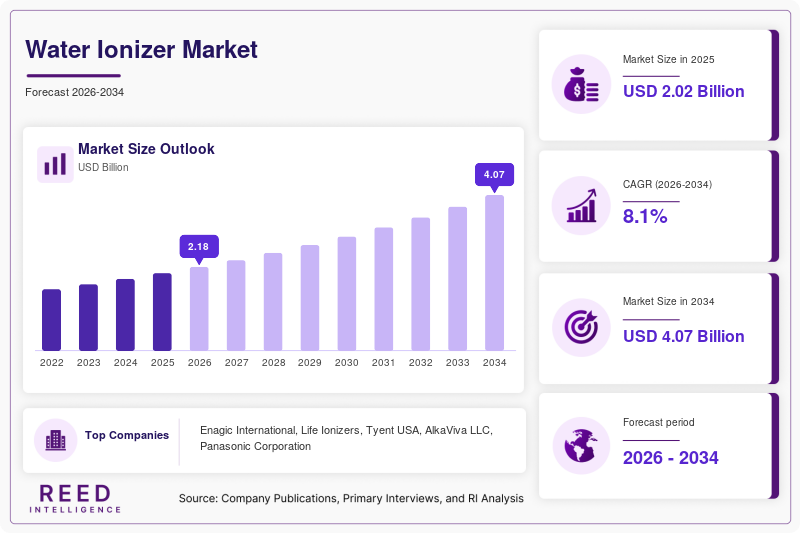
Global Water Ionizer market size is projected at USD 2.18 billion in 2026 and is expected to hit USD 4.07 billion by 2034 with a CAGR of 8.1%. The market is benefiting from increasing consumer interest in alkaline water, at-home water treatment, wellness-oriented appliances, and premium hydration solutions. Detailed segmentation, regional demand analysis, technology assessment, production volumes, and competitive landscape evaluation are increasingly important for understanding opportunities across residential and commercial applications.
Key Takeaways
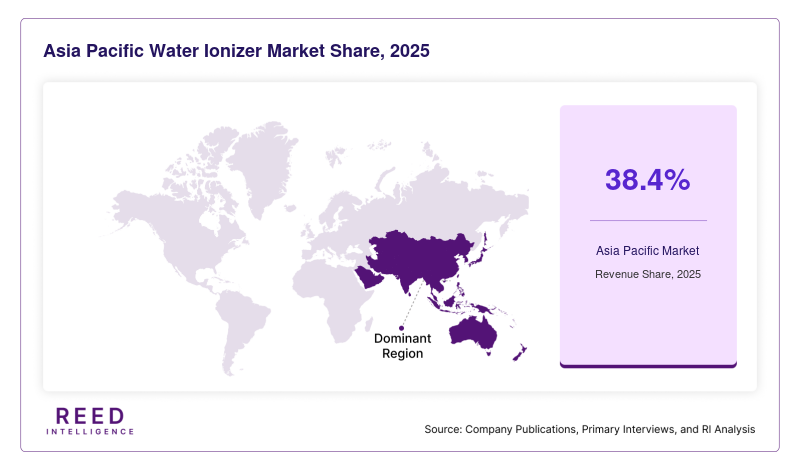
- Asia Pacific dominated the market with approximately 38.4% share in 2026, while North America is among the fastest-growing regions, expanding at approximately 8.7% CAGR through 2034.
- Countertop water ionizers accounted for nearly 46.8% of global revenue in 2026, while portable water ionizers represent the fastest-growing product category at approximately 9.2% CAGR.
- The residential application segment dominated with approximately 68.5% share in 2026, supported by household wellness adoption and increasing demand for convenient water treatment.
- Healthcare applications are projected to expand at approximately 8.9% CAGR during 2026–2034 as wellness centers, clinics, and specialized facilities increasingly incorporate premium hydration systems.
- India is an emerging high-growth country market and is projected to reach approximately USD 205 million by 2034, expanding at a CAGR of around 10.4% during the forecast period.
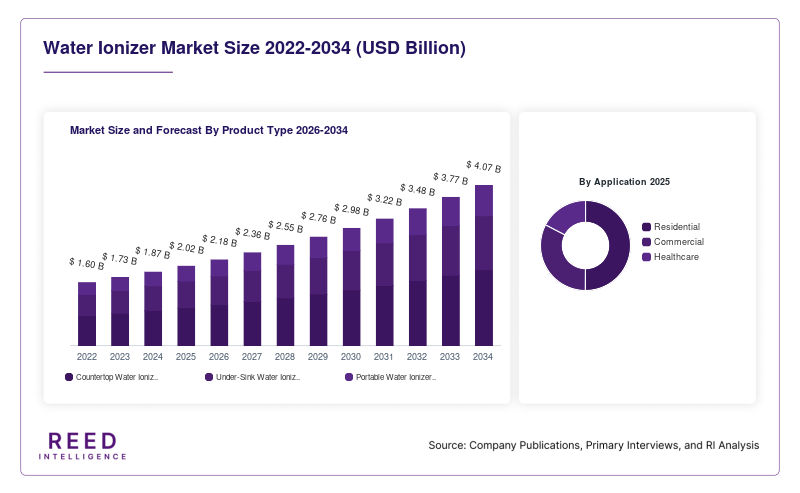
The global water ionizer market comprises appliances that use electrolysis to separate water into alkaline and acidic streams, generally producing ionized drinking water with adjustable pH levels. Global manufacturers are estimated to produce approximately 3.7 million water ionizer units annually in 2026, with residential systems accounting for more than two-thirds of total demand. Countertop models contribute approximately 46.8% of revenue, followed by under-sink systems at 34.6% and portable systems at 18.6%. Adoption is strongest in Japan, South Korea, China, the United States, and selected European markets, where premium water filtration and wellness appliances have relatively high household penetration.
Global Water Ionizer Market Trends
Smart Electrolysis and Integrated Filtration Drive Premiumization
Technology development is shifting water ionizers from basic electrolysis appliances toward connected hydration platforms incorporating multi-stage filtration, digital pH displays, automatic cleaning cycles, filter-life monitoring, touch controls, and app-enabled operating information. Premium systems increasingly use titanium or platinum-coated electrode plates, multi-electrode configurations, and electronically controlled electrolysis to deliver more consistent output. Manufacturers are also improving energy efficiency, reducing operating noise, and extending filter replacement intervals.
Sector-specific demand is expanding beyond traditional household wellness use. Hotels, spas, fitness centers, wellness clinics, restaurants, and corporate facilities are adopting higher-capacity ionization systems to differentiate hydration services. Demand for compact countertop appliances is particularly strong among urban consumers, while portable ionizers are gaining traction among travelers and fitness users. The commercial segment is also encouraging manufacturers to develop systems with larger flow rates, higher durability, and simplified maintenance.
Water Ionizer Market Drivers
Growing Demand for Wellness-Oriented Hydration
Increasing consumer focus on preventive wellness, hydration, premium drinking water, and home-based health routines is supporting water ionizer adoption. Consumers are increasingly willing to invest in appliances that combine filtration and water treatment with adjustable alkaline output. Rising disposable incomes in emerging economies, expanding premium appliance retail, and greater availability through e-commerce are reinforcing demand, particularly for systems priced between USD 500 and USD 3,000.
Water Ionizer Market Restraints
High Equipment Cost and Limited Consumer Understanding
High upfront prices remain a major constraint compared with conventional water filters and pitchers. Advanced units can cost several hundred to several thousand dollars, while replacement filters and periodic electrode maintenance add recurring expenses. Consumer understanding of water ionization technology also varies significantly by geography, limiting adoption in price-sensitive markets. Concerns regarding product claims, water chemistry, and differences between filtration and ionization can further lengthen purchasing decisions.
Water Ionizer Market Opportunities
Expansion of Smart and Sustainable Water Treatment Appliances
Manufacturers have significant opportunities to integrate IoT connectivity, automated filter diagnostics, energy-efficient electrolysis, recyclable components, and modular filtration technologies. Emerging markets across India, Southeast Asia, Latin America, and the Middle East offer substantial room for penetration as urban households upgrade drinking-water systems. Commercial wellness facilities and hospitality operators also represent an expanding opportunity, particularly for centralized systems capable of supplying higher volumes of treated water.
Challenges in Water Ionizer Market
Regulatory Complexity and Differentiation of Product Claims
The industry faces challenges associated with regulatory requirements, consumer education, product certification, and substantiation of health-related claims. Manufacturers must clearly distinguish water-treatment capabilities from unsupported medical benefits while maintaining compliance across different countries. Competitive differentiation is also difficult as filtration performance, electrode configuration, pH adjustment, flow rate, warranty coverage, and smart features increasingly influence purchasing decisions. Counterfeit and low-quality products sold through online channels add additional pressure on established brands.
Water Ionizer Market Segmentation Analysis
By product type, countertop water ionizers represented the dominant category with approximately 46.8% of global market revenue in 2026, supported by simple installation and strong residential demand. Under-sink models contributed around 34.6%, while portable systems accounted for approximately 18.6%. By application, residential users generated nearly 68.5% of revenue, followed by commercial applications at 23.7% and healthcare at 7.8%.
By Type
Countertop Water Ionizers: Countertop systems accounted for approximately 46.8% of 2026 revenue, representing an estimated 1.75 million units of annual global production. These systems typically provide multiple alkaline and acidic water settings, digital pH displays, multi-stage filtration, and flow rates of approximately 1.5–4.0 liters per minute. Their plug-and-use configuration makes them particularly attractive for households and small wellness facilities.
Under-Sink Water Ionizers: Under-sink systems held approximately 34.6% market share in 2026, corresponding to roughly 1.28 million units produced globally. These units integrate directly with kitchen plumbing and commonly feature external faucets, multi-stage filters, automated cleaning cycles, and electrolysis chambers using titanium or platinum-coated plates. Typical systems support flow rates of 2–5 liters per minute and are increasingly preferred for permanent household installations.
Portable Water Ionizers: Portable water ionizers represented about 18.6% of market revenue and approximately 670,000 units in annual production in 2026. Compact models generally use rechargeable lithium-ion batteries, USB-C charging, compact electrolysis cells, and filtration cartridges. Product capacity commonly ranges from 300 milliliters to 1 liter, making these systems suitable for travelers, athletes, office users, and consumers seeking mobile hydration solutions.
By Application
Residential: Residential applications dominated with approximately 68.5% share in 2026, representing demand for nearly 2.5 million units globally. Households increasingly use countertop and under-sink systems for daily drinking and cooking water. Demand is concentrated in premium urban households, wellness-focused consumers, and regions with strong awareness of filtration and alkaline-water appliances. Residential buyers typically prioritize filtration quality, ease of operation, warranty support, and compact design.
Commercial: Commercial applications contributed approximately 23.7% of 2026 revenue, equivalent to nearly 875,000 units of annual demand. Restaurants, hotels, spas, fitness centers, offices, and wellness facilities use higher-capacity systems to provide treated water to customers and employees. Commercial installations generally require flow rates exceeding 4 liters per minute, longer filter life, durable electrode systems, continuous-use capability, and simplified maintenance procedures.
Healthcare: Healthcare applications represented approximately 7.8% of global revenue in 2026, with around 290,000 units used across wellness clinics, rehabilitation facilities, specialized care environments, and related institutions. These systems generally emphasize filtration consistency, sanitation, controlled operation, monitoring features, and documented maintenance. Demand is also emerging from preventive-wellness centers and facilities that incorporate hydration services into broader lifestyle and wellness programs.
Water Ionizer Market Outlook
Asia Pacific Water Ionizer Market
Asia Pacific held the largest regional share at approximately 38.4% in 2026 and is expected to maintain its leadership through 2034. Japan and South Korea are major contributors because of established consumer familiarity with alkaline-water appliances and advanced home water-treatment technologies. China is expanding rapidly through e-commerce and domestic appliance manufacturing, while India and Southeast Asia are generating incremental demand. Residential applications account for roughly 70% of regional revenue, with commercial and healthcare uses contributing approximately 22% and 8%, respectively.
North America Water Ionizer Market
North America represented approximately 27.2% of the global market in 2026. The United States contributes the majority of regional demand, supported by premium wellness consumption, home filtration upgrades, and strong online distribution. Canada provides additional demand through residential and hospitality applications. Residential systems account for approximately 64% of regional revenue, while commercial applications contribute 27% and healthcare and wellness facilities approximately 9%. The region is projected to grow at about 8.7% CAGR through 2034.
Europe Water Ionizer Market
Europe accounted for approximately 19.1% of global revenue in 2026, with Germany, the United Kingdom, France, Italy, and the Nordic countries representing important markets. Consumer preference for premium household appliances and water-quality solutions supports adoption. Residential applications contribute nearly 67% of regional revenue, followed by commercial uses at 25% and healthcare at 8%. Demand is increasingly influenced by energy-efficient designs, sustainable filtration, and compact kitchen appliances.
Latin America Water Ionizer Market
Latin America contributed approximately 8.4% of global market revenue in 2026, with Brazil and Mexico representing the largest country markets. Increasing urbanization, growing middle-class purchasing power, and expansion of online appliance retail are supporting demand. Residential applications account for approximately 72% of regional sales, while commercial applications contribute around 21% and healthcare 7%. Premium pricing remains a consideration, but smaller portable products are improving market accessibility.
Middle East & Africa Water Ionizer Market
The Middle East & Africa region accounted for approximately 6.9% of global revenue in 2026. The United Arab Emirates, Saudi Arabia, and South Africa are key contributors, supported by premium hospitality, wellness centers, and high-end residential development. Commercial applications represent approximately 29% of regional demand, compared with 63% for residential use and 8% for healthcare. Increasing investment in luxury hospitality and wellness infrastructure is expected to support regional expansion.
Top players in Water Ionizer Market
- Enagic International
- Life Ionizers
- Tyent USA
- AlkaViva LLC
- Panasonic Corporation
- Konoshita Medical Instruments Co., Ltd.
- VWA Water
- Chanson Water
- IonWays
- PurePro Water Corporation
- Alkaline Water Ionizer Corporation
- Air Water Inc.
Recent Developments in Water Ionizer Market
- January 2026: Leading water-ionizer manufacturers expanded smart appliance portfolios with improved digital controls, automated cleaning programs, and filter-life monitoring capabilities.
- March 2026: Several premium appliance brands increased their focus on compact countertop ionizers designed for urban households and simplified installation.
- May 2026: Manufacturers introduced upgraded multi-stage filtration configurations combining sediment, carbon, and specialized filtration media with electrolysis systems.
- July 2026: Portable water-ionizer development accelerated, with new models emphasizing rechargeable batteries, USB-C connectivity, lightweight construction, and improved operating efficiency.
- August 2026: Industry players strengthened commercial distribution partnerships across hospitality, wellness, fitness, and specialty water-treatment channels to broaden institutional adoption.
Water Ionizer Market Segments
By Product Type
- Countertop Water Ionizers
- Under-Sink Water Ionizers
- Portable Water Ionizers
By Application
- Residential
- Commercial
- Healthcare
By Region
- North America
- Europe
- APAC
- Middle East and Africa
- LATAM