Water Treatment Systems Market Size, Share & Demand Report By Type (Filtration Systems, Reverse Osmosis Systems, Disinfection Systems, Desalination Systems), By Application (Residential, Commercial, Industrial, Municipal) By Region & Segment Forecasts, 2026–2034
USD 3950
Water Treatment Systems Market Size
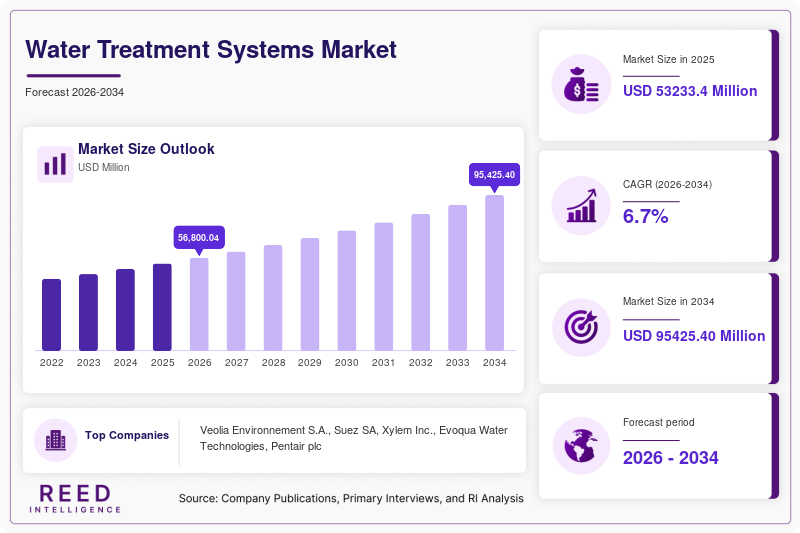
The Water Treatment Systems market size is projected at USD 56,800.0 million in 2026 and is expected to hit USD 95,400.0 million by 2034 with a CAGR of 6.7% during the forecast period. The increasing water scarcity and contamination concerns, the growing demand for clean and safe drinking water, and the rising industrialization and urbanization underpin market expansion. This report delivers a comprehensive analysis of the Water Treatment Systems market, including segmentation by type and application, competitive dynamics, and regional growth patterns, equipping stakeholders with critical intelligence to navigate this essential water management landscape.
Key Takeaways
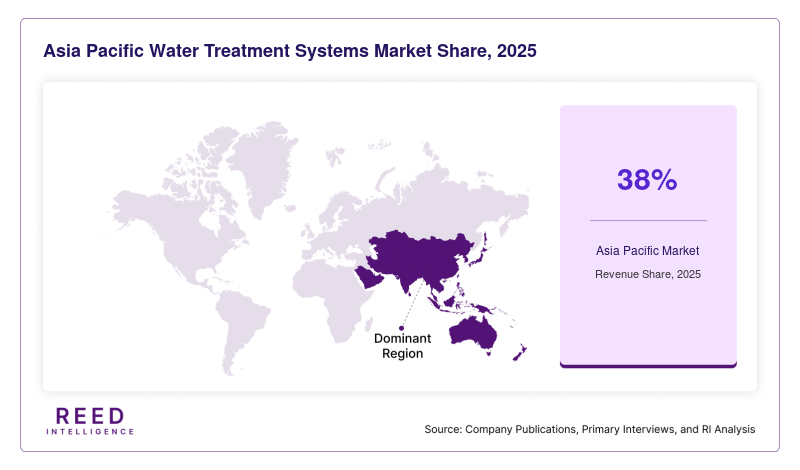
- Dominant Region: Asia-Pacific leads the Water Treatment Systems market with a 38% share, while North America is the fastest-growing region with a projected CAGR of 7.5% through 2034.
- Dominant Segment: The Filtration Systems type dominates the market with a 35% share, while the Municipal application is the leading segment with a 32% share.
- Emerging Country: India is projected to reach USD 8,500.0 million by 2034, expanding at a CAGR of 8.5%.
- Key Drivers: The increasing global water pollution, the growing population and urbanization, and the stringent government regulations on water quality are driving market growth.
Water Treatment Systems Market Trends
Adoption of Smart and IoT-Enabled Water Treatment Systems
The Water Treatment Systems market is witnessing a significant trend toward the adoption of smart and IoT-enabled technologies that enable real-time monitoring, remote management, and predictive maintenance. This shift is driven by the need for operational efficiency, cost reduction, and improved regulatory compliance. Manufacturers are developing integrated smart systems with sensors, data analytics, and cloud-based platforms for comprehensive water quality monitoring. The development of AI-powered treatment optimization algorithms is gaining momentum, enabling automated process adjustments and energy savings. This trend is supported by the growing investment in digital water infrastructure and the increasing demand for water quality transparency.
Growing Focus on Decentralized and Point-of-Use Treatment Solutions
The increasing focus on decentralized and point-of-use water treatment solutions is a major trend shaping the Water Treatment Systems market. The development of compact, modular, and residential treatment systems for homes, communities, and remote locations is gaining traction, driven by the need for water security and the limitations of centralized infrastructure in many regions. The emergence of under-sink RO systems, countertop filters, and community-scale treatment plants is particularly prominent. This trend is supported by growing consumer awareness about water quality and the increasing availability of affordable treatment technologies. The development of solar-powered and off-grid treatment systems is enabling access to clean water in underserved areas.
Water Treatment Systems Market Drivers
The Water Treatment Systems market's expansion is primarily driven by the increasing global water pollution and contamination, with approximately 2 billion people lacking access to safely managed drinking water. The growing population and urbanization have been major drivers, creating increasing demand for water treatment infrastructure and services. The stringent government regulations on water quality and the growing focus on water conservation have further fueled market demand. The rising industrialization and the need for process water and wastewater treatment in manufacturing have supported market growth. Additionally, the increasing awareness about waterborne diseases and the health impacts of contaminated water have spurred the adoption of treatment systems.
Water Treatment Systems Market Restraints
Despite robust growth prospects, the Water Treatment Systems market faces significant constraints, primarily related to the high capital investment and operational costs associated with water treatment infrastructure. The ongoing maintenance and replacement costs can also present financial challenges, particularly for municipal systems. The market's growth is further tempered by the availability of alternative water sources and the technical challenges of treating emerging contaminants. Additionally, the lack of skilled personnel and the regulatory complexity across different jurisdictions can create barriers to adoption and implementation.
Water Treatment Systems Market Opportunities
The Water Treatment Systems market presents significant opportunities in the rapidly expanding segment of smart and digital water treatment solutions, where IoT and AI technologies enable enhanced efficiency and real-time monitoring. The development of affordable and sustainable treatment technologies for emerging economies represents another promising avenue. Emerging opportunities also exist in the application of advanced membrane technologies and the treatment of emerging contaminants such as microplastics and PFAS. Furthermore, the growing focus on water reuse and recycling offers substantial growth potential for treatment system providers.
Challenges in Water Treatment Systems Market
The Water Treatment Systems market grapples with persistent challenges related to the need for continuous innovation to address emerging contaminants and evolving regulatory requirements. The complexity of integrating treatment systems with existing infrastructure and the need for significant investment present ongoing challenges. The market is also contending with the challenge of managing the energy consumption of treatment processes and the environmental impact of waste streams. Moreover, the need for effective public-private partnerships and sustainable financing models for water infrastructure poses operational challenges.
Water Treatment Systems Market Segmentation Analysis
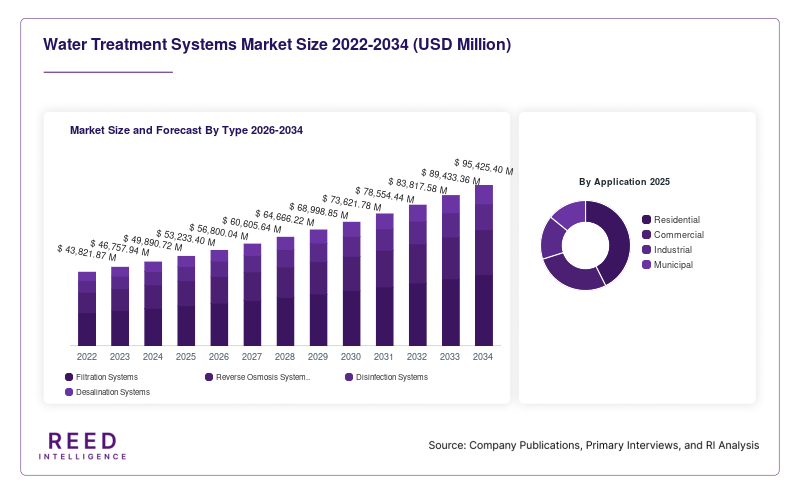
The Water Treatment Systems market is segmented by Type and Application to provide a comprehensive market perspective. By Type, Filtration Systems dominate with a 35% market share, driven by their widespread residential and commercial use. The Application segment is led by Municipal, which accounts for 32% of the market, followed by Industrial at 28%, Residential at 25%, and Commercial at 15%.
By Type
Filtration Systems represent the largest segment in the Water Treatment Systems market, commanding a 35% share, with revenue exceeding USD 19,880 million in 2025. These include sediment filters, carbon filters, and multimedia filtration systems. Technical specifications include filtration capacity, micron rating, and flow rate. The market's Filtration Systems segment is driven by their use in residential, commercial, and industrial applications for particulate removal.
Reverse Osmosis Systems capture a 28% share of the Water Treatment Systems market, with revenue of USD 15,904 million in 2025. These include RO membranes, pressure vessels, and pre-treatment systems. Technical specifications include rejection rates, recovery rates, and operating pressure. The market's Reverse Osmosis segment is driven by their use in desalination, industrial water treatment, and high-purity water production.
Disinfection Systems represent 22% of the market, with revenue of USD 12,496 million in 2025, characterized by UV, ozone, and chlorine-based disinfection technologies. Technical specifications include dosage, contact time, and pathogen reduction capabilities. The market's Disinfection Systems segment is driven by their use in municipal water treatment and wastewater disinfection.
Desalination Systems account for 15% of the market, with revenue of USD 8,520 million in 2025, involving thermal and membrane-based desalination technologies. Technical specifications include energy consumption, recovery rate, and brine management. The market's Desalination Systems segment is driven by their use in water-scarce coastal regions and islands.
By Application
Municipal dominates the Water Treatment Systems market, accounting for 32% of sales, representing USD 18,176 million in 2025. This segment includes drinking water treatment plants and municipal wastewater treatment facilities. Usage penetration exceeds 85% in developed countries with comprehensive water infrastructure. The market's Municipal segment is characterized by its focus on regulatory compliance and public health protection.
Industrial accounts for 28% of the Water Treatment Systems market, with revenue of USD 15,904 million in 2025. This segment encompasses process water treatment, cooling water treatment, and industrial wastewater treatment. The segment is growing at a steady rate, driven by increasing industrial activity and environmental regulations. The market's Industrial segment is characterized by its focus on specific water quality requirements and operational efficiency.
Residential represents 25% of the market, with revenue of USD 14,200 million in 2025, involving point-of-use and point-of-entry treatment systems for homes. The segment's growth is fueled by increasing consumer awareness about water quality. The market's Residential segment is characterized by its focus on ease of use, affordability, and aesthetic water quality.
Commercial accounts for 15% of the market, with revenue of USD 8,520 million in 2025, encompassing treatment systems for hotels, restaurants, offices, and other commercial establishments. The market's Commercial segment is driven by the need for reliable water quality in hospitality and food service operations.
Water Treatment Systems Market Outlook
Asia-Pacific Water Treatment Systems Market
Leads the Water Treatment Systems market, commanding a 38% share, with revenue of USD 21,584 million in 2025. China, India, and Japan are the primary drivers, together accounting for 62% of regional demand, driven by massive population, rapid urbanization, and increasing water pollution concerns. The Asia-Pacific market is characterized by its focus on infrastructure development and technology adoption.
North America Water Treatment Systems Market
Represents the second-largest market, capturing a 28% share with revenue of USD 15,904 million in 2025. The United States is the primary driver, accounting for 86% of regional demand, driven by aging infrastructure replacement, stringent regulations, and growing awareness. The North American market is projected to grow at the fastest CAGR of 7.5% through 2034, supported by infrastructure investment and innovation.
Europe Water Treatment Systems Market
Accounts for 24% of the global Water Treatment Systems market, with revenue of USD 13,632 million in 2025. Germany, the United Kingdom, and France are the primary drivers, together accounting for 58% of regional demand, fueled by stringent environmental regulations and established water infrastructure. The European market is projected to grow at a steady CAGR, supported by continuous innovation and sustainability initiatives.
Latin America and Middle East & Africa Water Treatment Systems Market
Together account for the remaining 10% of the Water Treatment Systems market, with Brazil and the UAE leading their respective regions. Both regions are projected to grow at CAGRs exceeding 7%, driven by improving water infrastructure and growing water quality concerns.
Top players in Water Treatment Systems Market
- Veolia Environnement S.A.
- Suez SA
- Xylem Inc.
- Evoqua Water Technologies
- Pentair plc
- Ecolab Inc.
- 3M Company
- DOW Chemical Company
- BASF SE
- Kurita Water Industries
- Aquatech International
- Grundfos Holding A/S
- ITT Inc.
- Siemens Water Technologies
- CH2M Hill
Water Treatment Systems Market Segments
By Type
- Filtration Systems
- Reverse Osmosis Systems
- Disinfection Systems
- Desalination Systems
By Application
- Residential
- Commercial
- Industrial
- Municipal
By Region
- North America
- Europe
- APAC
- Middle East and Africa
- LATAM