Wax Additive Market Size, Share & Demand Report By Type (Polyethylene Wax, Polypropylene Wax, Fischer-Tropsch Wax, Others), By Application (Coatings, Plastics, Inks, Adhesives), By End-Use Industry (Packaging, Automotive, Construction, Consumer Goods, Others), By Region & Segment Forecasts, 2026–2034
USD 3950
Market Overview
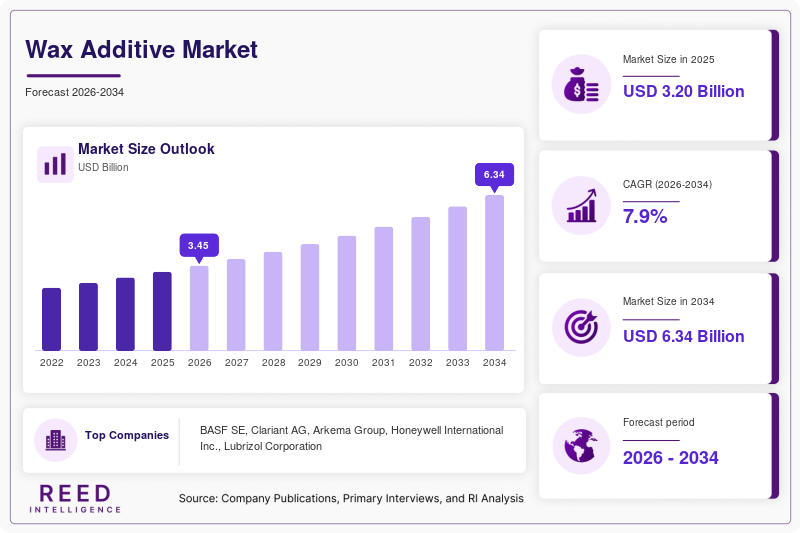
The Wax Additive Market size was valued at approximately USD 3.2 billion in 2026 and is projected to reach USD 5.9 billion by 2034, expanding at a CAGR of 7.9% during the forecast period (2026–2034). The market growth is supported by the increasing demand for performance-enhancing additives in coatings, plastics, inks, and adhesives, where wax additives play a critical role in improving surface properties, abrasion resistance, and processing efficiency. One of the key global factors driving expansion is the rising use of high-performance coatings in construction and automotive industries, where durability and environmental compliance are becoming increasingly important.
The market is also benefiting from advancements in synthetic and bio-based wax technologies, enabling manufacturers to meet sustainability goals without compromising performance. Growing industrialization in emerging economies continues to support consumption across diverse applications, while innovation in polymer processing techniques is further accelerating adoption.
Key Highlights
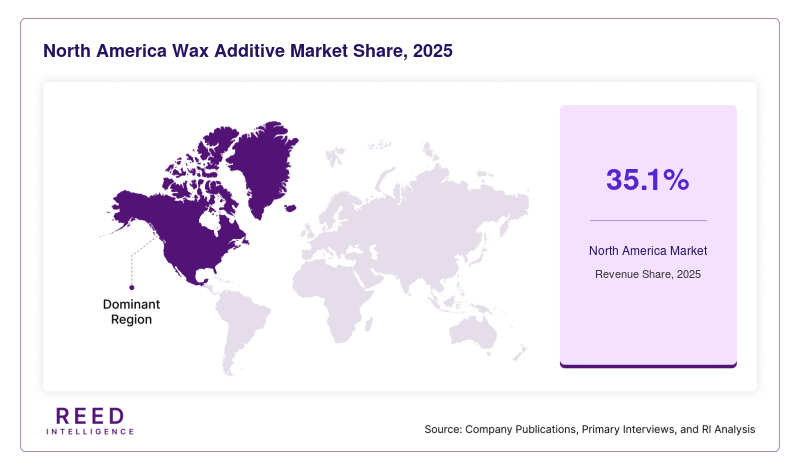
- North America dominated the market with a 35.1% share in 2025.
- Asia Pacific is expected to grow at the fastest CAGR of 9.2% during 2026–2034.
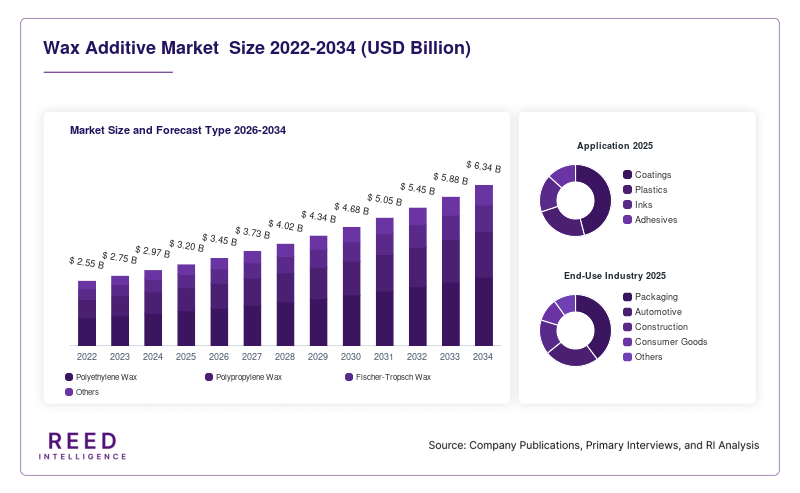
- By type, polyethylene wax accounted for the largest share of 39.4%, while Fischer-Tropsch wax is projected to grow at a CAGR of 10.1%.
- By application, coatings led with a 42.6% share, whereas plastics are expected to expand at a CAGR of 9.5%.
- The United States remained the dominant country, with market values of USD 720 million in 2024 and USD 780 million in 2025.
Market Trends
Increasing shift toward bio-based and sustainable wax additives
A notable trend shaping the Wax Additive Market is the increasing preference for bio-based and sustainable alternatives. Regulatory pressures and environmental concerns are encouraging manufacturers to replace petroleum-based waxes with renewable sources such as plant-derived waxes and synthetic biodegradable variants. These products offer comparable performance characteristics, including improved scratch resistance and lubrication properties, while reducing environmental impact. Industries such as packaging and coatings are particularly driving this transition, as sustainability becomes a key purchasing criterion. Additionally, consumer awareness regarding eco-friendly materials is influencing product formulations, prompting manufacturers to invest in green chemistry innovations and expand their sustainable product portfolios.
Rising demand for high-performance coatings in industrial applications
Another key trend is the growing demand for high-performance coatings across automotive, construction, and industrial sectors. Wax additives are increasingly used to enhance coating properties such as gloss control, matting, anti-blocking, and surface protection. With the expansion of infrastructure projects and automotive production, the need for coatings that provide durability and aesthetic appeal has intensified. Moreover, technological advancements in nano-sized wax additives are improving dispersion and compatibility, enabling superior performance in complex formulations. This trend is further supported by the shift toward water-based coatings, where specialized wax additives are required to maintain efficiency and compliance with environmental regulations.
Market Drivers
Expanding applications in plastics and polymer processing
The growing use of wax additives in plastics and polymer processing is a major driver of market growth. These additives improve flow properties, reduce friction, and enhance mold release characteristics, making them essential in manufacturing processes. With increasing demand for lightweight and durable plastic components in automotive, packaging, and consumer goods industries, the need for efficient processing aids has surged. Wax additives also contribute to improved surface finish and mechanical properties, making them indispensable in high-performance polymer applications. As industries continue to adopt advanced materials and manufacturing techniques, the reliance on wax additives is expected to rise steadily.
Growth of the coatings and inks industry globally
The expansion of the coatings and inks industry is significantly boosting the Wax Additive Market. These additives are widely used to improve scratch resistance, slip properties, and overall durability in coatings and printing inks. The increasing demand for decorative and protective coatings in residential and commercial construction is driving consumption. Additionally, the packaging industry’s growth, particularly in flexible packaging and labeling, is increasing the use of printing inks that rely on wax additives for improved performance. Technological advancements in ink formulations and the shift toward digital printing are further supporting demand, creating a stable growth trajectory for the market.
Market Restraint
Volatility in raw material prices impacting production costs
One of the primary challenges in the Wax Additive Market is the fluctuation in raw material prices, particularly for petroleum-based waxes. Variations in crude oil prices directly affect the cost structure of synthetic wax additives, creating uncertainty for manufacturers and end-users. This volatility can lead to increased production costs, reduced profit margins, and pricing inconsistencies in the market. Smaller manufacturers are particularly affected, as they may lack the financial resilience to absorb sudden cost increases. Additionally, supply chain disruptions and geopolitical factors can exacerbate these challenges, impacting availability and pricing stability. For example, disruptions in petrochemical supply chains can delay production schedules and increase dependency on alternative materials, further complicating market dynamics.
Market Opportunities
Technological advancements in specialty wax formulations
The development of specialty wax formulations presents significant growth opportunities in the market. Innovations in micronized and nano-sized wax additives are enabling enhanced performance characteristics such as improved dispersion, higher durability, and better compatibility with various substrates. These advanced formulations are particularly beneficial in high-end applications such as automotive coatings and industrial finishes. Manufacturers are investing in research and development to create customized solutions tailored to specific industry requirements, thereby expanding their product offerings. This trend is expected to open new revenue streams and strengthen competitive positioning in the market.
Emerging demand from developing economies
Rapid industrialization and urbanization in developing regions are creating new opportunities for the Wax Additive Market. Countries in Asia Pacific, Latin America, and the Middle East are witnessing increased investments in construction, automotive production, and packaging industries. This growth is driving demand for coatings, plastics, and adhesives, all of which rely heavily on wax additives. Additionally, the rising middle-class population and changing consumer preferences are boosting demand for high-quality consumer goods, further supporting market expansion. Local manufacturers are also entering the market, increasing competition and fostering innovation, which is expected to accelerate overall market growth.
Segmental Analysis
By Type
Polyethylene wax emerged as the dominant subsegment, accounting for 39.4% of the market share in 2024. Its widespread use is attributed to its excellent lubrication properties, chemical resistance, and cost-effectiveness. It is extensively utilized in plastics processing, coatings, and inks, where it enhances surface characteristics and processing efficiency. The availability of polyethylene wax in various grades and formulations allows manufacturers to tailor products according to specific application requirements. Additionally, its compatibility with a wide range of polymers makes it a preferred choice across multiple industries, contributing to its dominant position in the market.
Fischer-Tropsch wax is expected to be the fastest-growing subsegment, expanding at a CAGR of 10.1% during the forecast period. Its superior hardness, high melting point, and excellent thermal stability make it suitable for high-performance applications. The increasing demand for advanced coatings and specialty products is driving its adoption. Furthermore, ongoing research and development efforts are improving its performance characteristics, making it a viable alternative to conventional waxes. This growth is supported by the rising need for durable and high-quality materials in industrial applications.
By Application
Coatings accounted for the largest share of 42.6% in 2024, driven by their extensive use in construction, automotive, and industrial sectors. Wax additives play a crucial role in enhancing coating properties such as scratch resistance, slip, and surface finish. The increasing demand for protective and decorative coatings is boosting the consumption of wax additives. Additionally, the shift toward water-based coatings is creating new opportunities for specialized wax formulations, further supporting the growth of this segment.
Plastics are projected to be the fastest-growing application segment, with a CAGR of 9.5% during the forecast period. The rising demand for lightweight and durable plastic products in automotive, packaging, and consumer goods industries is driving this growth. Wax additives improve processing efficiency, reduce friction, and enhance surface properties, making them essential in plastic manufacturing. The increasing adoption of advanced polymer technologies is further accelerating the demand for wax additives in this segment.
By End-Use Industry
The packaging industry dominated the market, accounting for 36.8% of the share in 2024. The growing demand for flexible and rigid packaging solutions is driving the use of wax additives in coatings and inks. These additives enhance print quality, improve durability, and provide resistance to abrasion and moisture. The rapid growth of e-commerce and changing consumer preferences are further boosting demand for packaging materials, thereby supporting the market.
The automotive industry is expected to be the fastest-growing end-use segment, with a CAGR of 9.0% during the forecast period. The increasing production of vehicles and the growing demand for high-performance coatings and lightweight materials are driving the use of wax additives. These additives enhance the durability and aesthetic appeal of automotive components. Additionally, the shift toward electric vehicles is creating new opportunities for advanced materials, further supporting the growth of this segment.
Regional Analysis
North America
North America accounted for a significant share of 35.1% in 2025 and is expected to maintain steady growth with a CAGR of 6.8% during the forecast period. The region’s mature industrial base and strong presence of key manufacturers contribute to consistent demand for wax additives. Industries such as automotive, construction, and packaging are well-established, driving continuous consumption of coatings and plastics. Additionally, stringent environmental regulations are encouraging the adoption of advanced and eco-friendly wax additives.
The United States remains the dominant country in this region, supported by its robust manufacturing sector and technological advancements. A unique growth factor is the increasing focus on sustainable coatings and materials, driven by regulatory frameworks and corporate sustainability goals. This has led to higher investments in bio-based wax additives and innovative formulations, strengthening the market outlook in the country.
Europe
Europe held a market share of 27.4% in 2025 and is projected to grow at a CAGR of 6.5% through 2034. The region’s emphasis on environmental sustainability and regulatory compliance is a key factor influencing market dynamics. The adoption of eco-friendly coatings and materials is driving demand for specialized wax additives that meet stringent standards. Additionally, the presence of established automotive and industrial sectors supports steady consumption.
Germany stands out as the leading country in Europe, driven by its strong industrial and automotive base. A unique growth factor is the region’s leadership in green technologies and circular economy initiatives, which are encouraging the development and adoption of sustainable wax additives. This trend is expected to continue shaping the market in the coming years.
Asia Pacific
Asia Pacific accounted for 24.8% of the market in 2025 and is expected to grow at the fastest CAGR of 9.2% during the forecast period. Rapid industrialization, urbanization, and infrastructure development are driving demand for coatings, plastics, and adhesives, thereby boosting the use of wax additives. The region’s expanding manufacturing base and increasing investments in construction projects are key contributors to growth.
China dominates the Asia Pacific market, supported by its large-scale industrial production and growing demand for consumer goods. A unique growth factor is the increasing adoption of advanced manufacturing technologies, which require high-performance additives to enhance efficiency and product quality. This is expected to significantly drive market expansion in the region.
Middle East & Africa
The Middle East & Africa region held a market share of 6.2% in 2025 and is projected to grow at a CAGR of 7.1% through 2034. The region’s growth is driven by expanding construction activities and increasing investments in infrastructure projects. Demand for coatings and adhesives is rising, supporting the consumption of wax additives.
Saudi Arabia is the dominant country in this region, benefiting from large-scale infrastructure and industrial development projects. A unique growth factor is the government’s focus on economic diversification, which is encouraging the development of manufacturing industries and increasing demand for specialty chemicals, including wax additives.
Latin America
Latin America accounted for 6.5% of the market in 2025 and is expected to grow at a CAGR of 7.3% during the forecast period. The region’s growth is supported by expanding packaging and construction industries, which are driving demand for coatings and plastics. Increasing foreign investments are also contributing to market development.
Brazil leads the Latin American market, driven by its strong industrial base and growing consumer market. A unique growth factor is the rising demand for flexible packaging solutions, which require high-performance inks and coatings. This trend is expected to boost the consumption of wax additives in the region.
Competitive Landscape
The Wax Additive Market is characterized by the presence of several global and regional players focusing on product innovation and strategic collaborations. Leading companies are investing in research and development to introduce advanced and sustainable wax additives that meet evolving industry requirements. The market is moderately consolidated, with key players competing on the basis of product quality, pricing, and technological advancements.
A leading company in the market is BASF SE, which has a strong global presence and a diverse product portfolio. The company recently introduced a new range of bio-based wax additives aimed at reducing environmental impact while maintaining high performance. Other major players are also focusing on expanding their production capacities and strengthening their distribution networks to enhance market reach. Strategic partnerships and acquisitions are common strategies adopted to gain a competitive edge and expand product offerings.
Key Players
- BASF SE
- Clariant AG
- Arkema Group
- Honeywell International Inc.
- Lubrizol Corporation
- Croda International Plc
- Michelman Inc.
- BYK Additives & Instruments
- Evonik Industries AG
- Sasol Limited
- Mitsui Chemicals Inc.
- Eastman Chemical Company
- Akzo Nobel N.V.
- Paramelt B.V.
- Strahl & Pitsch LLC
Recent Developments
- BASF SE launched a new eco-friendly wax additive line in 2025 designed for water-based coatings, enhancing sustainability in industrial applications.
- Clariant AG expanded its production facility in Asia Pacific in 2024 to meet the growing demand for specialty wax additives in the region.
- Evonik Industries AG introduced advanced micronized wax additives in 2025, targeting high-performance coatings and improving surface durability.
Wax Additive Market Segments
Type
- Polyethylene Wax
- Polypropylene Wax
- Fischer-Tropsch Wax
- Others
Application
- Coatings
- Plastics
- Inks
- Adhesives
End-Use Industry
- Packaging
- Automotive
- Construction
- Consumer Goods
- Others
By Region
- North America
- Europe
- APAC
- Middle East and Africa
- LATAM