Wear Resistant Steel Plate Market Size, Share & Demand Report By Product Type (Abrasion Resistant Alloy Steel Plates, Heat Treated Wear Plates, Chromium Carbide Overlay Plates), By Application (Mining Equipment, Construction Machinery, Material Handling Systems), By End-Use Industry (Mining and Quarrying, Construction and Infrastructure, Manufacturing, Renewable Energy Infrastructure, Agriculture and Forestry) By Region & Segment Forecasts, 2026–2034
USD 3950
Market Overview
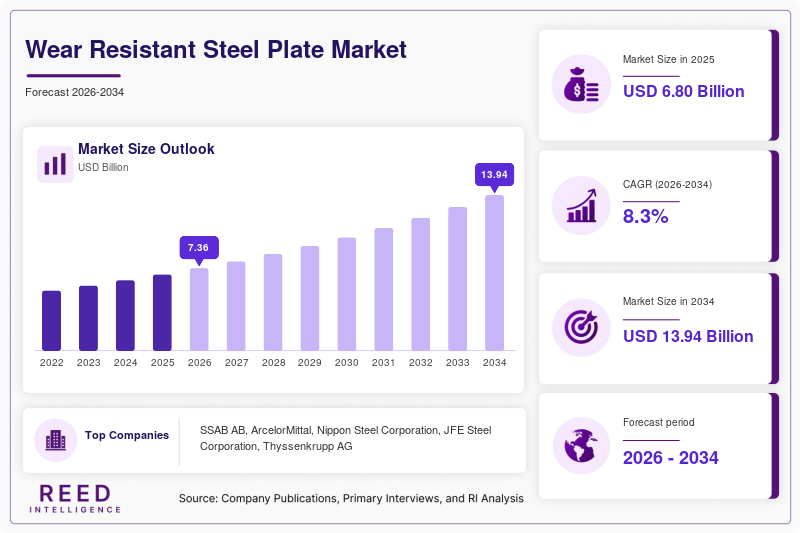
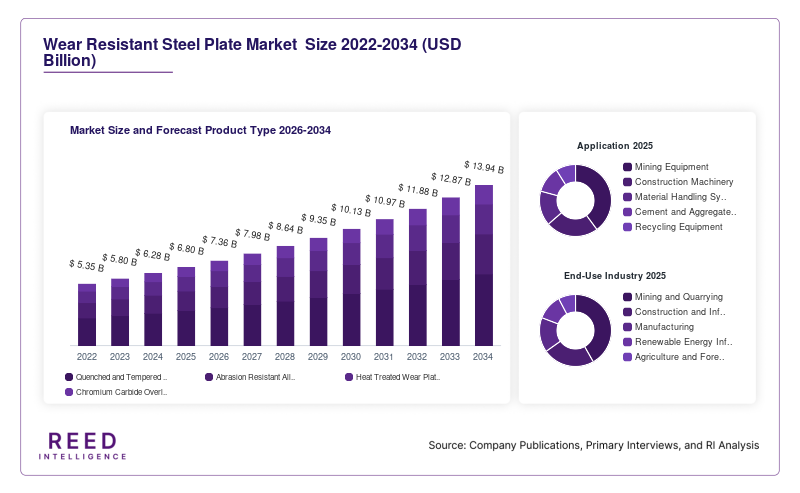
The global Wear Resistant Steel Plate Market size was valued at approximately USD 6.8 billion in 2026 and is projected to reach nearly USD 12.9 billion by 2034, expanding at a CAGR of 8.3% during the forecast period from 2026 to 2034. Wear resistant steel plates are widely used across mining, construction, heavy machinery, cement manufacturing, transportation, and material handling industries due to their ability to withstand abrasion, impact, and harsh operating conditions. These steel plates improve operational efficiency by reducing downtime, extending equipment life, and minimizing maintenance costs in industrial applications.
A major global factor supporting market growth is the continued expansion of infrastructure and mining activities across emerging economies. Governments and private investors are increasing investments in transportation projects, industrial facilities, and energy infrastructure, creating strong demand for durable steel materials. The rising adoption of automated heavy equipment and high-capacity industrial machinery has further accelerated the need for wear resistant steel plates in excavators, crushers, dump trucks, and conveyor systems. Manufacturers are also investing in advanced alloy technologies and heat treatment processes to improve hardness, weldability, and corrosion resistance, making these plates suitable for diverse industrial environments.
Key Highlights
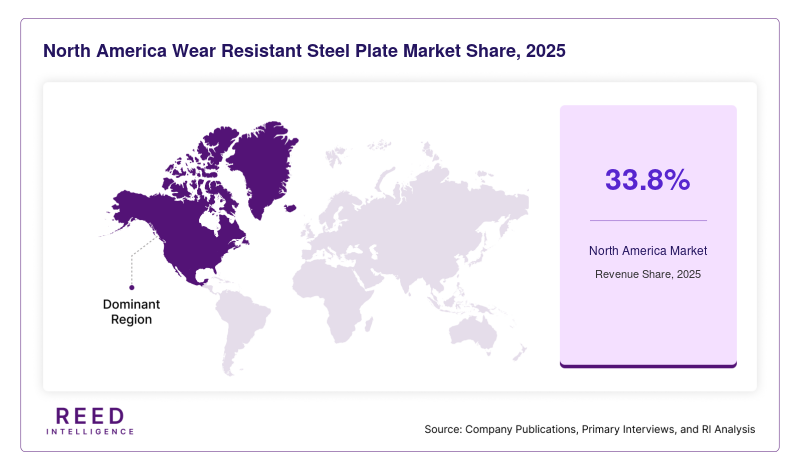
- North America dominated the market with a 33.8% share in 2025.
- Asia Pacific is expected to grow at the fastest CAGR of 10.9% during 2026–2034.
- By product type, quenched and tempered steel plates accounted for the largest share of 46.4%.
- while abrasion resistant alloy steel plates are projected to grow at a CAGR of 11.6%.
- By application, mining equipment led with a 39.7% share.
- whereas construction machinery is expected to expand at a CAGR of 10.8%.
- By end-use industry, mining and quarrying held the dominant share of 35.2%.
- while renewable energy infrastructure is projected to grow at a CAGR of 11.1%.
- The United States remained the dominant country, with market values of USD 1.42 billion in 2024 and USD 1.55 billion in 2025.
Market Trends
Growing Integration of Advanced Metallurgical Technologies
Manufacturers in the Wear Resistant Steel Plate Market are increasingly adopting advanced metallurgical technologies to improve plate durability, hardness consistency, and operational efficiency. Companies are focusing on optimized alloy compositions, thermo-mechanical rolling, and advanced heat treatment processes to produce steel plates capable of handling severe abrasion and impact conditions. Industries such as mining, earthmoving, and cement manufacturing are demanding high-strength plates that offer improved weldability and lower maintenance requirements. As a result, steel producers are developing products with balanced toughness and hardness properties suitable for both high-impact and high-friction applications. The integration of digital monitoring systems and automated quality inspection methods in steel production facilities has also enhanced production precision and reduced manufacturing defects.
The shift toward customized steel solutions is another important trend influencing the market. Industrial equipment manufacturers are requesting wear resistant plates tailored to specific operational conditions, including temperature resistance, corrosion protection, and extended lifecycle performance. This trend has encouraged partnerships between steel producers and equipment manufacturers to develop application-specific solutions. The growing use of simulation software for predicting wear behavior and material performance is also supporting product innovation. These developments are expected to improve operational productivity across heavy industries while strengthening the long-term demand outlook for wear resistant steel plates.
Rising Demand from Sustainable Infrastructure and Heavy Equipment Projects
The increasing focus on sustainable infrastructure development and efficient heavy equipment operations is shaping demand patterns within the Wear Resistant Steel Plate Market. Governments in developing and developed economies are investing heavily in transportation systems, urban infrastructure, renewable energy projects, and industrial modernization programs. These projects require durable construction and material handling equipment capable of operating under demanding conditions for extended periods. Wear resistant steel plates help reduce equipment replacement frequency and maintenance waste, supporting sustainability objectives across industrial sectors.
Construction and mining equipment manufacturers are also emphasizing fuel efficiency and operational productivity. Lightweight yet durable wear resistant plates allow equipment manufacturers to reduce structural weight while maintaining strength and abrasion resistance. This trend is particularly visible in dump trucks, loaders, crushers, and agricultural machinery. In addition, recycling industries are increasing their adoption of wear resistant materials in shredders, crushers, and sorting equipment due to growing global recycling activities. The combination of sustainability goals, industrial automation, and infrastructure expansion is expected to continue driving long-term market growth and product innovation.
Market Drivers
Expansion of Mining and Material Handling Industries
The rapid expansion of mining operations and bulk material handling activities worldwide is a primary growth driver for the Wear Resistant Steel Plate Market. Mining companies are increasing investments in advanced excavation machinery, crushers, conveyor systems, and heavy-duty trucks to improve operational efficiency and production capacity. These machines operate under severe abrasive environments where conventional steel materials wear out quickly. Wear resistant steel plates provide superior durability, reduce maintenance frequency, and extend equipment life, making them essential in mining and quarrying operations.
The growth of mineral extraction activities across Asia Pacific, Latin America, and Africa has significantly increased demand for durable steel components. Rising consumption of iron ore, copper, lithium, coal, and rare earth minerals for industrial manufacturing and renewable energy projects has further supported market expansion. In addition, the increasing automation of mining operations requires highly reliable equipment capable of continuous operation. This has encouraged equipment manufacturers to integrate advanced wear resistant materials into high-stress machine components. As industrial extraction activities continue to grow, demand for abrasion resistant steel solutions is expected to remain strong.
Increasing Infrastructure and Construction Equipment Investments
Global investments in infrastructure modernization and urban development are contributing significantly to the growth of the Wear Resistant Steel Plate Market. Governments are prioritizing road networks, railway systems, airports, ports, and smart city projects to support economic development and urban population growth. Construction machinery used in these projects faces continuous exposure to abrasion, heavy impact, and harsh operating conditions. Wear resistant steel plates are widely utilized in excavator buckets, bulldozers, dump bodies, and concrete processing equipment to improve equipment reliability and reduce operational downtime.
The construction sector is also adopting larger and more efficient machinery to complete projects within shorter timelines. This trend has increased the requirement for stronger and longer-lasting steel materials capable of handling intensive workloads. Equipment rental companies are particularly focused on minimizing maintenance costs and extending machinery service life, creating additional demand for wear resistant steel plates. Furthermore, industrialization in emerging economies and expansion of logistics infrastructure have accelerated the deployment of material handling systems, contributing to steady market growth throughout the forecast period.
Market Restraint
Volatility in Raw Material Prices and Production Costs
Fluctuations in raw material prices remain a major challenge for the Wear Resistant Steel Plate Market. The production of wear resistant steel plates relies heavily on alloying elements such as chromium, nickel, molybdenum, and manganese, along with high-quality iron ore and coking coal. Changes in global commodity prices, supply chain disruptions, geopolitical tensions, and energy cost fluctuations directly impact steel manufacturing expenses. As production costs rise, manufacturers often face difficulties maintaining competitive pricing while preserving profitability.
This challenge is particularly significant for small and medium-sized steel producers that operate with limited procurement flexibility and lower economies of scale. High production costs may also discourage adoption among cost-sensitive industries, especially in developing economies where lower-grade materials are still commonly used. In addition, environmental regulations related to carbon emissions and energy-intensive steel manufacturing processes have increased compliance expenses for producers. Some end users delay equipment replacement or opt for alternative materials during periods of economic uncertainty, affecting short-term market demand. These pricing and cost-related pressures may limit market expansion in regions with unstable industrial investment patterns.
Market Opportunities
Growing Adoption in Renewable Energy and Recycling Industries
The increasing deployment of renewable energy infrastructure and recycling systems presents substantial opportunities for the Wear Resistant Steel Plate Market. Wind energy facilities, biomass plants, and waste-to-energy projects rely on heavy-duty equipment exposed to abrasive materials and continuous operational stress. Wear resistant steel plates are being incorporated into conveyor systems, shredders, crushers, and material processing equipment to improve reliability and reduce maintenance requirements. As governments accelerate investments in sustainable energy projects, demand for durable industrial components is expected to increase steadily.
Recycling industries are also expanding rapidly due to stricter waste management regulations and rising environmental awareness. Recycling equipment processes large volumes of metal, plastic, glass, and industrial waste materials under severe operating conditions. Wear resistant steel plates help improve equipment lifespan and operational efficiency in these facilities. Manufacturers are responding by introducing specialized steel grades designed for recycling and renewable energy applications. This diversification of end-use industries is creating new revenue opportunities for steel producers and expanding the market beyond traditional mining and construction sectors.
Rising Industrialization Across Emerging Economies
Rapid industrialization across emerging economies offers considerable growth opportunities for companies operating in the Wear Resistant Steel Plate Market. Countries in Asia Pacific, the Middle East, Africa, and Latin America are expanding industrial production capabilities, infrastructure projects, mining activities, and manufacturing facilities. Governments are supporting economic diversification through investments in industrial parks, transportation systems, and energy infrastructure, creating sustained demand for heavy equipment and industrial machinery.
Many developing economies are also modernizing outdated industrial systems and adopting automated machinery to improve productivity and reduce operational inefficiencies. This transition is increasing the requirement for advanced wear resistant materials capable of supporting long operating cycles under demanding conditions. Local steel manufacturers are collaborating with international technology providers to improve production quality and meet rising industrial standards. In addition, increasing foreign direct investment in mining and construction sectors is supporting long-term market expansion. These factors collectively position emerging economies as important growth centers for wear resistant steel plate manufacturers during the forecast period.
Segmental Analysis
By Product Type
Quenched and tempered steel plates represented the dominant subsegment in the Wear Resistant Steel Plate Market, accounting for approximately 46.4% of the global share in 2024. These steel plates are widely preferred due to their balanced combination of hardness, toughness, and weldability, making them suitable for demanding industrial environments. Mining, construction, and material handling industries extensively use quenched and tempered plates in dump trucks, crushers, excavators, and conveyor systems. Their ability to withstand continuous abrasion and heavy impact significantly improves equipment lifespan and operational productivity. Manufacturers are increasingly focusing on enhancing heat treatment technologies to improve structural integrity and performance consistency.
The strong demand for quenched and tempered plates is also supported by their versatility across multiple industrial sectors. Heavy machinery manufacturers prefer these materials because they provide improved mechanical performance while reducing maintenance requirements. Industrial operators seeking lower equipment downtime and reduced lifecycle costs continue to adopt these steel plates in high-stress operating conditions. In addition, advancements in metallurgical processes have enabled producers to develop customized grades with enhanced corrosion resistance and higher tensile strength. These factors continue to reinforce the leadership position of quenched and tempered steel plates within the global market.
By Application
Mining equipment accounted for the largest share of the Wear Resistant Steel Plate Market in 2024, contributing nearly 39.7% of total revenue. Mining operations expose machinery to severe abrasion, impact, and corrosive conditions, making wear resistant steel plates essential for maintaining operational efficiency. Equipment such as excavators, loaders, crushers, conveyor systems, and haul trucks require durable steel components capable of handling continuous heavy-duty workloads. The growing global demand for minerals, metals, and rare earth resources has accelerated mining activities, further increasing the need for abrasion resistant materials.
The segment’s leadership position is also supported by rising investments in automated and high-capacity mining equipment. Mining companies are prioritizing productivity improvements and cost reduction strategies, leading to greater adoption of durable steel solutions that extend equipment lifespan and minimize maintenance downtime. Advanced wear resistant steel plates also improve equipment safety and operational reliability under challenging mining environments. Additionally, increased exploration activities and expansion of open-pit mining operations across Asia Pacific, Latin America, and Africa are expected to sustain strong demand for wear resistant steel materials in mining applications.
By End-Use Industry
Mining and quarrying emerged as the dominant end-use industry in the Wear Resistant Steel Plate Market, accounting for approximately 35.2% of global revenue in 2024. The industry relies heavily on heavy-duty machinery and material handling systems that operate in highly abrasive environments. Wear resistant steel plates are widely used in excavator buckets, crushers, liners, chutes, and dump truck bodies to improve operational efficiency and equipment durability. As global demand for minerals and raw materials continues to rise, mining companies are expanding production capacities and upgrading equipment fleets, creating sustained demand for advanced wear resistant materials.
The increasing adoption of automation and digital monitoring systems in mining operations has also contributed to segment growth. Mining companies are prioritizing equipment reliability and operational continuity to reduce downtime and improve profitability. Wear resistant steel plates support these objectives by extending maintenance intervals and enhancing machinery lifespan. In addition, the growing focus on sustainable mining practices has encouraged the use of durable materials that minimize waste generated through frequent equipment replacement. These industry trends continue to strengthen the market position of mining and quarrying applications.
Regional Analysis
North America
North America accounted for approximately 33.8% of the global Wear Resistant Steel Plate Market in 2025 and is expected to maintain a stable growth trajectory during the forecast period. The region is projected to register a CAGR of 7.6% from 2026 to 2034 due to consistent investments in mining operations, infrastructure maintenance, and advanced industrial equipment. Demand for high-performance steel plates remains strong across the United States and Canada, particularly in sectors such as construction, transportation, cement manufacturing, and material handling. The presence of established steel manufacturers and advanced production technologies further supports market expansion.
The United States remains the dominant country within the North American market due to extensive mining activities, industrial modernization programs, and infrastructure investments. A unique growth factor in the country is the increasing replacement of aging construction and material handling equipment across manufacturing and logistics sectors. Equipment operators are prioritizing durable components that reduce operational downtime and maintenance costs. In addition, the expansion of renewable energy projects and industrial recycling facilities is creating new application opportunities for wear resistant steel plates throughout the country.
Europe
Europe represented nearly 24.5% of the global Wear Resistant Steel Plate Market in 2025 and is anticipated to grow at a CAGR of 7.1% during the forecast period. The region benefits from strong industrial manufacturing capabilities, advanced engineering sectors, and a well-established mining equipment industry. Demand for wear resistant steel plates is increasing across Germany, France, Italy, and Nordic countries due to the growing emphasis on operational efficiency and equipment durability. European manufacturers are also focusing on low-carbon steel production technologies to align with regional sustainability regulations.
Germany dominates the European market due to its large industrial machinery sector and advanced steel manufacturing infrastructure. A major growth factor in the country is the rising adoption of automated manufacturing systems and high-capacity industrial machinery. German equipment manufacturers prioritize precision-engineered materials with improved wear performance and lower lifecycle costs. In addition, increased investments in recycling technologies and renewable energy infrastructure are contributing to the growing use of abrasion resistant steel materials across industrial applications.
Asia Pacific
Asia Pacific held approximately 28.9% of the global Wear Resistant Steel Plate Market in 2025 and is projected to witness the fastest CAGR of 10.9% between 2026 and 2034. Rapid urbanization, industrialization, and infrastructure expansion are driving substantial demand for heavy equipment and durable steel components throughout the region. Countries such as China, India, Japan, South Korea, and Australia are investing heavily in mining operations, transportation systems, and construction projects. The growing manufacturing base and increasing industrial automation are further accelerating market growth.
China remains the dominant country in the Asia Pacific market due to its large-scale steel production capacity and extensive industrial activities. A unique growth factor in the country is the continued expansion of domestic mining and infrastructure projects supported by government-led economic development initiatives. Chinese equipment manufacturers are increasingly adopting high-strength wear resistant steel plates to improve machinery performance and export competitiveness. Additionally, rising investments in smart manufacturing and industrial modernization are supporting long-term demand for advanced steel materials across multiple sectors.
Middle East & Africa
The Middle East & Africa region accounted for nearly 7.4% of the global Wear Resistant Steel Plate Market in 2025 and is expected to register a CAGR of 8.1% during the forecast period. Growth in the region is supported by expanding mining activities, energy infrastructure projects, and construction sector development. Countries across the Gulf Cooperation Council and Africa are investing in transportation networks, industrial facilities, and large-scale infrastructure modernization programs. These projects require heavy machinery and material handling systems that depend on durable steel components capable of operating in abrasive and high-temperature environments.
Saudi Arabia remains the dominant country in the regional market due to ongoing industrial diversification and infrastructure expansion programs. A key growth factor in the country is the development of large-scale mining and industrial projects under national economic transformation initiatives. Investments in phosphate mining, logistics infrastructure, and manufacturing facilities are increasing the demand for wear resistant steel plates in heavy-duty industrial equipment. In addition, the harsh desert operating environment creates strong demand for abrasion resistant materials with enhanced durability and operational reliability.
Latin America
Latin America captured approximately 5.4% of the global Wear Resistant Steel Plate Market in 2025 and is forecast to grow at a CAGR of 7.8% from 2026 to 2034. The region’s market growth is largely influenced by expanding mining operations, agricultural machinery demand, and infrastructure development activities. Brazil, Chile, Peru, and Mexico continue to invest in mineral extraction projects and industrial modernization programs. Rising commodity exports and increasing demand for efficient material handling equipment are contributing to the adoption of wear resistant steel plates in regional industries.
Brazil dominates the Latin American market due to its large mining industry and expanding construction equipment sector. One unique growth factor in the country is the increasing mechanization of agricultural and mining operations to improve productivity and reduce labor dependency. Agricultural equipment manufacturers are integrating abrasion resistant steel components into harvesting and material processing systems to improve equipment longevity. Furthermore, government-supported infrastructure investments and logistics upgrades are expected to support additional demand for durable industrial steel materials across Brazil.
Competitive Landscape
The Wear Resistant Steel Plate Market is moderately consolidated, with global and regional manufacturers competing through product innovation, advanced metallurgy, strategic partnerships, and capacity expansion initiatives. Leading companies are focusing on improving plate hardness, toughness, weldability, and corrosion resistance to address the evolving requirements of mining, construction, recycling, and industrial manufacturing industries. Market participants are also investing in sustainable steel production technologies and digital manufacturing systems to improve operational efficiency and reduce environmental impact.
SSAB AB remains one of the leading companies in the market due to its extensive portfolio of abrasion resistant steel products and strong global distribution network. The company has focused on developing advanced high-strength steel grades suitable for mining and heavy machinery applications. ArcelorMittal, Nippon Steel Corporation, JFE Steel Corporation, and Thyssenkrupp AG also maintain significant market positions through continuous investments in research and development activities.
Recent industry developments include the expansion of production facilities, collaborations with heavy equipment manufacturers, and the introduction of customized wear resistant steel solutions for recycling and renewable energy industries. Several manufacturers are also adopting low-carbon steelmaking technologies to align with sustainability goals and strengthen their competitive positioning in global markets.
Key Players
- SSAB AB
- ArcelorMittal
- Nippon Steel Corporation
- JFE Steel Corporation
- Thyssenkrupp AG
- POSCO Holdings
- Baosteel Group
- Dillinger Group
- NLMK Group
- Tata Steel Limited
- Bisalloy Steel Group
- Voestalpine AG
- Essar Steel
- Hebei Iron and Steel Group
- Hyundai Steel Company
Recent Developments
- SSAB AB announced the expansion of its high-strength wear resistant steel production capacity in 2025 to meet rising demand from mining and construction equipment manufacturers.
- ArcelorMittal introduced a new abrasion resistant steel grade with enhanced hardness and weldability properties designed for recycling and heavy material handling applications in 2025.
- Nippon Steel Corporation partnered with industrial equipment manufacturers in 2024 to develop customized wear resistant steel solutions for automated mining systems and high-capacity conveyor equipment.
- JFE Steel Corporation invested in advanced heat treatment technologies in 2025 to improve the durability and consistency of wear resistant steel plates used in industrial machinery.
- Thyssenkrupp AG expanded its sustainable steel manufacturing initiatives in 2024 with a focus on reducing carbon emissions in wear resistant steel production processes.
Wear Resistant Steel Plate Market Segments
Product Type
- Quenched and Tempered Steel Plates
- Abrasion Resistant Alloy Steel Plates
- Heat Treated Wear Plates
- Chromium Carbide Overlay Plates
Application
- Mining Equipment
- Construction Machinery
- Material Handling Systems
- Cement and Aggregate Processing
- Recycling Equipment
End-Use Industry
- Mining and Quarrying
- Construction and Infrastructure
- Manufacturing
- Renewable Energy Infrastructure
- Agriculture and Forestry
By Region
- North America
- Europe
- APAC
- Middle East and Africa
- LATAM