Global Wearable Inertial Sensors Market Size, Share & Trends Analysis Report By Sensor Type (Accelerometers, Gyroscopes, Magnetometers, Inertial Measurement Units (IMUs)), By Axis Configuration (3-Axis Sensors, 6-Axis Sensors (3 Accel + 3 Gyro), 9-Axis Sensors (Accel + Gyro + Magneto)), By Country (North America, Europe, APAC, Middle East and Africa, Latin America) and Forecast, 2026-2034
USD 3950
Wearable Inertial Sensors Market Size
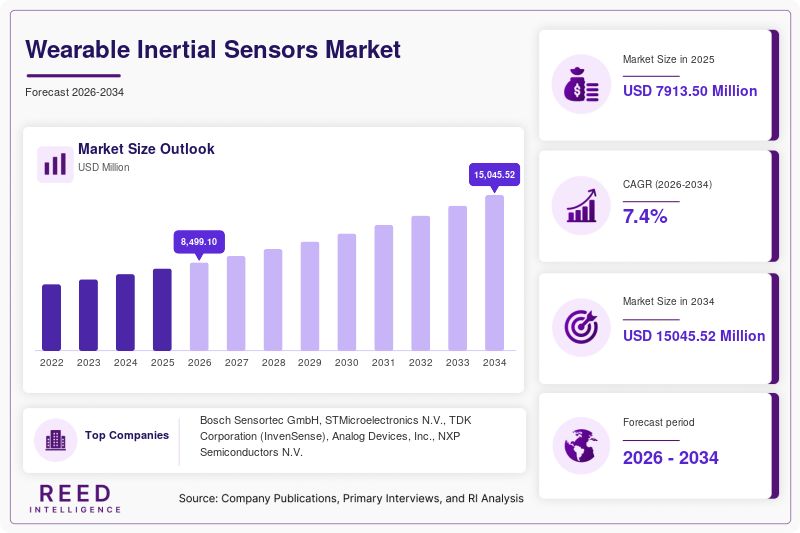
Global Wearable Inertial Sensors Market size is projected at USD 8,499.10 million in 2026 and is expected to hit USD 15,001.00 million by 2034 with a CAGR of 7.4%. The industry expands from USD 7,916.72 million in the 2025 base year, adding approximately USD 6,501.90 million during 2026–2034. Market assessment requires detailed sensor-type, axis, connectivity, application, form-factor and end-use segmentation alongside evaluation of MEMS suppliers, embedded intelligence and competitive positioning.
Key Takeaways
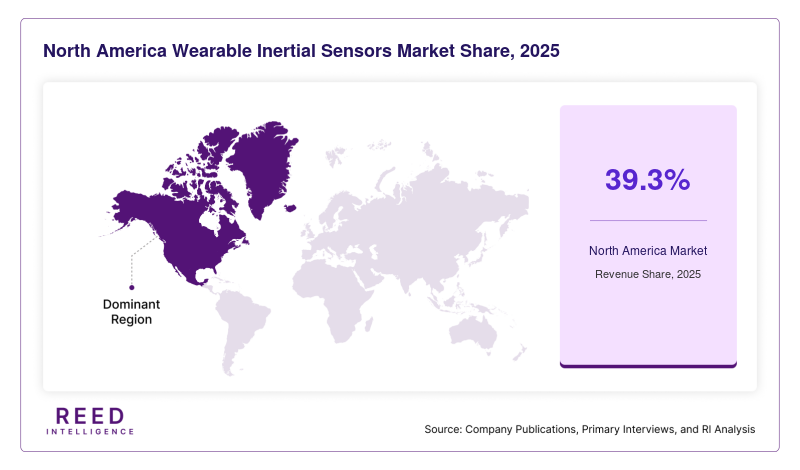
- North America dominates geographically with USD 3,340.16 million in 2026, equivalent to approximately 39.3% of the global regional total, while Asia Pacific is the fastest-growing major region at 7.70% CAGR.
- Accelerometers lead sensor types at USD 2,387.14 million in 2026, representing approximately 28.1% of the sensor-type total, and reach USD 4,317.99 million by 2034 at 7.69% CAGR.
- Integrated 3- or 6-axis units record the fastest sensor-type CAGR at 7.81%, rising from USD 707.56 million in 2026 to USD 1,291.32 million by 2034.
- Europe advances from USD 1,809.97 million in 2026 to USD 3,273.96 million by 2034 at 7.69% CAGR, while Middle East and Africa reaches USD 1,609.40 million at 7.47%.
- Asia Pacific increases from USD 1,668.60 million in 2026 to USD 3,020.49 million by 2034 at 7.70%, supporting expansion in China, Japan, South Korea and India.
Wearable inertial sensors comprise accelerometers, gyroscopes, magnetometers, IMUs and complementary pressure, force, temperature and biosensing components integrated into body-worn electronics for motion, orientation, activity and biomechanical measurement. The 2026 sensor-type total is USD 8,501.02 million, with accelerometers contributing about 28.1%, magnetometers 21.5%, gyroscopes 19.0% and IMUs 10.5%. Regionally, North America contributes approximately 39.3%, Europe 21.3% and Asia Pacific 19.6% of the supplied USD 8,499.10 million total. As a broader adoption indicator, worldwide wearable-device shipments reached 145.7 million units in Q1 2026, up 4.3% year over year, demonstrating the scale of the addressable device ecosystem.
Wearable Inertial Sensors Market Trends
Edge Intelligence and Ultra-Low-Power Sensor Fusion Reshape Wearable Motion Tracking
The transition from raw-motion sensing toward edge intelligence is accelerating. Worldwide wearable shipments totaled 145.7 million units in Q1 2026, with hearables representing roughly two-thirds of shipments; IDC forecasts 407.6 million hearable units during 2026, up 4.0%. These volumes increase requirements for miniature accelerometers and IMUs capable of continuous sensing without materially reducing battery life.
Sensor architectures increasingly combine 6-axis or 9-axis measurement, embedded machine learning and on-chip fusion. Bosch's BMI423 supports ±32 g acceleration and ±4,000 dps angular-rate ranges while consuming only 25 µA in always-on acceleration applications. TDK's 2026 ICM-456xx solutions execute tracking and detection algorithms on-chip, reducing dependence on host processors for smartwatches, AI glasses and hearables.
Wearable Inertial Sensors Market Drivers
Expanding Wearable Device Deployment Accelerates Motion-Sensing Integration
The principal driver is the expanding installed base of health, fitness, hearable, AR and occupational wearables. Q1 2026 worldwide wearable shipments reached 145.7 million units, increasing 4.3% year over year, while 2026 hearable shipments are forecast at 407.6 million units with 4.0% annual expansion. Manufacturers increasingly require 3-axis acceleration, 6-axis motion fusion and 9-axis orientation capability, while newer sensors combine ranges reaching ±32 g and ±4,000 dps with consumption as low as 25 µA.
Wearable Inertial Sensors Market Restraints
Wearable Saturation, Replacement Cycles and Power Constraints Limit Volume Expansion
Mature wearable categories face replacement-cycle and saturation pressure despite continued sensor innovation. India's smartwatch shipments, for example, declined 28.4% year over year to 6.6 million units in Q2 2025, while smartwatches represented 24.9% of the country's wearable shipments versus 31.5% a year earlier; advanced smartwatch shipments fell 39.5%. Such corrections reinforce requirements for lower-power sensors, longer usable device lives and differentiated health or AI functionality rather than reliance on unit-volume expansion alone.
Wearable Inertial Sensors Market Opportunities
Embedded AI Creates New Opportunities in Rehabilitation, AR and Intelligent Wearables
Embedded processing creates opportunities beyond conventional step counting. Research using an IMU with an embedded machine-learning core demonstrated 3 locomotion-mode classifications directly at sensor level, while another wearable prototype combining IMU, EMG and force sensing achieved 100 Hz operation, 8.7 ms median on-device latency and a 12.65% improvement in measured range of motion during technical feasibility testing. This shift supports higher-value rehabilitation, exoskeleton, athlete-analysis and industrial-safety systems.
Challenges in Global Wearable Inertial Sensors Market
Accuracy, Sensor Placement and Multi-Sensor Calibration Remain Engineering Barriers
Wearable motion systems must balance accuracy, battery life, calibration, placement and compact packaging. A 2025 research framework evaluated simulated IMU signals across 512 anatomical surface locations, illustrating the complexity of optimizing sensor placement for different activities. Meanwhile, emerging commercial solutions combine 6-axis IMUs with 3-axis magnetometers into 9-axis architectures, increasing orientation capability but also requiring fusion, calibration and interference management across 3 distinct sensing modalities.
Wearable Inertial Sensors Market Segmentation
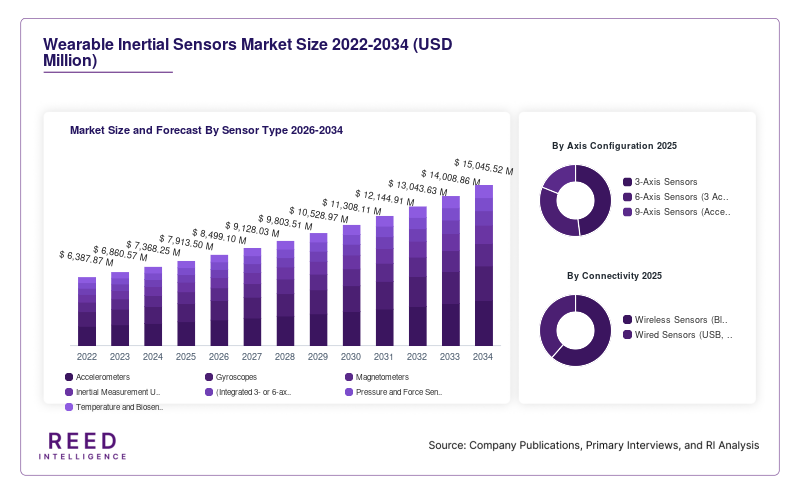
The industry is segmented by sensor type, axis configuration, connectivity, application, form factor and end-use sector. Among quantified sensor categories, accelerometers dominate with approximately 28.1% of the 2026 sensor-type total, followed by magnetometers at about 21.5% and gyroscopes at approximately 19.0%. Integrated 3- or 6-axis units post the highest supplied CAGR of 7.81%.
By Sensor Type
Accelerometers constitute the largest quantified category, increasing from USD 2,216.68 million in 2025 to USD 2,387.14 million in 2026 and USD 4,317.99 million in 2034 at 7.69% CAGR. Magnetometers advance from USD 1,829.54 million to USD 3,129.42 million, while gyroscopes rise from USD 1,616.16 million to USD 2,787.25 million between 2026 and 2034.
Integrated 3- or 6-axis units are the fastest-growing supplied sensor category at 7.81% CAGR, ahead of IMUs at 7.78%, pressure and force sensors at 7.56%, gyroscopes at 7.05%, temperature/biosensors at 6.99% and magnetometers at 6.94%. IMUs reach USD 1,633.03 million by 2034.
By Axis Configuration
The axis configuration structure includes 3-axis, 6-axis and 9-axis sensors. Commercial architectures increasingly move from basic 3-axis motion capture toward 6-axis accelerometer-plus-gyroscope combinations, while 9-axis designs add magnetometers for absolute orientation. TDK's PositionSense architecture, for example, combines a 6-axis IMU and 3-axis magnetometer in a 9-axis solution.
No axis-specific revenue or CAGR values were supplied in the mandatory tables; consequently, numerical market-size allocation is not inferred. Technology evidence nevertheless indicates expanding 6-axis and 9-axis integration as designers target navigation, AR/VR, smart glasses and higher-accuracy body-motion tracking.
By Connectivity
Connectivity divides the industry into wireless sensors using Bluetooth, Wi-Fi or ANT+ and wired sensors using USB or serial interfaces. Wireless architectures are central to body-worn applications requiring unrestricted movement, while wired interfaces retain relevance in development, clinical measurement and fixed monitoring environments.
No connectivity-specific market size or CAGR was provided in the mandatory dataset. The wider wearable ecosystem nevertheless recorded 145.7 million device shipments in Q1 2026, up 4.3%, demonstrating the large device base within which wireless motion sensing is deployed.
By Application
Applications include sports and fitness tracking, healthcare and rehabilitation, industrial safety, military training, AR/VR and gaming, and elderly fall detection. Motion sensors increasingly combine continuous activity measurement with embedded algorithms, enabling classification, gesture detection, fall detection and biomechanical analysis.
Application-specific revenue and CAGR figures were not supplied and therefore are not fabricated. Technical systems already demonstrate 100 Hz wearable sensing and 8.7 ms median edge-processing latency, while commercial IMUs provide ±32 g and ±4,000 dps ranges for dynamic movement.
By Form Factor
Wearable bands and watches, smart garments, footwear and insoles, headgear, and sensor patches or clip-ons constitute the principal form factors. Miniaturized MEMS packaging and always-on sensing allow inertial components to migrate from wrist-centric products toward hearables, smart glasses, shoes and distributed body nodes.
No form-factor revenue or CAGR figures were included in the mandatory tables. As an adoption benchmark, hearables account for roughly two-thirds of the 145.7 million wearable devices shipped globally in Q1 2026, highlighting the growing importance of non-watch form factors.
By End-Use Sector
Consumer electronics, healthcare, sports, military and industrial safety form the principal end-use sectors. Consumer products provide substantial unit scale, while healthcare and industrial deployments emphasize higher accuracy, continuous monitoring and dependable motion classification.
End-use-specific revenue and CAGR values were not supplied. The commercial opportunity is nevertheless supported by 145.7 million global wearable shipments in Q1 2026 and by sensor platforms designed for applications spanning smartwatches, fitness bands, AI glasses and TWS earbuds.
Wearable Inertial Sensors Market Regional Outlook
North America
North America leads the regional structure at USD 3,340.16 million in 2026, approximately 39.3% of the supplied global total, and is projected to reach USD 5,751.90 million by 2034 at 7.03% CAGR. The United States anchors regional wearable, healthcare, defense, AR/VR and consumer-electronics deployment, supported by substantial product development and semiconductor design activity.
Europe
Europe represents approximately 21.3% of the 2026 total with USD 1,809.97 million, rising from USD 1,680.72 million in 2025 to USD 3,273.96 million by 2034 at 7.69% CAGR. Germany, the United Kingdom, France and Nordic markets support demand across industrial safety, sports technology, rehabilitation and consumer wearables.
APAC
Asia Pacific accounts for approximately 19.6% in 2026 at USD 1,668.60 million and is the fastest-growing supplied major region at 7.70% CAGR, reaching USD 3,020.49 million in 2034. China, Japan, South Korea and India combine large electronics manufacturing ecosystems with expanding consumer, healthcare and fitness-device deployment.
Middle East and Africa
Middle East and Africa contributes approximately 10.6% of the 2026 total, with value increasing from USD 841.55 million in 2025 to USD 904.41 million in 2026 and USD 1,609.40 million by 2034 at 7.47% CAGR. Gulf economies support premium wearables, sports technologies and worker-safety applications, while broader African adoption remains more price sensitive.
Latin America
Latin America represents approximately 9.1% of the supplied 2026 total at USD 775.96 million, increasing to USD 1,345.25 million by 2034 at 7.12% CAGR. Brazil and Mexico constitute important addressable markets across fitness, consumer electronics, occupational monitoring and healthcare applications.
Top players in Global Wearable Inertial Sensors Market
- Bosch Sensortec GmbH
- STMicroelectronics N.V.
- TDK Corporation (InvenSense)
- Analog Devices, Inc.
- NXP Semiconductors N.V.
- Infineon Technologies AG
- Texas Instruments Incorporated
- Murata Manufacturing Co., Ltd.
- Honeywell International Inc.
- ROHM Co., Ltd.
- TE Connectivity Ltd.
- Sensata Technologies
- Kionix, Inc.
- CEVA, Inc.
- ams-OSRAM AG
Top Two Companies
-
Bosch Sensortec GmbH: A precise company percentage cannot be derived from the supplied dataset, which contains regional and sensor-category totals rather than vendor revenues. Bosch nevertheless maintains strong competitive positioning through wearable-optimized MEMS accelerometers and IMUs. Its BMI423 introduced at CES 2026 offers ±32 g acceleration, ±4,000 dps gyroscope measurement and 25 µA current consumption for always-on acceleration applications. These specifications position Bosch strongly in fitness devices, hearables, smart wearables and compact motion systems requiring high dynamic range and low power.
-
TDK Corporation (InvenSense): A defensible vendor percentage is likewise unavailable from the mandatory numerical tables and is therefore not estimated. TDK competes through SmartMotion IMUs, embedded sensor fusion and specialized solutions for AI glasses, earbuds, watches and fitness bands. In January 2026, TDK introduced 3 new IMU-based custom sensing solutions using its ICM-456xx family, emphasizing on-chip motion algorithms and reduced host-processor workloads. Its PositionSense platform additionally integrates 6-axis inertial sensing with a 3-axis TMR magnetometer to provide 9-axis orientation capability.
Recent Developments in Global Wearable Inertial Sensors Market
- 2026: Bosch Sensortec introduced the BMI423 IMU at CES 2026, delivering ±32 g acceleration, ±4,000 dps gyroscope capability and 25 µA consumption for always-on acceleration use cases.
- 2026: TDK launched 3 new SmartMotion custom IMU solutions based on the ICM-456xx family for TWS earbuds, AI glasses, AR eyewear, smartwatches and fitness bands.
- 2026: TDK expanded edge-intelligence functionality by enabling motion-tracking and detection algorithms to execute directly on IMUs, reducing computation requirements at the SoC or MCU level.
- 2025: TDK introduced PositionSense, a 2-chip 9-axis solution combining a 6-axis IMU with a 3-axis TMR magnetometer, on-chip sensor fusion and pedestrian dead-reckoning support.
- 2025: TDK expanded its SmartMotion portfolio for smart glasses and other consumer technologies, strengthening emphasis on ultra-low-power orientation sensing and embedded processing across compact wearable platforms.
Wearable Inertial Sensors Market Segments
By Sensor Type
- Accelerometers
- Gyroscopes
- Magnetometers
- Inertial Measurement Units (IMUs)
- (Integrated 3- or 6-axis units)
- Pressure and Force Sensors
- Temperature and Biosensors (when integrated into motion sensors)
By Axis Configuration
- 3-Axis Sensors
- 6-Axis Sensors (3 Accel + 3 Gyro)
- 9-Axis Sensors (Accel + Gyro + Magneto)
By Connectivity
- Wireless Sensors (Bluetooth, Wi-Fi, ANT+)
- Wired Sensors (USB, serial interfaces)
By Application
- Sports and Fitness Tracking
- Healthcare and Rehabilitation Monitoring
- Industrial and Worker Safety Monitoring
- Military and Defense Training Systems
- AR/VR and Motion Gaming
- Elderly Monitoring and Fall Detection
By Form Factor
- Wearable Bands and Watches
- Smart Garments and E-textiles
- Footwear and Insoles
- Headgear and Helmets
- Sensor Patches and Clip-ons
By End-Use Sector
- Consumer Electronics
- Healthcare and Medical
- Sports and Athletics
- Military and Defense
- Industrial and Occupational Safety
By Region
- North America
- Europe
- APAC
- Middle East and Africa
- LATAM