Wearable Tremor Therapy Market Size, Share & Demand Report By Product Type (Wearable Neuromodulation Devices, Smart Adaptive Tremor-Control Wearables, Mechanical Stabilization Wearables), By Application (Parkinson’s Disease, Essential Tremor, Multiple Sclerosis Tremor, Others), By End-Use (Hospitals & Clinics, Homecare Settings, Rehabilitation Centers), By Distribution Channel (Online Retail, Hospitals & Specialty Stores, Medical Device Distributors), By Region & Segment Forecasts, 2025–2034
USD 3950
Market Overview
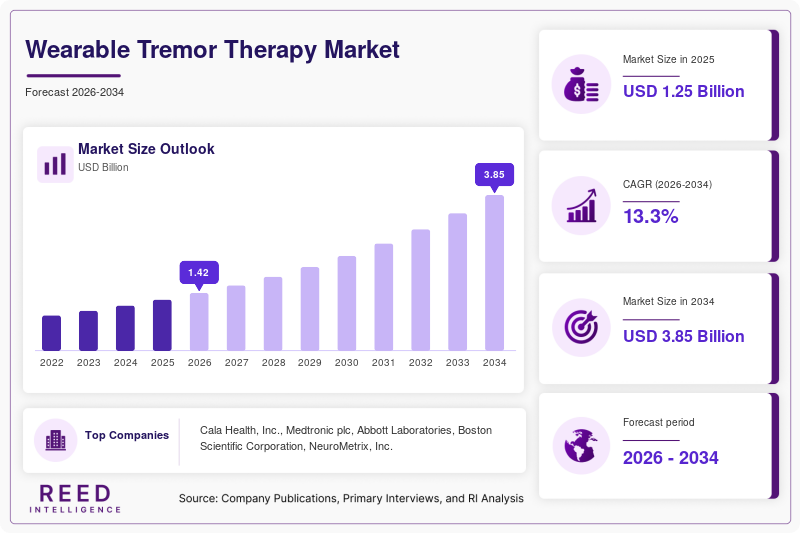
The global Wearable Tremor Therapy Market was valued at approximately USD 1.25 billion in 2025 and is projected to reach USD 3.85 billion by 2034, expanding at a CAGR of 13.3% during the forecast period (2025–2034). The market growth is driven by the increasing prevalence of neurological disorders such as essential tremor and Parkinson’s disease, coupled with rising demand for non-invasive, drug-free therapeutic solutions. Wearable tremor therapy devices, including wrist-worn and hand-held neuromodulation systems, are gaining traction as they provide targeted relief while improving patient mobility and quality of life.
A major global factor supporting market expansion is the growing aging population, which significantly increases the incidence of tremor-related disorders. Additionally, advancements in wearable technology, including miniaturization of sensors and integration with digital health platforms, are enhancing device effectiveness and patient adherence. Healthcare providers are increasingly recommending wearable solutions as adjunct or alternative therapies to pharmacological treatments.
Key Highlights:
- North America dominated the market with a 38.5% share in 2025, while Asia Pacific is projected to register the fastest CAGR of 15.1% through 2034.
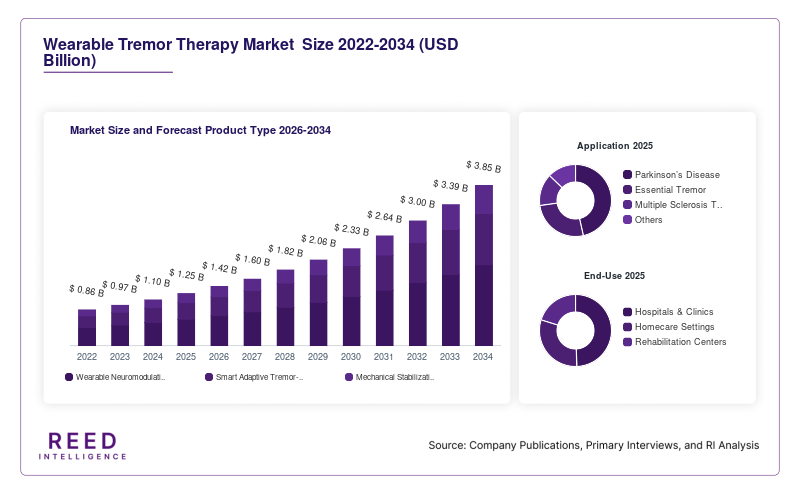
- By product type, wearable neuromodulation devices held the largest share, while smart adaptive tremor-control wearables are expected to grow at a CAGR of 16.2%.
- By application, Parkinson’s disease accounted for the largest share, while essential tremor therapy is expected to be the fastest-growing segment.
- The U.S. market was valued at USD 410 million in 2024 and reached approximately USD 445 million in 2025.
Market Trends
Integration of AI and Digital Health Platforms
The Wearable Tremor Therapy Market is witnessing increasing integration of artificial intelligence and connected health ecosystems. Modern devices are equipped with machine learning algorithms that analyze tremor patterns in real time and adjust therapy parameters accordingly. This trend enhances treatment precision and enables remote monitoring by healthcare professionals, reducing the need for frequent clinical visits. The convergence of wearable therapy with telehealth platforms is improving patient engagement and treatment outcomes.
Shift Toward Non-Invasive Neuromodulation Solutions
There is a growing preference for non-invasive therapeutic options over surgical interventions such as deep brain stimulation. Wearable neuromodulation devices offer targeted stimulation through peripheral nerves, minimizing risks and recovery time. This shift is particularly prominent among elderly patients and those seeking safer alternatives to medication. As clinical validation for these devices expands, their adoption is expected to accelerate across both developed and emerging markets.
Market Drivers
Rising Prevalence of Neurological Disorders
The increasing incidence of Parkinson’s disease and essential tremor globally is a major driver for the Wearable Tremor Therapy Market. Aging populations and lifestyle-related neurological conditions are contributing to a larger patient pool. As these disorders often require long-term management, wearable devices offer a convenient and continuous therapy option, driving demand across healthcare systems.
Technological Advancements in Wearable Devices
Rapid innovation in wearable technology is significantly boosting market growth. Improvements in sensor accuracy, battery life, and ergonomic design have enhanced device usability and effectiveness. Additionally, the integration of mobile applications and cloud-based analytics enables personalized therapy, which improves patient compliance and clinical outcomes. These advancements are making wearable tremor therapy devices more accessible and appealing to both patients and healthcare providers.
Market Restraint
High Cost of Advanced Wearable Devices
One of the primary challenges in the Wearable Tremor Therapy Market is the high cost associated with advanced devices. Many wearable tremor therapy solutions incorporate sophisticated technologies such as AI-driven algorithms, precision sensors, and wireless connectivity, which increase production costs. As a result, these devices are often priced beyond the reach of patients in low- and middle-income regions.
Limited reimbursement coverage further restricts adoption, particularly in developing healthcare systems. Patients may hesitate to invest in wearable therapy devices without clear insurance support or long-term cost benefits. Additionally, the lack of standardized pricing models and varying regulatory frameworks across regions contribute to market fragmentation.
This cost barrier not only limits accessibility but also slows down market penetration in emerging economies. While technological advancements continue to improve device performance, manufacturers face the challenge of balancing innovation with affordability. Addressing this restraint will be crucial for expanding the global reach of wearable tremor therapy solutions.
Market Opportunities
Expansion in Emerging Markets
Emerging economies present significant growth opportunities for the Wearable Tremor Therapy Market. Increasing healthcare awareness, improving infrastructure, and rising disposable incomes are driving demand for advanced therapeutic solutions. Governments in these regions are also investing in digital health initiatives, which can facilitate the adoption of wearable technologies. Market players can capitalize on this opportunity by offering cost-effective devices tailored to local needs.
Opportunity 2: Development of Personalized Therapy Solutions – The growing emphasis on personalized medicine is creating new avenues for wearable tremor therapy devices. By leveraging data analytics and patient-specific insights, manufacturers can develop customized treatment solutions that adapt to individual tremor patterns. This approach enhances therapeutic effectiveness and patient satisfaction. As healthcare shifts toward precision medicine, the demand for personalized wearable therapy solutions is expected to increase, providing a strong growth opportunity for industry participants.
Segmental Analysis
By Product Type
Wearable neuromodulation devices dominated the Wearable Tremor Therapy Market in 2024, accounting for approximately 54.3% of the total share. These devices gained widespread adoption due to their effectiveness in reducing tremor intensity through targeted nerve stimulation. Their non-invasive nature and ease of use made them a preferred choice among patients and healthcare providers.
Smart adaptive tremor-control wearables are projected to be the fastest-growing subsegment, expanding at a CAGR of 16.2% during the forecast period. These devices utilize advanced algorithms to adjust therapy in real time based on patient-specific tremor patterns. The ability to provide personalized treatment and improved outcomes will drive their adoption in the coming years.
By Application
Parkinson’s disease represented the largest application segment in 2024, holding a share of around 48.7%. The high prevalence of Parkinson’s disease and the need for continuous symptom management contributed to the dominance of this segment. Wearable devices offer an effective solution for managing tremors associated with this condition.
The essential tremor segment is expected to grow at the fastest CAGR of 14.9% through 2034. Increasing diagnosis rates and growing awareness of available treatment options are driving demand in this segment. Wearable therapy devices provide a convenient and non-invasive alternative for managing essential tremor symptoms.
By End-Use
Hospitals and clinics accounted for the largest share of approximately 46.5% in 2024. These settings serve as primary points of diagnosis and treatment for tremor-related disorders, leading to higher adoption of wearable therapy devices. Healthcare professionals often recommend these devices as part of comprehensive treatment plans.
Homecare settings are anticipated to witness the fastest growth, with a projected CAGR of 15.7%. The increasing preference for home-based treatment and remote monitoring solutions is driving this trend. Wearable devices enable patients to manage their condition independently, reducing the need for frequent hospital visits.
By Distribution Channel
Offline distribution channels dominated the market in 2024, capturing around 58.2% of the share. Traditional sales through hospitals, clinics, and specialty stores remained the primary mode of distribution due to the need for professional guidance during device selection.
Online distribution channels are expected to grow at the fastest CAGR of 17.1% during the forecast period. The expansion of e-commerce platforms and increasing digital literacy among consumers are driving this growth. Online channels offer convenience and access to a wider range of products, supporting their rapid adoption.
Regional Analysis
North America
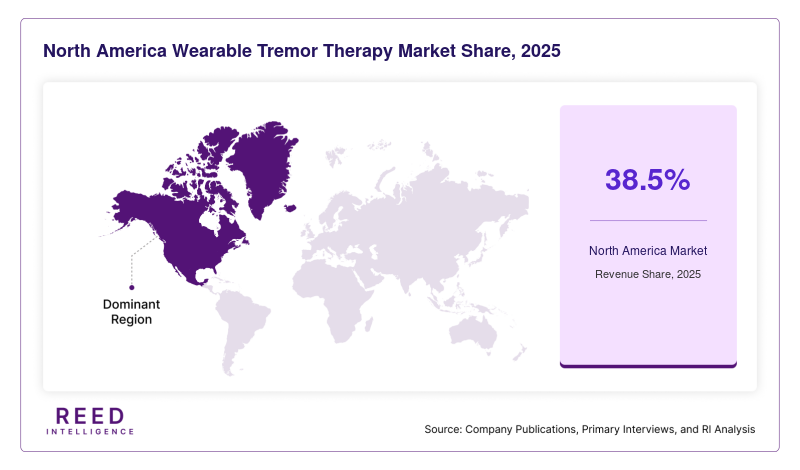
North America accounted for approximately 38.5% of the Wearable Tremor Therapy Market share in 2025 and will continue to maintain a significant position, expanding at a CAGR of 12.4% during the forecast period. The region benefited from strong healthcare infrastructure and high adoption of advanced medical technologies.
The United States dominated the regional market due to increasing awareness of tremor disorders and early adoption of innovative therapies. The presence of leading device manufacturers and ongoing clinical research initiatives has supported market expansion. Additionally, favorable reimbursement policies for certain wearable therapies have contributed to increased adoption among patients.
Europe
Europe held around 26.2% of the market share in 2025 and is expected to grow at a CAGR of 12.8% through 2034. The region demonstrated steady demand driven by rising geriatric populations and increasing focus on neurological healthcare.
Germany emerged as the leading country in the region, supported by a well-established healthcare system and strong emphasis on medical device innovation. Government initiatives promoting digital health adoption and increasing funding for neurological research have further strengthened the market outlook in Europe.
Asia Pacific
Asia Pacific captured approximately 20.1% of the market share in 2025 and is projected to grow at the fastest CAGR of 15.1% during the forecast period. The region experienced rapid growth due to increasing healthcare investments and rising awareness of wearable medical technologies.
China dominated the regional market, driven by its large patient population and expanding healthcare infrastructure. Government efforts to modernize healthcare systems and promote domestic manufacturing of medical devices have played a crucial role in accelerating market growth.
Middle East & Africa
The Middle East & Africa region accounted for about 8.4% of the market share in 2025 and is expected to grow at a CAGR of 11.2% through 2034. Growth in this region has been supported by improving healthcare access and increasing investments in medical technology.
The United Arab Emirates led the regional market due to its advanced healthcare facilities and focus on adopting innovative medical solutions. Government initiatives aimed at enhancing healthcare quality and promoting digital health technologies have contributed to market expansion.
Latin America
Latin America held approximately 6.8% of the market share in 2025 and is anticipated to grow at a CAGR of 11.7% during the forecast period. The region has shown gradual adoption of wearable tremor therapy devices, supported by improving economic conditions.
Brazil emerged as the dominant country in the region, driven by increasing healthcare expenditure and growing awareness of neurological disorders. Expansion of private healthcare services and rising demand for non-invasive therapies have further supported market growth in Latin America.
Competitive Landscape
The Wearable Tremor Therapy Market is characterized by a mix of established medical device companies and emerging technology firms. Key players are focusing on product innovation, strategic partnerships, and regulatory approvals to strengthen their market position.
Cala Health, Inc. is recognized as a leading player in the market, known for its advanced wearable neuromodulation devices. The company recently introduced an upgraded version of its therapy system with enhanced AI capabilities, improving treatment precision and patient outcomes.
Other prominent companies are investing in research and development to expand their product portfolios and address unmet clinical needs. Collaborations with healthcare providers and digital health platforms are also becoming a common strategy to enhance market reach and improve patient engagement.
Key Players
- Cala Health, Inc.
- Medtronic plc
- Abbott Laboratories
- Boston Scientific Corporation
- NeuroMetrix, Inc.
- Zynex, Inc.
- Nevro Corp.
- Bioventus LLC
- BioWave Corporation
- ElectroCore, Inc.
Recent Developments
- Cala Health launched an AI-enabled wearable therapy device with enhanced personalization features.
- Medtronic expanded its neuromodulation portfolio with new wearable-compatible solutions.
- Abbott Laboratories invested in digital health integration for remote patient monitoring.
- NeuroMetrix introduced a next-generation wearable device with improved battery efficiency.
- Omron Healthcare expanded its distribution network in Asia Pacific to strengthen market presence.
Wearable Tremor Therapy Market Segments
Product Type
- Wearable Neuromodulation Devices
- Smart Adaptive Tremor-Control Wearables
- Mechanical Stabilization Wearables
Application
- Parkinson’s Disease
- Essential Tremor
- Multiple Sclerosis Tremor
- Others
End-Use
- Hospitals & Clinics
- Homecare Settings
- Rehabilitation Centers
Distribution Channel
- Online Retail
- Hospitals & Specialty Stores
- Medical Device Distributors
By Region
- North America
- Europe
- APAC
- Middle East and Africa
- LATAM