Weather Simulation Chamber Market Size, Share & Demand Report By Chamber Type (Thermal Shock Chambers, Salt Spray Chambers, Altitude Test Chambers, Rain and Dust Simulation Chambers, UV Weathering Chambers), By Application (Pharmaceutical Stability Testing, Renewable Energy Equipment Testing, Industrial Materials Testing), By End-Use Industry (Automotive and Transportation, Aerospace and Defense, Electronics and Telecommunications, Pharmaceuticals and Biotechnology), By Region & Segment Forecast
USD 3950
Market Overview
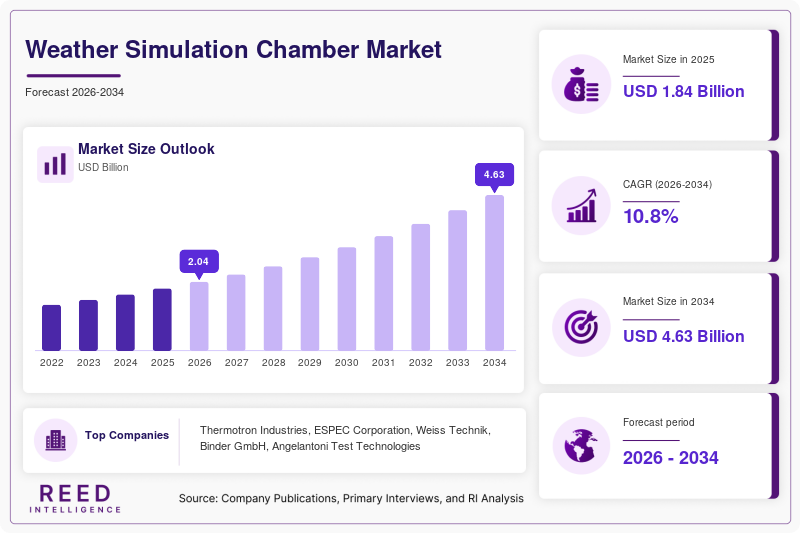
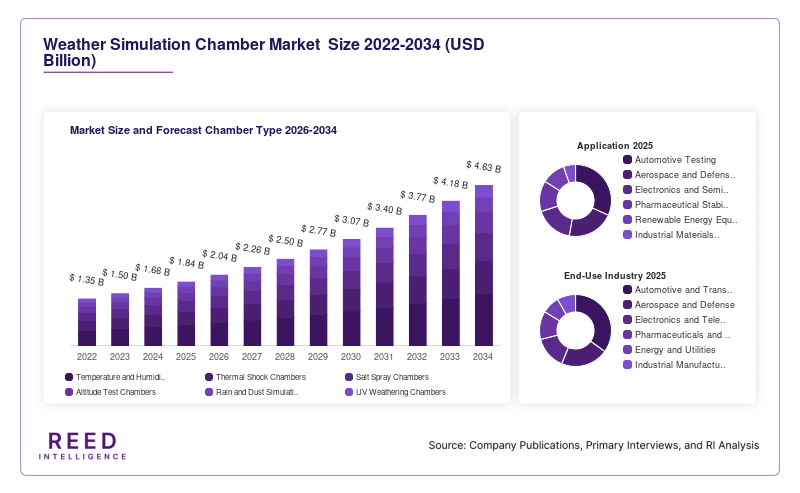
The global Weather Simulation Chamber Market size was valued at USD 1.84 billion in 2026 and is projected to reach USD 4.18 billion by 2034, expanding at a CAGR of 10.8% during the forecast period from 2026 to 2034. Weather simulation chambers are increasingly used across automotive, aerospace, electronics, pharmaceutical, and defense industries to evaluate product durability under controlled environmental conditions. These chambers replicate temperature fluctuations, humidity levels, salt spray exposure, rain simulation, UV radiation, thermal shock, and altitude conditions to ensure product quality, safety, and compliance with international testing standards. The rising demand for high-performance materials and reliable electronic systems has significantly increased the adoption of advanced environmental testing solutions worldwide.
The rapid expansion of electric vehicles and connected consumer electronics has emerged as a major factor supporting market growth. Manufacturers are under pressure to deliver products capable of operating efficiently under extreme environmental conditions. Weather simulation chambers help companies reduce field failures, improve reliability, and accelerate product development cycles. Increasing regulatory requirements for safety certification and environmental compliance are also encouraging industries to invest in automated and energy-efficient testing systems.
Key Highlights
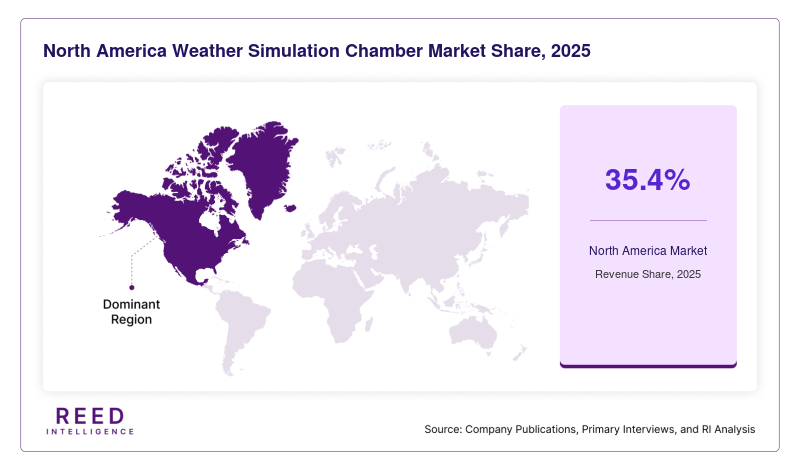
- North America dominated the market with a 35.4% share in 2025.
- Asia Pacific is expected to grow at the fastest CAGR of 11.9% during 2026–2034.
- By chamber type, temperature and humidity chambers accounted for the largest share of 39.1%.
- while thermal shock chambers are projected to grow at a CAGR of 12.6%.
- By application, automotive testing led with a 33.8% share.
- whereas electronics and semiconductor testing is expected to expand at a CAGR of 13.1%.
- By end-use industry, automotive and transportation held the dominant share of 31.4%.
- while renewable energy equipment testing is projected to register a CAGR of 12.8%.
- The United States remained the dominant country, with market values of USD 520 million in 2024 and USD 575 million in 2025.
Market Trends
Integration of Smart Monitoring and Automation Technologies
The Weather Simulation Chamber Market is experiencing a notable shift toward intelligent monitoring systems and automation-based testing environments. Manufacturers are increasingly integrating IoT sensors, cloud connectivity, remote diagnostics, and predictive maintenance software into weather simulation chambers to improve testing efficiency and reduce operational downtime. Smart chambers enable users to monitor real-time temperature, humidity, pressure, and airflow conditions through centralized dashboards, allowing accurate control over testing cycles. This trend is particularly important in industries such as aerospace, automotive, and electronics where testing precision directly influences product reliability and certification outcomes. Automated weather simulation systems also reduce labor dependency and support continuous testing operations, making them suitable for large-scale manufacturing facilities. The adoption of AI-enabled analytics is further improving failure prediction and performance assessment, helping companies accelerate product development timelines while maintaining compliance with international testing standards.
Rising Demand for Energy-Efficient and Compact Testing Systems
Growing focus on sustainability and energy optimization is encouraging manufacturers to develop compact and energy-efficient weather simulation chambers. Industries are seeking testing equipment that minimizes electricity consumption while maintaining consistent environmental conditions over extended testing periods. Modern chamber systems are being designed with advanced insulation materials, eco-friendly refrigerants, and variable-speed compressors to reduce operational costs and environmental impact. Compact chamber models are also gaining popularity among small and medium-sized enterprises due to space limitations in urban manufacturing facilities and research laboratories. Portable and modular weather simulation chambers are increasingly used for field testing applications in renewable energy, telecommunications, and defense sectors. The demand for sustainable testing infrastructure is expected to increase as governments and industrial organizations continue implementing stricter environmental regulations and carbon reduction initiatives across manufacturing operations.
Market Drivers
Expansion of Electric Vehicle and Battery Testing Activities
The rapid growth of the electric vehicle industry is a major driver supporting the Weather Simulation Chamber Market. Automotive manufacturers and battery producers require advanced environmental testing systems to validate the durability and safety of electric vehicle components under extreme weather conditions. Weather simulation chambers are extensively used to test lithium-ion batteries, charging systems, sensors, and electronic control units against heat, humidity, thermal shock, vibration, and freezing temperatures. As electric vehicle adoption increases globally, automakers are investing heavily in product quality assurance and reliability testing to reduce warranty failures and improve vehicle performance. Government incentives supporting electric mobility and stricter emission regulations are further increasing production volumes of electric vehicles, creating additional demand for advanced weather simulation chambers in automotive research and development facilities.
Increasing Product Reliability Requirements Across Electronics Industry
Consumer electronics and semiconductor manufacturers are placing stronger emphasis on reliability testing due to the growing complexity of electronic devices. Smartphones, wearable electronics, industrial sensors, telecommunications equipment, and semiconductor components must operate effectively across varying climatic conditions. Weather simulation chambers help manufacturers assess the impact of humidity, corrosion, rapid temperature changes, and altitude stress on electronic performance. The increasing deployment of 5G infrastructure, data centers, and industrial automation systems is further accelerating the need for environmental testing solutions. Companies are also adopting accelerated life testing methods to reduce product launch delays and improve quality control processes. The expansion of connected devices and smart technologies across industrial and consumer applications is expected to maintain strong demand for weather simulation chambers during the forecast period.
Market Restraint
High Initial Investment and Maintenance Costs Limiting Adoption
The high capital expenditure associated with advanced weather simulation chambers remains a significant restraint for market expansion, particularly among small and medium-sized enterprises. Large-scale chambers equipped with thermal shock systems, altitude simulation capabilities, and automated monitoring technologies require substantial upfront investment. In addition to equipment costs, companies must allocate resources for installation, calibration, energy consumption, and regular maintenance activities. Environmental testing chambers also require skilled technicians to manage operational parameters and ensure accurate testing outcomes. These factors increase the total cost of ownership, making adoption challenging for businesses with limited testing budgets. In developing economies, many smaller manufacturers continue relying on outsourced testing services instead of establishing in-house environmental testing facilities. The high operating cost of continuous temperature and humidity control systems can also affect profit margins for research laboratories and contract testing providers, slowing market penetration in cost-sensitive regions.
Market Opportunities
Growth Opportunities in Renewable Energy Equipment Testing
The rapid expansion of renewable energy infrastructure is creating substantial opportunities for the Weather Simulation Chamber Market. Solar panels, wind turbine components, energy storage systems, and hydrogen fuel technologies require extensive environmental testing to ensure long-term performance under harsh climatic conditions. Weather simulation chambers help manufacturers evaluate corrosion resistance, thermal endurance, moisture protection, and UV stability of renewable energy equipment. Governments worldwide are increasing investments in renewable power generation projects to support carbon reduction goals and energy transition strategies. This has encouraged manufacturers to enhance the durability and operational reliability of renewable energy systems. The growing installation of offshore wind farms and utility-scale solar projects is expected to increase demand for large-capacity weather simulation chambers capable of conducting complex environmental testing procedures.
Increasing Adoption in Pharmaceutical and Biotechnology Research
Pharmaceutical and biotechnology companies are increasingly using weather simulation chambers for stability testing, packaging validation, and environmental compliance studies. These chambers help evaluate the impact of temperature, humidity, and light exposure on drugs, vaccines, medical devices, and laboratory materials. The expansion of biologics manufacturing and vaccine development activities has significantly increased the need for controlled environmental testing systems. Regulatory agencies require pharmaceutical manufacturers to conduct stability testing under standardized climatic conditions before product commercialization. Growing investment in biotechnology research facilities and pharmaceutical production plants across Asia Pacific and North America is expected to create new revenue opportunities for chamber manufacturers. Advanced chambers equipped with digital monitoring systems and automated reporting features are gaining demand among pharmaceutical companies aiming to improve testing accuracy and regulatory compliance.
Segmental Analysis
By Chamber Type
Temperature and humidity chambers accounted for the largest share of the Weather Simulation Chamber Market in 2024, representing 39.1% of total revenue. These chambers are widely used across automotive, electronics, pharmaceuticals, and aerospace industries to evaluate product performance under varying climatic conditions. Their ability to simulate controlled temperature and humidity environments makes them essential for accelerated aging tests, stability analysis, and quality validation procedures. Manufacturers prefer temperature and humidity chambers because of their operational flexibility and compatibility with a broad range of testing applications. The increasing need for reliability testing of consumer electronics, electric vehicle components, and industrial sensors continues to support strong demand for these systems. Technological advancements such as programmable controls, touchscreen interfaces, and cloud-based monitoring platforms are further improving chamber efficiency and testing accuracy.
Thermal shock chambers are projected to witness the fastest growth during the forecast period, registering a CAGR of 12.6% from 2026 to 2034. These chambers are increasingly used to evaluate the resistance of materials and electronic components against sudden temperature changes. Industries such as aerospace, defense, automotive, and semiconductor manufacturing rely heavily on thermal shock testing to identify potential structural weaknesses and improve product durability. The rapid expansion of electric vehicle battery production and semiconductor fabrication facilities is significantly increasing demand for advanced thermal shock chambers. Manufacturers are developing energy-efficient systems with faster temperature transition capabilities and automated test cycle programming. Rising investments in high-performance electronics and mission-critical aerospace systems are expected to maintain strong growth momentum for thermal shock chambers across global markets.
By Application
Automotive testing held the dominant share of the Weather Simulation Chamber Market in 2024, accounting for 33.8% of overall revenue. Automotive manufacturers use environmental testing chambers to evaluate the durability and safety of engines, batteries, sensors, electronic control systems, and interior materials under different climatic conditions. The transition toward electric mobility and connected vehicle technologies has significantly increased the complexity of testing procedures within the automotive sector. Weather simulation chambers help companies validate product reliability under heat, humidity, freezing temperatures, and vibration stress. Increasing regulatory requirements related to vehicle safety and emission standards are encouraging automakers to invest in advanced environmental testing laboratories. Demand for comprehensive testing solutions is also rising due to the expansion of autonomous driving technologies and next-generation vehicle electronics.
Electronics and semiconductor testing is expected to emerge as the fastest-growing application segment, expanding at a CAGR of 13.1% during the forecast period. Semiconductor manufacturers and electronics companies require precise environmental testing systems to evaluate the reliability of chips, sensors, displays, and communication devices. The growing adoption of 5G technology, artificial intelligence systems, and industrial automation equipment has increased the need for advanced testing capabilities. Weather simulation chambers enable manufacturers to conduct accelerated stress testing and identify performance issues before commercial deployment. Increasing demand for compact consumer electronics and wearable devices is further contributing to segment growth. In addition, the global expansion of data centers and cloud computing infrastructure is encouraging semiconductor producers to strengthen quality assurance processes through advanced environmental simulation technologies.
By End-Use Industry
Automotive and transportation emerged as the dominant end-use industry in the Weather Simulation Chamber Market, capturing 31.4% of total revenue in 2024. Vehicle manufacturers, component suppliers, and transportation equipment producers rely on environmental testing chambers to ensure operational reliability and product durability. The increasing integration of advanced electronics, battery systems, and lightweight materials in modern vehicles has created a strong requirement for comprehensive weather simulation testing. Environmental chambers are used extensively for corrosion testing, thermal cycling, vibration analysis, and humidity exposure assessments. The rise in global vehicle production and growing adoption of electric commercial vehicles are further supporting market demand. Automotive companies are also establishing dedicated environmental testing facilities to reduce product development timelines and improve compliance with international safety standards.
Renewable energy equipment testing is anticipated to record the fastest CAGR of 12.8% during the forecast period due to expanding investments in sustainable energy infrastructure. Manufacturers of solar panels, wind turbine components, hydrogen systems, and energy storage technologies are increasingly using weather simulation chambers to validate equipment performance under harsh environmental conditions. These testing systems help assess resistance against moisture, UV exposure, temperature fluctuations, and salt corrosion. Government initiatives supporting clean energy adoption and carbon neutrality targets are encouraging large-scale deployment of renewable energy technologies worldwide. The growth of offshore wind projects and utility-scale solar installations is expected to create additional demand for large-capacity environmental simulation systems. Chamber manufacturers are responding by introducing customized testing solutions specifically designed for renewable energy applications.
Regional Analysis
North America
North America accounted for 35.4% of the global Weather Simulation Chamber Market in 2025 and maintained its leadership position due to strong investments in automotive testing, aerospace manufacturing, and advanced electronics production. The region is projected to expand at a CAGR of 9.8% during the forecast period. High demand for thermal shock chambers and environmental testing systems from defense contractors and electric vehicle manufacturers continues to support market expansion. Companies across the United States and Canada are investing in automated testing laboratories to improve product reliability and accelerate certification processes.
The United States remained the dominant country in North America due to the presence of established automotive manufacturers, aerospace companies, and semiconductor producers. A key growth factor supporting the market is the rapid expansion of electric vehicle battery testing infrastructure. Government support for domestic semiconductor manufacturing and renewable energy equipment production is also encouraging investment in environmental simulation technologies. Several testing laboratories are upgrading to AI-enabled chamber systems to improve operational efficiency and data accuracy.
Europe
Europe represented a significant share of the Weather Simulation Chamber Market in 2025 and is expected to grow at a CAGR of 9.5% through 2034. The region benefits from strict environmental and product safety regulations that require comprehensive testing across automotive, electronics, and industrial equipment sectors. Germany, France, Italy, and the United Kingdom are key contributors to regional market growth. Increasing investments in electric mobility, aerospace engineering, and industrial automation are supporting demand for advanced weather simulation chambers capable of meeting complex testing standards.
Germany emerged as the leading country within the European market due to its strong automotive manufacturing ecosystem and industrial engineering capabilities. One unique growth factor in the country is the increasing adoption of climate testing systems for autonomous driving technologies and advanced driver assistance systems. Automotive manufacturers are focusing on validating sensor performance under varying environmental conditions, including extreme heat, fog, snow, and humidity. This has created strong demand for customized environmental testing chambers across research and development centers.
Asia Pacific
Asia Pacific is projected to register the fastest CAGR of 11.9% during the forecast period, supported by expanding manufacturing industries and rising investments in electronics and semiconductor production. China, Japan, South Korea, and India are major markets driving regional demand. The increasing presence of consumer electronics manufacturers and electric vehicle production facilities has accelerated the adoption of weather simulation chambers across industrial testing applications. Government initiatives supporting domestic manufacturing and technology development are also contributing to market expansion in the region.
China dominated the Asia Pacific market due to its large-scale electronics manufacturing sector and growing electric vehicle production capacity. A major growth factor supporting the Chinese market is the expansion of battery testing laboratories and semiconductor fabrication facilities. Manufacturers are investing heavily in environmental simulation systems to improve product durability and meet international export quality standards. In addition, the rapid deployment of renewable energy infrastructure and smart manufacturing facilities is creating sustained demand for advanced environmental testing technologies.
Middle East & Africa
The Middle East & Africa Weather Simulation Chamber Market is expected to experience moderate growth during the forecast period, supported by increasing industrial diversification and infrastructure development activities. The region accounted for a smaller market share in 2025 but is projected to grow at a CAGR of 8.7% through 2034. Demand for environmental testing systems is rising across defense, construction materials, renewable energy, and oil and gas industries. Harsh climatic conditions in several countries have increased the need for product testing under high-temperature and sand exposure environments.
Saudi Arabia emerged as the dominant country in the Middle East & Africa market due to ongoing industrial modernization programs and investments in renewable energy projects. A unique growth factor driving market expansion is the increasing development of solar energy infrastructure across desert environments. Manufacturers require advanced weather simulation chambers to test photovoltaic panels and energy storage systems against extreme heat and dust conditions. The expansion of local manufacturing initiatives and industrial research facilities is also supporting demand for environmental testing equipment.
Latin America
Latin America is gradually expanding within the global Weather Simulation Chamber Market, supported by industrial development and increasing investment in automotive assembly and electronics manufacturing. The region is anticipated to grow at a CAGR of 8.9% during the forecast period. Brazil, Mexico, and Argentina are major contributors to regional demand for environmental testing systems. Companies are adopting weather simulation chambers to improve product quality and comply with export standards for international markets. Growth in telecommunications infrastructure and industrial automation is further supporting market development.
Brazil remained the leading market in Latin America due to its established automotive manufacturing sector and expanding industrial testing capabilities. One important growth factor in the country is the increasing need for durability testing of agricultural machinery and transportation equipment under tropical environmental conditions. Manufacturers are using weather simulation chambers to evaluate corrosion resistance, humidity tolerance, and thermal performance of heavy equipment used across agriculture and mining industries. Growing investment in industrial research centers is expected to support future market growth.
Competitive Landscape
The Weather Simulation Chamber Market is characterized by the presence of established environmental testing equipment manufacturers and specialized technology providers competing through innovation, product customization, and geographic expansion strategies. Leading companies are investing in automation technologies, energy-efficient chamber systems, and digital monitoring platforms to strengthen their competitive positions. Market participants are also focusing on strategic partnerships with automotive, aerospace, electronics, and pharmaceutical companies to expand their customer base.
Thermotron Industries is recognized as one of the leading companies in the market due to its extensive portfolio of environmental testing systems and strong presence across automotive and aerospace industries. The company recently introduced advanced AI-enabled monitoring solutions integrated with predictive maintenance features to improve chamber efficiency and reduce operational downtime. Weiss Technik, ESPEC Corporation, Binder GmbH, and Angelantoni Test Technologies are also focusing on expanding their global manufacturing capabilities and introducing compact chamber solutions for small and medium-sized enterprises.
Competitive intensity is increasing as regional manufacturers enter the market with cost-effective environmental testing systems. Companies are differentiating themselves through customized chamber configurations, faster temperature transition technologies, and sustainability-focused product designs. The growing demand for cloud-connected testing platforms and automated reporting solutions is expected to further influence competitive dynamics during the forecast period.
Key Players
- Thermotron Industries
- ESPEC Corporation
- Weiss Technik
- Binder GmbH
- Angelantoni Test Technologies
- CTS Climate Test Systems
- Russells Technical Products
- CM Envirosystems
- Envisys Technologies
- Hastest Solutions
- Cincinnati Sub-Zero Products
- Climats
- Sanwood Environmental Chambers
- Memmert GmbH
- Qualmark Corporation
Recent Developments
- ESPEC Corporation introduced a next-generation thermal shock chamber platform in 2025 featuring enhanced energy efficiency and cloud-based monitoring capabilities for semiconductor testing facilities.
- Weiss Technik expanded its manufacturing operations in Asia Pacific during 2024 to strengthen supply chain capabilities and meet increasing demand from electric vehicle battery manufacturers.
- Thermotron Industries launched an AI-assisted predictive maintenance solution in 2025 designed to improve operational reliability and reduce maintenance downtime for large environmental testing chambers.
- Binder GmbH announced the development of low-energy climate chambers with environmentally friendly refrigerants to support sustainability initiatives across industrial testing laboratories.
Weather Simulation Chamber Market Segments
Chamber Type
- Temperature and Humidity Chambers
- Thermal Shock Chambers
- Salt Spray Chambers
- Altitude Test Chambers
- Rain and Dust Simulation Chambers
- UV Weathering Chambers
Application
- Automotive Testing
- Aerospace and Defense Testing
- Electronics and Semiconductor Testing
- Pharmaceutical Stability Testing
- Renewable Energy Equipment Testing
- Industrial Materials Testing
End-Use Industry
- Automotive and Transportation
- Aerospace and Defense
- Electronics and Telecommunications
- Pharmaceuticals and Biotechnology
- Energy and Utilities
- Industrial Manufacturing
By Region
- North America
- Europe
- APAC
- Middle East and Africa
- LATAM