Wedge Pressure Catheter Market Size, Share Demand Report By Type (Balloon-Tipped Catheters, Multi-Lumen Catheters, Single-Lumen Catheters), By Material (Polyurethane, Silicone, Others), By Application (Cardiology, Critical Care Monitoring, Pulmonology), By End-Use (Hospitals, Specialty Clinics, Ambulatory Surgical Centers), By Region & Segment Forecasts, 2026–2034
USD 3950
Market Overview
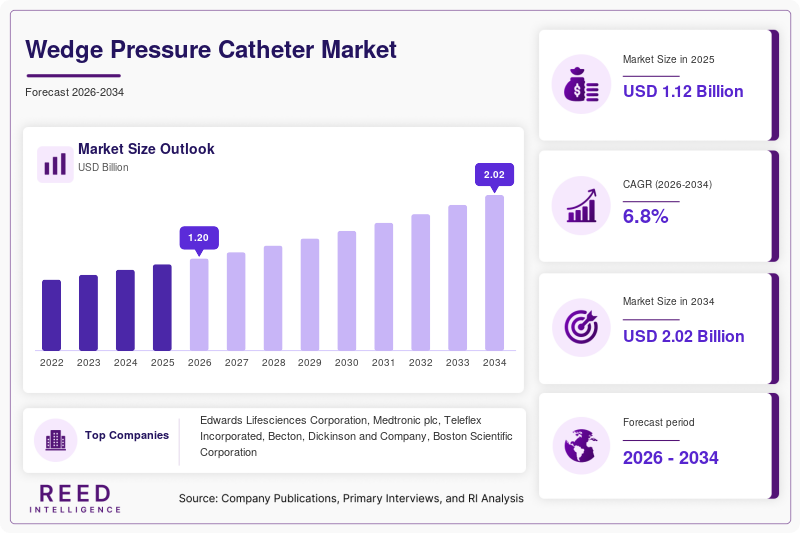
The Wedge Pressure Catheter Market size was valued at approximately USD 1.12 billion in 2026 and is projected to reach USD 1.89 billion by 2034, expanding at a CAGR of 6.8% during the forecast period (2026–2034). The market growth reflects increasing demand for advanced hemodynamic monitoring solutions, particularly in critical care and cardiology procedures.
One of the primary global factors supporting the expansion of the Wedge Pressure Catheter Market is the rising prevalence of cardiovascular diseases worldwide. The growing burden of conditions such as pulmonary hypertension, heart failure, and coronary artery diseases has significantly increased the need for accurate diagnostic and monitoring tools, including wedge pressure catheters. Additionally, advancements in catheter design, including enhanced flexibility, improved biocompatibility, and integration with digital monitoring systems, have further contributed to the adoption rate across hospitals and specialty clinics.
Key Highlights:
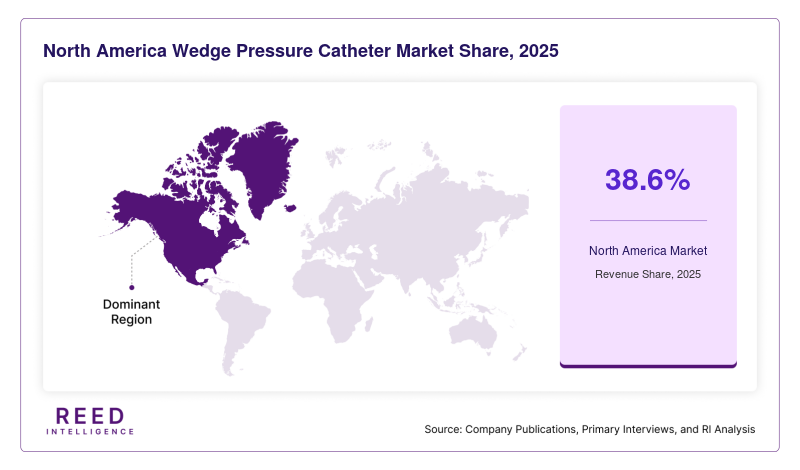
- North America dominated the market with 38.6% share, while Asia Pacific is expected to grow at a CAGR of 8.2%.
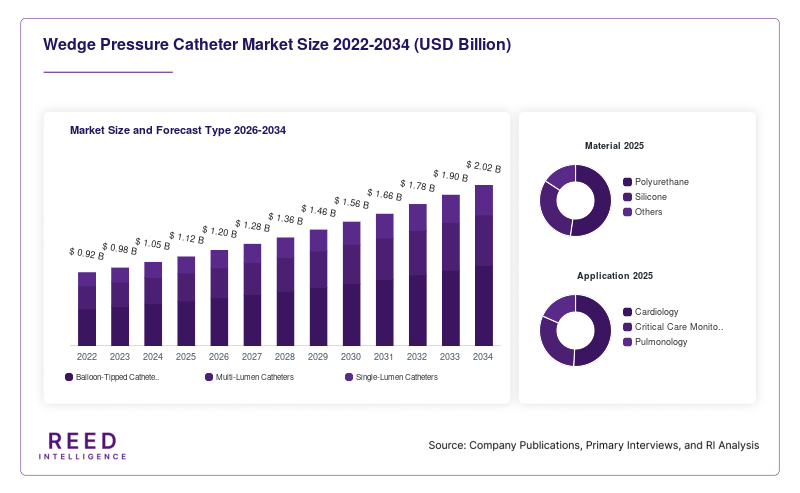
- By type, Balloon-Tipped Catheters led with 54.3% share, while Multi-Lumen Catheters are projected to grow fastest at 7.6% CAGR.
- By application, Cardiology held the largest share at 49.1%, whereas Critical Care Monitoring is anticipated to expand at 7.9% CAGR.
- The United States recorded market values of USD 0.34 billion in 2024 and USD 0.36 billion in 2025.
Market Trends
Integration of Smart Monitoring Technologies
The integration of smart technologies within the Wedge Pressure Catheter Market is transforming clinical workflows. Modern wedge pressure catheters are increasingly being paired with digital monitoring systems, allowing real-time data transmission and improved clinical decision-making. These systems enhance accuracy in measuring pulmonary capillary wedge pressure and reduce human error. Hospitals are adopting catheter systems that seamlessly integrate with electronic health records, enabling better patient tracking and long-term care management. The trend is particularly prominent in developed healthcare systems where digital infrastructure is well established.
Shift Toward Minimally Invasive Procedures
There is a notable shift toward minimally invasive procedures, which has significantly influenced the Wedge Pressure Catheter Market trends. Clinicians prefer catheter-based diagnostics due to reduced patient risk, shorter hospital stays, and quicker recovery times. This shift is driving innovation in catheter design, including smaller diameters and enhanced maneuverability. The increasing preference for outpatient procedures is also contributing to the growth of minimally invasive catheter technologies. As healthcare providers prioritize patient comfort and cost efficiency, this trend is expected to remain a key growth contributor over the forecast period.
Market Drivers
Rising Incidence of Cardiovascular Disorders
The increasing prevalence of cardiovascular diseases is a major driver of the Wedge Pressure Catheter Market. Conditions such as pulmonary artery hypertension and congestive heart failure require precise hemodynamic monitoring, which wedge pressure catheters provide. The aging global population further amplifies this demand, as elderly individuals are more prone to cardiac complications. Healthcare systems are therefore investing in advanced diagnostic tools to improve patient outcomes and reduce mortality rates.
Advancements in Catheter Technology
Technological advancements in catheter manufacturing have significantly boosted the Wedge Pressure Catheter Market growth. Innovations such as improved material durability, enhanced biocompatibility, and the development of multi-lumen catheters have expanded clinical applications. These advancements enable more accurate pressure measurements and reduce complications associated with catheter insertion. Additionally, manufacturers are focusing on user-friendly designs that simplify procedures for clinicians, thereby increasing adoption rates across healthcare settings.
Market Restraint
Risk of Complications and Invasive Nature
A key restraint in the Wedge Pressure Catheter Market is the potential risk associated with invasive procedures. Although wedge pressure catheters are essential diagnostic tools, their insertion carries risks such as infection, thrombosis, and pulmonary artery rupture. These complications can deter both patients and healthcare providers from opting for catheter-based monitoring, especially when non-invasive alternatives are available.
Additionally, the requirement for skilled professionals to perform catheterization procedures limits adoption in regions with inadequate healthcare infrastructure. Training and expertise are essential for accurate catheter placement and data interpretation, which increases operational costs for healthcare facilities. Regulatory requirements and stringent safety standards also pose challenges for manufacturers, potentially delaying product approvals and market entry.
Despite these limitations, ongoing advancements in catheter design and safety features are expected to mitigate risks over time, although the restraint remains a notable barrier to widespread adoption.
Market Opportunities
Expansion in Emerging Healthcare Markets
Emerging economies present significant growth opportunities for the Wedge Pressure Catheter Market. Rapid urbanization, increasing healthcare expenditure, and improving access to medical facilities are driving demand for advanced diagnostic tools. Countries in Asia Pacific and Latin America are investing heavily in healthcare infrastructure, creating a favorable environment for market expansion. Manufacturers are increasingly targeting these regions with cost-effective catheter solutions tailored to local needs.
Development of Hybrid Diagnostic Systems
The development of hybrid diagnostic systems combining wedge pressure catheters with imaging technologies offers new growth avenues. These integrated systems provide comprehensive insights into cardiovascular health, improving diagnostic accuracy and treatment planning. The adoption of such systems is expected to increase in advanced healthcare settings, where precision medicine is gaining traction. This opportunity aligns with the broader trend toward personalized healthcare, positioning the Wedge Pressure Catheter Market for sustained growth.
Segmental Analysis
By Type
Balloon-Tipped Catheters accounted for the largest share of 54.3% in 2025 within the Wedge Pressure Catheter Market. Their dominance was due to their ability to provide accurate pulmonary artery pressure measurements and ease of insertion during diagnostic procedures.
Multi-Lumen Catheters are expected to grow at the fastest CAGR of 7.6% during the forecast period. Their ability to perform multiple functions simultaneously, such as pressure monitoring and drug administration, will drive their adoption in advanced healthcare settings.
By Material
Polyurethane-based catheters held the dominant share of 46.8% in 2025 due to their flexibility and durability. These materials are widely preferred for their compatibility with various clinical applications.
Silicone-based catheters are projected to grow at a CAGR of 7.4% owing to their superior biocompatibility and reduced risk of adverse reactions. Increasing focus on patient safety will support their adoption.
By Application
Cardiology accounted for 49.1% of the market share in 2025, driven by the high prevalence of heart-related conditions requiring precise monitoring.
Critical Care Monitoring is expected to grow at a CAGR of 7.9%, supported by increasing ICU admissions and the need for continuous hemodynamic monitoring in critically ill patients.
By End-Use
Hospitals dominated the segment with 62.5% share in 2025, as they are primary centers for complex diagnostic procedures.
Specialty Clinics are anticipated to grow at a CAGR of 7.2%, driven by the rise of outpatient care and specialized treatment centers.
Regional Analysis
North America
North America accounted for 38.6% of the Wedge Pressure Catheter Market share in 2025 and is expected to grow at a CAGR of 6.5% during 2026–2034. The region’s dominance was attributed to advanced healthcare infrastructure and high adoption of minimally invasive diagnostic procedures.
The United States remained the dominant country due to strong investment in cardiovascular research and widespread availability of specialized healthcare facilities. The presence of leading medical device manufacturers and favorable reimbursement policies further supported market growth. Increasing awareness of early diagnosis and preventive care also contributed to sustained demand for wedge pressure catheters.
Europe
Europe held approximately 27.4% market share in 2025 and is projected to expand at a CAGR of 6.3% over the forecast period. The region benefited from well-established healthcare systems and increasing focus on patient safety and clinical efficiency.
Germany emerged as the leading country due to its robust healthcare infrastructure and emphasis on technological innovation. The country’s strong regulatory framework ensures high-quality medical devices, which supports the adoption of advanced catheter systems. Additionally, rising geriatric population levels have driven demand for cardiovascular diagnostics.
Asia Pacific
Asia Pacific captured around 20.8% share in 2025 and is anticipated to grow at the fastest CAGR of 8.2% during the forecast period. The region’s growth was driven by expanding healthcare access and rising prevalence of chronic diseases.
China dominated the regional market due to rapid healthcare infrastructure development and increasing government initiatives to improve medical services. The growing middle-class population and higher healthcare spending have also contributed to the adoption of advanced diagnostic tools, including wedge pressure catheters.
Middle East & Africa
The Middle East & Africa region accounted for 7.1% of the market share in 2025 and is expected to grow at a CAGR of 6.9%. The region showed steady growth due to increasing investments in healthcare infrastructure and medical tourism.
Saudi Arabia led the market owing to government initiatives aimed at modernizing healthcare systems. The country’s focus on specialized cardiac care facilities has driven the adoption of advanced diagnostic technologies. Rising awareness of cardiovascular health has further supported market expansion.
Latin America
Latin America held 6.1% market share in 2025 and is projected to grow at a CAGR of 7.1%. The region experienced growth due to improving healthcare systems and increased access to medical services.
Brazil dominated the market as a result of its expanding healthcare infrastructure and growing focus on cardiovascular disease management. Government initiatives to enhance public healthcare services have contributed to the adoption of advanced diagnostic tools, including wedge pressure catheters.
Competitive Landscape
The Wedge Pressure Catheter Market is moderately competitive, with key players focusing on innovation and strategic partnerships. Leading companies are investing in advanced catheter technologies to enhance product performance and expand their market presence.
Edwards Lifesciences Corporation is a prominent market leader, known for its strong portfolio of hemodynamic monitoring solutions. The company recently introduced an upgraded catheter system designed to improve accuracy and patient safety.
Other major players are focusing on expanding their product offerings and strengthening distribution networks. Continuous research and development efforts are shaping the competitive dynamics, with companies aiming to gain a technological edge.
Key Players List
- Edwards Lifesciences Corporation
- Medtronic plc
- Teleflex Incorporated
- Becton, Dickinson and Company
- Boston Scientific Corporation
- ICU Medical, Inc.
- Smiths Medical
- Terumo Corporation
- Cook Medical
- Merit Medical Systems
- Argon Medical Devices
- Vygon Group
- AngioDynamics, Inc.
- Nipro Corporation
- Cardinal Health
Recent Developments
- 2025: Edwards Lifesciences launched an advanced wedge pressure catheter with improved sensor accuracy.
- 2024: Medtronic expanded its catheter portfolio with enhanced multi-lumen designs.
- 2025: Teleflex Incorporated introduced a catheter system optimized for ICU settings.
- 2024: Boston Scientific invested in R&D for next-generation minimally invasive diagnostic tools.
- 2025: Terumo Corporation expanded its distribution network in Asia Pacific.
Wedge Pressure Catheter Market Segments
Type
- Balloon-Tipped Catheters
- Multi-Lumen Catheters
- Single-Lumen Catheters
Material
- Polyurethane
- Silicone
- Others
Application
- Cardiology
- Critical Care Monitoring
- Pulmonology
End-Use
- Hospitals
- Specialty Clinics
- Ambulatory Surgical Centers
By Region
- North America
- Europe
- APAC
- Middle East and Africa
- LATAM