Welded Spiral Heat Exchanger Market Size, Share & Demand Report By Type (Single-Channel Spiral Heat Exchangers, Multi-Channel Spiral Heat Exchangers), By Material (Carbon Steel, Stainless Steel, Other Alloys), By Application (Chemical Processing, Oil & Gas, Power Generation, Wastewater Treatment, Others), By End-Use Industry (Industrial Manufacturing, Energy & Utilities, Water & Wastewater Management, Others), By Region & Segment Forecasts, 2025–2034
USD 3950
Market Overview
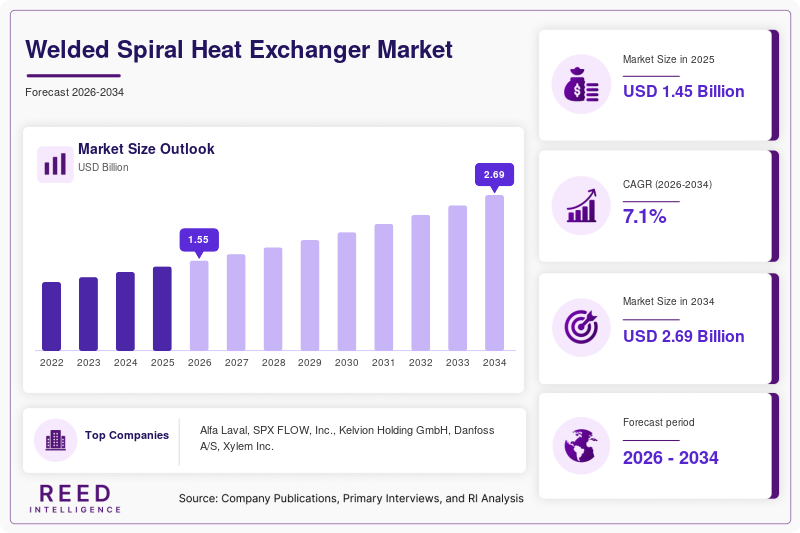
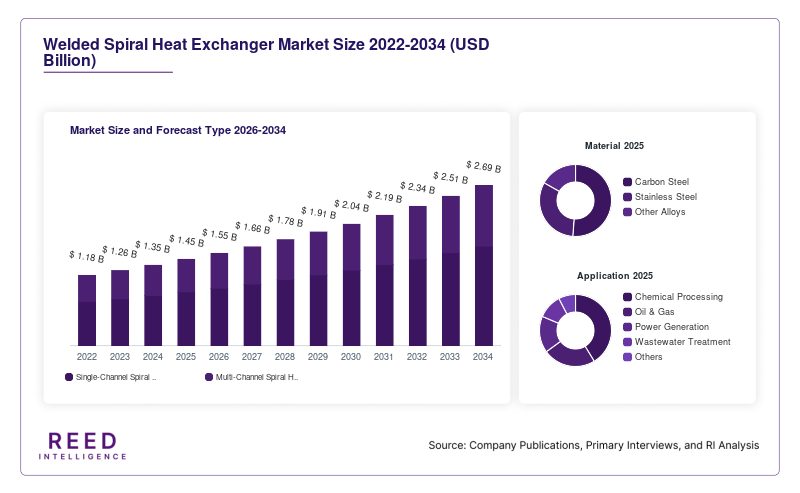
The Welded Spiral Heat Exchanger Market size was valued at approximately USD 1.45 billion in 2025 and is projected to reach USD 2.68 billion by 2034, expanding at a compound annual growth rate (CAGR) of 7.1% from 2025 to 2034. The market growth is being supported by increasing global demand for energy-efficient heat transfer equipment across industries such as chemical processing, oil & gas, power generation, and wastewater treatment.
A major global factor driving this growth is the intensifying focus on industrial energy efficiency and emission reduction initiatives. Governments and industries worldwide are implementing stricter environmental regulations, encouraging the adoption of compact and efficient heat exchangers that minimize energy loss and operational costs. Welded spiral heat exchangers, known for their high heat transfer efficiency and ability to handle fouling fluids, have emerged as a preferred solution in such environments.
Key Highlights
- Europe dominated the market in 2025 with a 34.2% share, while Asia Pacific is expected to register the fastest CAGR of 8.3% through 2034.
- By type, single-channel spiral heat exchangers led with a 58.6% share, while multi-channel designs are projected to grow fastest at a CAGR of 7.8%.
- By application, chemical processing dominated with 31.4% share, whereas wastewater treatment is anticipated to grow fastest at 8.5% CAGR.
- Germany remained the dominant country with market values of USD 215 million in 2025 and USD 228 million in 2026.
Market Trends
Increasing Adoption in Wastewater Treatment
The Welded Spiral Heat Exchanger Market is witnessing increased adoption in wastewater treatment applications. These systems are highly efficient in handling fluids with high fouling tendencies, making them suitable for sludge and effluent processing. Municipal and industrial wastewater treatment facilities are incorporating spiral heat exchangers to improve thermal recovery and reduce operational downtime. This trend is expected to strengthen as water reuse initiatives expand globally.
Integration with Energy Recovery Systems
Another key trend shaping the Welded Spiral Heat Exchanger Market is the integration of these systems into energy recovery processes. Industries are increasingly focusing on capturing waste heat from industrial processes and reusing it within operations. Spiral heat exchangers, due to their compact structure and high heat transfer coefficients, are becoming integral components in heat recovery systems. This trend aligns with sustainability goals and helps industries reduce their overall energy consumption and carbon footprint.
Market Drivers
Rising Demand for Energy-Efficient Heat Transfer Solutions
The growing emphasis on energy efficiency across industries is a primary driver for the Welded Spiral Heat Exchanger Market. Industries such as oil & gas, power generation, and chemicals are under pressure to reduce energy consumption and improve process efficiency. Welded spiral heat exchangers provide superior heat transfer performance while minimizing energy loss, making them an attractive choice for industrial operators.
Expansion of Chemical and Petrochemical Industries
The continuous expansion of chemical and petrochemical industries globally is another significant driver. These industries require reliable heat exchange systems capable of handling corrosive and viscous fluids. Welded spiral heat exchangers offer enhanced durability and resistance to fouling, which is critical in such demanding environments. Increasing investments in chemical production facilities, particularly in emerging economies, are expected to support sustained market growth.
Market Restraint
High Initial Investment and Complex Manufacturing
One of the major restraints in the Welded Spiral Heat Exchanger Market is the relatively high initial cost associated with these systems. The manufacturing process involves specialized welding techniques and high-quality materials, which increase production costs. Additionally, customization requirements for specific industrial applications further add to the overall expense.
For small and medium-sized enterprises, the upfront investment can be a significant barrier, limiting adoption despite long-term operational benefits. Moreover, the complexity involved in design and fabrication requires skilled labor and advanced manufacturing capabilities, which may not be readily available in all regions.
This cost factor often leads industries to consider alternative heat exchanger technologies, especially in applications where cost sensitivity outweighs performance advantages. While lifecycle cost benefits exist, the initial capital expenditure remains a key challenge affecting market penetration.
Market Opportunities
Growth in Renewable Energy Sector
The increasing adoption of renewable energy sources presents a promising opportunity for the Welded Spiral Heat Exchanger Market. Applications in biomass, geothermal, and solar thermal systems require efficient heat transfer solutions. Welded spiral heat exchangers can play a critical role in improving energy efficiency and system performance in these applications, supporting the global transition toward sustainable energy.
Industrial Modernization in Emerging Economies
Rapid industrialization and infrastructure development in emerging economies offer significant growth opportunities. Countries in Asia Pacific, Latin America, and the Middle East are investing in modernizing industrial processes, which includes upgrading heat exchange equipment. The demand for compact, efficient, and low-maintenance systems is expected to rise, creating new avenues for market expansion.
Segmental Analysis
By Type
Single-channel spiral heat exchangers dominated the Welded Spiral Heat Exchanger Market with a 58.6% share in 2025. Their simple design and ability to handle highly fouling fluids made them widely preferred across industries. These systems are particularly effective in applications requiring easy maintenance and reliable performance.
Multi-channel spiral heat exchangers are expected to grow at the fastest CAGR of 7.8% during the forecast period. Their ability to handle multiple fluid streams simultaneously provides enhanced operational efficiency, making them suitable for complex industrial processes.
By Material
Carbon steel accounted for the largest share of 46.3% in 2025, owing to its cost-effectiveness and widespread use in industrial applications. It offers a balance between performance and affordability, making it a preferred choice for many industries.
Stainless steel is projected to grow at a CAGR of 7.9%, driven by its superior corrosion resistance and durability. It is increasingly used in applications involving aggressive chemicals and high-temperature environments.
By Application
Chemical processing dominated the market with a 31.4% share in 2025, driven by the need for efficient heat exchange in handling corrosive and viscous fluids. Welded spiral heat exchangers are widely used in reactors and process lines within this sector.
Wastewater treatment is expected to register the fastest CAGR of 8.5%, supported by increasing investments in water treatment infrastructure. These systems are ideal for handling sludge and contaminated fluids, making them suitable for such applications.
By End-Use Industry
The oil & gas sector held a significant share of 28.7% in 2025, driven by the need for efficient heat exchange in refining and processing operations. The ability of welded spiral heat exchangers to handle fouling fluids made them suitable for this sector.
The power generation sector is anticipated to grow at a CAGR of 7.6%, driven by the need for efficient thermal management systems. Increasing investments in energy infrastructure are expected to support this growth.
Regional Analysis
North America
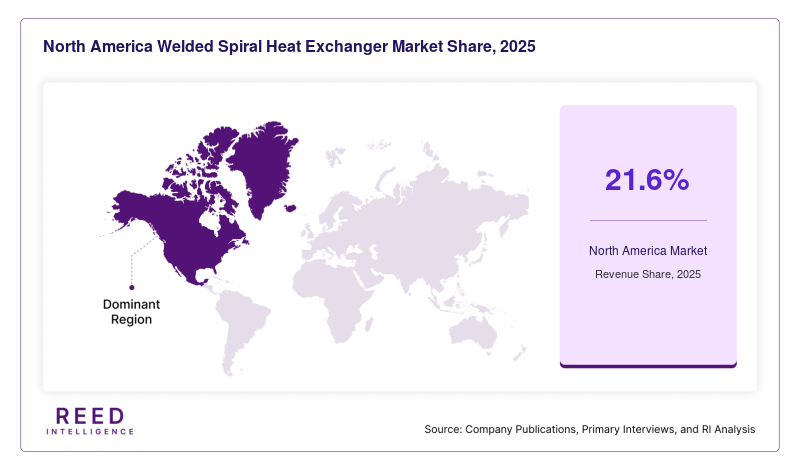
North America accounted for 21.6% of the Welded Spiral Heat Exchanger Market in 2025 and is expected to grow at a CAGR of 6.4% through 2034. The region’s mature industrial base and emphasis on process optimization contributed to its steady market presence.
The United States dominated the regional market due to its advanced manufacturing sector and strong presence in oil & gas refining. The country’s focus on improving industrial efficiency and upgrading aging infrastructure supported consistent demand for advanced heat exchanger solutions.
Europe
Europe held the largest share of 34.2% in 2025 and is projected to grow at a CAGR of 6.8%. The region’s stringent environmental regulations and focus on reducing industrial emissions significantly influenced market demand.
Germany emerged as the dominant country due to its strong chemical and manufacturing industries. The country’s emphasis on energy efficiency and adoption of advanced industrial technologies drove the demand for welded spiral heat exchangers.
Asia Pacific
Asia Pacific represented 27.8% of the market in 2025 and is anticipated to expand at the fastest CAGR of 8.3%. Rapid industrialization and increasing investments in infrastructure development contributed to market growth.
China led the region due to its large-scale industrial activities and expanding chemical sector. The country’s growing focus on improving industrial efficiency and reducing environmental impact supported the adoption of advanced heat exchanger systems.
Middle East & Africa
The Middle East & Africa held 9.1% of the market share in 2025 and is expected to grow at a CAGR of 7.0%. The region’s oil & gas sector played a significant role in driving demand for efficient heat transfer solutions.
Saudi Arabia dominated the region due to its extensive petrochemical industry and ongoing investments in industrial diversification. The need for reliable and efficient heat exchangers in processing facilities supported market growth.
Latin America
Latin America accounted for 7.3% of the market in 2025 and is projected to grow at a CAGR of 6.9%. The region’s growing industrial sector and increasing investments in energy infrastructure contributed to market expansion.
Brazil led the regional market due to its expanding industrial base and focus on improving energy efficiency. The country’s investments in chemical and energy sectors supported demand for advanced heat exchanger technologies.
Competitive Landscape
The Welded Spiral Heat Exchanger Market is moderately fragmented, with several global and regional players competing based on product innovation, customization capabilities, and pricing strategies.
Leading companies focus on expanding their product portfolios and strengthening their presence in emerging markets. Strategic collaborations and investments in advanced manufacturing technologies are common approaches to gaining a competitive edge.
A key market leader, Alfa Laval, continues to strengthen its position through technological advancements and product innovation. The company recently introduced enhanced spiral heat exchanger designs aimed at improving heat transfer efficiency and reducing maintenance requirements.
Other players are also investing in research and development to improve product performance and expand application areas, contributing to the overall growth and competitiveness of the market.
Key Players List
- Alfa Laval
- SPX FLOW, Inc.
- Kelvion Holding GmbH
- Danfoss A/S
- Xylem Inc.
- Koch Heat Transfer Company
- API Heat Transfer Inc.
- HRS Heat Exchangers Ltd.
- GEA Group AG
- Hisaka Works, Ltd.
- Tranter Inc.
- Thermowave GmbH
- FUNKE Wärmeaustauscher Apparatebau GmbH
- Sondex A/S
- SWEP International AB
Recent Developments
- In 2024, Alfa Laval introduced an upgraded spiral heat exchanger series with enhanced anti-fouling design features.
- In 2023, Kelvion expanded its manufacturing facility to increase production capacity for industrial heat exchangers.
- In 2024, SPX FLOW launched a new line of energy-efficient heat exchangers targeting chemical processing applications.
- In 2023, GEA Group invested in research to develop advanced materials for improved heat exchanger durability.
- In 2024, Danfoss expanded its distribution network to strengthen its presence in emerging markets.
Welded Spiral Heat Exchanger Market Segments
Type
- Single-Channel Spiral Heat Exchangers
- Multi-Channel Spiral Heat Exchangers
Material
- Carbon Steel
- Stainless Steel
- Other Alloys
Application
- Chemical Processing
- Oil & Gas
- Power Generation
- Wastewater Treatment
- Others
End-Use Industry
- Industrial Manufacturing
- Energy & Utilities
- Water & Wastewater Management
- Others
Distribution Channel
- Direct Sales (OEMs)
- Distributors & Suppliers
- Online/Industrial Platforms
By Region
- North America
- Europe
- APAC
- Middle East and Africa
- LATAM