Welding Helmet Market Size, Share Demand Report By Product Type (Passive Welding Helmets, Auto-Darkening Welding Helmets, Smart Welding Helmets), By Application (Industrial Manufacturing, Construction, Automotive, Oil & Gas, Shipbuilding, Aerospace), By Distribution Channel (Offline Distribution, Online Retail, Industrial Safety Equipment Suppliers, Specialty Industrial Stores) By Region & Segment Forecasts, 2026–2034
USD 3950
Market Overview
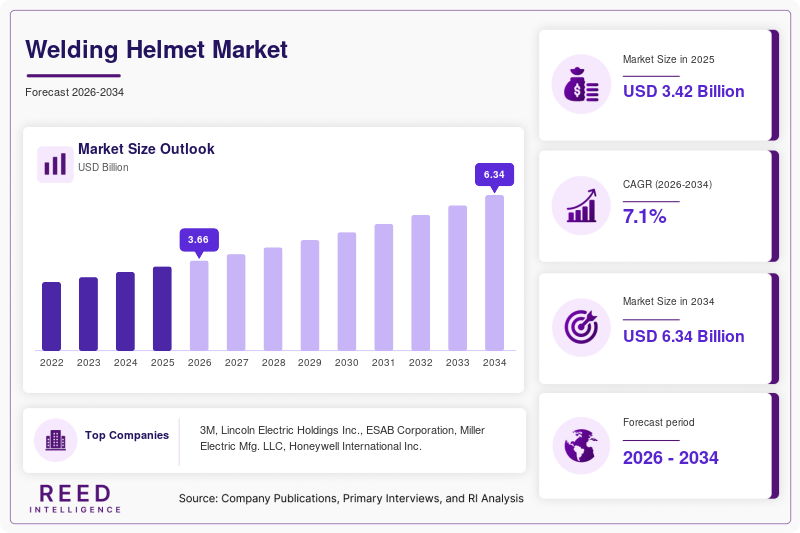
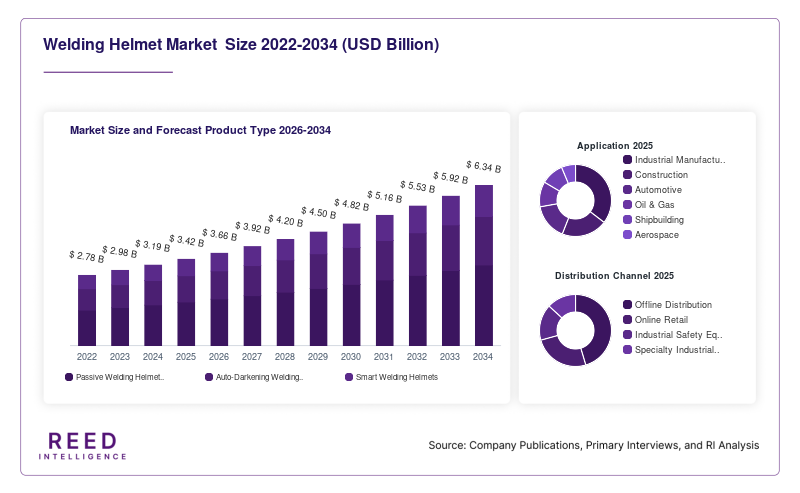
The Welding Helmet Market size was valued at approximately USD 3.42 billion in 2026 and is projected to reach nearly USD 5.91 billion by 2034, expanding at a CAGR of 7.1% during the forecast period from 2026 to 2034. The market continues to witness stable expansion due to rising welding activities across automotive manufacturing, heavy engineering, construction, oil & gas, shipbuilding, and metal fabrication industries. Welding helmets remain an essential component of industrial safety equipment because they protect workers from sparks, ultraviolet radiation, infrared exposure, and heat generated during welding operations. Increasing workplace safety awareness and regulatory compliance requirements are also contributing to steady product adoption across both developed and developing economies.
One of the major global factors supporting Welding Helmet Market growth is the rapid increase in infrastructure modernization and industrial automation activities. Governments across Asia Pacific, North America, and the Middle East are investing in transportation infrastructure, industrial plants, energy pipelines, and commercial construction projects. These sectors require large-scale welding operations, which directly increase the demand for advanced welding protection equipment. In addition, manufacturers are introducing auto-darkening helmets, lightweight materials, and sensor-based protective systems that improve worker comfort and operational efficiency. Growing use of robotic welding systems and smart manufacturing technologies is also encouraging demand for technologically advanced welding helmets capable of supporting precision welding applications.
Key Highlights
- North America dominated the market with a 34.2% share in 2025, while Asia Pacific is expected to grow at the fastest CAGR of 11.2% during 2026–2034.
- By product type, auto-darkening welding helmets accounted for the largest share of 62.8%, while smart welding helmets are projected to grow at a CAGR of 12.6%.
- By application, industrial manufacturing led with a 44.3% share, whereas construction activities are expected to expand at a CAGR of 9.8%.
- By distribution channel, offline sales dominated with a 67.5% share, while online distribution is projected to grow at a CAGR of 10.7%.
- The United States remained the dominant country, with market values of USD 615 million in 2024 and USD 668 million in 2025.
Market Trends
Integration of Smart and Connected Welding Technologies
The Welding Helmet Market is witnessing increased integration of smart technologies that improve safety, productivity, and monitoring capabilities during welding operations. Manufacturers are introducing helmets equipped with auto-darkening filters, Bluetooth connectivity, digital controls, and sensor-enabled monitoring systems. These technologies allow welders to adjust lens settings automatically based on arc brightness and working conditions. In addition, some advanced helmets provide real-time environmental monitoring and connectivity with industrial automation systems. Demand for these products is increasing in aerospace, automotive, and heavy engineering industries where welding precision is critical. The trend toward connected industrial workplaces and smart manufacturing facilities is also supporting adoption of intelligent welding helmets with enhanced operational capabilities.
Growing Preference for Lightweight and Ergonomic Helmet Designs
Industrial workers are increasingly preferring lightweight and ergonomically designed welding helmets that reduce physical strain during long working hours. Traditional helmets often caused neck fatigue and discomfort because of heavy materials and limited adjustment features. To address these concerns, manufacturers are using advanced thermoplastics, carbon fiber composites, and improved balancing systems that reduce overall helmet weight while maintaining durability and impact resistance. Ventilation systems and adjustable headgear are also being integrated to improve worker comfort. Demand for ergonomic welding helmets is particularly increasing across North America and Europe where occupational health standards are becoming stricter. This trend is expected to encourage continuous product innovation during the forecast period.
Market Drivers
Expansion of Construction and Industrial Manufacturing Activities
The growth of global construction and industrial manufacturing sectors is a major factor driving the Welding Helmet Market. Infrastructure development projects including bridges, railways, airports, industrial plants, and commercial buildings require extensive welding operations for metal joining and fabrication. Automotive production, shipbuilding, and heavy machinery manufacturing are also increasing the demand for welding equipment and protective gear. Emerging economies are investing heavily in industrial expansion, which is creating long-term demand for welding helmets across fabrication workshops and manufacturing facilities. As welding remains one of the most widely used industrial fabrication techniques, safety equipment demand continues to rise steadily across both developed and developing markets.
Rising Focus on Workplace Safety and Regulatory Compliance
Growing awareness regarding workplace safety and occupational health hazards is significantly supporting Welding Helmet Market growth. Welding activities expose workers to ultraviolet radiation, sparks, toxic fumes, and heat-related injuries. Governments and industrial organizations have implemented strict worker safety regulations requiring the use of certified protective equipment during welding operations. Companies are increasingly investing in advanced helmets with auto-darkening filters, enhanced optical clarity, and heat-resistant materials to comply with these standards. Safety training initiatives and employer liability concerns are also encouraging businesses to adopt premium protective solutions. Increasing regulatory enforcement across industrial sectors is expected to maintain strong demand for high-quality welding helmets throughout the forecast period.
Market Restraint
High Cost of Advanced Auto-Darkening and Smart Helmets
The relatively high cost of advanced welding helmets remains a key challenge affecting market expansion, especially in price-sensitive developing economies. Conventional passive welding helmets are more affordable and widely used among small fabrication workshops and independent welders. In contrast, smart and auto-darkening helmets equipped with digital displays, sensors, and advanced optical systems involve significantly higher manufacturing costs. Many small and medium-sized enterprises hesitate to invest in premium helmets because of budget limitations and uncertain return on investment. Additionally, maintenance expenses related to battery replacement, electronic component repairs, and lens servicing further increase ownership costs. This pricing gap slows penetration of technologically advanced products in emerging regions despite rising awareness regarding worker safety. Some industrial users also continue using conventional helmets because workers are already familiar with traditional protective equipment. As a result, manufacturers face challenges balancing product innovation with affordability while maintaining profitability in competitive industrial safety markets.
Market Opportunities
Growth Potential Across Smart Manufacturing Facilities
The increasing adoption of Industry 4.0 technologies is creating significant opportunities for Welding Helmet Market participants. Smart factories are integrating automated welding systems, robotics, artificial intelligence, and connected monitoring platforms into production environments. These advanced industrial systems require protective equipment capable of supporting digital workflows and enhanced operational visibility. Manufacturers are developing welding helmets with integrated sensors, communication systems, and real-time monitoring capabilities that improve workplace efficiency and operator safety. Industries such as aerospace, automotive, and precision engineering are increasingly adopting technologically advanced helmets to improve welding accuracy and productivity. The growing transition toward intelligent manufacturing environments is expected to create strong demand for connected welding safety equipment during the coming years.
Expanding Industrialization in Emerging Economies
Rapid industrialization across emerging economies presents another major growth opportunity for the Welding Helmet Market. Countries including India, China, Brazil, Indonesia, Vietnam, and Saudi Arabia are witnessing rising investments in infrastructure, transportation, manufacturing facilities, and energy projects. These developments are increasing the demand for welding activities across construction sites, fabrication workshops, and industrial plants. Governments are also strengthening worker safety regulations and encouraging the use of certified protective equipment in hazardous industrial environments. Rising urbanization and increasing foreign direct investments in manufacturing sectors are further contributing to market growth potential. International welding helmet manufacturers are expanding their regional distribution networks and local production capabilities to capitalize on these opportunities in developing economies.
Segmental Analysis
By Product Type
Auto-darkening welding helmets accounted for the largest share of the Welding Helmet Market in 2024, representing approximately 62.8% of global revenue. These helmets are widely preferred because they automatically adjust lens darkness levels according to welding arc intensity, improving operational convenience and worker protection. Industrial users increasingly prefer auto-darkening models because they reduce manual adjustments and improve welding accuracy. The automotive, shipbuilding, and heavy machinery industries are major end users of these products due to the high frequency of welding operations in production facilities. Manufacturers are also improving optical clarity, battery efficiency, and viewing area size to strengthen product performance. Continuous innovation in lens technologies and ergonomic designs has further increased the adoption of auto-darkening welding helmets across industrial applications.
By Application
Industrial manufacturing emerged as the dominant application segment in the Welding Helmet Market, accounting for nearly 44.3% of the total market share in 2024. Welding helmets are extensively used across automotive manufacturing, machinery production, heavy engineering, aerospace fabrication, and industrial equipment assembly operations. The increasing use of metal fabrication processes in manufacturing industries continues to support steady demand for reliable protective equipment. Industrial employers are focusing on improving workplace safety standards while maintaining operational efficiency, which is encouraging adoption of high-performance welding helmets. Auto-darkening and ergonomic helmet designs are particularly popular in manufacturing facilities because they improve worker comfort and reduce fatigue during prolonged welding operations. Rising global industrial output and manufacturing investments are expected to sustain demand for welding safety products in this segment.
By Distribution Channel
Offline distribution channels dominated the Welding Helmet Market in 2024, accounting for approximately 67.5% of total market revenue. Industrial buyers continue to prefer offline procurement through authorized distributors, safety equipment suppliers, and industrial retail stores because these channels provide direct product inspection and technical consultation. Large manufacturing companies often establish long-term procurement agreements with regional distributors to ensure consistent supply and product quality. Offline sales channels also support after-sales services, maintenance assistance, and product demonstrations, which remain important for industrial customers purchasing advanced welding helmets. In addition, safety equipment regulations in several countries encourage businesses to purchase certified protective products through trusted suppliers. Strong relationships between industrial manufacturers and distribution partners continue to support the dominance of offline sales channels.
Regional Analysis
North America
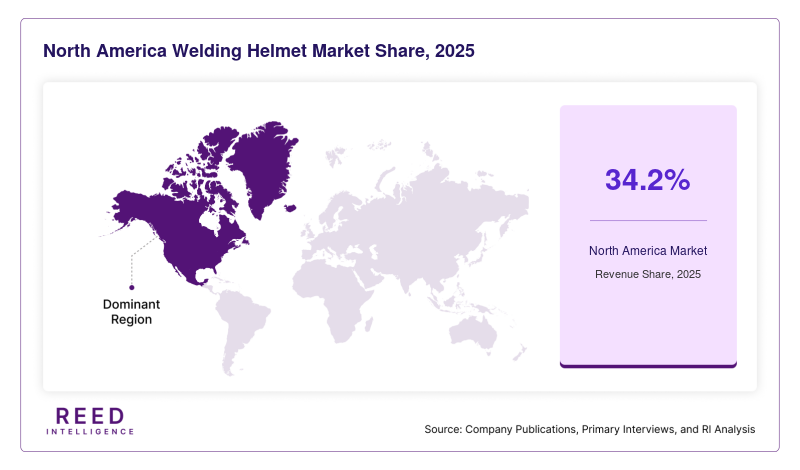
North America accounted for approximately 34.2% of the global Welding Helmet Market share in 2025 and is expected to maintain a stable growth trajectory throughout the forecast period. The region is projected to expand at a CAGR of 6.5% between 2026 and 2034 due to strong industrial infrastructure and increasing adoption of advanced welding technologies. Demand for high-performance welding helmets remains high across automotive manufacturing, aerospace production, defense engineering, and oil and gas industries. Strict occupational safety standards imposed by regulatory authorities are also encouraging industries to upgrade traditional protective equipment with technologically advanced helmet systems.
The United States remains the dominant country within the North American Welding Helmet Market due to its extensive manufacturing base and strong industrial automation adoption. One of the major regional growth factors is the rapid implementation of robotic welding systems in automotive and heavy equipment production facilities. Manufacturers are increasingly adopting smart welding helmets compatible with automated operations and digital manufacturing systems. Rising investment in industrial modernization and worker safety initiatives continues to support steady product demand across the country.
Europe
Europe represented nearly 27.6% of the global Welding Helmet Market share in 2025 and is forecast to grow at a CAGR of 6.8% during the assessment period. The region benefits from advanced industrial manufacturing capabilities, high safety awareness, and strong regulatory frameworks related to workplace protection. Countries across Europe continue investing in industrial modernization, energy infrastructure, and transportation development projects that require extensive welding operations. Demand for lightweight and ergonomic welding helmets is increasing because industries are focusing more on worker productivity and long-term occupational health management.
Germany dominates the European Welding Helmet Market because of its strong automotive engineering and machinery manufacturing sectors. A unique growth factor supporting the regional market is the increasing integration of sustainable manufacturing practices and advanced industrial automation technologies. German manufacturers are rapidly adopting precision welding systems and technologically advanced protective equipment to improve operational efficiency. Additionally, growing demand for electric vehicles and renewable energy infrastructure is contributing to increased welding activities throughout the country.
Asia Pacific
Asia Pacific is expected to register the fastest growth in the Welding Helmet Market, expanding at a CAGR of 11.2% from 2026 to 2034. The region accounted for approximately 23.8% of the global market share in 2025 due to rapid industrialization and infrastructure development. Construction projects, manufacturing expansion, and increasing investments in transportation infrastructure are significantly driving demand for welding safety equipment across the region. Governments in major economies are encouraging industrial production and export-oriented manufacturing, which is increasing the use of welding technologies in factories and fabrication workshops.
China continues to dominate the Asia Pacific Welding Helmet Market because of its large-scale manufacturing ecosystem and extensive industrial workforce. One unique regional growth factor is the expansion of heavy infrastructure projects including railways, industrial corridors, ports, and energy pipelines. These projects require large volumes of welding operations and safety equipment procurement. Additionally, rising worker safety awareness and growing adoption of modern welding technologies are supporting increased demand for advanced welding helmets across Chinese industrial sectors.
Middle East & Africa
The Middle East & Africa region accounted for around 7.3% of the global Welding Helmet Market share in 2025 and is anticipated to grow at a CAGR of 8.1% during the forecast period. Market growth is primarily supported by rising investments in oil and gas infrastructure, construction activities, and industrial diversification programs across Gulf countries. Welding operations play a crucial role in pipeline construction, refinery expansion, and industrial plant development. Increasing focus on worker safety standards in hazardous industrial environments is also contributing to rising adoption of certified welding helmets.
Saudi Arabia remains the leading country within the regional Welding Helmet Market due to ongoing industrial transformation initiatives and infrastructure expansion projects. A significant growth factor is the country’s increasing investment in non-oil industrial sectors under economic diversification programs. Large-scale projects involving transportation systems, energy facilities, and urban development require extensive welding activities and protective equipment. Growing foreign investments in manufacturing and industrial construction are also supporting long-term market growth across the country.
Latin America
Latin America held approximately 7.1% of the global Welding Helmet Market share in 2025 and is projected to expand at a CAGR of 7.6% during the forecast period. The region is benefiting from gradual industrial recovery, infrastructure investments, and increasing mining and manufacturing activities. Demand for welding helmets is growing steadily across automotive assembly plants, construction sites, and metal fabrication workshops. Governments are also promoting industrial safety practices and encouraging companies to adopt certified protective equipment for hazardous work environments.
Brazil dominates the Latin American Welding Helmet Market because of its extensive industrial base and growing infrastructure development activities. One unique growth factor supporting the market is the expansion of mining and metal processing industries, which require intensive welding and fabrication operations. In addition, modernization of transportation infrastructure and industrial facilities is creating demand for skilled welding labor and advanced protective equipment. Rising awareness regarding occupational safety standards is expected to further strengthen market growth in the country.
Competitive Landscape
The Welding Helmet Market is moderately fragmented with several international and regional manufacturers competing based on product quality, pricing, technological innovation, and distribution capabilities. Leading companies are investing heavily in research and development activities to introduce advanced helmets with improved optical clarity, lightweight materials, and smart safety features. Product differentiation through ergonomic design, enhanced durability, and digital connectivity has become a major competitive strategy among market participants. Manufacturers are also expanding regional production facilities and strengthening partnerships with industrial distributors to improve global market penetration.
Major companies operating in the market include 3M, Lincoln Electric, ESAB, Miller Electric, and Honeywell International. These companies maintain strong brand recognition and broad product portfolios catering to industrial manufacturing, construction, and heavy engineering applications. Among them, 3M continues to hold a leading market position because of its extensive global distribution network and focus on technologically advanced welding safety products. The company recently introduced upgraded auto-darkening welding helmets featuring improved lens response times, enhanced optical visibility, and lightweight protective materials designed for long-duration industrial applications. Other market participants are also increasing investments in smart helmet technologies and connected industrial safety solutions to strengthen their competitive positioning.
Key Players
- 3M
- Lincoln Electric Holdings Inc.
- ESAB Corporation
- Miller Electric Mfg. LLC
- Honeywell International Inc.
- Optrel AG
- Jackson Safety
- Kemppi Oy
- Fronius International GmbH
- Hobart Welding Products
- Sellstrom Manufacturing Company
- GYS Group
- Parweld Ltd.
- DEWALT
- Karam Industries
Recent Developments
- 3M launched an upgraded auto-darkening welding helmet series with improved optical clarity and enhanced response speed for industrial fabrication applications.
- Lincoln Electric expanded its smart welding equipment portfolio by introducing connected helmet systems compatible with digital welding environments.
- ESAB announced investments in lightweight helmet materials and ergonomic product designs to improve worker comfort during extended welding operations.
Welding Helmet Market Segments
Product Type
- Passive Welding Helmets
- Auto-Darkening Welding Helmets
- Smart Welding Helmets
Application
- Industrial Manufacturing
- Construction
- Automotive
- Oil & Gas
- Shipbuilding
- Aerospace
Distribution Channel
- Offline Distribution
- Online Retail
- Industrial Safety Equipment Suppliers
- Specialty Industrial Stores
By Region
- North America
- Europe
- APAC
- Middle East and Africa
- LATAM