Whipped Butter Market Size, Share & Demand Report By Product Type (Salted Whipped Butter, Unsalted Whipped Butter), By Distribution Channel (Supermarkets and Hypermarkets, Convenience Stores), By Application (Household Consumption, Bakery and Confectionery, Foodservice and Hospitality), By Packaging Type (Tubs and Containers, Squeeze Packaging, Foil Wraps) By Region & Segment Forecasts, 2026–2034
USD 3950
Market Overview
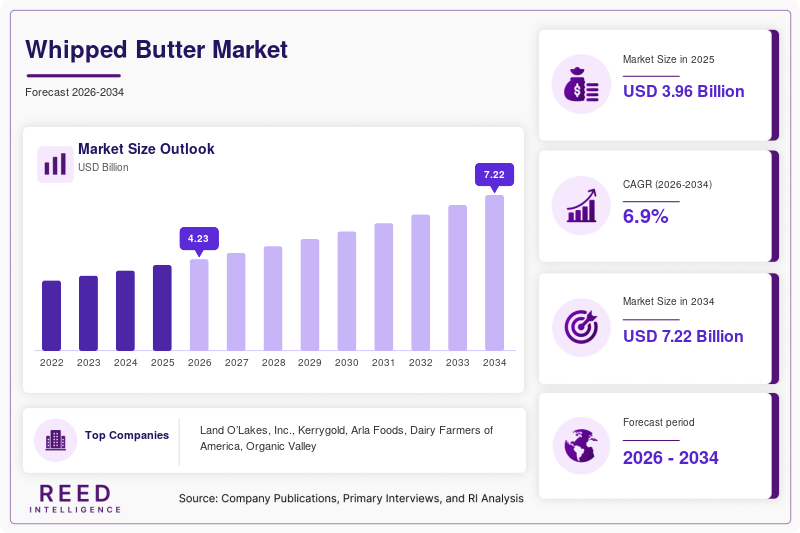
The global Whipped Butter Market was valued at USD 3.96 billion in 2026 and is projected to reach USD 6.74 billion by 2034, expanding at a CAGR of 6.9% during the forecast period from 2026 to 2034. The market growth has been supported by increasing consumer demand for convenient dairy products with enhanced spreadability and texture. Whipped butter has gained strong popularity among households, bakeries, restaurants, and foodservice providers due to its light consistency, ease of use, and appealing taste profile.
The growing preference for premium dairy products and clean-label food ingredients has significantly accelerated demand in the Whipped Butter Market. Consumers are increasingly seeking minimally processed butter products made with natural ingredients and reduced artificial additives. Manufacturers are responding by introducing organic, flavored, and low-sodium whipped butter variants designed to meet evolving dietary preferences.
Key Highlights
- North America accounted for 34.9% of the global Whipped Butter Market share in 2025, while Asia Pacific is projected to register the fastest CAGR of 7.8% during the forecast period.
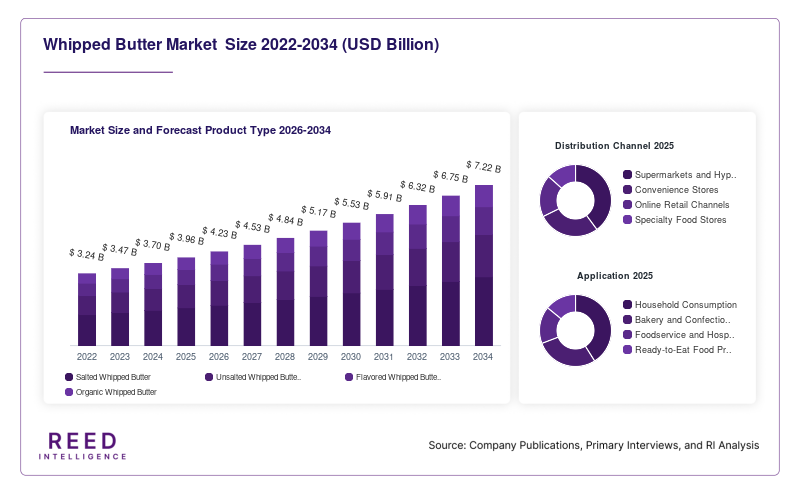
- By product type, salted whipped butter held the leading share of 43.7% in 2025, while flavored whipped butter is expected to witness the fastest CAGR of 8.4% through 2034.
- By distribution channel, supermarkets and hypermarkets dominated with 46.2% market share in 2025, whereas online retail channels are anticipated to grow at a CAGR of 8.7%.
- By application, household consumption represented 51.4% of the market in 2025, while bakery and confectionery applications are projected to expand at a CAGR of 8.2%.
- By packaging type, tubs and containers remained the dominant segment with 48.8% share in 2025, while squeeze packaging is expected to grow at a CAGR of 8.5%.
- The United States Whipped Butter Market was valued at USD 908 million in 2024 and reached USD 962 million in 2025 due to rising demand for premium breakfast spreads and bakery ingredients.
Market Trends
Growing Demand for Flavored Dairy Spreads
The Whipped Butter Market is witnessing increasing demand for flavored butter varieties infused with garlic, herbs, honey, cinnamon, and spices. Consumers are showing greater interest in premium dairy spreads that offer enhanced taste experiences and convenience in meal preparation. Manufacturers are launching innovative flavor combinations targeting both household and foodservice applications.
Rising Popularity of Organic and Clean-Label Products
Organic and clean-label dairy products are becoming important trends shaping the Whipped Butter Market. Consumers are increasingly preferring butter products made without artificial preservatives, synthetic colors, or genetically modified ingredients. Dairy brands are introducing organic whipped butter formulations sourced from grass-fed milk to align with health-conscious purchasing preferences.
Market Drivers
Expansion of Bakery and Breakfast Food Consumption
The increasing consumption of bakery products and breakfast foods is a major factor driving the Whipped Butter Market. Whipped butter is widely used as a spread and ingredient in toast, pancakes, pastries, muffins, and baked goods due to its creamy consistency and improved spreadability.
The growing café culture and expansion of quick-service breakfast chains have also strengthened commercial demand. Foodservice providers increasingly prefer whipped butter because it enhances presentation quality and simplifies portion control during food preparation.
Increasing Consumer Preference for Convenience Foods
The rising demand for convenient food products is significantly driving the Whipped Butter Market. Busy consumer lifestyles and changing eating habits have encouraged the adoption of ready-to-use dairy spreads that require minimal preparation.
Whipped butter products offer easier refrigeration handling and faster spreading compared to traditional butter blocks. This convenience factor has increased product penetration across residential kitchens and commercial foodservice operations.
Market Restraint
Fluctuation in Dairy Raw Material Prices
Volatility in milk and dairy raw material prices remains a significant restraint for the Whipped Butter Market. Dairy manufacturers face challenges related to changing feed costs, supply chain disruptions, and seasonal milk production fluctuations. These factors can impact production costs and create pricing instability in competitive retail markets.
Market Opportunities
Expansion of Plant-Based and Dairy-Blended Products
The increasing popularity of plant-based diets is creating opportunities in the Whipped Butter Market. Manufacturers are introducing dairy-blended whipped butter products incorporating olive oil, avocado oil, and plant-based ingredients to appeal to flexitarian consumers. Hybrid butter spreads are expected to gain traction among health-conscious buyers seeking balanced taste and nutrition.
Growing Demand from Emerging Retail Markets
The expansion of organized retail and cold-chain distribution infrastructure in emerging economies is expected to create growth opportunities for the Whipped Butter Market. Supermarkets, convenience stores, and digital grocery platforms are increasing product accessibility in urban and semi-urban regions. Rising disposable income levels and westernized food consumption patterns are also supporting product adoption.
Segmental Analysis
By Product Type
Salted Whipped Butter: Salted whipped butter accounted for 43.7% of the Whipped Butter Market share in 2025. Its dominance was supported by strong consumer preference for traditional butter flavors and extended shelf life benefits. Salted whipped butter remained widely used in residential kitchens and foodservice applications.
Flavored Whipped Butter: Flavored whipped butter is projected to grow at a CAGR of 8.4% through 2034. Increasing consumer interest in gourmet dairy products and premium breakfast spreads will support segment expansion. Manufacturers are expected to introduce innovative flavors targeting specialty retail and café markets.
By Distribution Channel
Supermarkets and Hypermarkets: Supermarkets and hypermarkets held the largest share of 46.2% in 2025 due to strong product visibility, organized refrigeration infrastructure, and high consumer footfall. Retail chains remained major distribution points for premium dairy spreads and butter products.
Online Retail Channels: Online retail channels are expected to register a CAGR of 8.7% during the forecast period. Increasing digital grocery shopping adoption and home delivery convenience will accelerate product availability through e-commerce platforms.
By Application
Household Consumption: Household consumption accounted for 51.4% of the Whipped Butter Market in 2025. Demand remained strong due to increasing home breakfast preparation and consumer preference for convenient dairy spreads.
Bakery and Confectionery Applications: Bakery and confectionery applications are projected to grow at a CAGR of 8.2% through 2034. Expanding bakery chains and rising premium dessert consumption will strengthen demand for whipped butter as a baking ingredient.
By Packaging Type
Tubs and Containers: Tubs and containers accounted for 48.8% of the Whipped Butter Market share in 2025. These packaging formats remained widely preferred because of ease of storage, product protection, and consumer convenience.
Squeeze Packaging: Squeeze packaging is expected to witness a CAGR of 8.5% during the forecast period. Rising demand for portable and mess-free dairy packaging solutions will support segment growth across urban retail markets.
Regional Analysis
North America
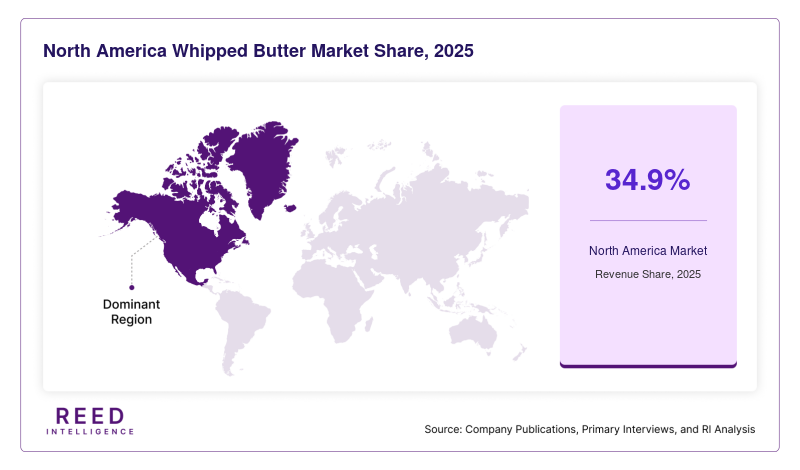
North America accounted for 34.9% of the global Whipped Butter Market share in 2025 and is expected to grow at a CAGR of 6.3% through 2034. The regional market benefited from strong dairy consumption patterns and increasing demand for premium breakfast spreads.
The United States dominated the regional market due to rising bakery product consumption and growing preference for convenient dairy spreads. Consumers increasingly preferred flavored whipped butter products and organic dairy offerings across retail supermarkets and foodservice channels.
Europe
Europe represented 28.1% of the Whipped Butter Market in 2025 and is projected to expand at a CAGR of 6.4% during the forecast period. The market was supported by strong traditional dairy consumption and premium bakery culture across several European countries.
Germany emerged as the leading country in the region owing to increasing consumer demand for natural dairy products and artisanal butter formulations. Food manufacturers also increased the use of whipped butter in premium bakery and confectionery products.
Asia Pacific
Asia Pacific held 22.7% of the Whipped Butter Market share in 2025 and is anticipated to witness the fastest CAGR of 7.8% from 2026 to 2034. Urbanization, rising disposable income, and westernization of food preferences contributed to regional market growth.
China dominated the regional market due to increasing bakery product consumption and expansion of organized retail grocery networks. The growing popularity of café chains and premium breakfast products also supported whipped butter demand.
Middle East & Africa
The Middle East & Africa accounted for 8.0% of the Whipped Butter Market in 2025 and is forecast to grow at a CAGR of 6.1% through 2034. The market benefited from expanding hospitality industries and increasing dairy product consumption.
Saudi Arabia emerged as the dominant country in the region because of rising urban food consumption trends and growing supermarket penetration. Premium dairy spreads gained popularity among younger consumers and foodservice operators.
Latin America
Latin America captured 6.3% of the Whipped Butter Market share in 2025 and is expected to grow at a CAGR of 5.9% during the forecast period. Rising bakery consumption and improving cold-chain distribution systems supported regional market expansion.
Brazil led the regional market owing to increasing demand for dairy-based breakfast products and expanding retail grocery infrastructure. Foodservice establishments also increased usage of whipped butter in bakery preparation and breakfast menus.
Competitive Landscape
The Whipped Butter Market remains moderately fragmented with the presence of multinational dairy companies and regional butter manufacturers. Companies are focusing on premium product launches, flavored butter innovations, and sustainable dairy sourcing practices to strengthen their competitive position.
Land O’Lakes, Inc. remained a leading participant in the Whipped Butter Market due to its strong dairy brand portfolio and extensive retail distribution network. The company recently introduced flavored whipped butter products designed for breakfast and bakery applications with clean-label ingredient positioning.
Kerrygold focused on expanding grass-fed whipped butter product offerings targeting premium dairy consumers. Arla Foods strengthened its organic dairy portfolio through new whipped butter formulations. Dairy Farmers of America expanded refrigerated distribution capabilities across retail chains. Organic Valley emphasized sustainable dairy sourcing and clean-label butter product development.
Key Players List
- Land O’Lakes, Inc.
- Kerrygold
- Arla Foods
- Dairy Farmers of America
- Organic Valley
- Fonterra Co-operative Group
- Lactalis Group
- Anchor Butter
- Cabot Creamery
- Challenge Dairy Products Inc.
- Crystal Farms Dairy Company
- Tillamook County Creamery Association
- Président
- Amul
- Saputo Inc.
Recent Developments
- In February 2026, Land O’Lakes, Inc. launched a new flavored whipped butter range targeting premium breakfast applications.
- In November 2025, Arla Foods expanded organic whipped butter production capacity to address increasing clean-label dairy demand.
- In September 2025, Kerrygold introduced grass-fed whipped butter products with sustainable packaging solutions.
- In June 2025, Dairy Farmers of America strengthened cold-chain distribution infrastructure for premium dairy spreads across North America.
- In March 2025, Organic Valley launched dairy-blended whipped butter products incorporating plant-based oils for flexitarian consumers.
Whipped Butter Market Segments
Product Type
- Salted Whipped Butter
- Unsalted Whipped Butter
- Flavored Whipped Butter
- Organic Whipped Butter
Distribution Channel
- Supermarkets and Hypermarkets
- Convenience Stores
- Online Retail Channels
- Specialty Food Stores
Application
- Household Consumption
- Bakery and Confectionery
- Foodservice and Hospitality
- Ready-to-Eat Food Products
Packaging Type
- Tubs and Containers
- Squeeze Packaging
- Foil Wraps
- Single-Serve Portions
By Region
- North America
- Europe
- APAC
- Middle East and Africa
- LATAM