White Charcoal Powder Market Size, Share & Demand Report By Type (Binchotan Charcoal Powder, Activated White Charcoal Powder, Others), By Application (Water Purification, Air Filtration, Cosmetics & Personal Care, Food & Beverage, Others), By End-Use Industry (Household, Industrial, Commercial), By Distribution Channel (Online, Offline), By Region & Segment Forecasts, 2026–2034
USD 3950
Market Overview
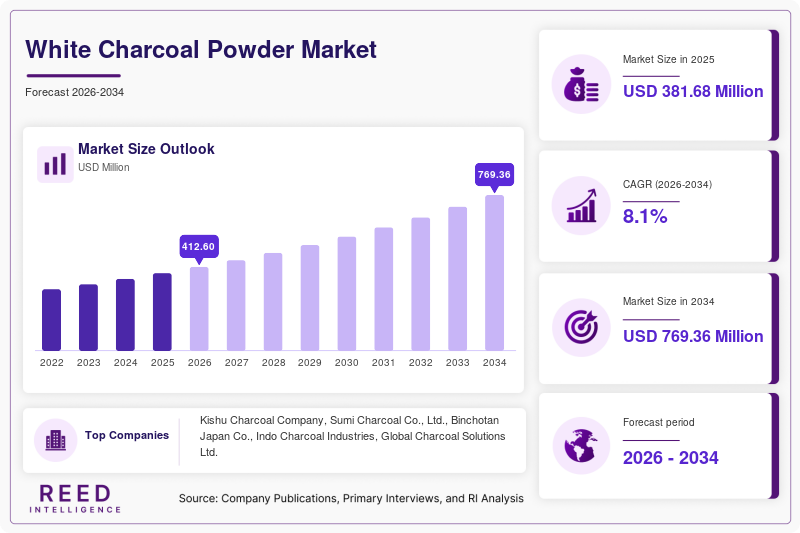
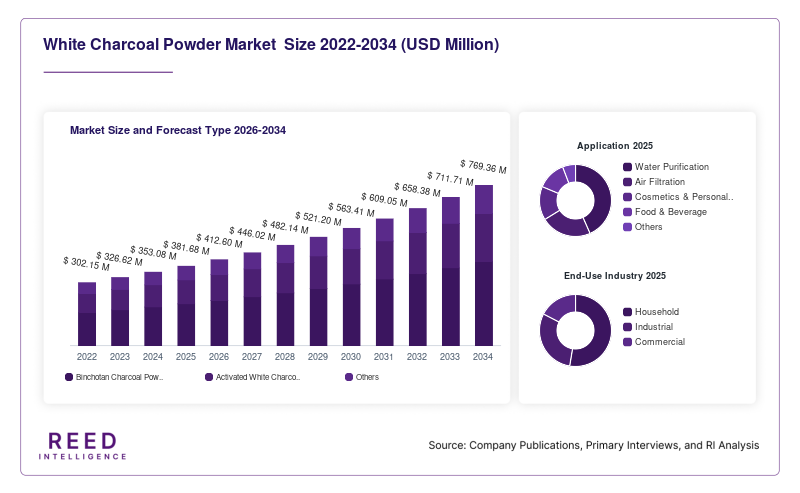
The White Charcoal Powder Market size was estimated at USD 412.6 million in 2026 and is projected to reach USD 768.4 million by 2034, expanding at a CAGR of 8.1% during 2026–2034. The market growth has been largely supported by the rising global demand for eco-friendly and sustainable materials across industrial, cosmetic, and filtration applications. White charcoal powder, derived from high-temperature carbonization processes, offers superior adsorption capacity, purity, and minimal emissions, making it increasingly preferred over conventional charcoal variants.
Growing environmental awareness and regulatory frameworks encouraging low-carbon materials have further accelerated adoption across diverse sectors such as water purification, personal care, and air filtration. The unique microporous structure of white charcoal powder enhances its usability in high-performance applications, contributing to consistent market expansion.
Key Highlights:
- Asia Pacific dominated the market with a 42.8% share in 2025, while North America is expected to register the fastest growth at a CAGR of 8.9%.
- By type, Binchotan charcoal powder held the largest share of 48.3% in 2025, while activated white charcoal powder is projected to grow fastest at a CAGR of 9.2%.
- By application, water purification accounted for 36.5% share in 2025, while cosmetics & personal care is anticipated to expand at a CAGR of 9.6%.
- Japan, the dominant country, recorded USD 78.4 million in 2024 and USD 82.1 million in 2025 market value.
Market Trends
Rising Integration in Premium Personal Care Products
White charcoal powder is increasingly being incorporated into high-end skincare and cosmetic formulations due to its detoxifying and anti-pollution properties. Consumers are showing a growing preference for natural and functional ingredients, driving innovation in charcoal-based masks, cleansers, and oral care products.
Expansion in Advanced Filtration Technologies
The use of white charcoal powder in water and air purification systems is gaining traction due to its superior adsorption efficiency and low impurity levels. Industrial filtration systems are increasingly adopting this material to meet stricter environmental compliance standards.
Market Drivers
Growing Demand for Sustainable Filtration Materials
The increasing need for environmentally safe filtration solutions is driving the adoption of white charcoal powder. Its ability to remove toxins, heavy metals, and odors without releasing harmful byproducts makes it suitable for both residential and industrial applications.
Expanding Applications in Health and Wellness Sector
The health-conscious consumer base is contributing to the rising demand for white charcoal powder in dietary supplements, detox products, and oral hygiene formulations. Its perceived benefits in toxin absorption and digestive health are supporting its market penetration.
Market Restraint
High Production Cost and Limited Raw Material Availability
The production of white charcoal powder involves controlled high-temperature processes and specific hardwood sources, leading to higher costs compared to conventional charcoal. Limited availability of raw materials restricts large-scale production and impacts price competitiveness.
Market Opportunities
Increasing Use in Industrial Air Purification
The growing emphasis on air quality management in industrial settings presents opportunities for white charcoal powder manufacturers. Its high adsorption capacity makes it suitable for removing volatile organic compounds (VOCs) and industrial emissions.
Emerging Demand in Functional Food Additives
White charcoal powder is gradually being explored as an ingredient in functional foods and beverages due to its detoxifying properties. This emerging application area is expected to create new revenue streams for market participants.
Segmental Analysis
By Type
Binchotan charcoal powder dominated the market with a 48.3% share in 2025, attributed to its high carbon content and superior adsorption efficiency. Its traditional manufacturing process ensures purity and consistent quality.
Activated white charcoal powder is expected to be the fastest-growing segment, registering a CAGR of 9.2%, driven by its enhanced surface area and increased effectiveness in filtration and cosmetic applications.
By Application
Water purification emerged as the dominant application, accounting for 36.5% share in 2025, due to its widespread use in residential and industrial filtration systems.
Cosmetics & personal care is projected to be the fastest-growing segment with a CAGR of 9.6%, supported by increasing demand for natural skincare solutions and innovative product formulations.
By End-Use Industry
The household sector dominated with a 31.2% share in 2025, driven by the use of white charcoal powder in water filters and odor control products.
The industrial sector is anticipated to grow at a CAGR of 8.7%, owing to rising adoption in air purification and emission control systems.
By Distribution Channel
Offline distribution channels held the largest share of 58.4% in 2025, supported by established retail networks and bulk industrial purchases.
Online channels are expected to grow fastest at a CAGR of 10.1%, driven by increasing e-commerce penetration and consumer preference for convenience.
Regional Analysis
North America
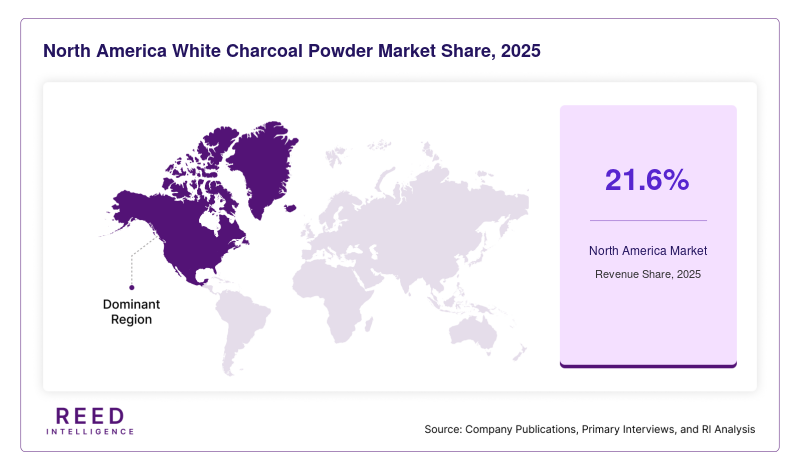
North America accounted for 21.6% of the market share in 2025 and is projected to grow at a CAGR of 8.9% during the forecast period. The United States dominated the regional market, driven by increasing adoption in advanced filtration systems and growing demand for premium personal care products.
Europe
Europe held 19.4% share in 2025 and will expand at a CAGR of 7.8%. Germany led the region due to its strong focus on sustainable materials and regulatory compliance in industrial emissions control.
Asia Pacific
Asia Pacific was the largest region with a 42.8% share in 2025 and is expected to grow at a CAGR of 8.3%. Japan dominated the region owing to its traditional expertise in Binchotan charcoal production and continuous technological advancements.
Middle East & Africa
The Middle East & Africa region captured 8.7% share in 2025 and is projected to grow at a CAGR of 7.2%. The UAE led regional growth due to increasing investments in water purification infrastructure.
Latin America
Latin America held 7.5% share in 2025 and is anticipated to grow at a CAGR of 7.5%. Brazil dominated the market due to expanding industrial applications and rising awareness of eco-friendly materials.
Competitive Landscape
The White Charcoal Powder Market is moderately fragmented, with a mix of regional and global players competing on product quality, innovation, and distribution reach. The market leader, Kishu Charcoal Company, has maintained its position through consistent product quality and expansion into international markets. The company recently introduced a high-purity activated white charcoal powder for premium cosmetic applications, strengthening its portfolio.
Other key players are focusing on strategic partnerships, product innovation, and capacity expansion to gain a competitive edge. Companies are also investing in sustainable sourcing and advanced carbonization technologies to enhance efficiency and reduce environmental impact. The competitive landscape is expected to intensify as new entrants explore niche applications and existing players diversify their offerings.
Key Players List
- Kishu Charcoal Company
- Sumi Charcoal Co., Ltd.
- Binchotan Japan Co.
- Indo Charcoal Industries
- Global Charcoal Solutions Ltd.
- CarboTech AC GmbH
- Kuraray Co., Ltd.
- Jacobi Carbons Group
- Donau Carbon GmbH
- Haycarb PLC
- Osaka Charcoal Co.
- Activated Carbon Technologies Pty Ltd
- Boyce Carbon
- Silcarbon Aktivkohle GmbH
- Universal Carbons
Recent Developments
- In 2025, Kishu Charcoal Company launched a premium-grade activated white charcoal powder targeting the global cosmetics industry.
- In 2024, Jacobi Carbons expanded its production capacity to meet increasing demand for high-performance filtration materials.
- In 2025, Kuraray Co., Ltd. introduced a new eco-friendly carbonization process to reduce emissions during production.
- In 2024, Haycarb PLC invested in R&D for developing white charcoal-based air purification solutions.
- In 2025, Donau Carbon GmbH entered strategic partnerships to strengthen its distribution network in Europe.
White Charcoal Powder Market Segments
Type
- Binchotan Charcoal Powder
- Activated White Charcoal Powder
- Others
Application
- Water Purification
- Air Filtration
- Cosmetics & Personal Care
- Food & Beverage
- Others
End-Use Industry
- Household
- Industrial
- Commercial
Distribution Channel
- Online Retail
- Offline Retail
By Region
- North America
- Europe
- APAC
- Middle East and Africa
- LATAM