White Mineral Oil Market Size, Share Demand Report By Type (Pharmaceutical Grade, Food Grade, Technical Grade), By Application (Personal Care and Cosmetics, Pharmaceuticals, Food Processing, Industrial Applications), By End-Use Industry (Healthcare, Food and Beverage, Cosmetics Industry, Industrial Sector) By Region & Segment Forecasts, 2026–2034
USD 3950
Market Overview
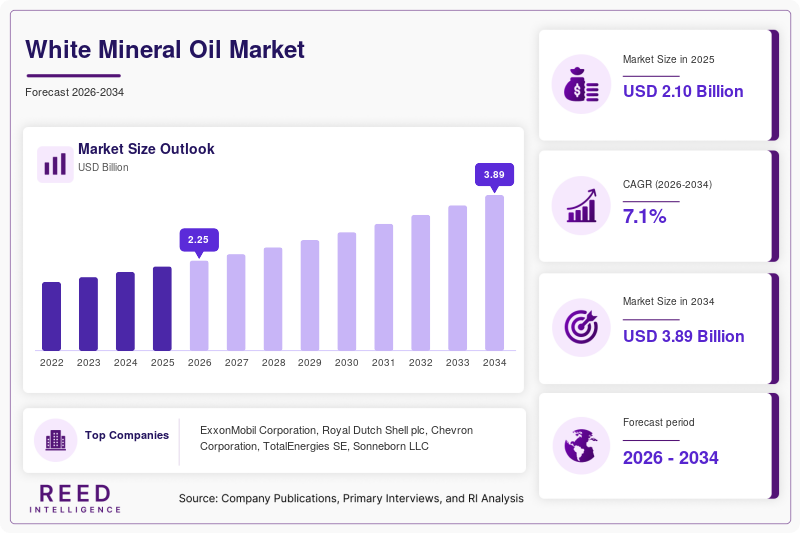
The global White Mineral Oil Market size was valued at approximately USD 2.1 billion in 2026 and is projected to reach USD 3.6 billion by 2034, expanding at a compound annual growth rate (CAGR) of 7.1% during the forecast period (2026–2034). White mineral oil, a highly refined petroleum derivative, is widely used in pharmaceuticals, cosmetics, food processing, and industrial applications due to its purity, stability, and non-toxic nature. The increasing demand for high-quality lubricants and pharmaceutical-grade oils has significantly contributed to market expansion in recent years.
A major global factor supporting market growth is the rising demand for personal care and pharmaceutical products. As consumer awareness regarding hygiene and wellness continues to rise, manufacturers are increasingly incorporating white mineral oil into formulations such as creams, ointments, and lotions. Additionally, strict regulatory standards across developed economies have encouraged the use of highly refined and safe ingredients, further strengthening demand.
Key Highlights
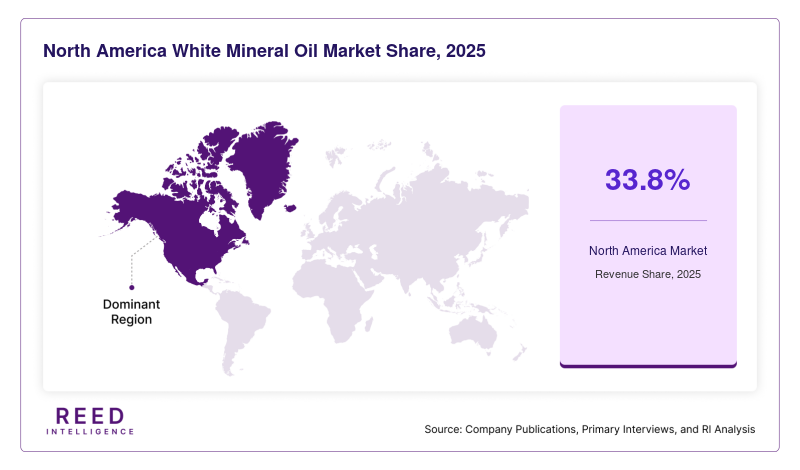
- North America dominated the market with a 33.8% share in 2025.
- Asia Pacific is expected to grow at the fastest CAGR of 8.9% during 2026–2034.
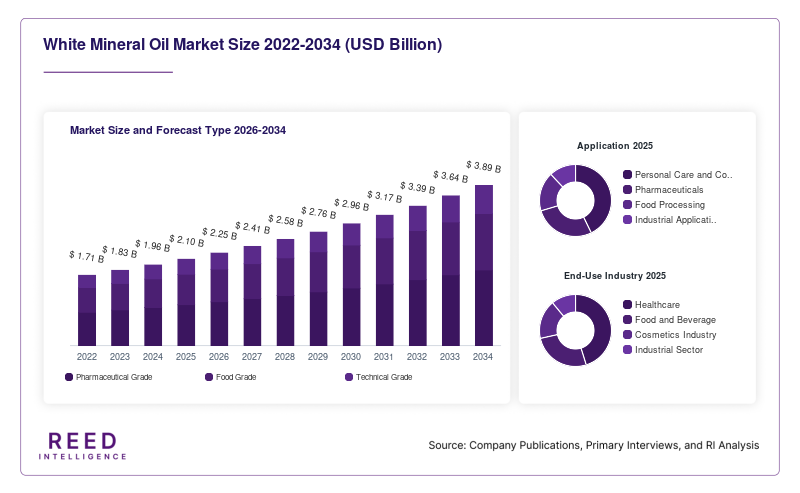
- By type, pharmaceutical-grade oil accounted for the largest share of 42.6%, while food-grade oil is projected to grow at a CAGR of 8.5%.
- By application, personal care and cosmetics led with a 39.4% share, whereas pharmaceuticals are expected to expand at a CAGR of 8.7%.
- The United States remained the dominant country, with market values of USD 540 million in 2024 and USD 590 million in 2025.
Market Trends
Rising Demand for High-Purity Ingredients in Personal Care
The increasing consumer preference for safe and dermatologically tested products is influencing the demand for white mineral oil in personal care formulations. Manufacturers are focusing on producing highly refined oils that meet stringent safety and purity standards. This trend is particularly evident in developed markets where regulatory frameworks emphasize ingredient transparency and quality. White mineral oil is widely used in lotions, creams, and baby care products due to its moisturizing properties and low allergenic potential.
Furthermore, the growth of premium skincare products has amplified the need for stable and odorless base ingredients. Brands are leveraging white mineral oil for its consistency and compatibility with active ingredients. The expansion of e-commerce platforms has also improved product accessibility, further boosting demand. As consumers continue to prioritize product safety and effectiveness, the use of refined mineral oils is expected to remain a significant trend across the industry.
Expansion of Pharmaceutical Applications
The pharmaceutical sector is witnessing increased utilization of white mineral oil as a base for ointments, laxatives, and medicinal formulations. Its chemical stability and inert nature make it suitable for various therapeutic uses. The rising prevalence of chronic conditions and the growing geriatric population are contributing to higher demand for pharmaceutical-grade oils.
In addition, regulatory authorities are enforcing strict quality requirements for excipients used in drug formulations. This has encouraged manufacturers to invest in advanced refining processes to produce ultra-pure mineral oils. Emerging markets are also expanding their pharmaceutical manufacturing capabilities, further driving consumption. As healthcare systems evolve and access to medicines improves, the role of white mineral oil in pharmaceutical applications is expected to grow steadily.
Market Drivers
Growth in Pharmaceutical and Healthcare Industries
The expansion of global healthcare infrastructure is a key factor driving the White Mineral Oil Market. White mineral oil is widely used in medicinal formulations due to its non-reactive and safe properties. With increasing investments in healthcare facilities and pharmaceutical production, the demand for high-quality excipients is rising. This trend is particularly prominent in emerging economies where healthcare access is improving.
Additionally, the increasing prevalence of lifestyle-related diseases has led to higher consumption of pharmaceutical products. White mineral oil is commonly used in laxatives and topical medications, making it an essential component in treatment formulations. Manufacturers are focusing on enhancing production capacity to meet growing demand. The continuous development of new drug formulations further supports the expansion of the market, ensuring steady growth over the forecast period.
Increasing Demand from Food Processing Industry
The food processing industry is another major driver of the market, as white mineral oil is used as a lubricant, release agent, and coating material. Its non-toxic and odorless nature makes it suitable for food-grade applications. With the rapid growth of packaged and processed food consumption, the demand for safe and efficient processing aids is increasing.
Moreover, stringent food safety regulations require the use of high-purity substances in production processes. This has led to a shift toward food-grade white mineral oil in manufacturing facilities. The rise of global food supply chains and the need for efficient production methods are further contributing to market growth. As consumer demand for packaged food continues to increase, the role of white mineral oil in ensuring product quality and safety is expected to expand.
Market Restraint
Volatility in Crude Oil Prices and Availability of Alternatives
Fluctuations in crude oil prices pose a significant challenge to the White Mineral Oil Market. Since white mineral oil is derived from petroleum, changes in crude oil prices directly impact production costs and profit margins. This volatility creates uncertainty for manufacturers and can lead to price instability in the market.
In addition, the growing preference for bio-based and plant-derived alternatives is limiting market expansion. Consumers and industries are increasingly shifting toward sustainable products, especially in regions with strict environmental regulations. For example, vegetable oils and synthetic substitutes are being used in certain applications where environmental concerns are a priority. This shift may reduce the demand for petroleum-based products over time.
Despite these challenges, manufacturers are focusing on improving refining efficiency and exploring sustainable production methods to remain competitive. However, the presence of alternative products and cost fluctuations continues to restrain market growth to some extent.
Market Opportunities
Rising Demand in Emerging Economies
Emerging economies present significant growth opportunities for the White Mineral Oil Market. Rapid industrialization, urbanization, and increasing disposable incomes are driving demand for personal care, pharmaceutical, and food products. Countries in Asia Pacific and Latin America are experiencing strong economic growth, leading to higher consumption of refined oils across various industries.
Furthermore, governments in these regions are investing in healthcare infrastructure and manufacturing capabilities. This has resulted in increased production of pharmaceutical and cosmetic products, boosting demand for white mineral oil. Local manufacturers are also expanding their operations to cater to domestic and international markets. As these economies continue to develop, they are expected to play a crucial role in shaping the future growth of the market.
Technological Advancements in Refining Processes
Advancements in refining technologies are creating new opportunities for market growth. Modern processes enable the production of ultra-pure white mineral oil that meets stringent regulatory standards. These innovations improve product quality, reduce impurities, and enhance performance in various applications.
In addition, technological improvements are helping manufacturers optimize production efficiency and reduce costs. This allows companies to offer high-quality products at competitive prices. The development of specialized grades tailored for specific applications, such as pharmaceuticals and food processing, is further expanding market potential. As technology continues to evolve, it is expected to drive innovation and create new avenues for growth in the market.
Segmental Analysis
By Type
Pharmaceutical-grade white mineral oil held the largest market share of approximately 42.6% in 2024. This dominance is attributed to its extensive use in medicinal formulations and personal care products. The high level of purity and compliance with regulatory standards make it suitable for sensitive applications. Pharmaceutical-grade oil is widely used in ointments, creams, and laxatives due to its stability and non-reactive properties.
The demand for pharmaceutical-grade oil is further supported by the growth of the healthcare industry and increasing consumer awareness regarding product safety. Manufacturers are investing in advanced refining technologies to produce high-quality oils that meet strict standards. The segment’s strong performance reflects its importance in critical applications where safety and effectiveness are essential.
Food-grade white mineral oil is expected to grow at the fastest CAGR of 8.5% during the forecast period. This growth is driven by increasing demand from the food processing industry, where it is used as a lubricant and release agent. The expansion of packaged food consumption is a key factor supporting this segment.
In addition, regulatory requirements for food safety are encouraging the use of high-purity oils. Manufacturers are focusing on producing food-grade oils that comply with international standards. The segment’s growth is further supported by the increasing adoption of automated processing systems in the food industry, which require efficient and safe lubricants.
By Application
The personal care and cosmetics segment accounted for the largest share of 39.4% in 2024. White mineral oil is widely used in skincare and haircare products due to its moisturizing and protective properties. Its ability to form a barrier on the skin helps retain moisture, making it a preferred ingredient in lotions and creams.
The segment’s dominance is driven by rising consumer demand for personal care products and increasing awareness of skincare routines. Manufacturers are focusing on developing innovative formulations that incorporate high-quality ingredients. The growth of the cosmetics industry, particularly in emerging markets, is further supporting the segment’s expansion.
The pharmaceutical application segment is projected to grow at the fastest CAGR of 8.7% during the forecast period. This growth is driven by increasing demand for medicinal products and the expanding healthcare sector. White mineral oil is used in various pharmaceutical formulations due to its safety and stability.
The segment is also benefiting from advancements in drug development and the introduction of new formulations. Regulatory requirements for high-quality excipients are encouraging manufacturers to use pharmaceutical-grade mineral oil. As healthcare systems continue to evolve, the demand for pharmaceutical applications is expected to increase significantly.
By End-Use Industry
The healthcare industry held the largest market share of approximately 36.8% in 2024. White mineral oil is widely used in medical and pharmaceutical applications due to its safety and effectiveness. The growing demand for healthcare services and products is a key factor driving the segment’s dominance.
The expansion of healthcare infrastructure and increasing investments in pharmaceutical manufacturing are further supporting the segment’s growth. White mineral oil is used in a variety of applications, including ointments, creams, and medical devices. The segment’s strong performance reflects its importance in ensuring product quality and safety.
The food and beverage industry is expected to grow at the fastest CAGR of 8.3% during the forecast period. This growth is driven by increasing demand for processed and packaged food products. White mineral oil is used as a lubricant and processing aid in food manufacturing.
The segment is also benefiting from the adoption of advanced processing technologies that require high-quality lubricants. Regulatory requirements for food safety are encouraging the use of food-grade mineral oil. As the food industry continues to expand, the demand for white mineral oil is expected to increase significantly.
Regional Analysis
North America
North America accounted for approximately 33.8% of the global White Mineral Oil Market share in 2025 and is expected to grow at a CAGR of 6.5% during the forecast period. The region benefits from a well-established pharmaceutical and personal care industry, which drives consistent demand for high-purity mineral oils. Regulatory frameworks in the region emphasize product safety and quality, encouraging the use of refined oils across applications.
The United States dominates the regional market due to its advanced healthcare system and strong manufacturing base. A key growth factor is the increasing demand for premium skincare and pharmaceutical products. Consumers in the country are highly conscious of product quality, which supports the use of pharmaceutical-grade mineral oils.
Europe
Europe held a significant market share of around 27.4% in 2025 and is projected to grow at a CAGR of 6.2% through 2034. The region is characterized by stringent regulatory standards that ensure the use of safe and high-quality ingredients in consumer products. This has led to widespread adoption of white mineral oil in pharmaceuticals and cosmetics.
Germany leads the European market due to its strong industrial and healthcare sectors. A unique growth factor is the emphasis on sustainable production practices. Manufacturers in the region are focusing on improving refining processes to meet environmental standards while maintaining product quality.
Asia Pacific
Asia Pacific is the fastest-growing region, with a CAGR of 8.9% during the forecast period and a market share of 24.6% in 2025. Rapid industrialization and increasing consumer demand for personal care products are driving market growth. The region also benefits from expanding pharmaceutical manufacturing capabilities.
China dominates the regional market, supported by its large population and growing industrial base. A key growth factor is the increasing demand for processed food and healthcare products. The country’s expanding middle class is contributing to higher consumption of products that utilize white mineral oil.
Middle East & Africa
The Middle East & Africa region accounted for approximately 7.1% of the market share in 2025 and is expected to grow at a CAGR of 6.8%. The region’s growth is supported by increasing investments in industrial and healthcare sectors. Demand for white mineral oil is rising in applications such as lubricants and pharmaceuticals.
Saudi Arabia is a leading market in the region due to its strong petrochemical industry. A unique growth factor is the availability of raw materials, which supports local production of mineral oil. This reduces dependency on imports and enhances market stability.
Latin America
Latin America held a market share of around 7.1% in 2025 and is projected to grow at a CAGR of 6.9%. The region is witnessing steady growth in the pharmaceutical and food processing industries, which drives demand for white mineral oil. Increasing urbanization is also contributing to market expansion.
Brazil dominates the regional market due to its large consumer base and growing industrial sector. A key growth factor is the expansion of the food processing industry, which requires high-quality lubricants and processing aids. This is expected to support market growth in the coming years.
Competitive Landscape
The White Mineral Oil Market is moderately competitive, with several global and regional players focusing on product quality, innovation, and strategic partnerships. Companies are investing in advanced refining technologies to produce high-purity oils that meet regulatory standards. The market is characterized by the presence of established players with strong distribution networks and extensive product portfolios.
ExxonMobil Corporation is a leading player in the market, known for its high-quality mineral oil products and global presence. The company has recently expanded its production capacity to meet growing demand from pharmaceutical and personal care industries. Other major players are also focusing on strategic collaborations and product innovations to strengthen their market position.
The competitive environment is further shaped by increasing demand for sustainable and high-performance products. Companies are exploring new technologies and production methods to enhance efficiency and reduce environmental impact. This focus on innovation is expected to drive competition and support market growth in the coming years.
Key Players
- ExxonMobil Corporation
- Royal Dutch Shell plc
- Chevron Corporation
- TotalEnergies SE
- Sonneborn LLC
- Sasol Limited
- Petro-Canada Lubricants Inc.
- Calumet Specialty Products Partners
- H&R Group
- Nynas AB
- Savita Oil Technologies Limited
- Eastern Petroleum Pvt. Ltd.
- Raj Petro Specialities Pvt. Ltd.
- Apar Industries Limited
- Gandhar Oil Refinery India Limited
Recent Developments
- ExxonMobil Corporation expanded its specialty oil production facility in 2025 to enhance supply capabilities for pharmaceutical-grade mineral oils.
- Sasol Limited introduced a new range of high-purity white mineral oils designed for personal care applications in 2024.
- Savita Oil Technologies Limited announced capacity expansion in India in 2025 to meet rising domestic and export demand.
White Mineral Oil Market Segments
Type
- Pharmaceutical Grade
- Food Grade
- Technical Grade
Application
- Personal Care and Cosmetics
- Pharmaceuticals
- Food Processing
- Industrial Applications
End-Use Industry
- Healthcare
- Food and Beverage
- Cosmetics Industry
- Industrial Sector
By Region
- North America
- Europe
- APAC
- Middle East and Africa
- LATAM