White Phosphorus Market Size, Share & Demand Report By Grade (Industrial Grade, High-Purity Grade, Technical Grade), By Application (Phosphoric Acid Production, Flame Retardants, Smoke Generation Compounds, Chemical Intermediates, Industrial Additives), By End-Use Industry (Chemicals and Manufacturing, Agriculture, Defense and Aerospace, Electronics, Construction, Automotive) By Region & Segment Forecasts, 2026–2034
USD 3950
Market Overview
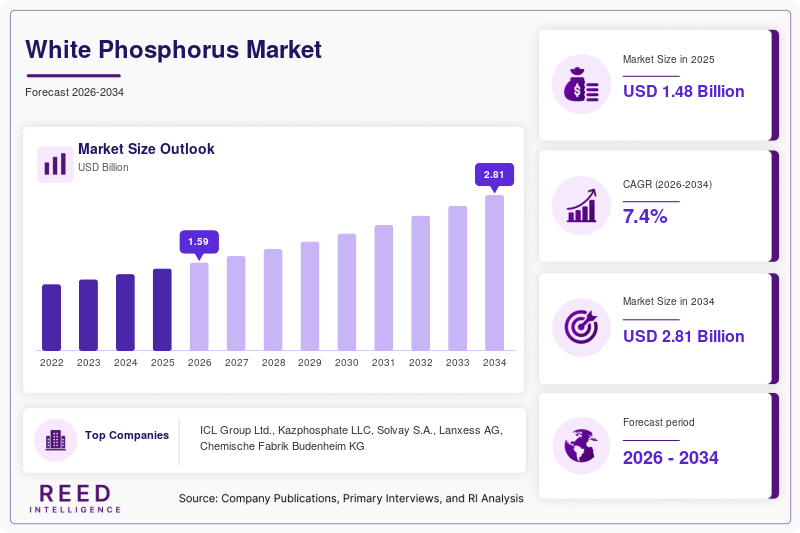
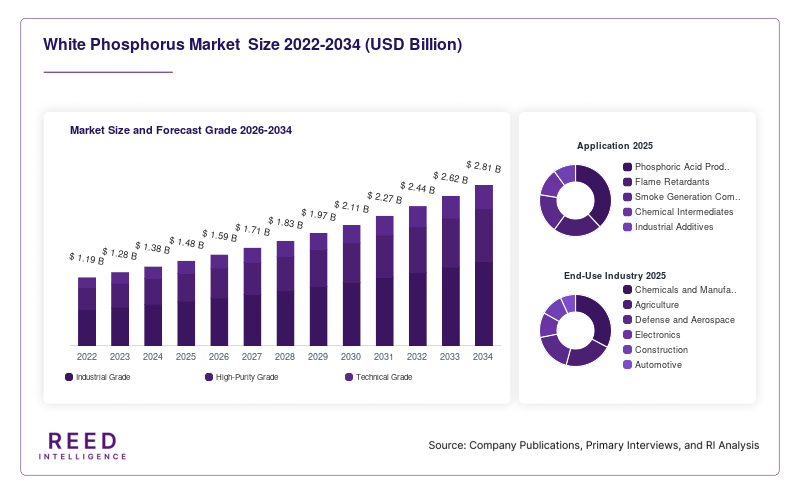
The global White Phosphorus Market size was valued at USD 1.48 billion in 2026 and is projected to reach USD 2.63 billion by 2034, expanding at a CAGR of 7.4% during the forecast period from 2026 to 2034. Market expansion is being influenced by growing demand for phosphorus-based chemicals across agriculture, defense, flame retardants, and industrial processing applications. White phosphorus remains a critical raw material in the production of phosphoric acid derivatives, smoke-generating compounds, and specialty chemical formulations used in several manufacturing industries. The increasing need for high-efficiency agrochemicals and industrial additives has supported long-term demand for white phosphorus across developed and emerging economies.
One of the major global factors contributing to market growth is the continued expansion of fertilizer production and food security initiatives. Governments and private agricultural companies are investing in advanced nutrient management solutions to improve crop productivity. This trend has increased the consumption of phosphorus-based compounds, thereby creating stable demand for white phosphorus processing and downstream chemical manufacturing. In addition, industrial modernization across Asia Pacific and the Middle East has accelerated investments in chemical manufacturing facilities that rely on phosphorus intermediates.
Key Highlights
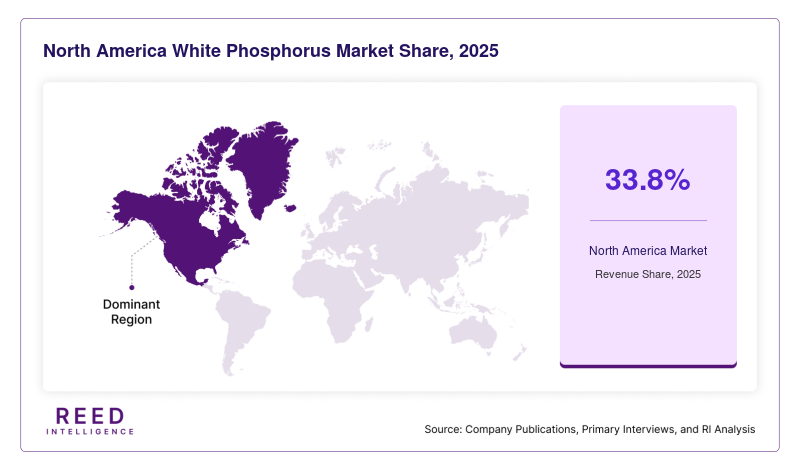
- North America dominated the market with a 33.8% share in 2025.
- Asia Pacific is expected to grow at the fastest CAGR of 8.9% during 2026–2034.
- By grade, industrial grade accounted for the largest share of 46.4%.
- while high-purity grade is projected to grow at a CAGR of 8.7%.
- By application, phosphoric acid production led with a 42.1% share, whereas flame retardants are expected to expand at a CAGR of 8.4%.
- By end-use industry, chemicals and manufacturing held the dominant share of 39.6%, while defense and aerospace are projected to grow at a CAGR of 8.8%.
- China remained the dominant country, with market values of USD 318 million in 2024 and USD 347 million in 2025.
Market Trends
Rising Adoption of High-Purity White Phosphorus in Specialty Chemicals
The growing use of specialty chemicals across electronics, advanced coatings, and industrial catalysts is creating stronger demand for high-purity white phosphorus products. Manufacturers are increasingly focusing on premium phosphorus compounds that offer improved consistency, low contamination levels, and enhanced chemical performance. This trend is particularly visible in semiconductor processing chemicals, electronic-grade phosphates, and advanced flame-retardant formulations. Industrial buyers are prioritizing quality-controlled phosphorus inputs because impurities can affect production efficiency and end-product reliability. As a result, several chemical manufacturers are expanding purification capacities and introducing advanced refining technologies to meet stricter industrial standards.
The trend is also supported by the expansion of high-value manufacturing sectors in Asia Pacific and Europe. Electronics production, battery material development, and specialty polymer manufacturing are creating new consumption channels for refined phosphorus compounds. Companies are entering long-term supply agreements with chemical producers to secure reliable raw material access. In addition, sustainability initiatives are encouraging producers to improve recovery rates and reduce waste during phosphorus purification. These operational improvements are expected to support stable market growth throughout the forecast period.
Increasing Integration of Automation and Safety Technologies in Production Facilities
White phosphorus production involves strict handling and storage requirements due to the material’s reactive properties. As a result, manufacturers are increasingly investing in automated production systems, advanced monitoring equipment, and safety-focused containment infrastructure. Automated temperature monitoring, robotic handling systems, and digital process control platforms are becoming common in modern phosphorus manufacturing plants. These technologies help reduce operational risks, improve production efficiency, and minimize workplace incidents.
The implementation of industrial automation is also helping companies comply with evolving environmental and occupational safety regulations. Several producers are modernizing older facilities to improve storage safety and reduce emissions generated during processing activities. Digital monitoring systems are enabling real-time analysis of furnace performance, chemical purity, and energy consumption. These upgrades are particularly important in regions with strict industrial compliance frameworks such as North America and Europe. The broader adoption of smart manufacturing systems is expected to improve productivity while supporting long-term operational sustainability in the White Phosphorus Market.
Market Drivers
Expanding Demand for Phosphorus-Based Fertilizer Intermediates
The increasing global demand for fertilizers continues to support growth in the White Phosphorus Market. White phosphorus serves as a critical intermediate in the production of phosphoric acid and related phosphate compounds used in agricultural fertilizers. Rapid population growth and changing food consumption patterns are increasing pressure on agricultural productivity, leading governments and farming companies to invest heavily in nutrient-rich fertilizers. Developing economies across Asia Pacific, Latin America, and Africa are expanding agricultural output to strengthen food supply chains, which is contributing to steady phosphorus consumption.
Agricultural modernization programs are also encouraging the adoption of advanced fertilizer blends with improved nutrient efficiency. Manufacturers are increasing production capacity for phosphate-based fertilizers to address growing crop demand and improve soil productivity. In countries with large agricultural sectors, public investment in farming infrastructure and irrigation systems is further supporting fertilizer consumption. These factors are creating stable downstream demand for white phosphorus and strengthening long-term market growth opportunities.
Growth of Defense and Smoke Generation Applications
White phosphorus continues to play an important role in defense applications, particularly in smoke-generating systems, signaling devices, and military-grade incendiary formulations. Increasing defense modernization programs across major economies are contributing to higher procurement of phosphorus-based materials for tactical and operational applications. Governments are expanding investments in military preparedness, which is supporting demand for specialty chemical compounds used in defense manufacturing.
The growing focus on advanced battlefield smoke systems and training equipment is also contributing to market expansion. Several defense contractors are working with chemical suppliers to improve the stability and performance of phosphorus-based smoke generation technologies. In addition, geopolitical tensions and border security investments across parts of Europe, Asia Pacific, and the Middle East are encouraging higher spending on military equipment and tactical chemical materials. This trend is expected to create sustained demand for white phosphorus products throughout the forecast period.
Market Restraint
Stringent Environmental and Safety Regulations Limiting Production Expansion
The White Phosphorus Market faces significant challenges related to environmental regulations and workplace safety requirements. White phosphorus is highly reactive and requires controlled storage, transportation, and processing conditions. Governments across North America and Europe have introduced strict regulations regarding emissions, hazardous waste disposal, and industrial handling procedures. Compliance with these regulations increases operational costs for manufacturers and can delay expansion projects. Small and mid-sized companies often face financial pressure when upgrading facilities to meet evolving environmental standards.
Environmental concerns associated with phosphorus mining and processing activities are also affecting market growth. Regulatory agencies are monitoring emissions generated during furnace operations and phosphorus extraction processes. In several regions, obtaining permits for new production facilities has become increasingly difficult due to concerns regarding water contamination, hazardous material exposure, and industrial emissions. For example, manufacturers operating older phosphorus plants may need to invest heavily in emission-control systems and wastewater treatment technologies to maintain regulatory compliance. These additional costs can reduce profit margins and slow capacity expansion activities.
Market Opportunities
Expansion of Advanced Flame Retardant Manufacturing
The growing use of flame-retardant materials in construction, electronics, automotive, and industrial equipment manufacturing is creating strong opportunities for the White Phosphorus Market. White phosphorus derivatives are widely used in the production of phosphorus-based flame retardants that help improve fire resistance in plastics, textiles, and electrical components. Increasing safety regulations regarding fire prevention in commercial buildings and consumer electronics are encouraging manufacturers to develop advanced flame-retardant compounds.
The shift toward lightweight materials in electric vehicles and electronic devices is also contributing to demand for phosphorus-based additives. Manufacturers are seeking high-performance flame retardants that can maintain thermal stability while meeting environmental and safety standards. This trend is particularly important in Asia Pacific and North America, where electric vehicle production and electronics manufacturing continue to expand. Investments in research and development activities are expected to create new commercial opportunities for specialized phosphorus compounds in advanced industrial applications.
Rising Industrial Investments in Emerging Economies
Emerging economies are becoming important growth centers for white phosphorus production and downstream chemical manufacturing. Countries across Asia Pacific, the Middle East, and Latin America are investing in industrial infrastructure, fertilizer production, and specialty chemical manufacturing facilities. Favorable government policies, expanding export capabilities, and lower manufacturing costs are encouraging chemical producers to establish regional processing operations.
The growth of industrial corridors and integrated chemical zones is creating new opportunities for phosphorus supply chain development. Several governments are offering incentives for domestic chemical production to reduce import dependence and strengthen industrial competitiveness. Expanding infrastructure projects, rising agricultural activity, and increasing demand for industrial chemicals are supporting long-term market growth. In addition, partnerships between regional manufacturers and global chemical companies are expected to improve technology transfer, production efficiency, and distribution capabilities in developing markets.
Segmental Analysis
By Grade
Industrial grade white phosphorus accounted for the largest share of the market in 2024, representing approximately 46.4% of total revenue. The dominance of this segment is linked to its extensive use in phosphoric acid production, flame retardants, and industrial chemical manufacturing. Industrial grade products are widely preferred because they offer cost-effective performance for large-scale manufacturing applications. Fertilizer producers, chemical processing companies, and industrial manufacturers rely heavily on industrial grade phosphorus compounds to support stable production output. Growing demand from developing economies with expanding agricultural and industrial sectors has further strengthened the position of this segment.
High-purity grade white phosphorus is expected to record the fastest CAGR of 8.7% during the forecast period. The growth of this segment is being driven by increasing demand for advanced specialty chemicals, electronics-grade phosphorus compounds, and high-performance industrial additives. Manufacturers operating in electronics, semiconductor processing, and precision chemical production require highly refined phosphorus materials to maintain product quality and operational efficiency. In addition, stricter quality standards in Europe and North America are encouraging companies to shift toward premium-grade phosphorus products. Expanding investments in advanced purification technologies and quality-controlled production systems are expected to support continued segment growth.
By Application
Phosphoric acid production held the dominant share of the White Phosphorus Market in 2024, accounting for 42.1% of total market revenue. White phosphorus serves as an important intermediate in the manufacturing of phosphoric acid, which is widely used in fertilizers, food additives, industrial cleaning agents, and water treatment chemicals. The steady rise in global fertilizer demand continues to support phosphoric acid production activities across Asia Pacific, North America, and Latin America. Large-scale agricultural modernization and growing food security concerns are encouraging manufacturers to expand phosphate production capacity.
Flame retardants are projected to emerge as the fastest-growing application segment, expanding at a CAGR of 8.4% during the forecast period. This growth is primarily associated with rising fire safety regulations across the construction, automotive, and electronics industries. Manufacturers are increasingly adopting phosphorus-based flame retardants because they provide improved thermal stability and effective fire resistance. Demand for lightweight and heat-resistant materials in electric vehicles and electronic devices is also contributing to segment expansion. Research and development activities focused on environmentally compliant flame-retardant formulations are expected to create additional opportunities for phosphorus compound manufacturers.
By End-Use Industry
The chemicals and manufacturing segment accounted for the largest market share in 2024, representing 39.6% of global revenue. White phosphorus is widely used in the production of industrial chemicals, phosphates, detergents, specialty additives, and processing compounds. Strong industrial activity across Asia Pacific and North America has contributed to stable demand from chemical manufacturers. Companies are investing in production capacity expansion and process optimization to improve output efficiency and reduce operating costs. The increasing use of phosphorus compounds in industrial processing and material manufacturing continues to support segment dominance.
Defense and aerospace is expected to register the fastest CAGR of 8.8% between 2026 and 2034. Growing military modernization programs and increasing investments in tactical smoke-generation systems are contributing to rising phosphorus demand within this segment. White phosphorus is used in signaling devices, smoke screens, and specialized defense applications that require rapid smoke generation and high combustion efficiency. Several countries are increasing defense budgets to strengthen operational readiness and border security capabilities. In addition, technological advancements in military-grade smoke systems and training equipment are expected to create long-term growth opportunities for phosphorus-based products.
Regional Analysis
North America
North America accounted for 33.8% of the global White Phosphorus Market in 2025 and is expected to maintain stable growth at a CAGR of 6.8% during the forecast period. The region benefits from established chemical manufacturing infrastructure, advanced industrial safety standards, and strong demand from defense and specialty chemical industries. Market growth is also supported by rising investments in phosphorus-based flame retardants and industrial additives used in electronics, construction materials, and transportation applications. The United States and Canada continue to invest in advanced chemical processing technologies to improve production efficiency and environmental compliance.
The United States remains the dominant country in the regional market due to its large defense sector and well-developed industrial chemicals industry. The country recorded strong demand for phosphorus compounds used in smoke-generation systems, industrial processing chemicals, and high-performance additives. One unique growth factor supporting the U.S. market is the modernization of domestic specialty chemical production facilities. Companies are integrating automated process monitoring systems and energy-efficient furnaces to improve operational performance while meeting environmental standards.
Europe
Europe represented 24.6% of the global White Phosphorus Market in 2025 and is projected to expand at a CAGR of 6.5% from 2026 to 2034. The regional market is supported by strict industrial quality standards, strong research capabilities, and increasing demand for advanced flame-retardant materials. European chemical manufacturers are focusing on developing environmentally compliant phosphorus compounds for industrial and commercial applications. Rising investments in sustainable manufacturing and recycling technologies are also supporting regional market growth.
Germany leads the European market due to its strong industrial base and advanced specialty chemicals sector. The country has a well-established network of chemical processing companies involved in phosphorus derivative manufacturing. A unique factor driving growth in Germany is the increasing integration of phosphorus-based flame retardants in automotive electronics and industrial automation equipment. Growing electric vehicle production and advanced manufacturing activities are expected to support long-term demand for high-quality phosphorus compounds across the country.
Asia Pacific
Asia Pacific held 28.9% of the global White Phosphorus Market in 2025 and is expected to witness the fastest CAGR of 8.9% during the forecast period. The region benefits from rapid industrialization, expanding agricultural activities, and large-scale chemical manufacturing operations. Strong fertilizer demand across China, India, and Southeast Asia continues to support phosphorus consumption. In addition, increasing investments in electronics manufacturing, construction materials, and industrial processing chemicals are strengthening regional market expansion.
China remains the largest market in Asia Pacific due to its dominant phosphorus mining and chemical production capabilities. The country has extensive manufacturing infrastructure for phosphoric acid, industrial chemicals, and phosphorus derivatives. One unique growth factor supporting China’s market is the expansion of integrated chemical production clusters that improve supply chain efficiency and reduce manufacturing costs. Government-backed industrial modernization programs and export-oriented production strategies are also contributing to continued market growth.
Middle East & Africa
The Middle East & Africa region accounted for 7.4% of the global White Phosphorus Market in 2025 and is projected to grow at a CAGR of 7.1% through 2034. Market growth is being supported by increasing investments in industrial diversification and fertilizer manufacturing. Several countries in the region are expanding chemical processing capabilities to reduce dependence on imports and improve domestic industrial output. Rising infrastructure development and agricultural modernization programs are also contributing to regional phosphorus demand.
Saudi Arabia represents the leading market within the region due to its expanding petrochemical and industrial chemicals sector. The country is investing heavily in integrated manufacturing facilities that support fertilizer production and specialty chemical development. A unique growth factor driving the Saudi Arabian market is the government’s long-term industrial diversification strategy, which encourages domestic chemical production and export expansion. These initiatives are expected to strengthen regional demand for white phosphorus and phosphorus-based compounds.
Latin America
Latin America captured 5.3% of the global White Phosphorus Market in 2025 and is anticipated to register a CAGR of 6.9% during the forecast period. The regional market is influenced by growing agricultural activities, increasing fertilizer consumption, and expanding industrial manufacturing. Countries across the region are investing in modern farming practices to improve crop yields and food exports. This trend is contributing to rising demand for phosphate-based fertilizers and phosphorus intermediates.
Brazil dominates the Latin American market due to its large agricultural economy and strong fertilizer demand. The country relies heavily on phosphorus-based nutrients to support soybean, sugarcane, and corn production. One unique factor driving growth in Brazil is the increasing adoption of precision agriculture technologies that require efficient nutrient management solutions. Rising investments in domestic fertilizer manufacturing and agricultural supply chain modernization are expected to support continued market expansion.
Competitive Landscape
The White Phosphorus Market is moderately consolidated, with leading manufacturers focusing on production efficiency, safety compliance, and downstream product expansion. Major companies are investing in advanced furnace technologies, purification systems, and integrated chemical manufacturing operations to strengthen market positioning. Strategic partnerships with fertilizer producers, specialty chemical manufacturers, and industrial distributors remain an important competitive strategy within the market.
ICL Group is considered one of the leading participants due to its broad phosphorus product portfolio and strong global distribution network. The company continues to invest in operational modernization and environmentally compliant production technologies. In a recent development, the company expanded its specialty phosphorus processing capabilities to support growing demand from industrial and flame-retardant applications.
Key Players
- ICL Group Ltd.
- Kazphosphate LLC
- Solvay S.A.
- Lanxess AG
- Chemische Fabrik Budenheim KG
- Thermphos International B.V.
- Fosfa a.s.
- Prayon S.A.
- Nippon Chemical Industrial Co., Ltd.
- Sichuan Chuantou Chemical Industry Group
- Guizhou Kailin Group
- Yunnan Phosphate Chemical Group
- Italmatch Chemicals S.p.A.
- Innophos Holdings Inc.
Recent Developments
- In February 2025, a major phosphorus producer in China announced the expansion of its integrated phosphorus processing facility to improve output capacity for specialty chemical applications.
- In August 2024, ICL Group introduced upgraded purification technology designed to improve phosphorus quality and reduce industrial emissions during production processes.
- In November 2025, a European chemical manufacturer entered a strategic agreement with an automotive materials supplier to develop phosphorus-based flame-retardant compounds for electric vehicle applications.
- In March 2026, a Middle Eastern industrial chemicals company invested in advanced phosphorus storage and safety systems to support expanding fertilizer manufacturing operations.
White Phosphorus Market Segments
Grade
- Industrial Grade
- High-Purity Grade
- Technical Grade
Application
- Phosphoric Acid Production
- Flame Retardants
- Smoke Generation Compounds
- Chemical Intermediates
- Industrial Additives
End-Use Industry
- Chemicals and Manufacturing
- Agriculture
- Defense and Aerospace
- Electronics
- Construction
- Automotive
By Region
- North America
- Europe
- APAC
- Middle East and Africa
- LATAM