Wilsons Disease Market Size, Share & Demand Report By Treatment Type (Chelation Therapy, Zinc Therapy, Gene Therapy), By Diagnosis Method (Blood and Urine Tests, Liver Biopsy, Genetic Testing), By End-User (Hospitals, Specialty Clinics, Research Institutes), By Distribution Channel (Hospital Pharmacies, Retail Pharmacies, Online Pharmacies), By Region & Segment Forecasts, 2025–2034
USD 3950
Market Overview
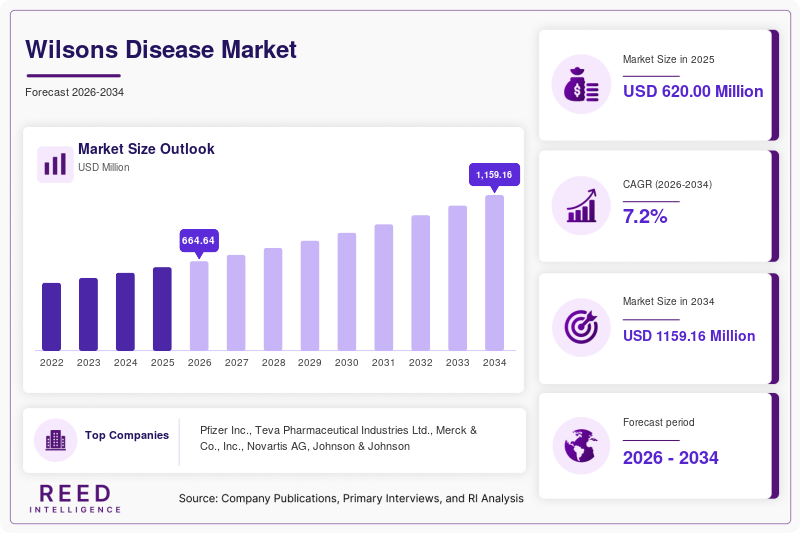
The Wilsons Disease Market size was valued at approximately USD 620 million in 2025 and is projected to reach USD 1.15 billion by 2034, expanding at a CAGR of 7.2% during the forecast period (2025–2034). The market has demonstrated stable growth due to increasing awareness of rare genetic disorders and improvements in diagnostic technologies. Wilson’s disease, a rare autosomal recessive disorder characterized by excessive copper accumulation in the liver and brain, requires lifelong treatment, creating sustained demand for therapeutic interventions.
A key global factor supporting market growth is the expansion of rare disease screening programs and early diagnosis initiatives across developed and emerging economies. Governments and healthcare organizations are increasingly prioritizing genetic disorder detection, enabling earlier intervention and improved patient outcomes. This shift has strengthened the demand for chelation therapies, zinc-based treatments, and liver transplantation services.
Key Highlights
- North America dominated the market with a 38.5% share in 2025, while Asia Pacific is projected to register the fastest CAGR of 8.6% through 2034.
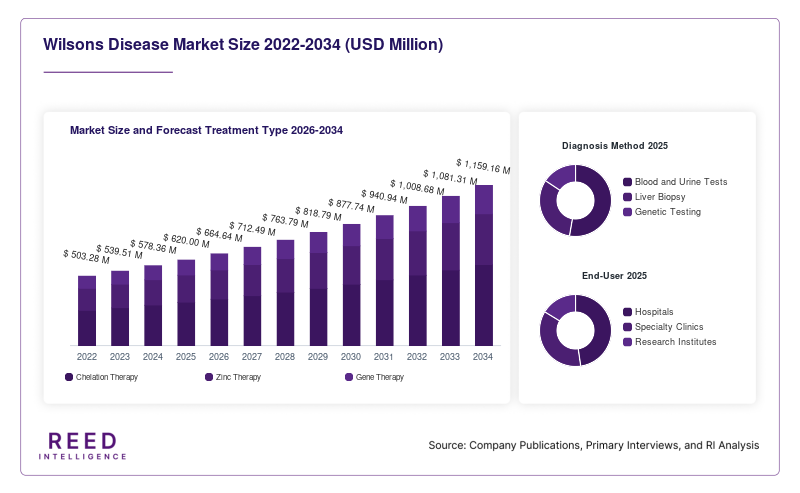
- By treatment type, chelation therapy accounted for the largest share at 52.3% in 2025, while gene therapy is expected to grow at the fastest CAGR of 10.2%.
- By distribution channel, hospital pharmacies led with 46.7% share, while online pharmacies are projected to expand at a CAGR of 9.4%.
- The United States recorded a market value of USD 210 million in 2025 and is estimated to reach USD 225 million in 2026.
Market Trends
Increasing Adoption of Targeted Therapies
The Wilsons Disease Market is witnessing a gradual shift toward targeted and personalized treatment approaches. Traditional chelation therapies are being complemented by novel formulations designed to minimize side effects and improve patient adherence. Pharmaceutical companies are exploring advanced drug delivery systems and precision medicine approaches, which are expected to enhance therapeutic efficacy. This trend reflects the broader movement within rare disease management toward individualized treatment regimens.
Growing Focus on Genetic Research and Gene Therapy
Advancements in genetic research have opened new pathways for treating Wilson’s disease at its root cause. Gene therapy is emerging as a promising area, aiming to correct ATP7B gene mutations responsible for the disorder. While still in early stages, clinical trials are gaining traction, supported by funding from research institutions and biotech firms. This trend is likely to reshape the long-term outlook of the Wilsons Disease Market by potentially offering curative treatment options rather than lifelong management.
Market Drivers
Rising Awareness and Early Diagnosis Programs
Increased awareness about rare genetic disorders has significantly contributed to the growth of the Wilsons Disease Market. Public health initiatives and educational campaigns have improved disease recognition among healthcare professionals and patients. Early diagnosis enables timely treatment initiation, reducing complications and increasing survival rates, thereby driving demand for therapeutic solutions.
Expansion of Orphan Drug Development Incentives
Regulatory frameworks supporting orphan drug development have accelerated innovation within the Wilsons Disease Market. Incentives such as tax credits, market exclusivity, and expedited approval processes encourage pharmaceutical companies to invest in rare disease treatments. This has led to a growing pipeline of therapies, enhancing market competitiveness and expanding available treatment options.
Market Restraint
High Cost of Treatment and Limited Accessibility
The high cost associated with Wilson’s disease treatment remains a significant barrier to market growth. Long-term therapies, including chelation drugs and liver transplantation, impose substantial financial burdens on patients and healthcare systems. In many low- and middle-income regions, access to advanced treatments is limited due to inadequate healthcare infrastructure and reimbursement challenges.
Additionally, the rarity of the disease results in smaller patient populations, which can restrict large-scale investment and limit economies of scale in drug production. This contributes to higher drug prices and reduced affordability. These factors collectively hinder the widespread adoption of treatment options and constrain the overall growth potential of the Wilsons Disease Market.
Market Opportunities
Development of Curative Gene-Based Therapies
The emergence of gene therapy presents a significant opportunity in the Wilsons Disease Market. As research progresses, therapies targeting the underlying genetic mutation may offer long-term or permanent solutions. This could reduce dependency on lifelong medication and transform treatment paradigms. Companies investing in gene-editing technologies and viral vector platforms are likely to gain a competitive edge.
Expansion in Emerging Healthcare Markets
Emerging economies present untapped potential due to improving healthcare infrastructure and increasing awareness of rare diseases. Countries in Asia Pacific, Latin America, and the Middle East are investing in diagnostic capabilities and expanding access to specialized care. As healthcare systems evolve, the adoption of Wilson’s disease treatments is expected to rise, creating new revenue streams for market participants.
Segmental Analysis
By Treatment Type
Chelation therapy dominated the Wilsons Disease Market in 2025, accounting for approximately 52.3% of the total share. This dominance was attributed to its widespread use as a first-line treatment for removing excess copper from the body. Established drugs such as penicillamine and trientine have been widely prescribed due to their proven efficacy.
Gene therapy is expected to emerge as the fastest-growing segment, registering a CAGR of 10.2% during the forecast period. Its growth will be driven by advancements in genetic engineering and increasing investment in curative treatment approaches.
By Diagnosis Method
Blood and urine tests held the largest share of 44.8% in 2025 due to their accessibility and cost-effectiveness. These methods are commonly used for initial screening and ongoing monitoring.
Genetic testing is projected to grow at a CAGR of 9.1% owing to its ability to provide definitive diagnosis. Advances in molecular diagnostics will support its adoption.
By End-User
Hospitals accounted for the largest share at 49.6% in 2025, driven by the availability of specialized care and advanced treatment facilities.
Specialty clinics are expected to grow at a CAGR of 8.8% as patients increasingly seek targeted and personalized care.
By Distribution Channel
Hospital pharmacies dominated with a 46.7% share in 2025 due to direct access to prescribed medications.
Online pharmacies are anticipated to grow at a CAGR of 9.4% driven by increasing digitalization and convenience.
Regional Analysis
North America
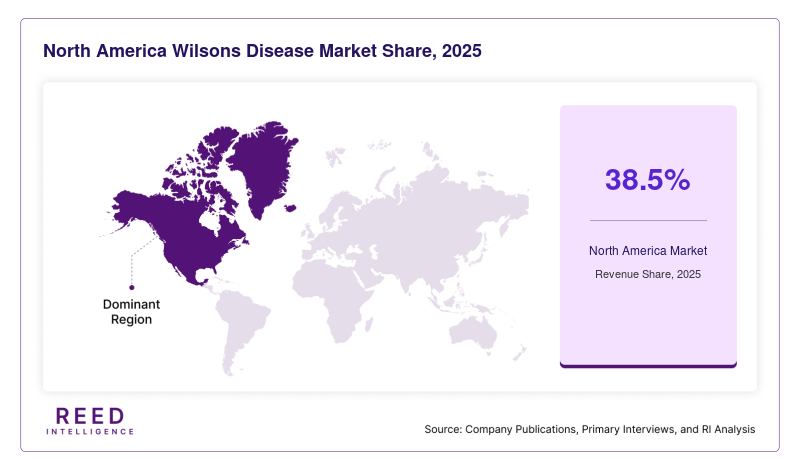
North America accounted for approximately 38.5% of the Wilsons Disease Market share in 2025 and will continue to grow at a CAGR of 6.8% through 2034. The region benefited from advanced healthcare infrastructure and strong research capabilities.
The United States dominated the regional market due to well-established rare disease programs and access to specialized treatment centers. High awareness levels and strong reimbursement frameworks supported consistent treatment adoption.
Europe
Europe held a market share of around 27.2% in 2025 and is expected to grow at a CAGR of 6.9% during the forecast period. The region demonstrated steady growth supported by government-backed healthcare systems.
Germany emerged as the leading country due to its strong pharmaceutical industry and emphasis on rare disease research. National health programs and early screening initiatives contributed to improved diagnosis rates.
Asia Pacific
Asia Pacific represented 18.6% of the Wilsons Disease Market share in 2025 and is projected to expand at the fastest CAGR of 8.6% through 2034. The region experienced rapid growth due to increasing healthcare investments.
China led the regional market owing to its large population base and expanding diagnostic infrastructure. Growing awareness and improved access to healthcare services have accelerated treatment adoption.
Middle East & Africa
The Middle East & Africa accounted for 8.1% of the market share in 2025 and will grow at a CAGR of 7.4% over the forecast period. The region showed gradual improvement in healthcare accessibility.
Saudi Arabia dominated due to increasing investments in healthcare modernization and rare disease management programs. Government initiatives have enhanced access to specialized treatments.
Latin America
Latin America held a 7.6% market share in 2025 and is expected to grow at a CAGR of 7.1% through 2034. The region displayed moderate growth supported by expanding healthcare services.
Brazil led the market due to its improving public healthcare system and rising awareness of genetic disorders. Efforts to enhance diagnostic capabilities have supported market expansion.
Competitive Landscape
The Wilsons Disease Market is moderately competitive, with a mix of established pharmaceutical companies and emerging biotech firms. Key players focus on expanding their product portfolios and investing in research to develop advanced therapies.
Pfizer Inc. is considered a leading player, leveraging its strong research capabilities and global distribution network. The company recently expanded its rare disease portfolio through strategic collaborations aimed at developing innovative treatments for genetic disorders.
Other companies are focusing on clinical trials, partnerships, and regional expansion strategies to strengthen their market presence. The competitive landscape is expected to evolve further as new entrants explore gene therapy and precision medicine opportunities.
Key Players
- Pfizer Inc.
- Teva Pharmaceutical Industries Ltd.
- Merck & Co., Inc.
- Novartis AG
- Johnson & Johnson
- Bristol-Myers Squibb Company
- F. Hoffmann-La Roche Ltd
- AstraZeneca plc
- Sanofi S.A.
- Takeda Pharmaceutical Company Limited
- Amgen Inc.
- Bayer AG
- Mallinckrodt Pharmaceuticals
- Orphalan SA
- Ultragenyx Pharmaceutical Inc.
Recent Developments
- In 2024, several biotech firms initiated early-stage clinical trials focusing on gene therapy for Wilson’s disease.
- In 2025, a leading pharmaceutical company introduced an improved formulation of chelation therapy aimed at reducing side effects.
- Regulatory agencies expanded orphan drug incentives to accelerate the development of rare disease treatments.
- Partnerships between research institutions and pharmaceutical companies increased, focusing on genetic research and precision medicine.
- Digital health platforms were integrated into patient management systems to improve treatment adherence and monitoring.
Wilsons Disease Market Segments
Treatment Type
- Chelation Therapy
- Zinc Therapy
- Gene Therapy
Diagnosis Method
- Blood and Urine Tests
- Liver Biopsy
- Genetic Testing
End-User
- Hospitals
- Specialty Clinics
- Research Institutes
Distribution Channel
- Hospital Pharmacies
- Retail Pharmacies
- Online Pharmacies
By Region
- North America
- Europe
- APAC
- Middle East and Africa
- LATAM