Wind Anemometers Market Size, Share & Demand Report By Product Type (Ultrasonic Anemometers, Cup Anemometers, Vane Anemometers, Portable Handheld Anemometers), By Application (Renewable Energy Monitoring, Aviation and Aerospace, Environmental and Weather Research, Marine and Offshore Operations), By End Use (Energy and Utilities, Construction, Agriculture, Transportation and Aviation, Oil and Gas, Research Institutions, Manufacturing), By Region & Segment Forecasts, 2026–2034
USD 3950
Market Overview
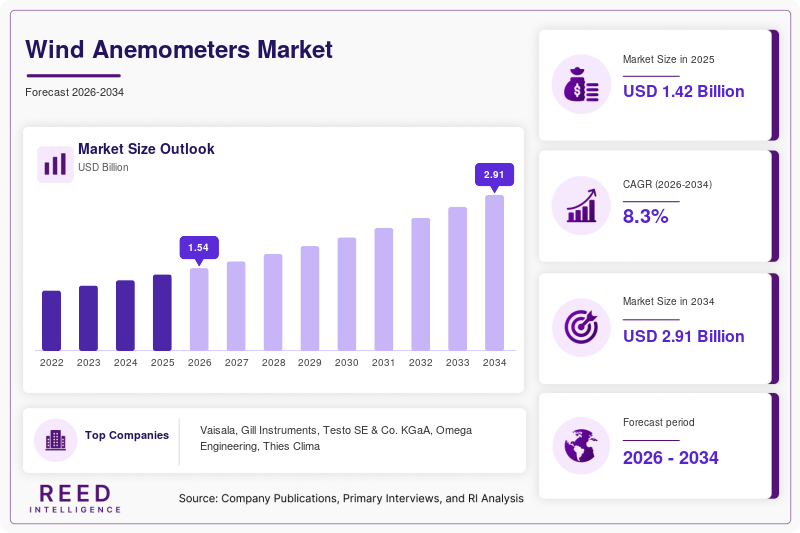
The global Wind Anemometers Market size was valued at USD 1.42 billion in 2026 and is projected to reach USD 2.68 billion by 2034, expanding at a CAGR of 8.3% during the forecast period from 2026 to 2034. The market is experiencing stable growth due to rising investments in renewable energy infrastructure, expanding industrial safety standards, and increasing demand for precision weather monitoring systems across transportation, agriculture, construction, and environmental research sectors. Wind anemometers are widely used for measuring wind speed, pressure, and airflow in commercial as well as industrial applications. Growing deployment of offshore and onshore wind farms has further strengthened demand for reliable and durable wind monitoring equipment.
A major global factor supporting market growth is the increasing focus on climate monitoring and renewable energy integration. Governments and private organizations are investing in meteorological infrastructure to improve weather forecasting, aviation safety, and wind resource assessment. The rapid development of smart cities and connected infrastructure has also increased the need for advanced digital wind measurement systems integrated with cloud analytics and IoT-enabled monitoring platforms. In addition, stricter workplace safety regulations across manufacturing plants, mining facilities, marine operations, and energy projects continue to create sustained demand for portable and fixed wind anemometers.
Key Highlights
- North America dominated the market with a 35.1% share in 2025.
- Asia Pacific is expected to grow at the fastest CAGR of 10.8% during 2026–2034.
- By product type, ultrasonic anemometers accounted for the largest share of 39.4%.
- while portable handheld anemometers are projected to grow at a CAGR of 11.5%.
- By application, renewable energy monitoring led with a 42.1% share, whereas smart infrastructure monitoring is expected to expand at a CAGR of 12.1%.
- The United States remained the dominant country, with market values of USD 420 million in 2024 and USD 462 million in 2025.
Market Trends
Integration of IoT and Smart Monitoring Technologies
The Wind Anemometers Market is witnessing growing adoption of IoT-enabled monitoring systems across industrial and commercial sectors. Modern wind anemometers are increasingly integrated with wireless communication platforms, cloud-based analytics, and real-time monitoring dashboards. These systems enable continuous wind data collection and automated reporting for wind farms, airports, construction sites, and marine operations. Smart monitoring solutions reduce manual inspection requirements and improve operational efficiency by providing predictive maintenance insights. Industrial operators are investing in connected environmental monitoring systems to enhance safety and comply with environmental standards. The demand for smart weather stations in smart city projects has also accelerated adoption of digital anemometers equipped with remote calibration and automated alert systems.
Rising Demand for Ultrasonic and Non-Mechanical Devices
The transition from conventional mechanical wind measurement systems toward ultrasonic wind anemometers has become a significant market trend. Ultrasonic devices offer higher accuracy, lower maintenance costs, and improved durability compared to cup or vane-based instruments. These products are increasingly preferred in offshore wind farms, research stations, and aviation infrastructure where reliable performance under harsh weather conditions is critical. Manufacturers are focusing on compact designs and lightweight materials to improve portability and ease of installation. The adoption of ultrasonic technology is also expanding in agriculture and environmental monitoring due to its ability to provide multidirectional wind measurements with minimal calibration requirements. As industries prioritize long-term operational efficiency, demand for maintenance-free anemometers is expected to increase steadily.
Market Drivers
Expansion of Renewable Energy Projects Worldwide
The rapid growth of renewable energy infrastructure is a major factor driving the Wind Anemometers Market. Governments across North America, Europe, and Asia Pacific are investing heavily in onshore and offshore wind energy projects to reduce carbon emissions and strengthen energy security. Wind anemometers play a critical role in site assessment, turbine placement, wind resource analysis, and operational monitoring. Accurate wind measurement data helps energy companies improve turbine efficiency and optimize power generation output. Increasing installations of offshore wind farms in countries such as China, the United States, Germany, and the United Kingdom have significantly increased demand for advanced ultrasonic and digital anemometers capable of operating in demanding environmental conditions.
In addition, energy companies are using advanced wind monitoring systems integrated with analytics software to improve forecasting accuracy and reduce operational risks. Rising investments in grid modernization and renewable energy storage infrastructure continue to create favorable market conditions. Emerging economies are also accelerating wind energy deployment through supportive government incentives and renewable energy targets. These developments are expected to maintain long-term demand for precision wind monitoring equipment.
Growing Focus on Workplace and Aviation Safety
The increasing emphasis on occupational safety standards and aviation safety regulations is supporting strong demand for wind measurement equipment. Construction companies, mining operators, ports, marine facilities, and oil and gas sites use wind anemometers to monitor hazardous weather conditions and protect workers and equipment. Regulatory agencies in several countries require real-time wind monitoring at industrial sites where high wind speeds can affect crane operations, lifting activities, and worker safety.
The aviation sector is another major contributor to market growth. Airports and air traffic management authorities rely on accurate wind speed and direction data to improve aircraft navigation and runway safety. Rising global air traffic and airport infrastructure expansion projects are increasing demand for advanced weather monitoring systems. Portable handheld anemometers are also gaining popularity among field technicians and inspection teams due to their mobility and ease of operation. Continuous advancements in sensor accuracy and digital communication technologies are further enhancing adoption across safety-critical applications.
Market Restraints
High Initial Costs and Calibration Challenges
The high installation and maintenance costs associated with advanced wind anemometer systems remain a key restraint for market growth. Ultrasonic and IoT-enabled devices offer improved accuracy and digital connectivity, but their initial procurement costs are significantly higher than traditional mechanical systems. Small businesses, local weather stations, and budget-sensitive industries often hesitate to invest in premium monitoring solutions due to limited financial resources. In developing economies, low-cost conventional devices continue to dominate certain applications because of affordability concerns.
Calibration and maintenance requirements also create operational challenges for end users. Wind anemometers used in offshore wind farms, industrial facilities, and research stations require periodic inspection and recalibration to maintain accuracy. Harsh environmental conditions such as saltwater exposure, dust accumulation, and temperature fluctuations can affect sensor performance over time. Equipment downtime during maintenance activities may disrupt industrial operations and increase service costs. In addition, the lack of skilled technical personnel for advanced sensor calibration in some regions limits wider adoption of sophisticated monitoring systems. These factors may slow market penetration among small and medium-scale users despite increasing demand for accurate wind measurement technologies.
Market Opportunities
Increasing Adoption in Smart Infrastructure Projects
The growing development of smart infrastructure projects presents significant opportunities for the Wind Anemometers Market. Governments and urban planning agencies are investing in smart transportation systems, connected buildings, and intelligent environmental monitoring networks. Wind anemometers are increasingly integrated into urban weather stations and smart infrastructure platforms to support traffic safety, pollution monitoring, and disaster management applications. Real-time wind data helps authorities manage bridge operations, monitor high-rise building safety, and improve emergency response systems during severe weather conditions.
The expansion of smart city programs in Asia Pacific and the Middle East is expected to create strong demand for compact wireless wind sensors. Manufacturers are focusing on low-power devices with cloud integration capabilities to meet the needs of digital infrastructure projects. Integration with AI-based weather prediction systems and automated control platforms can further improve operational efficiency. As cities prioritize climate resilience and environmental sustainability, demand for advanced wind monitoring technologies is expected to rise steadily.
Growth Potential in Precision Agriculture and Environmental Research
Precision agriculture and environmental research applications are creating new revenue opportunities for market participants. Farmers and agricultural technology providers are increasingly using wind anemometers to monitor spray drift, irrigation planning, and crop management activities. Accurate wind measurements help reduce pesticide waste and improve agricultural productivity. The growing adoption of precision farming practices in countries such as India, Brazil, and Australia is expected to support demand for portable and low-cost wind monitoring devices.
Environmental research organizations and climate monitoring agencies are also investing in advanced meteorological equipment to improve data accuracy and climate analysis capabilities. Rising concerns regarding climate change, air quality, and extreme weather events have increased funding for environmental observation programs. Universities and research institutions are adopting ultrasonic and multi-parameter weather stations for scientific studies and atmospheric analysis. Manufacturers have opportunities to develop customized products for agriculture and environmental applications, particularly in emerging markets with expanding research infrastructure.
Segmental Analysis
By Product Type
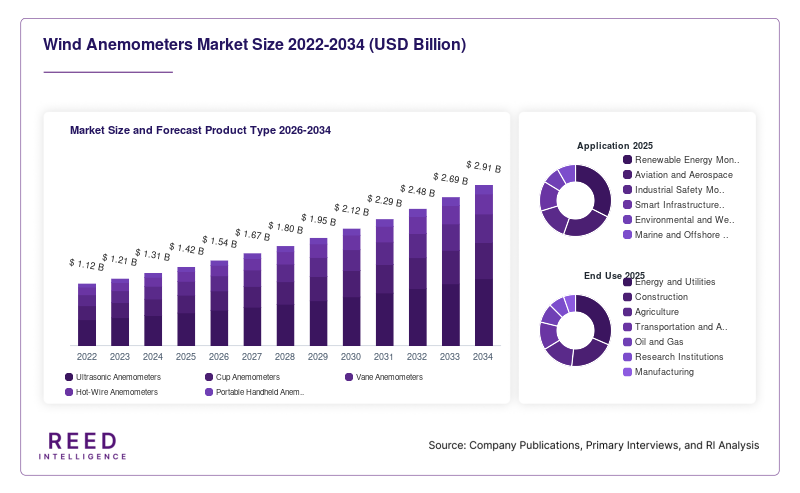
Ultrasonic anemometers accounted for the largest share of the Wind Anemometers Market in 2024, representing approximately 39.4% of total revenue. These devices are widely preferred across offshore wind farms, aviation systems, meteorological stations, and industrial applications because they provide accurate and multidirectional wind measurements without moving mechanical components. Their low maintenance requirements and ability to operate effectively in harsh environmental conditions have contributed to strong adoption across developed economies. Manufacturers are introducing compact ultrasonic systems with wireless communication and cloud integration features to improve operational efficiency. Increasing demand for high-precision weather monitoring and renewable energy optimization has further strengthened the dominance of this product category.
By Application
Renewable energy monitoring emerged as the dominant application segment in 2024, accounting for 42.1% of the overall Wind Anemometers Market share. Wind anemometers are extensively used for wind resource assessment, turbine efficiency analysis, and operational monitoring in onshore and offshore wind farms. Energy companies require accurate wind speed and direction data to optimize power generation output and improve project planning. The expansion of renewable energy targets across major economies has significantly increased installation of advanced wind monitoring systems. Offshore projects in Europe, North America, and Asia Pacific have further accelerated demand for durable ultrasonic and digital anemometers capable of delivering reliable performance under challenging environmental conditions.
By End Use
The energy and utilities sector held the largest share of the Wind Anemometers Market in 2024, contributing nearly 37.8% of global revenue. Wind anemometers are critical for renewable energy production, weather forecasting, and grid management applications. Utility companies rely on accurate wind data to improve operational planning and optimize renewable energy integration into power grids. Increasing deployment of offshore wind projects and modernization of existing renewable energy infrastructure have significantly increased demand for high-performance wind monitoring systems. The adoption of automated monitoring technologies by utility operators is also improving operational efficiency and reducing maintenance costs. These factors continue to support the dominance of the energy and utilities segment.
Regional Analysis
North America
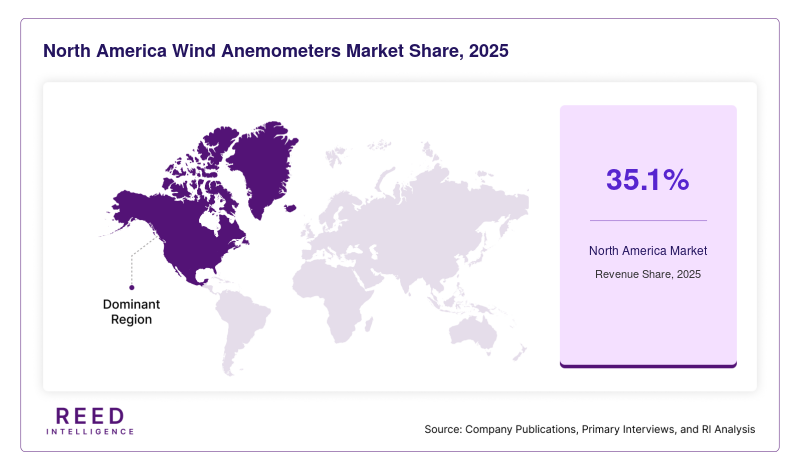
North America accounted for 35.1% of the global Wind Anemometers Market share in 2025 and is expected to maintain a stable growth trajectory during the forecast period. The region is projected to expand at a CAGR of 7.9% from 2026 to 2034 due to increasing investments in renewable energy projects and advanced meteorological infrastructure. The United States and Canada continue to adopt high-precision wind monitoring systems for offshore wind farms, aviation operations, and industrial safety management. Strong adoption of IoT-enabled environmental monitoring systems and strict workplace safety regulations are supporting demand for digital and ultrasonic anemometers.
Europe
Europe represented 28.4% of the global Wind Anemometers Market in 2025 and is forecast to grow at a CAGR of 8.1% during the study period. The region benefits from strong environmental regulations, established renewable energy targets, and significant investments in offshore wind energy infrastructure. Countries across Western and Northern Europe are expanding meteorological monitoring networks to improve climate forecasting and renewable energy planning. Demand for ultrasonic anemometers is particularly strong due to the need for accurate and low-maintenance systems in offshore installations and research applications.
Asia Pacific
Asia Pacific held 22.6% of the Wind Anemometers Market in 2025 and is expected to register the fastest CAGR of 10.8% during 2026–2034. Rapid industrialization, urban expansion, and large-scale renewable energy projects are driving market growth across the region. Countries including China, India, Japan, and South Korea are increasing investments in smart city infrastructure, environmental monitoring systems, and weather forecasting technologies. The expansion of manufacturing facilities and construction projects has also increased demand for portable and fixed wind monitoring solutions across industrial sites.
Middle East & Africa
The Middle East & Africa region accounted for 7.2% of the global Wind Anemometers Market in 2025 and is anticipated to grow at a CAGR of 8.6% during the forecast period. Increasing investments in renewable energy diversification and industrial safety infrastructure are supporting market development. Countries in the Gulf region are expanding weather monitoring capabilities to support aviation operations, marine activities, and large-scale construction projects. Demand for durable wind measurement systems is increasing due to extreme climatic conditions and the need for continuous environmental monitoring.
Latin America
Latin America captured 6.7% of the Wind Anemometers Market share in 2025 and is projected to grow at a CAGR of 7.8% during 2026–2034. The region is benefiting from growing renewable energy investments, agricultural modernization, and infrastructure development activities. Governments are increasing focus on climate resilience and environmental monitoring, creating opportunities for meteorological equipment suppliers. The demand for portable anemometers is particularly strong in agricultural and construction applications where cost-effective weather monitoring solutions are required.
Competitive Landscape
The Wind Anemometers Market is moderately fragmented, with several international and regional companies competing through product innovation, pricing strategies, and technological advancements. Leading market participants are focusing on wireless connectivity, AI-enabled monitoring systems, and durable sensor technologies to strengthen their market positions. Strategic partnerships with renewable energy companies and meteorological agencies have become common among major manufacturers seeking to expand their global customer base.
Vaisala remains one of the leading companies in the market due to its strong product portfolio and extensive presence across renewable energy and environmental monitoring applications. The company has continued to invest in ultrasonic sensing technology and cloud-based analytics solutions to improve monitoring accuracy and operational efficiency. Other major players are emphasizing product customization and portable monitoring solutions to meet diverse industrial requirements.
Key Players
- Vaisala
- Gill Instruments
- Testo SE & Co. KGaA
- Omega Engineering
- Thies Clima
- Campbell Scientific
- Kestrel Instruments
- AIRMAR Technology Corporation
- Lufft
- Biral
- FT Technologies
- Delta OHM
- Kanomax USA
- PCE Instruments
Recent Developments
- Vaisala introduced an upgraded ultrasonic wind monitoring system in 2025 designed for offshore renewable energy projects with enhanced corrosion resistance and remote diagnostics capabilities.
- Gill Instruments expanded its wireless IoT-enabled anemometer portfolio in 2024 to support smart city and infrastructure monitoring applications across Asia Pacific and Europe.
- Testo SE & Co. KGaA launched a compact handheld digital anemometer in 2025 with smartphone integration features targeting HVAC inspection and industrial maintenance professionals.
- Campbell Scientific partnered with renewable energy operators in North America during 2024 to deploy advanced weather monitoring stations integrated with predictive analytics platforms.
Wind Anemometers Market Segments
Product Type
- Ultrasonic Anemometers
- Cup Anemometers
- Vane Anemometers
- Hot-Wire Anemometers
- Portable Handheld Anemometers
Application
- Renewable Energy Monitoring
- Aviation and Aerospace
- Industrial Safety Monitoring
- Smart Infrastructure Monitoring
- Environmental and Weather Research
- Marine and Offshore Operations
End Use
- Energy and Utilities
- Construction
- Agriculture
- Transportation and Aviation
- Oil and Gas
- Research Institutions
- Manufacturing
By Region
- North America
- Europe
- APAC
- Middle East and Africa
- LATAM