Wind Turbine Inspection Drones Market Size, Share & Demand Report By Type (Multirotor Drones, Fixed-Wing Drones, Hybrid Drones), By Application (Blade Inspection, Tower Inspection, Nacelle Inspection, Offshore Inspection), By Component (Hardware, Software, Services), By End-Use (Wind Farm Operators, Third-Party Service Providers) & Segment Forecasts, 2025–2034
USD 3950
Market Overview
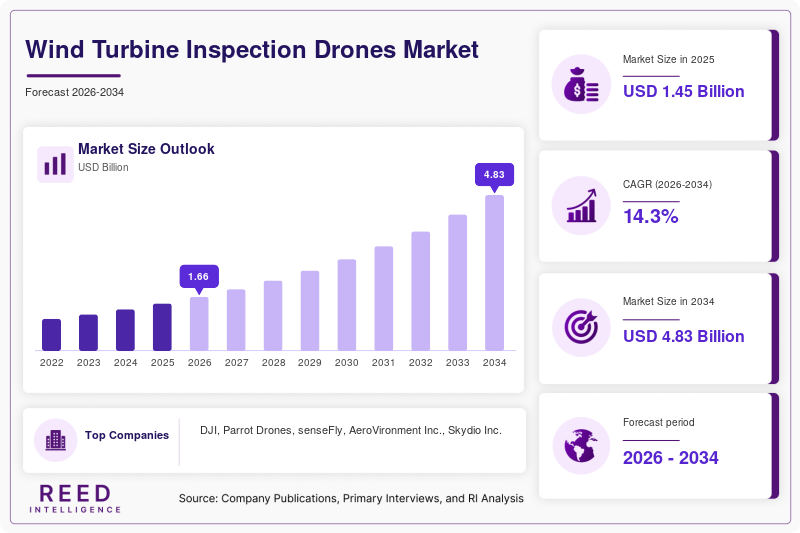
The global Wind Turbine Inspection Drones Market size was valued at approximately USD 1.45 billion in 2025 and is projected to reach USD 4.82 billion by 2034, expanding at a CAGR of 14.3% during the forecast period (2025–2034). The market has witnessed steady expansion driven by the growing deployment of wind energy infrastructure worldwide and the need for efficient inspection and maintenance solutions. As wind turbines increase in size and complexity, manual inspection methods have become less practical, encouraging the adoption of drone-based inspection systems.
A key global factor supporting market growth is the increasing emphasis on renewable energy targets and decarbonization policies. Governments and private entities are investing heavily in wind energy projects, which require periodic inspection to maintain operational efficiency and minimize downtime. Drone technology provides a cost-effective and time-efficient alternative to traditional inspection techniques, significantly reducing operational risks.
Key Highlights
- North America dominated the market with a 34% share in 2025, while Asia Pacific is projected to register the fastest CAGR of 16.8% during the forecast period.
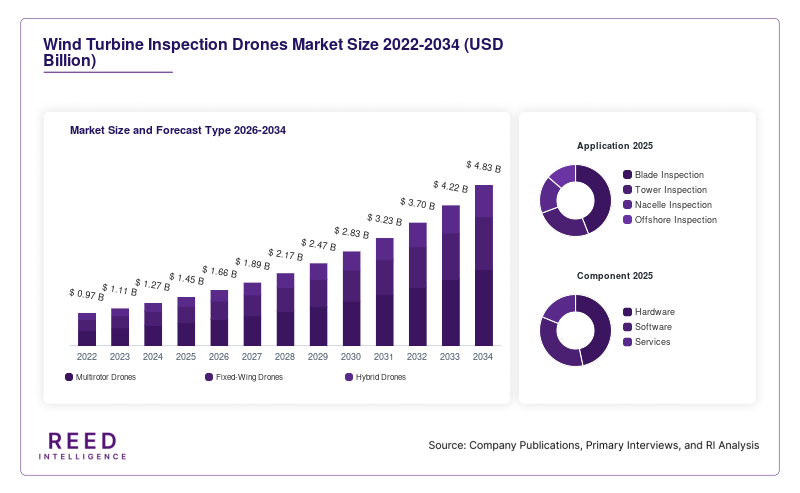
- By type, multirotor drones accounted for the largest share at 61%, whereas hybrid drones are expected to grow fastest at a CAGR of 17.5%.
- By application, blade inspection led with 48% share, while offshore inspection is anticipated to grow fastest at 18.2% CAGR.
- The U.S. market was valued at USD 0.42 billion in 2025 and is expected to reach USD 0.47 billion in 2026.
Market Trends
Integration of AI and Advanced Analytics in Drone Inspections
The integration of artificial intelligence (AI) and machine learning into drone inspection systems is transforming the Wind Turbine Inspection Drones Market. AI-powered image processing allows drones to automatically detect cracks, erosion, and structural defects in turbine blades. This reduces reliance on manual analysis and enhances accuracy. Predictive maintenance capabilities enabled by AI are also gaining traction, allowing operators to anticipate component failures before they occur.
Increasing Adoption of Autonomous and BVLOS Operations
The shift toward autonomous drone operations and beyond visual line of sight (BVLOS) capabilities is another significant trend. Autonomous drones can perform inspections without continuous human intervention, improving efficiency and reducing labor costs. Regulatory advancements in several regions are supporting BVLOS operations, enabling large-scale inspection of wind farms, especially offshore installations. This trend is expected to enhance operational scalability and expand the application scope of drone technologies.
Market Drivers
Rising Demand for Cost-Effective Maintenance Solutions
Wind farm operators are increasingly seeking cost-efficient inspection methods to maintain turbine performance. Traditional inspection methods involving rope access or cranes are expensive and time-consuming. Drone-based inspections significantly reduce downtime and labor costs while improving safety. This cost advantage is a major driver accelerating adoption across both onshore and offshore wind farms.
Expansion of Offshore Wind Energy Projects
The rapid expansion of offshore wind energy projects is driving demand for advanced inspection technologies. Offshore turbines are located in harsh environments, making manual inspections challenging and risky. Drones equipped with high-resolution cameras and sensors provide a practical solution for inspecting offshore turbines, enabling real-time data collection and minimizing operational disruptions.
Market Restraint
Regulatory and Operational Limitations in Drone Usage
One of the major restraints in the Wind Turbine Inspection Drones Market is the presence of regulatory restrictions governing drone operations. Many countries have stringent rules regarding flight permissions, altitude limits, and BVLOS operations. These regulations can limit the scalability of drone-based inspections, especially in densely populated or restricted areas.
Additionally, operational challenges such as limited battery life, sensitivity to adverse weather conditions, and the need for skilled operators hinder widespread adoption. In offshore environments, strong winds and unpredictable weather can affect drone performance, reducing inspection efficiency. These factors collectively pose challenges to market growth, particularly in regions with strict regulatory frameworks and challenging climatic conditions.
Market Opportunities
Growth in Digital Twin Technology Integration
The integration of digital twin technology with drone inspections presents a promising opportunity. By creating virtual replicas of wind turbines, operators can monitor structural health in real time. Drone-collected data can be integrated into digital models, enabling advanced diagnostics and performance optimization. This approach is expected to enhance maintenance planning and reduce operational costs.
Emerging Markets and Rural Electrification Projects
Developing regions are increasingly investing in wind energy to support rural electrification and energy diversification. These markets offer significant growth potential for drone inspection services. As wind infrastructure expands in regions such as Asia Pacific and Latin America, demand for efficient inspection solutions is expected to rise. Companies entering these markets early can benefit from untapped opportunities and long-term growth prospects.
Segmental Analysis
By Type
Multirotor drones dominated the market in 2025, accounting for approximately 61% of the total share. Their ability to hover, maneuver in tight spaces, and capture detailed images made them suitable for turbine inspections, especially for blade analysis.
Hybrid drones are expected to witness the fastest growth, with a projected CAGR of 17.5%. These drones combine the advantages of fixed-wing and multirotor systems, offering extended flight time and improved coverage. Their ability to inspect large wind farms efficiently will drive adoption.
By Application
Blade inspection emerged as the dominant application segment, holding a 48% share in 2025. Wind turbine blades are critical components requiring frequent inspection due to exposure to environmental stress.
Offshore inspection is projected to grow at the fastest CAGR of 18.2%. The increasing number of offshore wind projects and the challenges associated with manual inspections will drive demand for drone-based solutions in this segment.
By Component
Hardware components, including drones and sensors, accounted for the largest share of 57% in 2025. The demand for high-performance drones equipped with advanced imaging systems contributed to this dominance.
Software solutions are expected to grow fastest at a CAGR of 16.9%, driven by the rising need for data analytics, AI-based defect detection, and cloud-based reporting platforms.
By End-Use
Wind farm operators represented the dominant end-use segment, capturing 52% of the market share in 2025. Their direct involvement in turbine maintenance and operations led to high adoption of drone inspection services.
Third-party inspection service providers are expected to grow at the fastest CAGR of 15.8%, as outsourcing inspection services becomes more common among operators seeking cost efficiency.
Regional Analysis
North America
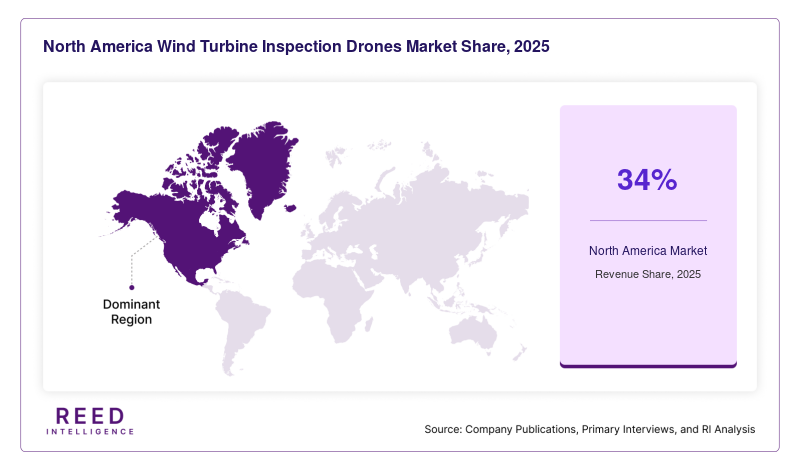
North America accounted for approximately 34% of the Wind Turbine Inspection Drones Market share in 2025 and is expected to grow at a CAGR of 13.6% during the forecast period. The region’s mature wind energy sector and strong adoption of advanced technologies supported its dominant position.
The United States emerged as the dominant country, driven by a large installed base of wind turbines and increasing investments in digital inspection technologies. The presence of established drone service providers and favorable technological infrastructure contributed to market growth.
Europe
Europe held a 28% market share in 2025 and is projected to grow at a CAGR of 13.9% through 2034. The region’s focus on renewable energy expansion and sustainability goals supported market growth.
Germany dominated the European market due to its extensive wind energy capacity and strong regulatory support for renewable energy. The country’s emphasis on efficient maintenance practices further boosted the adoption of drone-based inspection solutions.
Asia Pacific
Asia Pacific captured a 22% share in 2025 and is anticipated to grow at the fastest CAGR of 16.8% during the forecast period. Rapid industrialization and increasing investments in renewable energy projects drove market expansion.
China led the regional market due to its large-scale wind energy installations and growing focus on automation in maintenance operations. The country’s efforts to enhance energy efficiency and reduce operational costs supported the adoption of drone inspections.
Middle East & Africa
The Middle East & Africa region accounted for 9% of the market share in 2025 and is expected to grow at a CAGR of 14.5% during the forecast period. Increasing investments in renewable energy projects and diversification of energy sources contributed to market growth.
The United Arab Emirates emerged as a key country, driven by government initiatives to expand renewable energy capacity and adopt advanced technologies for infrastructure maintenance.
Latin America
Latin America held a 7% share of the Wind Turbine Inspection Drones Market in 2025 and is projected to grow at a CAGR of 14.1% through 2034. The region’s growing focus on clean energy and wind power installations supported market expansion.
Brazil dominated the regional market due to its significant wind energy capacity and favorable climatic conditions for wind power generation. The need for efficient inspection solutions in remote wind farms further boosted demand.
Competitive Landscape
The Wind Turbine Inspection Drones Market is characterized by the presence of several established players and emerging companies offering specialized inspection solutions. The market is moderately fragmented, with companies focusing on technological advancements and service expansion to gain a competitive edge.
A leading player in the market is DJI, which has developed advanced drone platforms tailored for industrial inspections. The company recently introduced enhanced AI-based imaging capabilities to improve defect detection accuracy in wind turbine inspections.
Other key players are focusing on strategic partnerships, product innovation, and geographic expansion to strengthen their market position. The competitive landscape is expected to intensify as new entrants introduce innovative solutions and existing players invest in research and development.
Key Players List
- DJI
- Parrot Drones
- senseFly
- AeroVironment Inc.
- Skydio Inc.
- Delair
- Insitu Inc.
- PrecisionHawk
- Cyberhawk Innovations Ltd.
- Terra Drone Corporation
- Airobotics Ltd.
- Flyability SA
- SkySpecs Inc.
- DroneDeploy Inc.
- Kespry Inc.
Recent Developments
- 2025: DJI launched an upgraded industrial drone with enhanced thermal imaging capabilities for wind turbine inspections.
- 2025: SkySpecs introduced an AI-driven analytics platform to automate defect detection.
- 2024: Terra Drone expanded its wind inspection services in Asia Pacific.
- 2024: Flyability developed a collision-tolerant drone designed for confined turbine inspections.
- 2023: Cyberhawk partnered with renewable energy firms to enhance offshore inspection services.
Wind Turbine Inspection Drones Market Segments
Type
- Multirotor Drones
- Fixed-Wing Drones
- Hybrid Drones
Application
- Blade Inspection
- Tower Inspection
- Nacelle Inspection
- Offshore Inspection
Component
- Hardware
- Software
- Services
End-Use
- Wind Farm Operators
- Third-Party Service Providers
By Region
- North America
- Europe
- APAC
- Middle East and Africa
- LATAM