Wire Pulling Tensioning Market Size, Share Demand Report By Product Type (Hydraulic Wire Pulling Tensioners, Electric Wire Pulling Tensioners), By Application (Power Transmission Installation, Telecom Cable Deployment, Industrial Cable Installation), By End Use (Utility Contractors, Telecommunication Contractors, Industrial Operators, Renewable Energy Contractors), By Mobility (Trailer-Mounted Systems, Portable Compact Systems), By Region & Segment Forecasts, 2026–2034
USD 3950
Market Overview
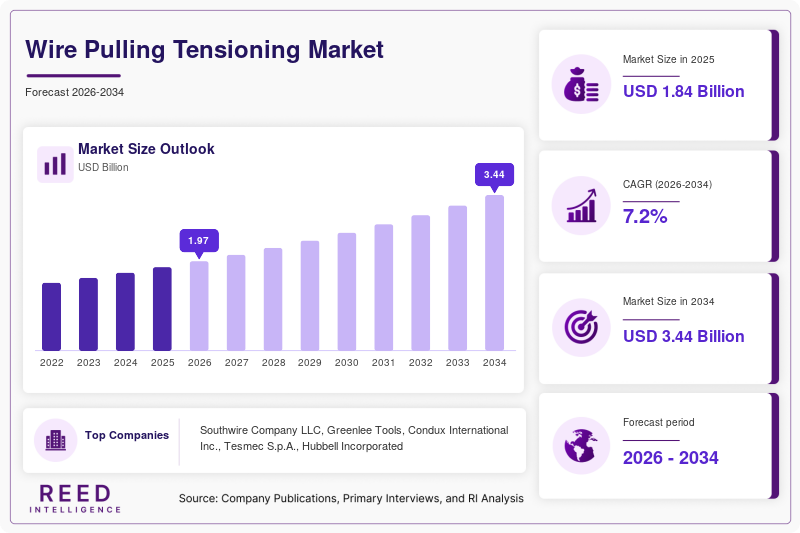
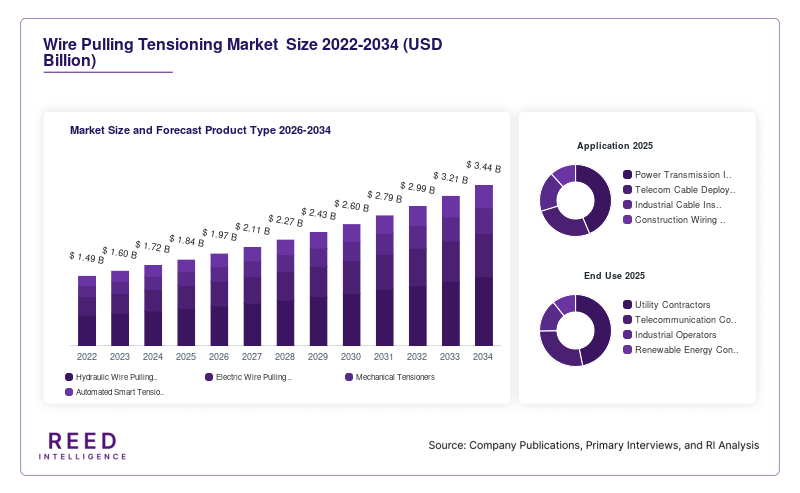
The global Wire Pulling Tensioning Market was valued at USD 1.84 billion in 2026 and is projected to reach USD 3.21 billion by 2034, expanding at a CAGR of 7.2% during the forecast period (2026–2034). The market is gaining traction due to rising demand for efficient cable installation systems across utilities, telecommunications, construction, and industrial infrastructure projects. Growing modernization of electrical grids and expansion of underground cable deployment have created sustained demand for advanced wire pulling tensioning systems that improve operational precision and reduce installation risks.
One global factor supporting the growth of the Wire Pulling Tensioning Market has been increasing investments in transmission and distribution infrastructure. Governments and private utilities are allocating capital toward grid expansion, renewable energy interconnections, and smart power systems, which require reliable tension-controlled wire installation technologies. These developments have increased adoption of hydraulic, electric, and automated tensioning equipment.
Key Highlights
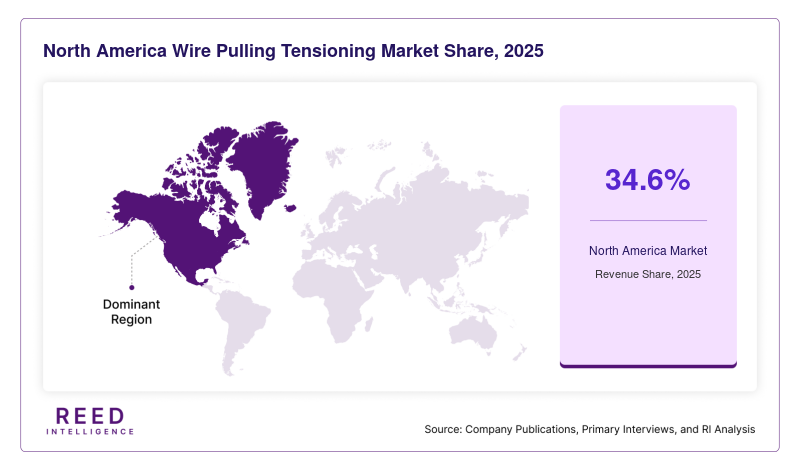
- North America held the dominant market share of 34.6% in 2025, while Asia Pacific is projected to register the fastest CAGR of 8.6% through 2034.
- By Product Type, hydraulic wire pulling tensioners led with 42.8% share in 2025, while automated electric tensioners are expected to grow at 9.1% CAGR.
- By Application, power transmission installation dominated with 39.4% share, whereas telecom cable deployment is forecast to expand at 8.9% CAGR.
- By End Use, utility contractors remained the leading subsegment with 36.7% share, while renewable energy contractors are anticipated to grow at 9.4% CAGR.
- The U.S., the dominant country, accounted for USD 495 million in 2024 and USD 528 million in 2025.
Market Trends
Automation Integration in Cable Installation Equipment
A notable trend shaping the Wire Pulling Tensioning Market is the growing integration of automation and digital monitoring in tensioning systems. Equipment manufacturers are introducing programmable tension controls, load sensors, and remote monitoring capabilities that improve installation consistency and reduce manual intervention. Contractors increasingly prefer systems capable of recording tension data and preventing cable damage during complex installations. This trend is supporting demand for intelligent pulling systems across industrial and utility projects.
Shift Toward Compact Portable Tensioning Systems
Another major trend is the rising demand for compact and portable tensioning equipment designed for urban and confined job sites. Contractors working in underground utilities, data center installations, and metropolitan construction projects are adopting lightweight tensioners that provide mobility and operational flexibility. Manufacturers are developing modular systems that improve transport efficiency while maintaining pulling performance, contributing to broader market expansion.
Market Drivers
Expansion of Underground Power Cable Networks
Increasing deployment of underground power networks is driving growth in the Wire Pulling Tensioning Market. Urban electrification projects and grid resilience initiatives require controlled cable pulling solutions to install high-value power cables safely. Wire tensioning systems help reduce strain, improve placement accuracy, and minimize installation delays. This demand continues to support growth across developed and emerging infrastructure markets.
Rising Telecom Infrastructure Development
Rapid expansion of fiber optic and telecom infrastructure is another major growth driver. Telecom operators require tension-controlled installation systems to deploy long-distance fiber and communication cables without damage. Growing broadband investments, 5G rollout, and network modernization are supporting adoption of specialized pulling tensioning solutions designed for sensitive cable applications.
Market Restraint
High Initial Equipment Cost
A key restraint affecting the Wire Pulling Tensioning Market is the relatively high upfront cost associated with advanced tensioning equipment. Hydraulic and automated systems often involve substantial procurement and maintenance expenses, which can limit adoption among small contractors and cost-sensitive users. Budget constraints in some developing regions may slow penetration of premium equipment.
Market Opportunities
Growth in Renewable Energy Transmission Projects
Large-scale renewable energy projects are creating opportunities for wire pulling tensioning equipment providers. Wind farms and solar parks require extensive transmission cable installation, increasing demand for specialized tensioning solutions capable of handling long-distance and high-capacity cable deployments.
Emerging Demand from Data Center Infrastructure
Rising investment in hyperscale and edge data centers presents another growth opportunity. These facilities require dense structured cabling and precision wire installation, creating demand for compact and high-control tensioning systems designed for critical electrical infrastructure.
Segmental Analysis
By Product Type
Hydraulic Wire Pulling Tensioners Dominated
Hydraulic wire pulling tensioners held the dominant share of 42.8% in 2025. Their ability to manage high pulling loads and deliver controlled tension made them widely adopted in heavy-duty utility and transmission applications. Contractors favored hydraulic systems for demanding field operations requiring durability and performance.
Automated Electric Tensioners to Register Fastest Growth
Automated electric tensioners are projected to expand at 9.1% CAGR through 2034. Growth will be supported by increasing demand for programmable controls and lower maintenance systems. Their energy efficiency and suitability for precision installations will drive adoption across advanced cable deployment projects.
By Application
Power Transmission Installation Led the Market
Power transmission installation accounted for 39.4% market share in 2025. This segment benefited from growing demand for controlled pulling systems in high-voltage and underground cable projects where tension management is critical.
Telecom Cable Deployment to Grow Rapidly
Telecom cable deployment is anticipated to expand at 8.9% CAGR over the forecast period. Growth will be supported by fiber network expansion and demand for equipment capable of handling delicate communication cables with minimal stress.
By End Use
Utility Contractors Held Leading Position
Utility contractors represented 36.7% share in 2025. This segment benefited from large-scale use of tensioning systems in transmission and distribution installations where operational efficiency remains a priority.
Renewable Energy Contractors to Show Fastest Growth
Renewable energy contractors are forecast to grow at 9.4% CAGR through 2034. Expansion of wind and solar transmission projects will support rising demand for specialized tensioning solutions for long-route cable installations.
By Mobility
Trailer-Mounted Systems Dominated
Trailer-mounted systems accounted for 47.3% share in 2025. Their high pulling capacity and suitability for large outdoor projects supported broad adoption across infrastructure installations.
Portable Compact Systems to Expand Faster
Portable compact systems are expected to register 8.8% CAGR during the forecast period. Their growth will be driven by demand in urban utilities, maintenance work, and confined installation environments.
By Control Mode
Manual-Assisted Systems Led Demand
Manual-assisted systems held 54.2% share in 2025. Established contractor familiarity and lower capital requirements supported segment dominance.
Smart Sensor-Controlled Systems to Grow Faster
Smart sensor-controlled systems are expected to grow at 9.2% CAGR through 2034. Growth will be driven by increasing demand for tension monitoring and predictive performance management.
Regional Analysis
North America
North America accounted for 34.6% of the global Wire Pulling Tensioning Market in 2025. The region benefited from utility modernization, replacement of aging transmission infrastructure, and sustained industrial maintenance activities. The market in North America is expected to expand at a 6.8% CAGR through 2034.
The United States remained the dominant country due to strong investment in grid hardening programs. Rising adoption of advanced cable installation systems for high-voltage underground projects contributed to country-level growth.
Europe
Europe held 26.2% market share in 2025. Demand was supported by cross-border energy infrastructure development and increased adoption of advanced installation equipment in industrial projects. The regional market is projected to grow at a 6.9% CAGR during the forecast period.
Germany dominated the regional market due to extensive transmission upgrades linked to renewable integration. Demand for precision cable handling systems supported equipment adoption across utility and industrial sectors.
Asia Pacific
Asia Pacific represented 24.1% of the Wire Pulling Tensioning Market in 2025 and is expected to witness the fastest CAGR of 8.6% through 2034. Strong infrastructure investment and expanding electrification programs supported regional growth.
China led the regional market due to extensive power transmission expansion. Increasing deployment of long-distance cable systems created strong demand for high-capacity tensioning equipment.
Middle East & Africa
Middle East & Africa accounted for 8.1% market share in 2025. Demand was driven by utility network expansion and industrial construction projects. The region is forecast to grow at a 7.5% CAGR over the study period.
Saudi Arabia dominated due to large-scale energy infrastructure projects. Growing use of tension-controlled cable installation systems in utility developments supported market expansion.
Latin America
Latin America captured 7.0% of the market in 2025. Rising electrical infrastructure investments and industrial upgrades supported regional demand. The market is projected to grow at 7.1% CAGR through 2034.
Brazil led the regional market due to transmission corridor development. Demand for efficient cable pulling systems increased as utility contractors sought improved installation productivity.
Competitive Landscape
The Wire Pulling Tensioning Market remains moderately fragmented, with global and regional participants competing through product innovation, equipment durability, and service support. Leading manufacturers are emphasizing automation, portable equipment design, and application-specific solutions to strengthen market positioning. Companies are also expanding rental offerings and aftermarket services to improve recurring revenue streams.
Southwire Company LLC remained a market leader due to its broad equipment portfolio and established distribution presence. A recent development included expansion of advanced tension-controlled pulling equipment for utility applications. Greenlee Tools continued strengthening its position through compact installation solutions. Condux International focused on engineered cable handling systems for transmission projects. Tesmec S.p.A. maintained strong presence in heavy-duty tensioning systems used in power infrastructure. Hubbell Incorporated expanded its cable installation equipment range to address industrial and contractor demand. Competitive strategies increasingly focus on digital control integration and application-focused product customization.
Key Players List
- Southwire Company LLC
- Greenlee Tools
- Condux International Inc.
- Tesmec S.p.A.
- Hubbell Incorporated
- Klein Tools
- General Machine Products Company
- Maxis Tools
- DCD Design & Manufacturing
- Current Tools Inc.
- Sherman + Reilly Inc.
- Thorne & Derrick
- ZECK GmbH
- OMAC Italia
- Jakob Thaler GmbH
Recent Developments
- Southwire introduced enhanced digital wire pulling tension monitoring solutions for utility contractors.
- Tesmec expanded its high-capacity tensioner portfolio for long-distance transmission cable applications.
- Greenlee launched compact portable tensioning equipment designed for urban underground cable installations.
- Condux International expanded engineered pulling systems for fiber optic and telecom deployment projects.
- Hubbell introduced upgraded tension control solutions focused on industrial electrical installations.
- ZECK GmbH developed advanced tensioners designed for renewable energy transmission applications.
- General Machine Products expanded product offerings targeting structured cabling and fiber installation markets.
- Sherman + Reilly invested in equipment modernization focused on improved pulling efficiency and safety controls.
Wire Pulling Tensioning Market Segments
Product Type
- Hydraulic Wire Pulling Tensioners
- Electric Wire Pulling Tensioners
- Mechanical Tensioners
- Automated Smart Tensioners
Application
- Power Transmission Installation
- Telecom Cable Deployment
- Industrial Cable Installation
- Construction Wiring Projects
End Use
- Utility Contractors
- Telecommunication Contractors
- Industrial Operators
- Renewable Energy Contractors
Mobility
- Trailer-Mounted Systems
- Portable Compact Systems
- Fixed Installation Systems
Control Mode
- Manual-Assisted Systems
- Semi-Automatic Systems
- Smart Sensor-Controlled Systems
By Region
- North America
- Europe
- APAC
- Middle East and Africa
- LATAM