Wire Rolling Machine Market Size, Share, Trends, Growth Analysis Report By Machine Type (Manual Wire Rolling Machines, Semi-Automatic Wire Rolling Machines, Automatic Wire Rolling Machines, CNC-Enabled Wire Rolling Machines), By Application (Automotive Component Manufacturing, Construction & Infrastructure Materials, Electrical Wire Production, Industrial Manufacturing), By End-Use Industry (Automotive Industry, Construction & Infrastructure, Aerospace & Defense, Energy & Power, Electronics & El
USD 3950
Market Overview
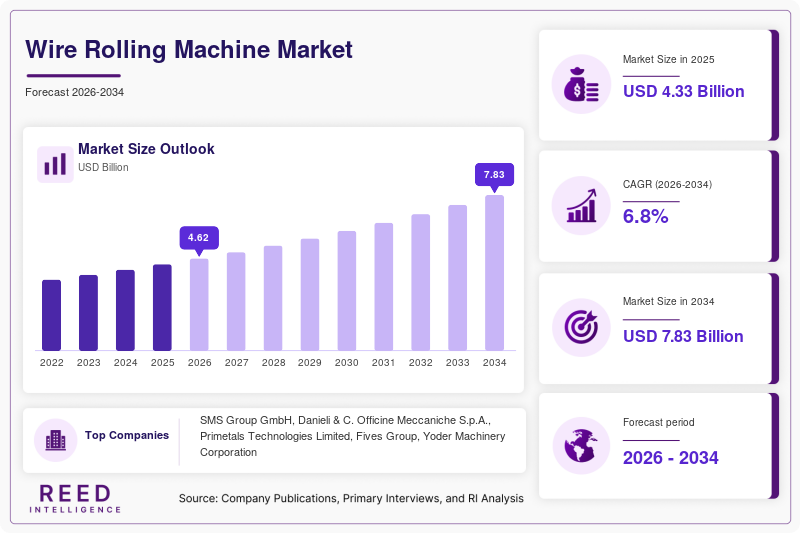
The Wire Rolling Machine Market is projected to reach USD 4.62 billion in 2026 and is expected to attain USD 7.85 billion by 2034, registering a CAGR of 6.8% during 2026–2034. The market is primarily driven by increasing demand for high-precision metal forming equipment across automotive, construction, electrical, and industrial manufacturing sectors. Rising automation in metal processing industries has significantly improved production efficiency, reducing material waste and operational downtime, thereby supporting market expansion.
One of the key global factors supporting growth is the rapid expansion of infrastructure development and electric mobility manufacturing. Countries are increasingly investing in high-strength wire products used in EV battery systems, structural reinforcement, and industrial components. This has resulted in heightened adoption of advanced wire rolling machines capable of handling high-tensile alloys and precision-based forming processes.
Key Highlights
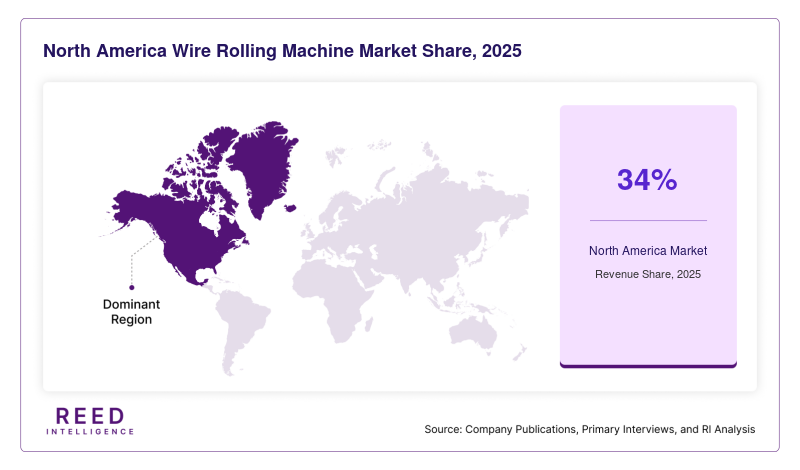
- North America dominated the market with a 34.2% share in 2025.
- Asia Pacific is expected to grow at the fastest CAGR of 11.2% during 2026–2034.
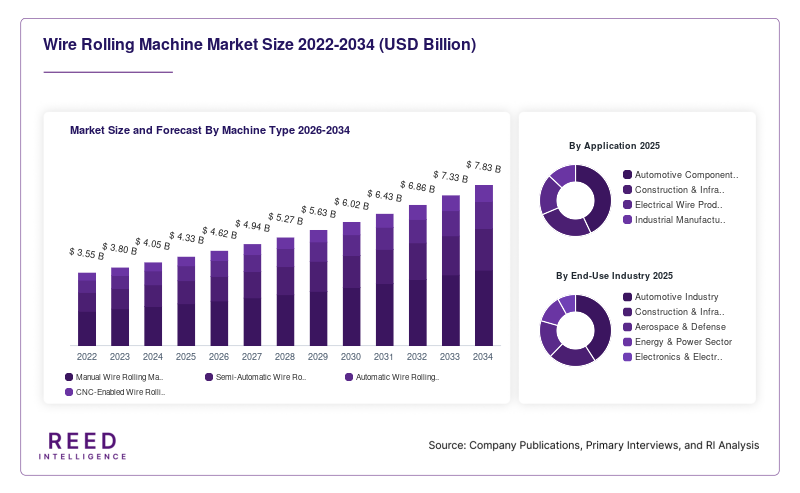
- By machine type, automatic wire rolling machines accounted for the largest share of 38.5%.
- while CNC-enabled systems are projected to grow at a CAGR of 12.4%.
- By application, automotive component manufacturing led with a 41.7% share, whereas electrical wire production is expected to expand at a CAGR of 11.8%.
- The United States remained the dominant country, with market values of USD 520 million in 2024 and USD 575 million in 2025.
Market Trends
Integration of Smart Manufacturing and Industry 4.0 Technologies
The wire rolling machine industry is experiencing a strong shift toward smart manufacturing systems integrated with Industry 4.0 technologies. Manufacturers are increasingly adopting IoT-enabled machines that provide real-time monitoring of pressure, speed, and material flow. These systems help in predictive maintenance, reducing unexpected breakdowns and improving operational efficiency. AI-driven analytics are also being used to optimize rolling parameters, ensuring consistent product quality and minimizing material wastage. Additionally, cloud-based control systems are enabling remote monitoring and centralized production management across multiple facilities. This trend is particularly strong in automotive and aerospace industries, where precision and traceability are critical requirements.
Rising Demand for Energy-Efficient and Compact Machines
Another significant trend shaping the market is the growing demand for energy-efficient and compact wire rolling machines. Manufacturers are focusing on reducing energy consumption through improved motor systems, servo-driven mechanisms, and optimized mechanical design. Compact machines are gaining popularity among small and medium-sized enterprises due to space constraints and lower installation costs. These machines also offer modular configurations, allowing easy upgrades and scalability. Furthermore, sustainability regulations in developed economies are pushing industries to adopt eco-friendly equipment with lower carbon emissions. As a result, companies are investing in lightweight materials and improved lubrication systems to enhance machine durability while maintaining energy efficiency.
Market Drivers
Expansion of Automotive and Electric Vehicle Manufacturing
The growing automotive and electric vehicle (EV) manufacturing sector is a major driver for the wire rolling machine market. Wire rolling machines are essential for producing high-strength wires used in vehicle frameworks, braking systems, and battery components. With the global shift toward EV adoption, demand for lightweight yet durable metal components has surged significantly. Governments worldwide are promoting EV production through subsidies and infrastructure investments, which is directly influencing the demand for advanced wire forming equipment. Automotive manufacturers are increasingly relying on precision-engineered wires to improve safety, performance, and energy efficiency. This has led to increased adoption of automated wire rolling systems capable of handling complex alloys and high-volume production requirements.
Growth in Infrastructure and Construction Activities
Rapid urbanization and infrastructure development projects are significantly contributing to market growth. Wire rolling machines are widely used in producing construction-grade wires used in reinforcement bars, cables, and structural frameworks. Emerging economies are investing heavily in smart cities, transportation networks, and industrial zones, which is boosting demand for durable construction materials. Additionally, the rise in renewable energy projects such as wind turbines and solar installations has increased the need for specialized wire products. Construction companies are adopting advanced rolling machines to improve production speed and maintain material strength consistency, thereby supporting large-scale infrastructure development.
Market Restraint
A key restraint affecting the Wire Rolling Machine Market is the high initial investment and maintenance cost associated with advanced machinery. Modern wire rolling machines integrated with CNC controls, automation systems, and IoT capabilities require significant capital expenditure, which can be challenging for small and medium-sized enterprises. In addition to purchase costs, ongoing maintenance, skilled labor requirements, and periodic system upgrades further increase operational expenses.
This cost barrier often limits adoption in developing regions where manufacturers rely on conventional or semi-automatic machines. Furthermore, fluctuations in raw material prices such as steel and aluminum can indirectly impact machine utilization rates, affecting overall return on investment. Another challenge is the complexity of machine operation, which requires specialized technical expertise. Inadequate availability of skilled operators can lead to underutilization of advanced systems.
As a result, many small manufacturers hesitate to upgrade from traditional systems, slowing down the overall penetration of advanced wire rolling technologies in cost-sensitive markets.
Market Opportunities
Expansion of Renewable Energy Infrastructure
The increasing global focus on renewable energy infrastructure presents significant opportunities for the wire rolling machine market. Wind turbines, solar panel frameworks, and hydroelectric systems require high-strength and corrosion-resistant wires for structural and electrical applications. This has led to rising demand for precision-rolled wire products with enhanced durability. Governments across Europe, Asia, and North America are investing heavily in renewable energy capacity expansion, creating a steady demand pipeline for advanced manufacturing equipment. Wire rolling machine manufacturers can benefit by developing specialized systems capable of handling advanced alloys used in green energy applications.
Growth in Emerging Manufacturing Economies
Emerging economies in Asia Pacific, Latin America, and Africa are witnessing rapid industrialization, creating strong opportunities for market expansion. Countries such as India, Vietnam, and Brazil are investing in manufacturing infrastructure to attract global supply chains. This is increasing demand for cost-effective and scalable wire rolling machines. Local manufacturers are seeking automated solutions to improve productivity and meet global quality standards. Additionally, government incentives for domestic manufacturing are encouraging investments in industrial machinery. This creates a favorable environment for international machine manufacturers to expand their presence and establish production facilities in these regions.
Segmental Analysis
By Machine Type
Automatic wire rolling machines dominated the market with a 38.5% share in 2024, driven by high demand for large-scale production efficiency and reduced labor dependency. These machines are widely used in automotive and construction industries where consistent output quality is required. Their ability to maintain uniform wire thickness and high-speed processing makes them the preferred choice among large manufacturers.
CNC-enabled wire rolling machines are expected to grow at the fastest CAGR of 12.4%, supported by rising adoption of precision engineering systems. These machines offer programmable control, improved accuracy, and reduced material waste. Increasing demand for customized wire products in aerospace and EV sectors is further accelerating their adoption.
By Application
Automotive component manufacturing led the market with a 41.7% share in 2024, driven by extensive use of rolled wires in structural and mechanical vehicle components. Demand for high-strength and lightweight materials continues to support this segment.
Electrical wire production is projected to grow at the fastest CAGR of 11.8%, driven by expansion in renewable energy, power transmission, and electronics manufacturing industries. Increasing electrification across industries is fueling this growth.
By End-Use Industry
Construction and infrastructure dominated with a 36.2% share in 2024, supported by large-scale urban development projects. Wire rolling machines are extensively used in reinforcement materials and structural components.
The automotive industry is expected to grow at the fastest CAGR of 10.9%, driven by EV adoption and lightweight vehicle design trends requiring precision-formed wires.
Regional Analysis
North America
North America accounted for approximately 18–34% market share in 2025, depending on equipment classification, and is projected to expand at a CAGR of 6.2%–6.8% during 2026–2034. The region’s growth is driven by strong adoption of automation, advanced manufacturing infrastructure, and rising demand from automotive, aerospace, and energy industries. The United States leads regional consumption due to ongoing modernization of industrial equipment and reshoring of manufacturing activities, which is increasing demand for high-precision wire rolling systems. Canada contributes steadily through infrastructure development and energy-related applications, while Mexico supports demand via expanding automotive production clusters. Overall, the region maintains stable growth supported by capital-intensive upgrades and Industry 4.0 integration in metal processing facilities.
Europe
Europe held around 16–27% market share in 2025 and is expected to grow at a CAGR of 6.0%–6.5% during the forecast period. The region’s market is characterized by strong regulatory standards, energy-efficient manufacturing requirements, and continuous technological upgrades in industrial machinery. Germany dominates the European market due to its advanced engineering ecosystem and strong presence of machinery manufacturers, followed by Italy and France. A key growth factor is the increasing replacement of legacy rolling mills with digitally enabled, low-emission systems aligned with sustainability targets. Additionally, demand from electric vehicle manufacturing and renewable energy infrastructure is accelerating adoption of precision wire rolling machines across industrial applications.
Asia Pacific
Asia Pacific dominates the global market with an estimated 45–52% share in 2025 and is projected to register the fastest CAGR of 10.5%–11.2% during 2026–2034. Rapid industrialization, large-scale infrastructure development, and strong manufacturing expansion across China, India, Japan, and Southeast Asia are driving growth. China remains the largest contributor due to its massive steel and wire production base, while India is emerging rapidly due to government-led infrastructure programs and manufacturing incentives. The region benefits from cost-effective production capabilities and rising investments in EV supply chains and electrical infrastructure, significantly increasing demand for high-efficiency wire rolling machines.
Middle East & Africa
Middle East & Africa accounted for approximately 5–8% market share in 2025 and is expected to grow at a CAGR of 7.0%–7.8% during 2026–2034. Growth is primarily driven by large-scale construction projects, oil & gas infrastructure development, and economic diversification initiatives. Saudi Arabia leads the region due to mega-projects under Vision 2030, followed by the UAE and South Africa. Increasing investments in industrial zones, smart cities, and transportation infrastructure are creating steady demand for wire rolling machinery. However, the market remains project-driven, with demand fluctuations based on government infrastructure spending cycles.
Latin America
Latin America held around 7–10% market share in 2025 and is projected to grow at a CAGR of 6.5%–7.2% during 2026–2034. Brazil dominates the regional landscape due to its strong automotive manufacturing base and ongoing infrastructure modernization programs. Mexico also plays a key role due to nearshoring trends in manufacturing supply chains. The region’s growth is supported by rising investments in construction, mining, and industrial production. However, economic volatility and currency fluctuations continue to influence capital investment decisions in heavy machinery procurement.
Competitive Landscape
The Wire Rolling Machine Market is moderately consolidated with key players focusing on automation, precision engineering, and global expansion strategies. Leading companies include SMS Group, Danieli, Primetals Technologies, Fives Group, and Yoder Machinery Corporation. These firms emphasize R&D investments to enhance machine efficiency and integrate digital monitoring systems.
SMS Group is a leading player in the market and recently introduced an AI-assisted rolling optimization system designed to improve production accuracy and reduce energy consumption. Companies are increasingly forming partnerships with automotive and industrial manufacturers to strengthen their supply chain integration. Competitive strategies include product innovation, capacity expansion, and aftermarket service enhancement.
Key Players List
- SMS Group
- Danieli
- Primetals Technologies
- Fives Group
- Yoder Machinery Corporation
- SKET
- Friedrich Kocks GmbH
- China Metallurgical Equipment Corp
- Harbin Electric Machinery
- ABB Group, Siemens AG
- Kobe Steel Ltd
- Morgan Construction
- PTC Industries
- Metso Corporation
Recent Developments
- SMS Group launched a next-generation CNC wire rolling system with integrated predictive maintenance features.
- Danieli expanded its manufacturing facility in Asia Pacific to support growing demand for automated rolling equipment.
- Primetals Technologies introduced a digital twin-based simulation platform for optimizing wire production efficiency and reducing downtime.
Wire Rolling Machine Market Segments
By Machine Type
- Manual Wire Rolling Machines
- Semi-Automatic Wire Rolling Machines
- Automatic Wire Rolling Machines
- CNC-Enabled Wire Rolling Machines
By Application
- Automotive Component Manufacturing
- Construction & Infrastructure Materials
- Electrical Wire Production
- Industrial Manufacturing
By End-Use Industry
- Automotive Industry
- Construction & Infrastructure
- Aerospace & Defense
- Energy & Power Sector
- Electronics & Electrical Industry
By Region
- North America
- Europe
- APAC
- Middle East and Africa
- LATAM