Wireless Antenna Market Size, Share & Demand Report By Antenna Type (Omnidirectional Antennas, Directional Antennas), By Frequency Band (Sub-1 GHz, 1 GHz–6 GHz, Sub-6 GHz, Millimeter Wave), By Technology (MIMO Antenna Systems, Beamforming Antenna Systems, Massive MIMO Systems, Adaptive Antenna Systems, Conventional Antenna Systems), By Application (Telecommunication Infrastructure, Consumer Electronics), By Region & Segment Forecasts, 2026–2034
USD 3950
Market Overview
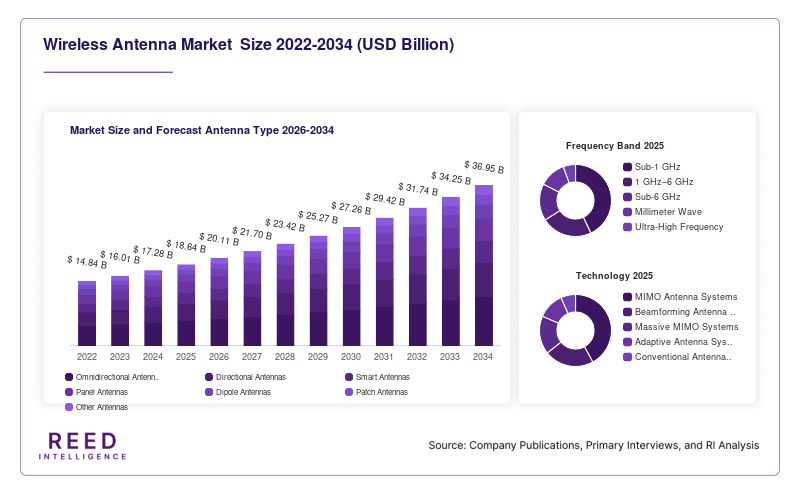
The Wireless Antenna Market size was valued at USD 18.64 billion in 2026 and is projected to reach USD 34.28 billion by 2034, expanding at a CAGR of 7.9% during 2026–2034. The global Wireless Antenna Market continues to experience steady growth as wireless communication technologies become increasingly important across telecommunications, consumer electronics, automotive connectivity, industrial automation, aerospace systems, smart infrastructure, and IoT ecosystems. Wireless antennas serve as critical components enabling signal transmission and reception across diverse communication networks, supporting the growing demand for seamless connectivity.
A major global factor supporting market growth has been the accelerating deployment of advanced wireless communication infrastructure. Governments and private enterprises worldwide are investing heavily in 5G networks, smart city projects, industrial digitalization initiatives, and connected transportation systems. These investments require extensive deployment of wireless antennas across base stations, connected devices, enterprise networks, and communication equipment. Furthermore, increasing adoption of cloud computing, edge computing, and machine-to-machine communication technologies continues to expand demand for high-performance wireless antenna solutions.
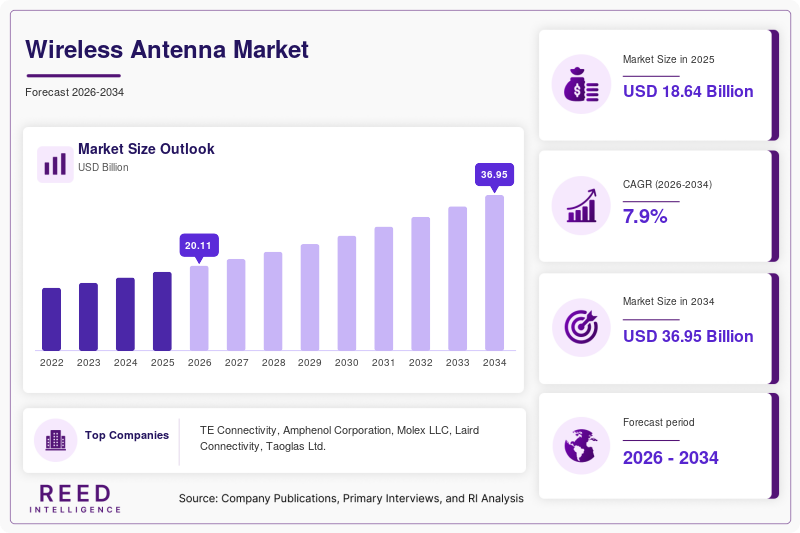
Key Highlights
- Asia Pacific dominated the market with a 41.7% share in 2025.
- Middle East & Africa is expected to be the fastest-growing region, registering a CAGR of 9.1% during 2026–2034.
- By Antenna Type, Omnidirectional Antennas held the leading 36.8% market share in 2025.
- By Antenna Type, Smart Antennas are projected to grow at the fastest 10.2% CAGR through 2034.
- By Frequency Band, Sub-6 GHz Antennas accounted for 54.6% market share in 2025.
- By Frequency Band, Millimeter Wave Antennas are forecast to expand at a 11.3% CAGR.
- By Application, Telecommunication Infrastructure represented 38.9% share in 2025.
- By Application, Industrial IoT & Automation is expected to register a 10.7% CAGR during the forecast period.
- China remained the dominant country market, valued at USD 2.74 billion in 2024 and USD 2.98 billion in 2025.
Market Trends
Growing Integration of Smart Antenna Technologies
One of the most notable trends influencing the Wireless Antenna Market is the increasing adoption of smart antenna systems capable of dynamically optimizing signal transmission and reception. Smart antennas utilize advanced algorithms, beam steering, adaptive signal processing, and MIMO technologies to improve network efficiency and coverage.
As communication networks become more complex and data-intensive, service providers are increasingly deploying intelligent antenna solutions to enhance spectrum utilization and support higher user densities. This trend is expected to accelerate with continued expansion of 5G and future wireless communication standards.
Expansion of Compact Multi-Band Antenna Designs
Manufacturers are increasingly developing compact antennas capable of operating across multiple frequency bands. Smartphones, wearable devices, connected vehicles, and industrial equipment require efficient antenna solutions that support various wireless protocols within limited physical space.
Multi-band antenna technologies reduce component complexity while improving device functionality. Growing demand for compact connected devices is encouraging innovation in antenna design, materials engineering, and integration techniques across multiple industries.
Market Drivers
Expansion of Global 5G Network Deployments
Rapid deployment of 5G communication infrastructure remains a major growth driver for the Wireless Antenna Market. Mobile network operators continue expanding network coverage to support higher data speeds, lower latency, and enhanced connectivity services.
5G infrastructure requires advanced antenna technologies, including massive MIMO systems, beamforming arrays, and high-frequency antenna modules. As telecom operators increase investments in network modernization projects, demand for wireless antennas continues to rise across developed and emerging markets.
Rising Adoption of Connected Consumer Electronics
The growing popularity of connected consumer devices is significantly supporting market growth. Smartphones, tablets, laptops, smart TVs, gaming systems, wearable devices, and smart home products all depend on wireless antenna technologies for reliable connectivity.
Consumers increasingly expect seamless wireless performance across devices and applications. This trend is driving manufacturers to incorporate advanced antenna systems capable of supporting multiple communication standards while maintaining compact device designs.
Market Restraint
Signal Interference and Spectrum Congestion Challenges
A major restraint affecting the Wireless Antenna Market involves increasing signal interference and spectrum congestion in densely populated communication environments. The growing number of connected devices and wireless networks can negatively impact communication quality and network performance.
Addressing interference issues often requires sophisticated antenna designs, additional infrastructure investments, and advanced signal management technologies, increasing deployment complexity and operational costs.
Market Opportunities
Growth of Connected Vehicle Ecosystems
Connected vehicle technologies present significant opportunities for wireless antenna manufacturers. Modern vehicles increasingly incorporate cellular connectivity, vehicle-to-everything communication systems, navigation platforms, infotainment services, and remote diagnostics capabilities.
These applications require multiple high-performance antennas capable of supporting reliable communication under diverse operating conditions. Continued advancements in connected mobility solutions are expected to create substantial market opportunities.
Expansion of Private Wireless Networks
The increasing adoption of private wireless networks across industrial facilities, logistics centers, manufacturing plants, mining operations, and enterprise campuses offers emerging growth opportunities. Organizations are deploying dedicated wireless networks to support mission-critical applications and secure communications.
Private network deployments require specialized antenna solutions optimized for industrial environments and application-specific connectivity requirements, creating attractive opportunities for equipment manufacturers.
Segmental Analysis
By Antenna Type
Omnidirectional Antennas
Omnidirectional antennas dominated the market and accounted for 36.8% of revenue in 2025. Their widespread utilization across consumer electronics, wireless routers, enterprise networking equipment, and communication systems supported segment leadership. These antennas provide consistent signal coverage across multiple directions, making them suitable for a broad range of applications.
Smart Antennas
Smart antennas are projected to grow at a 10.2% CAGR through 2034. Growth will be driven by increasing deployment of intelligent communication networks requiring adaptive signal optimization capabilities. Advanced beamforming functionality and improved spectral efficiency will support broader adoption across next-generation wireless systems.
By Frequency Band
Sub-6 GHz Antennas
Sub-6 GHz antennas represented 54.6% market share in 2025. Their compatibility with existing communication infrastructure and broad deployment across wireless networks contributed significantly to market dominance.
Millimeter Wave Antennas
Millimeter wave antennas will register an 11.3% CAGR during the forecast period. Growth will be supported by increasing implementation of ultra-high-speed communication networks and advanced wireless applications requiring greater bandwidth capacity.
By Application
Telecommunication Infrastructure
Telecommunication infrastructure accounted for 38.9% market share in 2025. Continuous expansion of cellular networks, communication towers, and wireless access systems maintained strong demand for antenna technologies.
Industrial IoT & Automation
Industrial IoT and automation applications are expected to expand at a 10.7% CAGR through 2034. Growing deployment of connected machinery, industrial sensors, and smart manufacturing systems will increase demand for reliable wireless communication solutions.
By Technology
MIMO Antenna Systems
MIMO antenna systems held 42.4% of market revenue in 2025. Their ability to improve signal quality, network capacity, and communication efficiency supported broad adoption across advanced wireless networks.
Beamforming Antenna Systems
Beamforming antenna systems are forecast to grow at a 10.9% CAGR. Increasing demand for targeted signal transmission, improved network coverage, and enhanced wireless performance will contribute to segment growth.
By End-Use Industry
Consumer Electronics
Consumer electronics captured 33.5% market share in 2025. Strong demand for smartphones, wearable devices, tablets, laptops, and smart home products contributed to segment leadership.
Automotive & Transportation
Automotive and transportation applications are projected to register a 9.8% CAGR through 2034. Growth will be supported by increasing integration of connected vehicle technologies, advanced driver assistance systems, and vehicle communication platforms.
Regional Analysis
North America
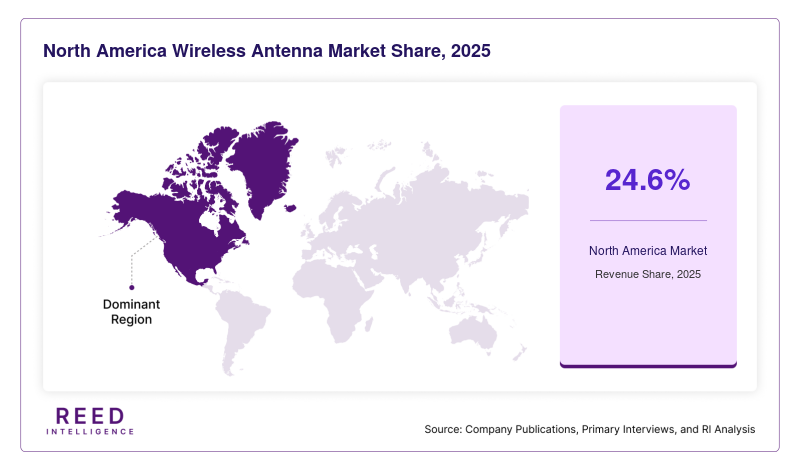
North America accounted for 24.6% of the global Wireless Antenna Market share in 2025. The region benefited from advanced telecommunications infrastructure, widespread digital connectivity, and strong investments in next-generation communication technologies. The market will expand at a CAGR of 7.3% during 2026–2034.
The United States remained the dominant country market due to continuous investment in network modernization projects and increasing deployment of advanced wireless communication systems. Strong adoption of connected technologies across commercial and industrial sectors continues to support market growth.
Europe
Europe held 21.3% market share in 2025. The region benefited from expanding digital transformation initiatives, industrial connectivity programs, and growing deployment of wireless communication infrastructure. The market will grow at a CAGR of 7.1% through 2034.
Germany emerged as the leading country due to increasing implementation of Industry 4.0 technologies and strong investments in advanced communication systems. The country’s manufacturing ecosystem continues to support demand for industrial wireless connectivity solutions.
Asia Pacific
Asia Pacific represented 41.7% of global revenue in 2025, making it the largest regional market. The region is expected to register a CAGR of 8.5% between 2026 and 2034.
China dominated regional revenue generation owing to large-scale telecommunications infrastructure expansion and extensive deployment of connected devices. Continued investments in smart cities, industrial automation, and digital infrastructure projects are contributing significantly to market development.
Middle East & Africa
The Middle East & Africa accounted for 6.5% market share in 2025. The region will grow at a CAGR of 9.1% during the forecast period, making it the fastest-growing regional market.
The United Arab Emirates remained the dominant country due to increasing investments in smart infrastructure, advanced telecommunications networks, and digital transformation programs. Wireless communication technologies play an important role in supporting national innovation initiatives.
Latin America
Latin America captured 5.9% of global revenue in 2025 and is forecast to expand at a CAGR of 7.6% through 2034.
Brazil led the regional market as telecommunications operators expanded network coverage and invested in communication infrastructure upgrades. Rising adoption of connected devices and enterprise networking solutions continues to support market expansion.
Competitive Landscape
The Wireless Antenna Market is moderately fragmented, with manufacturers competing through technological innovation, product customization, communication performance, and strategic partnerships. Companies are investing in advanced antenna architectures, miniaturization technologies, and next-generation communication solutions to strengthen market positions.
TE Connectivity maintained a leading position through its diversified antenna portfolio and extensive global presence. The company recently expanded its advanced wireless connectivity solutions portfolio designed to support evolving 5G infrastructure and industrial communication requirements.
Amphenol Corporation continues strengthening its market presence through innovative antenna technologies serving telecommunications, automotive, aerospace, and industrial customers.
Laird Connectivity focuses on integrated wireless solutions designed for IoT devices, enterprise applications, and industrial communication systems.
Molex LLC remains active in developing advanced connectivity technologies supporting next-generation wireless networks and connected devices.
Taoglas Ltd. continues expanding its antenna offerings through product innovation and application-specific wireless communication solutions.
Key Players List
- TE Connectivity
- Amphenol Corporation
- Molex LLC
- Laird Connectivity
- Taoglas Ltd.
- CommScope Holding Company, Inc.
- Airgain, Inc.
- Pulse Electronics Corporation
- PCTEL, Inc.
- Linx Technologies
- Quectel Wireless Solutions Co., Ltd.
- Antenova Ltd.
- Abracon LLC
- HUBER+SUHNER AG
- Kathrein SE
Recent Developments
- Several antenna manufacturers introduced advanced beamforming solutions designed for 5G and private wireless network deployments.
- New compact multi-band antenna platforms were launched to support connected consumer electronics and IoT applications.
- Companies increased investments in millimeter wave antenna technologies to address growing demand for high-capacity communication networks.
- Strategic collaborations were established between antenna suppliers and telecommunications infrastructure providers to accelerate network deployment projects.
- Industrial-grade wireless antenna solutions were introduced for smart manufacturing and automation environments.
- Automotive antenna manufacturers expanded product portfolios supporting connected mobility and vehicle communication applications.
- Research and development investments increased across adaptive antenna systems and advanced signal optimization technologies to improve wireless communication performance.
Wireless Antenna Market Segments
Antenna Type
- Omnidirectional Antennas
- Directional Antennas
- Smart Antennas
- Panel Antennas
- Dipole Antennas
- Patch Antennas
- Other Antennas
Frequency Band
- Sub-1 GHz
- 1 GHz–6 GHz
- Sub-6 GHz
- Millimeter Wave
- Ultra-High Frequency
Technology
- MIMO Antenna Systems
- Beamforming Antenna Systems
- Massive MIMO Systems
- Adaptive Antenna Systems
- Conventional Antenna Systems
Application
- Telecommunication Infrastructure
- Consumer Electronics
- Industrial IoT & Automation
- Smart Cities
- Connected Vehicles
- Aerospace & Defense
- Healthcare Devices
End-Use Industry
- Consumer Electronics
- Telecommunications
- Automotive & Transportation
- Industrial Manufacturing
- Aerospace & Defense
- Healthcare
- Energy & Utilities
By Region
- North America
- Europe
- APAC
- Middle East and Africa
- LATAM