Wireless Brain Sensor Market Size, Share & Demand Report By Type (EEG Sensors, MEG Sensors, Implantable Brain Sensors), By Application (Medical Diagnostics, Brain-Computer Interface, Cognitive Monitoring), By End-Use (Hospitals & Clinics, Research Institutes, Home Healthcare), By Region & Segment Forecasts, 2025–2034
USD 3950
Market Overview
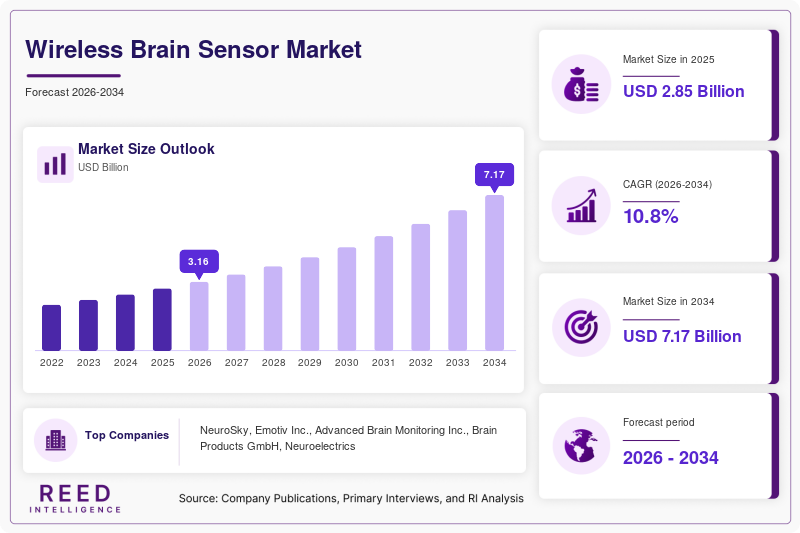
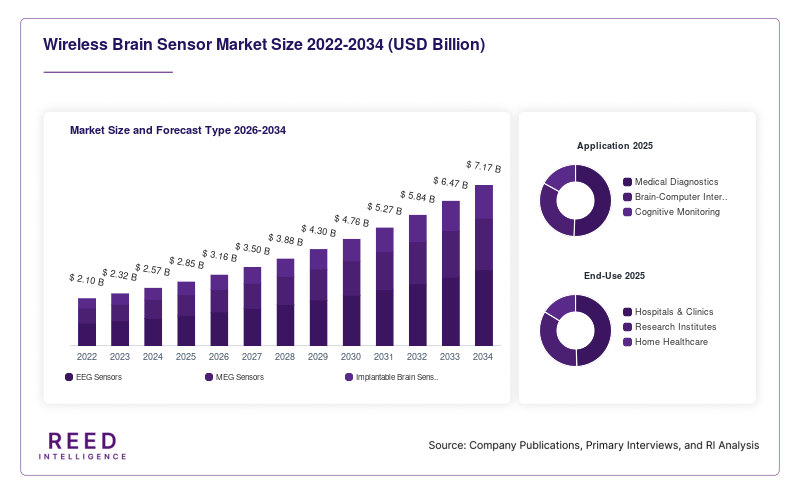
The Wireless Brain Sensor Market size is estimated at USD 2.85 billion in 2025 and is projected to reach USD 3.24 billion in 2026. Over the forecast period, the market is expected to grow significantly, reaching approximately USD 8.12 billion by 2034, registering a compound annual growth rate (CAGR) of 10.8% from 2025 to 2034.
Wireless brain sensors are increasingly used for monitoring brain activity in clinical, research, and consumer wellness settings. These sensors eliminate the limitations of wired systems, enabling mobility, real-time data collection, and remote patient monitoring. The demand is rising in applications such as epilepsy diagnosis, sleep studies, brain-computer interfaces, and mental health tracking.
Key Highlights
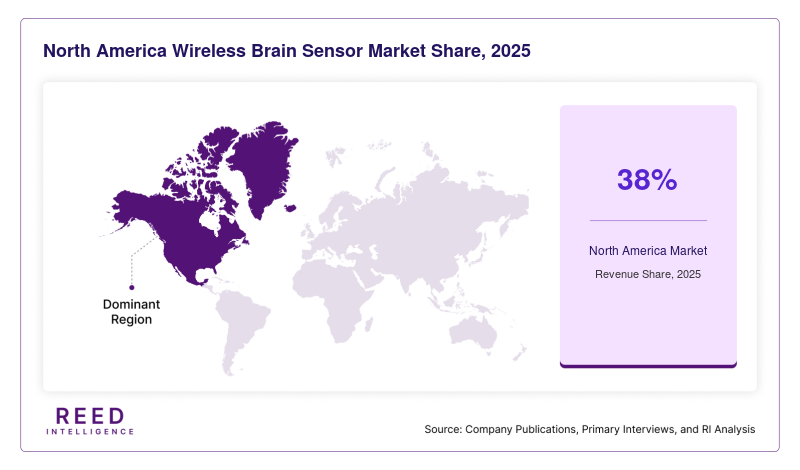
- North America held 38.0% of the Wireless Brain Sensor Market share in 2025, while Asia Pacific will register the fastest CAGR of 12.6% through 2034.
- EEG sensors accounted for 48.0% share in 2025, while implantable brain sensors will grow at a CAGR of 12.9%.
- Medical diagnostics applications represented 52.0% share in 2025, whereas brain-computer interface applications will grow at a CAGR of 13.4%.
- The United States remained the dominant country, with the market valued at USD 1.08 billion in 2025 and projected to reach USD 1.22 billion in 2026.
Market Trends
Integration of AI and Cloud-Based Analytics in Brain Monitoring
The integration of artificial intelligence and cloud-based analytics is transforming the Wireless Brain Sensor Market. Advanced algorithms are being used to analyze complex brain signals, enabling faster and more accurate diagnosis of neurological conditions. Cloud platforms allow real-time data storage and sharing, facilitating remote monitoring and telemedicine applications. Healthcare providers can now access patient data from anywhere, improving response time and treatment outcomes. This trend is particularly relevant in managing chronic neurological disorders, where continuous monitoring is required. As AI models become more sophisticated, their ability to detect subtle abnormalities in brain activity is expected to further enhance the value of wireless brain sensors.
Expansion of Consumer Neurotechnology and Wearable Devices
Consumer-focused neurotechnology is emerging as a key trend in the market. Wireless brain sensors are increasingly being integrated into wearable devices for applications such as stress management, sleep tracking, and cognitive performance enhancement. These devices are gaining popularity among fitness enthusiasts, gamers, and professionals seeking productivity improvements. The growing awareness of mental health and wellness is driving demand for accessible and user-friendly brain monitoring solutions. Manufacturers are focusing on compact designs, improved battery life, and seamless connectivity to attract a broader consumer base. This trend is expanding the market beyond clinical environments and opening new revenue streams.
Market Drivers
Rising Prevalence of Neurological Disorders
The increasing incidence of neurological disorders is a major driver for the Wireless Brain Sensor Market. Conditions such as epilepsy, Alzheimer’s disease, and traumatic brain injuries require continuous monitoring for effective management. Wireless brain sensors provide a convenient and efficient solution for long-term observation, reducing the need for hospital visits. As the global population ages, the burden of neurological diseases is expected to rise, further increasing demand for advanced diagnostic tools. Healthcare providers are adopting these technologies to improve patient outcomes and reduce healthcare costs. This growing need for efficient neurological monitoring systems is significantly contributing to market growth.
Growing Demand for Remote Patient Monitoring
The shift toward remote healthcare delivery is driving the adoption of wireless brain sensors. Telemedicine and home-based care models are gaining traction, especially after the increased focus on decentralized healthcare systems. Wireless sensors enable real-time monitoring of brain activity without requiring patients to remain in clinical settings. This is particularly beneficial for patients in rural or underserved areas. The convenience and cost-effectiveness of remote monitoring solutions are encouraging healthcare providers to integrate these technologies into their practice. As digital health infrastructure continues to improve, the demand for wireless brain sensors is expected to increase steadily.
Market Restraint
High Cost and Data Privacy Concerns
Despite the positive growth outlook, the Wireless Brain Sensor Market faces challenges related to high costs and data privacy concerns. Advanced wireless brain sensors often involve significant investment in hardware, software, and infrastructure, making them less accessible for smaller healthcare facilities and developing regions. Additionally, the collection and transmission of sensitive brain data raise concerns about data security and patient privacy. Unauthorized access or data breaches could have serious implications, limiting user trust and adoption. For example, healthcare providers must comply with strict regulations regarding data protection, which can increase operational complexity and costs. These factors may slow down market penetration, particularly in regions with limited resources or regulatory support.
Market Opportunities
Growth in Brain-Computer Interface Applications
The development of brain-computer interface (BCI) technology presents significant opportunities for the Wireless Brain Sensor Market. BCIs enable direct communication between the brain and external devices, offering potential applications in rehabilitation, prosthetics, and assistive technologies. Wireless brain sensors play a critical role in capturing neural signals required for these interfaces. As research in this field advances, the demand for reliable and high-performance sensors is expected to grow. This opportunity is particularly relevant for patients with paralysis or severe disabilities, as BCIs can improve their quality of life. Increasing investments in neurotechnology research are likely to accelerate innovation and market expansion.
Expansion in Emerging Markets
Emerging markets offer substantial growth potential for the Wireless Brain Sensor Market. Countries in Asia Pacific, Latin America, and the Middle East are investing in healthcare infrastructure and adopting advanced medical technologies. Rising awareness of neurological health and increasing healthcare expenditure are driving demand for innovative diagnostic tools. Wireless brain sensors can address the need for cost-effective and scalable monitoring solutions in these regions. Additionally, government initiatives to improve healthcare access are supporting market growth. As these markets continue to develop, they are expected to contribute significantly to global revenue.
Segmental Analysis
By Type
The electroencephalography (EEG) sensors segment dominated the Wireless Brain Sensor Market in 2024, accounting for approximately 48% of the total market share. EEG sensors are widely used for monitoring brain activity in both clinical and research settings due to their non-invasive nature and high reliability. These sensors are commonly applied in the diagnosis of epilepsy, sleep disorders, and other neurological conditions. Their ability to provide real-time data and compatibility with wireless technologies make them a preferred choice among healthcare providers. The increasing demand for portable and user-friendly monitoring devices is further supporting the dominance of this segment.
The implantable brain sensors segment is expected to be the fastest-growing, registering a CAGR of 12.9% during the forecast period. These sensors are used in advanced applications such as brain-computer interfaces and neurostimulation therapies. The growth of this segment is driven by ongoing research and development efforts aimed at improving sensor accuracy and functionality. Implantable sensors offer long-term monitoring capabilities and are particularly useful for patients with severe neurological conditions. As technological advancements continue, the adoption of these sensors is expected to increase significantly.
By Application
The medical diagnostics segment held the largest share of the Wireless Brain Sensor Market in 2024, accounting for around 52% of total revenue. Wireless brain sensors are extensively used in diagnosing neurological disorders, monitoring brain activity, and supporting clinical decision-making. The growing prevalence of neurological conditions and the need for early detection are driving the demand for diagnostic applications. Healthcare providers are increasingly adopting wireless solutions to improve patient comfort and reduce hospital stays, further supporting the growth of this segment.
The brain-computer interface applications segment is projected to be the fastest-growing, with a CAGR of 13.4% during the forecast period. This growth is driven by advancements in neurotechnology and increasing investment in research. BCIs are being developed for various applications, including assistive devices, gaming, and cognitive enhancement. Wireless brain sensors play a crucial role in enabling these interfaces by capturing neural signals accurately. The expanding scope of BCI applications is expected to drive significant demand for wireless brain sensors.
By End-Use
Hospitals and clinics dominated the Wireless Brain Sensor Market in 2024, accounting for approximately 45% of the market share. These facilities rely on wireless brain sensors for diagnosing and monitoring neurological conditions. The availability of advanced healthcare infrastructure and skilled professionals supports the adoption of these technologies in clinical settings. Hospitals are increasingly integrating wireless monitoring solutions to improve patient outcomes and streamline operations.
The home healthcare segment is expected to grow at the fastest rate, with a CAGR of 13.1% during the forecast period. The shift toward remote patient monitoring and home-based care is driving the demand for wireless brain sensors in this segment. Patients prefer the convenience of monitoring their health from home, reducing the need for frequent hospital visits. Technological advancements and increasing awareness of digital health solutions are supporting the growth of this segment.
Regional Analysis
North America
North America holds a significant share of the Wireless Brain Sensor Market, accounting for approximately 38% of the global market in 2025. The region is expected to maintain steady growth with a projected CAGR of 10.2% through 2034. The presence of advanced healthcare infrastructure, high adoption of digital health technologies, and strong research capabilities are key factors supporting market expansion. Additionally, the increasing prevalence of neurological disorders and rising demand for remote monitoring solutions are driving the adoption of wireless brain sensors across the region.
The United States dominates the North American market due to its well-established healthcare system and significant investments in neurotechnology research. A unique growth factor in the country is the strong collaboration between academic institutions and technology companies, which accelerates innovation in brain monitoring solutions. These partnerships are leading to the development of more accurate and user-friendly devices, further boosting market growth.
Europe
Europe accounts for around 27% of the global Wireless Brain Sensor Market in 2025 and is expected to grow at a CAGR of 9.8% during the forecast period. The region benefits from a robust healthcare system, increasing awareness of neurological health, and supportive government policies. The adoption of wireless brain sensors is growing in clinical and research settings, driven by the need for advanced diagnostic tools and improved patient care.
Germany leads the European market, supported by its strong medical device industry and focus on research and development. A unique growth factor in Germany is the integration of wireless brain sensors into rehabilitation programs, particularly for stroke and brain injury patients. This application is enhancing patient recovery outcomes and driving demand for innovative monitoring solutions.
Asia Pacific
Asia Pacific is emerging as a high-growth region in the Wireless Brain Sensor Market, holding a 20% market share in 2025 and expected to register a CAGR of 12.6% through 2034. Rapid urbanization, increasing healthcare expenditure, and growing awareness of neurological disorders are key factors driving market growth. The adoption of wireless brain sensors is expanding in both healthcare and consumer applications across the region.
China dominates the Asia Pacific market due to its large population and increasing investment in healthcare infrastructure. A unique growth factor in China is the government’s focus on digital health initiatives, which promotes the adoption of advanced medical technologies. This support is encouraging local manufacturers to develop cost-effective wireless brain sensors, contributing to market expansion.
Middle East & Africa
The Middle East & Africa region holds a smaller share of the Wireless Brain Sensor Market, accounting for approximately 8% in 2025, with a projected CAGR of 9.1% through 2034. The market is gradually expanding due to improving healthcare infrastructure and increasing awareness of neurological conditions. Governments are investing in modern medical technologies to enhance healthcare services.
Saudi Arabia is a key market in the region, driven by its focus on healthcare modernization and technological adoption. A unique growth factor is the increasing use of wireless brain sensors in specialized hospitals and research centers. This trend is supported by government initiatives aimed at improving healthcare quality and accessibility.
Latin America
Latin America represents around 7% of the global Wireless Brain Sensor Market in 2025 and is expected to grow at a CAGR of 9.5% during the forecast period. The region is experiencing gradual adoption of advanced medical technologies, supported by increasing healthcare investments and rising awareness of neurological health.
Brazil leads the Latin American market, driven by its large population and expanding healthcare sector. A unique growth factor in Brazil is the growing use of wireless brain sensors in academic research and clinical trials. This application is contributing to the development of new diagnostic and therapeutic approaches, supporting market growth.
Competitive Landscape
The Wireless Brain Sensor Market is moderately competitive, with several established players and emerging companies focusing on innovation and product development. Key companies are investing in research and development to enhance sensor accuracy, connectivity, and user experience. Strategic collaborations, mergers, and acquisitions are common strategies used to strengthen market position.
One of the leading players in the market is NeuroSky, which has a strong presence in consumer neurotechnology and wearable devices. The company focuses on developing affordable and user-friendly brain sensors for various applications. A recent development in the market includes the launch of advanced wireless EEG systems with improved signal processing capabilities, aimed at enhancing diagnostic accuracy.
Other major players are also expanding their product portfolios and entering new markets to increase their global footprint. The competitive landscape is expected to evolve as new technologies and applications emerge, creating opportunities for both established and new entrants.
Key Players
- NeuroSky
- Emotiv Inc.
- Advanced Brain Monitoring Inc.
- Brain Products GmbH
- Neuroelectrics
- OpenBCI
- Natus Medical Incorporated
- Compumedics Limited
- g.tec medical engineering GmbH
- Cognionics Inc.
- InteraXon Inc.
- Kernel Inc.
- Bitbrain Technologies
- NeuroPace Inc.
- Cadwell Industries Inc.
Recent Developments
- A leading company introduced a next-generation wireless EEG headset with enhanced battery life and improved data accuracy for clinical use.
- A neurotechnology firm announced a partnership with a research institute to develop advanced brain-computer interface solutions using wireless sensors.
- A medical device manufacturer expanded its product portfolio by launching compact wireless brain monitoring devices for home healthcare applications.
Wireless Brain Sensor Market Segments
Type
- EEG Sensors
- MEG Sensors
- Implantable Brain Sensors
Application
- Medical Diagnostics
- Brain-Computer Interface
- Cognitive Monitoring
End-Use
- Hospitals & Clinics
- Research Institutes
- Home Healthcare
By Region
- North America
- Europe
- APAC
- Middle East and Africa
- LATAM