Wireless Display Market Size, Share & Demand Report By Offering (Hardware Solutions, Software & Platform Solutions, Services), By Technology (Wi-Fi Display, Miracast, AirPlay, Google Cast, Cloud-Based Wireless Display, Others), By End Use (Enterprise & Corporate Offices, Education, Healthcare, Government, Retail, Hospitality, Residential, Others), By Region & Segment Forecasts, 2026–2034
USD 3950
Market Overview
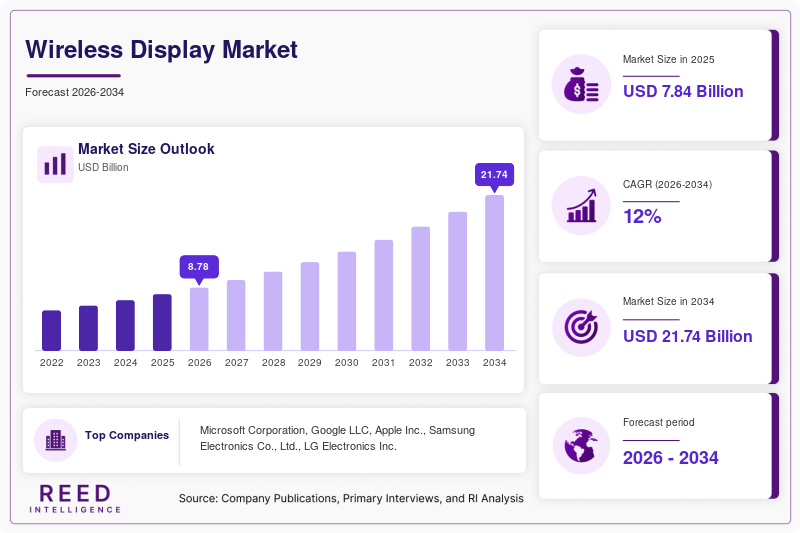
The global Wireless Display Market size was valued at USD 7.84 billion in 2026 and is projected to reach USD 19.47 billion by 2034, expanding at a CAGR of 12.0% during the forecast period (2026–2034). The market continues to evolve as businesses, educational institutions, healthcare facilities, and consumers increasingly adopt cable-free connectivity solutions for seamless content sharing and screen mirroring. Wireless display technologies enable users to transmit audio, video, presentations, and application content from smartphones, tablets, laptops, and desktop systems to larger screens without physical connections.
A major factor supporting market expansion is the global transition toward hybrid workplaces and digital collaboration environments. Organizations across developed and emerging economies are investing in wireless presentation systems, smart conference rooms, and collaborative display platforms to improve productivity and user convenience. The growing penetration of smart televisions, connected displays, and cloud-enabled ecosystems has further strengthened market demand.
Key Highlights
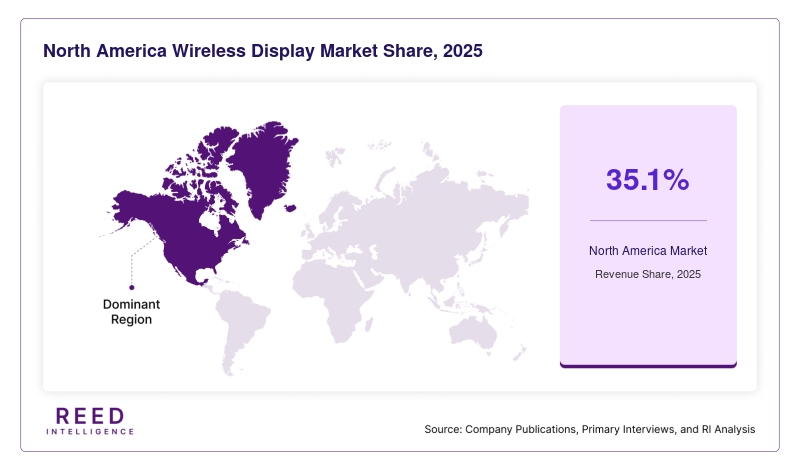
- North America dominated the market with a 35.1% share in 2025.
- while Asia Pacific is expected to grow at the fastest CAGR of 13.8% during 2026–2034.
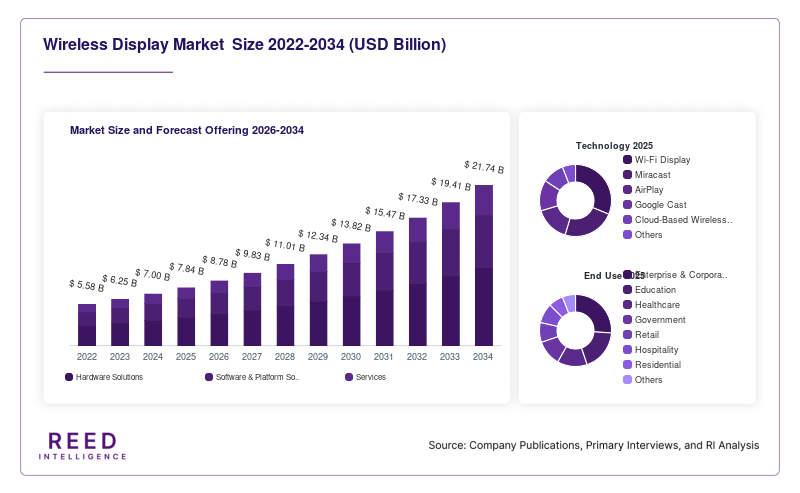
- By offering, hardware solutions accounted for the largest share of 57.4%.
- while software and platform solutions are projected to grow at a CAGR of 14.2%.
- By technology, Wi-Fi display technology led with a 46.8% share.
- whereas cloud-based wireless display solutions are expected to expand at a CAGR of 15.1%.
- By end use, enterprise and corporate offices held a 39.6% share.
- while the education sector is expected to register a CAGR of 14.7%.
- The United States remained the dominant country, with market values of USD 1.96 billion in 2024 and USD 2.18 billion in 2025.
Market Trends
Growing Adoption of Hybrid Collaboration Ecosystems
The increasing adoption of hybrid work environments has emerged as a major trend shaping the Wireless Display Market. Organizations are redesigning conference rooms and collaboration spaces to support seamless interaction between remote and in-office employees. Wireless display platforms allow participants to share presentations, documents, and multimedia content instantly without relying on cables or adapters. Businesses are increasingly integrating display systems with video conferencing platforms, digital whiteboards, and cloud collaboration tools. This trend is particularly visible among multinational corporations that require consistent communication infrastructure across geographically dispersed offices. As workforce flexibility becomes a long-term operational strategy, demand for wireless display technologies that improve meeting efficiency and reduce setup complexity continues to rise across commercial sectors.
Expansion of Smart Home Entertainment and Connected Devices
The rapid growth of smart homes and connected consumer electronics is creating strong momentum for wireless display adoption. Consumers increasingly seek convenient methods for streaming content from smartphones, tablets, gaming consoles, and laptops to large-screen displays. Smart televisions equipped with native wireless casting technologies have become mainstream in both developed and emerging markets. Device manufacturers are focusing on interoperability and user-friendly experiences, enabling seamless connectivity across operating systems and hardware platforms. The rising popularity of 4K and 8K content streaming, online gaming, and multimedia sharing further supports demand. As households continue investing in connected ecosystems, wireless display technologies are becoming an essential component of modern entertainment environments.
Market Drivers
Rising Demand for Flexible Workplace Technology Infrastructure
The growing need for flexible and efficient workplace technology solutions is a major driver of the Wireless Display Market. Organizations are investing heavily in digital workplace transformation initiatives to improve employee productivity and collaboration. Wireless display systems eliminate the limitations associated with traditional wired connections, enabling users to connect multiple devices quickly and securely. Large enterprises, government agencies, and small businesses increasingly deploy wireless presentation solutions to streamline meeting experiences and reduce infrastructure complexity. The ability to support bring-your-own-device environments has become particularly valuable as employees use diverse hardware platforms. Continuous improvements in network performance, security protocols, and compatibility standards are further encouraging widespread deployment of wireless display technologies across modern workplaces.
Increasing Digitalization Across Education and Healthcare Sectors
Educational institutions and healthcare facilities are adopting wireless display technologies to support more interactive and efficient operations. Schools, universities, and training centers use wireless content-sharing systems to enhance classroom engagement and facilitate collaborative learning experiences. Educators can easily present digital resources from multiple devices, improving instructional flexibility. In healthcare environments, wireless displays support medical imaging reviews, patient consultations, training sessions, and multidisciplinary collaboration. Hospitals increasingly require secure and reliable display solutions that enable healthcare professionals to access and share information efficiently. Growing investments in digital infrastructure, combined with government initiatives promoting technology adoption, continue to create favorable growth conditions for wireless display vendors serving these sectors.
Market Restraint
Security and Network Reliability Concerns Limiting Adoption
Despite strong growth prospects, security concerns and network reliability challenges remain significant restraints for the Wireless Display Market. Many organizations handle sensitive information that requires strict data protection measures during content transmission. Unauthorized access, network vulnerabilities, and potential interception risks can discourage adoption, particularly in regulated industries such as healthcare, finance, and government. In addition, wireless display performance depends heavily on network quality and bandwidth availability. Congested networks may result in latency, signal interruptions, or reduced streaming quality, affecting user experience. Small and medium-sized enterprises with limited IT resources often face challenges in implementing and maintaining secure wireless display environments. These concerns can delay purchasing decisions and increase deployment costs. Although vendors continue introducing advanced encryption protocols, authentication mechanisms, and network optimization technologies, overcoming security and reliability perceptions remains essential for broader market penetration.
Market Opportunities
Integration of Artificial Intelligence in Display Management Platforms
Artificial intelligence is creating new opportunities within the Wireless Display Market by enhancing system performance, automation, and user experience. AI-powered display management platforms can optimize network utilization, automatically prioritize bandwidth allocation, and improve content delivery quality. Organizations increasingly seek intelligent meeting room solutions capable of recognizing users, configuring devices automatically, and providing predictive maintenance insights. AI-driven analytics can also help administrators monitor device utilization, identify operational inefficiencies, and improve resource allocation. As enterprises pursue smarter workplace environments, demand for advanced wireless display solutions incorporating artificial intelligence capabilities is expected to increase significantly, creating attractive opportunities for technology providers and software developers.
Emerging Demand from Smart Cities and Digital Infrastructure Projects
The expansion of smart city initiatives and large-scale digital infrastructure investments presents substantial opportunities for market participants. Governments and urban development authorities are deploying connected public facilities, transportation hubs, command centers, and information systems that require advanced display technologies. Wireless displays facilitate flexible communication, real-time information sharing, and centralized content management across diverse environments. Airports, railway stations, public safety centers, and municipal facilities increasingly utilize wireless display systems to improve operational efficiency and public engagement. As developing economies continue investing in digital modernization programs, vendors have opportunities to introduce scalable wireless display solutions tailored to public sector requirements and large infrastructure projects.
Segmental Analysis
By Offering
Hardware solutions represented the dominant subsegment, accounting for approximately 57.4% of market revenue in 2024. This category includes wireless display adapters, receivers, transmitters, presentation devices, and integrated display systems. Strong demand stems from enterprise conference rooms, educational institutions, and commercial facilities seeking reliable hardware platforms for content sharing. Many organizations prefer dedicated hardware solutions because they offer consistent performance, improved security, and simplified deployment. The growing adoption of smart displays and connected televisions further supports segment growth. Manufacturers continue introducing compact, high-performance devices capable of supporting multiple users and high-resolution content transmission, reinforcing the segment's leadership position within the overall market.
Software and platform solutions are anticipated to record the fastest CAGR of 14.2% through 2034. Growth is driven by increasing demand for cloud-based management, remote administration, and cross-platform compatibility. Organizations are prioritizing scalable solutions that reduce hardware dependency while improving flexibility. Software platforms enable centralized device monitoring, user authentication, analytics, and content management capabilities. The expansion of hybrid work environments has increased the importance of software-driven collaboration ecosystems. Vendors are also integrating artificial intelligence, security enhancements, and workflow automation features to improve operational efficiency. These developments position software solutions as a key growth area within the Wireless Display Market.
By Technology
Wi-Fi display technology accounted for the largest share of approximately 46.8% in 2024, making it the dominant technology segment. Wi-Fi-based solutions provide reliable, high-speed content transmission and support a broad range of consumer and enterprise devices. Their widespread adoption is largely attributable to existing wireless infrastructure, reducing the need for extensive additional investments. Businesses, educational institutions, and households utilize Wi-Fi display technologies for presentations, streaming, collaboration, and entertainment applications. Ongoing advancements in wireless networking standards continue improving performance, bandwidth capacity, and user experience. These advantages help maintain the segment's strong market position and widespread adoption across multiple industries.
Cloud-based wireless display solutions are projected to expand at a CAGR of 15.1% during the forecast period. Growing reliance on cloud computing and remote collaboration platforms is accelerating adoption. These solutions enable users to share content across geographically dispersed locations without requiring extensive on-premise infrastructure. Enterprises benefit from centralized management, enhanced scalability, and reduced maintenance requirements. The increasing integration of cloud-based display platforms with conferencing software and digital workplace applications further strengthens demand. As organizations continue migrating toward cloud-first operational models, cloud-enabled wireless display technologies are expected to experience substantial growth.
By End Use
Enterprise and corporate offices held the dominant position with a market share of approximately 39.6% in 2024. Organizations increasingly depend on wireless display solutions to improve communication, collaboration, and meeting efficiency. The adoption of hybrid work arrangements has accelerated investment in modern conference room technologies capable of supporting both remote and in-person participants. Enterprises value wireless displays for their flexibility, ease of deployment, and compatibility with multiple devices. Large corporations, financial institutions, consulting firms, and technology companies continue investing in advanced collaboration infrastructure. As workplace modernization remains a strategic priority, the enterprise segment is expected to maintain its leading market position.
The education sector is anticipated to register the fastest CAGR of 14.7% through 2034. Schools, universities, and training centers are rapidly adopting digital learning technologies to improve engagement and instructional effectiveness. Wireless display solutions enable educators to share content seamlessly from various devices, encouraging interactive participation and collaborative learning experiences. Government initiatives supporting digital education infrastructure are further stimulating demand. Educational institutions increasingly seek flexible classroom technologies capable of supporting hybrid and remote learning models. The combination of rising technology investments and evolving educational methodologies is expected to drive sustained growth within this segment.
Regional Analysis
North America
North America accounted for approximately 35.1% of the global Wireless Display Market in 2025 and continues to maintain a leading position. The region is projected to expand at a CAGR of 11.4% through 2034, supported by strong technology adoption rates and mature digital infrastructure. Enterprises across the United States and Canada continue investing in advanced collaboration technologies to support hybrid working models. High penetration of smart devices, cloud platforms, and enterprise communication tools further strengthens market demand.
The United States remains the dominant country within the region. A key growth factor is the widespread implementation of smart workplace initiatives across corporate sectors. Organizations increasingly deploy wireless conferencing and presentation systems to improve productivity and support distributed workforces. Continued investments in innovation, coupled with strong purchasing power among enterprises, support long-term market expansion throughout the country.
Europe
Europe represented approximately 27.3% of the global market in 2025 and is forecast to grow at a CAGR of 10.8% during the assessment period. The region benefits from increasing digital transformation efforts across enterprises, educational institutions, and public sector organizations. Demand for flexible communication technologies continues to rise as businesses modernize office environments and seek efficient collaboration solutions. Regulatory support for digital innovation also contributes to market development.
Germany leads the European market due to its strong industrial and corporate technology ecosystem. A unique growth factor is the country's emphasis on smart manufacturing and Industry 4.0 initiatives. Businesses increasingly require advanced display and collaboration technologies to support connected operations, workforce training, and real-time decision-making. These developments continue generating substantial demand for wireless display solutions.
Asia Pacific
Asia Pacific held nearly 24.6% of global revenue in 2025 and is expected to register the fastest CAGR of 13.8% through 2034. Rapid urbanization, expanding internet connectivity, and increasing adoption of smart devices are creating significant growth opportunities. Governments across the region continue promoting digital transformation programs, while enterprises invest heavily in modern communication technologies. Rising consumer demand for connected entertainment systems further accelerates market expansion.
China dominates the regional market owing to its extensive electronics manufacturing sector and large consumer base. One important growth factor is the rapid expansion of smart home ecosystems. Consumers increasingly adopt connected televisions, streaming devices, and wireless content-sharing solutions. This trend, combined with ongoing investments in communication infrastructure, supports robust growth across the Chinese market.
Middle East & Africa
The Middle East & Africa region accounted for approximately 6.8% of the global market in 2025 and is projected to grow at a CAGR of 10.5% during the forecast period. Market growth is supported by increasing investments in smart infrastructure, commercial development projects, and digital modernization programs. Governments are emphasizing technology adoption to improve public services, business efficiency, and educational outcomes, creating favorable conditions for wireless display deployment.
The United Arab Emirates remains the leading market within the region. A unique growth factor is the country's focus on smart city development and advanced digital infrastructure projects. Public institutions, commercial facilities, and transportation networks increasingly incorporate wireless communication and display technologies. These investments continue driving demand for innovative display solutions across multiple application environments.
Latin America
Latin America captured around 6.2% of global market revenue in 2025 and is expected to expand at a CAGR of 10.1% through 2034. Increasing digitalization across educational institutions, businesses, and government agencies is supporting market growth. The region is witnessing gradual improvements in internet connectivity and enterprise technology adoption. Growing awareness regarding collaborative workplace technologies is also contributing to increased demand for wireless display systems.
Brazil leads the regional market due to its large economy and expanding technology sector. A distinctive growth factor is the increasing modernization of educational infrastructure. Schools and universities are investing in interactive learning technologies that support digital teaching methods and remote collaboration. These initiatives continue creating significant opportunities for wireless display vendors operating within the Brazilian market.
Competitive Landscape
The Wireless Display Market remains moderately competitive, with global technology providers focusing on product innovation, ecosystem integration, and strategic partnerships. Companies are investing in advanced connectivity capabilities, cloud management platforms, and security enhancements to strengthen market positioning. Competitive differentiation increasingly depends on interoperability, user experience, and support for hybrid collaboration environments.
Microsoft Corporation maintains a leadership position through its strong ecosystem integration and enterprise collaboration capabilities. The company continues expanding wireless display functionality across workplace productivity solutions. Google LLC, Apple Inc., Samsung Electronics Co., Ltd., and LG Electronics Inc. also maintain significant market presence through extensive consumer and enterprise product portfolios.
A recent industry development involved the introduction of next-generation wireless presentation platforms featuring AI-assisted device management and enhanced security protocols. Vendors are increasingly focusing on cloud-native architectures and cross-platform compatibility to address evolving enterprise requirements. Strategic collaborations between display manufacturers and collaboration software providers are also becoming more common as organizations seek unified communication environments.
Key Players
- Microsoft Corporation
- Google LLC
- Apple Inc.
- Samsung Electronics Co., Ltd.
- LG Electronics Inc.
- Sony Group Corporation
- Barco NV
- Airtame Inc.
- Roku Inc.
- Amazon.com, Inc.
- BenQ Corporation
- Panasonic Holdings Corporation
- Cisco Systems, Inc.
- Actiontec Electronics
- ScreenBeam Inc.
Recent Developments
- Microsoft expanded enterprise wireless display capabilities through enhanced integration with collaborative workplace platforms and intelligent meeting room solutions.
- Samsung introduced advanced smart display products supporting improved multi-device wireless connectivity and high-resolution content sharing capabilities.
- Barco launched upgraded wireless presentation systems featuring stronger cybersecurity frameworks, centralized management tools, and enhanced cross-platform compatibility.
- Google expanded casting functionality across connected device ecosystems to improve interoperability between smartphones, tablets, and smart televisions.
- LG Electronics introduced enterprise-focused display solutions designed to support hybrid collaboration environments and cloud-based content management platforms.
Wireless Display Market Segments
Offering
- Hardware Solutions
- Software & Platform Solutions
- Services
Technology
- Wi-Fi Display
- Miracast
- AirPlay
- Google Cast
- Cloud-Based Wireless Display
- Others
End Use
- Enterprise & Corporate Offices
- Education
- Healthcare
- Government
- Retail
- Hospitality
- Residential
- Others
By Region
- North America
- Europe
- APAC
- Middle East and Africa
- LATAM