Wireless Intercom Market Size, Share & Demand Report By Technology (Wi-Fi Systems, Bluetooth Systems, DECT Systems), By Component (Hardware, Software & Cloud Platforms), By Application (Commercial, Residential, Industrial, Healthcare, Transportation), By End User (Residential Users, Commercial Facilities, Industrial Facilities), By Distribution Channel (Direct Sales, Distributors, Specialty Electronics Stores,) By Region & Segment Forecasts, 2026–2034
USD 3950
Market Overview
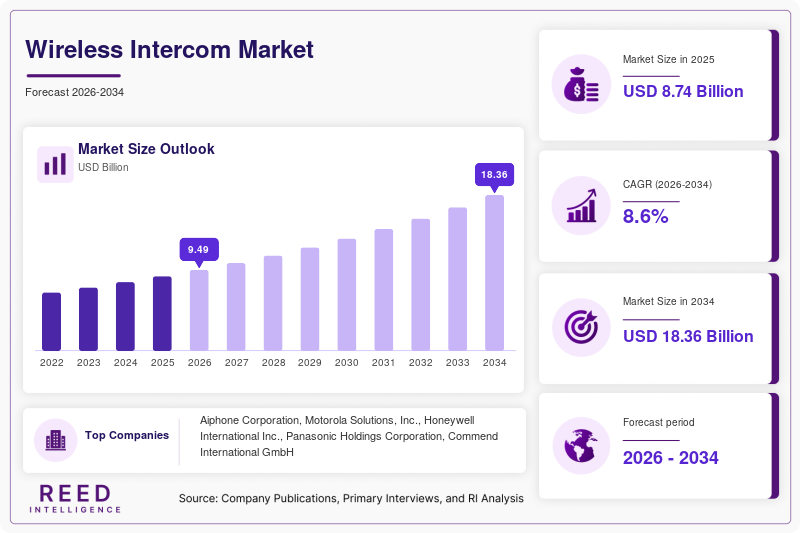
The Wireless Intercom Market size was valued at USD 8.74 billion in 2026 and is projected to reach USD 16.92 billion by 2034, expanding at a CAGR of 8.6% during the forecast period from 2026 to 2034. The global Wireless Intercom Market growth has been supported by increasing demand for real-time communication systems across residential, commercial, industrial, transportation, and public safety sectors.
Wireless intercom systems enable seamless communication without extensive wiring infrastructure, making them suitable for modern buildings, smart homes, industrial facilities, and event management applications. The increasing adoption of wireless technologies, coupled with rising investments in smart infrastructure development, has accelerated product deployment across developed and emerging economies.
Key Highlights
- North America accounted for 36.4% of the global Wireless Intercom Market share in 2025, while Asia Pacific is projected to register the fastest CAGR of 9.4% during the forecast period.
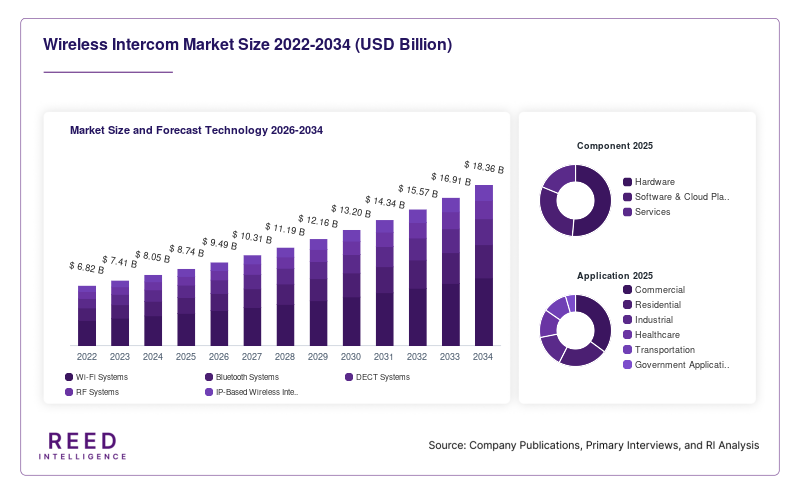
- By technology, Wi-Fi wireless intercom systems held the leading market share of 39.8% in 2025, whereas IP-based wireless intercom systems are expected to expand at a CAGR of 9.8% through 2034.
- By application, commercial applications accounted for 34.2% of the Wireless Intercom Market share in 2025, while healthcare applications are projected to grow at a CAGR of 9.6%.
- By component, hardware represented 58.7% of the market share in 2025, whereas software and cloud platforms are anticipated to witness a CAGR of 10.1% during the study period.
- By end user, residential users accounted for 31.6% of the market share in 2025, while industrial facilities are expected to grow at a CAGR of 9.2%.
- The United States Wireless Intercom Market was valued at USD 2.14 billion in 2024 and increased to USD 2.31 billion in 2025 due to increasing adoption of smart building communication systems.
Market Trends
Increasing Integration with Smart Home Ecosystems
One of the key trends shaping the Wireless Intercom Market is the growing integration of intercom systems with smart home ecosystems. Consumers increasingly prefer centralized platforms that combine communication, surveillance, access control, and automation features within a single mobile-enabled interface.
Manufacturers are introducing wireless intercom systems compatible with smart assistants, cloud connectivity, and smartphone applications. This trend is expected to improve product adoption across residential and mixed-use infrastructure projects.
Rising Demand for Video-Enabled Wireless Intercom Systems
Another major trend influencing the Wireless Intercom Market is the increasing deployment of video-enabled wireless intercom systems. Businesses and homeowners are adopting audio-video communication solutions to improve security monitoring and visitor management.
High-definition cameras, facial recognition technologies, and remote mobile access functionalities are increasingly becoming standard features in modern wireless intercom systems. This trend is expected to support premium product demand during the forecast period.
Market Drivers
Expansion of Smart Building Infrastructure
The rapid expansion of smart building infrastructure has emerged as a major driver for the Wireless Intercom Market. Commercial offices, residential complexes, healthcare facilities, and educational institutions are increasingly implementing connected communication systems to improve operational management.
Wireless intercom systems offer scalable deployment, lower installation complexity, and improved flexibility compared to traditional wired communication systems. Increasing investments in smart city projects are expected to continue driving market growth.
Growing Demand for Enhanced Security Solutions
The increasing need for advanced security and access management solutions has significantly contributed to Wireless Intercom Market growth. Property owners are investing in integrated communication systems to strengthen visitor verification and emergency communication capabilities.
Wireless intercom systems integrated with surveillance cameras, remote access controls, and mobile applications are increasingly adopted across residential and commercial environments to improve security efficiency.
Market Restraint
Connectivity and Signal Interference Challenges
Connectivity limitations and signal interference remain major restraints for the Wireless Intercom Market. Wireless communication systems may experience performance disruptions due to network congestion, physical obstructions, or electromagnetic interference.
Large industrial facilities and densely populated urban environments may require additional infrastructure investments to maintain communication reliability, potentially limiting adoption in certain applications.
Market Opportunities
Growth of Healthcare Communication Infrastructure
The increasing modernization of healthcare communication infrastructure presents a major opportunity for the Wireless Intercom Market. Hospitals and medical centers are adopting wireless intercom systems to improve staff coordination, patient monitoring, and emergency communication.
The growing demand for elderly care monitoring systems and nurse call communication platforms is expected to create long-term growth opportunities for market participants.
Expansion of Event Management and Broadcasting Applications
The event management and broadcasting industries are generating new opportunities for the Wireless Intercom Market. Large-scale events, sports venues, production studios, and live broadcasting operations require portable and scalable communication systems.
Wireless intercom technologies enable flexible communication between production teams, technical staff, and event coordinators, supporting increasing adoption across entertainment and media sectors.
Segmental Analysis
By Technology
Based on technology, the Wireless Intercom Market is segmented into Wi-Fi systems, Bluetooth systems, DECT systems, RF systems, and IP-based wireless intercom systems.
Wi-Fi wireless intercom systems dominated the market with a 39.8% share in 2025 due to their broad compatibility with smart devices and building automation platforms.
IP-based wireless intercom systems are expected to witness the fastest CAGR of 9.8% during the forecast period. Increasing demand for scalable cloud-enabled communication infrastructure is expected to support segment growth.
By Component
Based on component, the Wireless Intercom Market is segmented into hardware, software & cloud platforms, and services.
Hardware accounted for the highest market share of 58.7% in 2025 because organizations continued investing in intercom devices, access panels, wireless transmitters, and communication consoles.
Software and cloud platforms are anticipated to expand at a CAGR of 10.1% through 2034. Increasing demand for remote monitoring and centralized communication management solutions is expected to drive segment growth.
By Application
Based on application, the Wireless Intercom Market is segmented into commercial, residential, industrial, healthcare, transportation, and government applications.
Commercial applications held the leading market share of 34.2% in 2025 due to rising deployment across office buildings, hotels, retail facilities, and mixed-use developments.
Healthcare applications are expected to grow at a CAGR of 9.6% during the study period. Increasing investments in digital healthcare communication systems and patient monitoring infrastructure are projected to strengthen segment demand.
By End User
Based on end user, the Wireless Intercom Market is categorized into residential users, commercial facilities, industrial facilities, public infrastructure operators, and transportation operators.
Residential users accounted for the dominant market share of 31.6% in 2025 because homeowners increasingly adopted smart communication and access management systems.
Industrial facilities are projected to witness a CAGR of 9.2% through 2034. Growing industrial automation and workplace coordination requirements are expected to support demand for advanced wireless communication systems.
By Distribution Channel
Based on distribution channel, the Wireless Intercom Market is segmented into direct sales, distributors, specialty electronics stores, and online retail.
Direct sales dominated the market with a 44.5% share in 2025 due to strong enterprise procurement partnerships and customized installation requirements.
Online retail is anticipated to register the fastest CAGR of 10.3% during the forecast period. Increasing e-commerce adoption and wider product accessibility are expected to strengthen segment growth.
Regional Analysis
North America
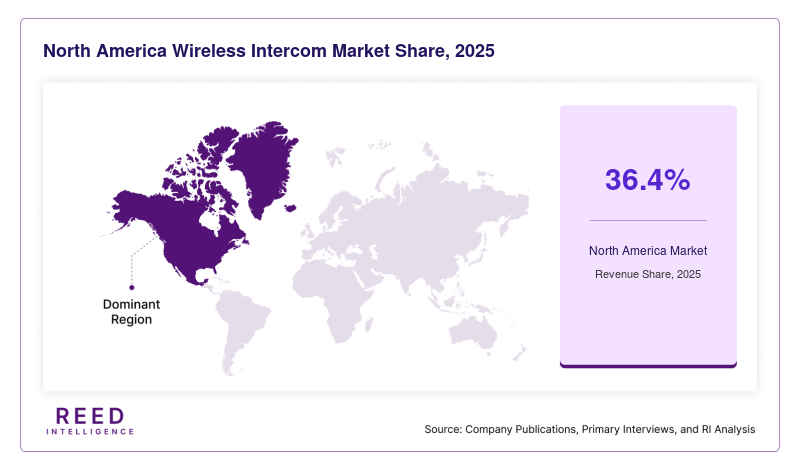
North America accounted for 36.4% of the Wireless Intercom Market share in 2025 and is projected to expand at a CAGR of 8.1% during the forecast period. The region maintained strong market demand due to rapid smart home adoption and increasing investments in commercial security systems.
The United States represented the dominant country within the regional market because of rising deployment of integrated communication technologies across residential and commercial infrastructure projects.
Europe
Europe held 27.6% of the global Wireless Intercom Market share in 2025 and is expected to grow at a CAGR of 8.3% through 2034. The regional market benefited from increasing adoption of smart building technologies and modernization of public infrastructure.
Germany dominated the regional market due to strong investments in industrial automation and intelligent building management systems.
Asia Pacific
Asia Pacific accounted for 23.9% of the Wireless Intercom Market share in 2025 and is anticipated to register the fastest CAGR of 9.4% during the study period. Rising urbanization and increasing smart residential construction supported regional market expansion.
China emerged as the dominant country within the region because of large-scale smart city development projects and expanding consumer electronics adoption.
Middle East & Africa
The Middle East & Africa represented 6.5% of the Wireless Intercom Market share in 2025 and is projected to grow at a CAGR of 8.7% during the forecast period. Infrastructure modernization and rising security investments contributed to regional market growth.
The United Arab Emirates dominated the regional market due to increasing deployment of advanced building communication technologies across commercial and hospitality sectors.
Latin America
Latin America accounted for 5.6% of the Wireless Intercom Market share in 2025 and is expected to witness a CAGR of 8.4% through 2034. Increasing residential security awareness and commercial infrastructure development supported market demand across the region.
Brazil represented the leading country within Latin America because of rising adoption of apartment access control systems and connected residential technologies.
Competitive Landscape
The Wireless Intercom Market remains moderately competitive, with companies focusing on wireless communication technologies, cloud-enabled management systems, and integrated security platforms. Market participants are increasingly investing in smart communication ecosystems and AI-supported access management technologies to strengthen their competitive positioning.
Aiphone Corporation maintained a leading position in the market due to its diversified portfolio of residential, commercial, and industrial wireless intercom systems. The company recently introduced advanced mobile-connected video intercom platforms designed for smart building applications.
Commend International GmbH expanded its IP-based communication product offerings for transportation and public safety applications. Motorola Solutions strengthened enterprise communication infrastructure through integrated wireless communication platforms. Panasonic Holdings Corporation continued focusing on smart residential communication systems, while Honeywell International Inc. increased investment in connected building security technologies.
Key Players List
- Aiphone Corporation
- Motorola Solutions, Inc.
- Honeywell International Inc.
- Panasonic Holdings Corporation
- Commend International GmbH
- Legrand SA
- Samsung Electronics Co., Ltd.
- Hikvision Digital Technology Co., Ltd.
- Axis Communications AB
- Fermax Electronica S.A.U.
- Zenitel Group
- Clear-Com LLC
- RTS Intercom Systems
- Bosch Security Systems
- Sennheiser electronic GmbH & Co. KG
Recent Developments
- In February 2026, Aiphone Corporation launched upgraded cloud-enabled wireless video intercom systems for smart residential applications.
- In September 2025, Motorola Solutions introduced integrated enterprise wireless communication platforms for industrial and public safety sectors.
- In November 2025, Honeywell International Inc. expanded connected building communication technologies with enhanced mobile integration features.
- In April 2026, Commend International GmbH introduced advanced IP-based wireless intercom systems for transportation infrastructure projects.
- In July 2025, Panasonic Holdings Corporation launched compact wireless intercom devices integrated with smart home automation platforms.
Wireless Intercom Market Segments
Technology
- Wi-Fi Systems
- Bluetooth Systems
- DECT Systems
- RF Systems
- IP-Based Wireless Intercom Systems
Component
- Hardware
- Software & Cloud Platforms
- Services
Application
- Commercial
- Residential
- Industrial
- Healthcare
- Transportation
- Government Applications
End User
- Residential Users
- Commercial Facilities
- Industrial Facilities
- Public Infrastructure Operators
- Transportation Operators
Distribution Channel
- Direct Sales
- Distributors
- Specialty Electronics Stores
- Online Retail
By Region
- North America
- Europe
- APAC
- Middle East and Africa
- LATAM